A new First Nations partnership is opening doors for travellers

hero media
A new partnership between the Australian government and First Nations tourism representatives will benefit Aboriginal-owned businesses and visitors alike.

Cultural experiences are often a top priority for visitors travelling to and around Australia. And with over 250 Indigenous Nations within the country, there’s an incredible diversity and richness of Aboriginal culture to learn about and experience first-hand. Now, a new First Nations tourism partnership is set to champion Aboriginal tour operators and open doors for visitors to connect with Indigenous culture.

What is the First Nations Visitor Economy Partnership?

The First Nations Visitor Economy Partnership is a collaboration between the Australian government and First Nations tourism representatives from every state. The partnership sees the establishment of an independent First Nations tourism body to provide leadership and guidance on Aboriginal tourism offerings.
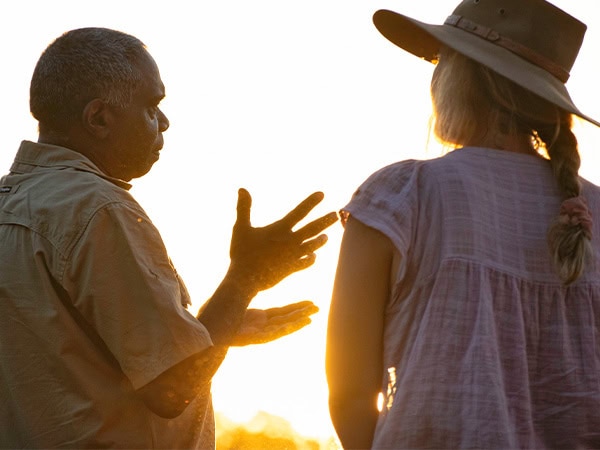
Victor Cooper Ayal Aboriginal tours
When leading tours, Victor Cooper draws on his 25-plus-year tenure as one of Kakadu’s original park rangers. (Image: Tourism NT/Ayal Aboriginal Tours)

“The partnership is about working collaboratively to provide a unique, potentially life-changing experience for travellers that they’ll remember forever," says Paul Ah Chee, a Yankunytatjara, Wankangurru and Arrernte man and director of build on entities that already exist, providing more opportunities and support for First Nations tourism operators," says Paul.


View this post on Instagram


A post shared by Paul Ah Chee (@paul_ah_chee)

How will it impact tourism in Australia?
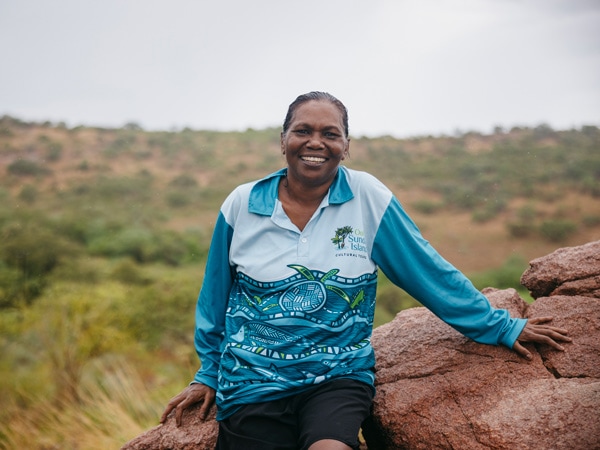
guide Rosanna Angus of Oolin Sunday Island Cultural Tours
Guide Rosanna Angus of Oolin Sunday Island Cultural Tours won Top Tour Guide in the Qantas Australian Tourism Awards 2023. (Image: Tourism Western Australia)

 “[The tourism offerings] can be broadened out, says Paul. “In the NT, we’ve got a really functional Aboriginal tourism committee. Other states and territories are in a bit more of an infancy stage [in terms of the structures to support First Nations operators]. So the partnership can really provide broader and higher level advocacy for Aboriginal tourism on a national scale".

Some examples of Aboriginal tours to have on your radar include: an art walk on Minjerribah/North Stradbroke Island with Quandamooka artist Delvene Cockatoo-Collins ; a tour of Garbalgu billabong in the NT with former Kakadu park ranger Victor Cooper of Ayal Aboriginal Tours ; and a tour of WA’s Oolin Sunday Island with Rosanna Angus, winner of the Top Tour Guide in the Qantas Australian Tourism Awards 2023.
Delvene Cockatoo-Collins on North Stradbroke Island
Artist Delvene Cockatoo-Collins showcases artwork at her shop. (Image: Tourism and Events Queensland)

“We want visitors to not just stay in the capital cities, but spread out around Australia. That’s why we need to develop a lot more Aboriginal and First Nations products in remote and regional Australia," Paul says. “We have the ingredients for a fantastic tourism experience, that only we can deliver as First Nations people".

Elizabeth Whitehead
Elizabeth Whitehead is a writer obsessed with all things culture; doesn't matter if it's pop culture or cultures of the world. She graduated with a degree in History from the University of Sydney (after dropping out from Maths). Her bylines span AFAR, Lonely Planet, ELLE, Harper's BAZAAR and Refinery 29. Her work for Australian Traveller was shortlisted for single article of the year at the Mumbrella Publishing Awards 2024. She is very lucky in thrifting, very unlucky in UNO.
See all articles
hero media

Look up: The Aurora Australis might be visible tonight

The most severe solar storm of the year is underway.

A powerful solar storm is happening right now, and if you’re in southern Australia, tonight might be your chance to see the colourful display.

According to the Australian Space Weather Forecasting Centre (ASWFC) at the Bureau of Meteorology , a severe geomagnetic storm is underway. They have issued an Aurora Alert, meaning space weather activity is favourable for viewing the spectacle: “Severe geomagnetic storm in progress. Aurora may be observed during local nighttime hours in good observing conditions at regions as far equatorward as middle latitudes.”

According to the ASWFC’s website, Aurora Alerts are issued “when space weather activity favourable for viewing aurora is in progress. When an alert is current, the alert information indicates the latitudinal range in terms of high, middle, low and equatorial regions where aurora may be visible under good observing conditions.”

What is the Aurora Australis?

A man with a head torch looking at the Aurora Australis
Tasmania is the best place in Australia to see the spectacle. (Image: Tourism Tasmania)

The Aurora Australis – also known as the Southern Lights – is one of the most dazzling natural displays visible to the human eye. Put simply, the phenomenon occurs when the sun releases a massive burst of charged particles and magnetic fields into space.  These particles are captured and funnelled toward the southern poles by Earth’s magnetic field, colliding with gases in the Earth’s atmosphere. The collisions result in light being emitted and a spectacular natural dancing rainbow ensuing. 

The past two years have been particularly good years for viewing the phenomenon. 

How to see the Aurora Australis

An Aurora Australis display at night along the coastline
A Southern Lights display can last minutes to hours. (Image: Unsplash/Graham Holtshausen)

Tasmania has historically been the best spot to see the Aurora Australis due to low light pollution and its position closer to the South Pole than mainland Australia. South Arm Peninsula, Bruny Island and Cockle Creek are popular viewing locations on the island.

But the good news is the ASWFC has shared that it’s possible the Aurora Australis could be seen further north, in mid to southern parts of Australia.  

In Victoria, Wilsons Promontory National Park, Point Lonsdale and Phillip Island are favourable locations; in New South Wales, Jervis Bay, Kiama or the Blue Mountains might offer you the glowing display; and in South Australia, the Fleurieu Peninsula, Kangaroo Island and Eyre Peninsula offer excellent southern exposure. 

A Southern Lights display can last minutes to hours, with the best active window typically being between 10pm and 2am.

You can read more about the natural light display in our Southern Lights guide and stay up to date via the Bureau of Meteorology website