Meteors, supermoons, a comet: a guide to the southern sky in 2024

hero media
What exciting events will we see in the southern sky in 2024? Meteor showers, Saturn covered by the Moon, close approaches of bright planets to each other, supermoons – and, if we’re lucky, a comet visible to the naked eye.

Even if you live in a city surrounded by light pollution, these are all worth looking out for. Here are some of the highlights.

May – the Eta Aquarid meteors

The first of the two main Southern Hemisphere meteor showers during the year is the Eta Aquariid or Eta Aquarid shower. It’s named after a star in the constellation of Aquarius, the Water Carrier, as the meteors appear to originate from there.

Meteors are small particles hitting Earth’s atmosphere and creating a streak of light as they burn up. A meteor shower occurs when many particles hit, all coming from the same direction.

They are generally due to Earth passing through a stream of dust left behind by a comet. For the Eta Aquariids, the comet is the famous Halley’s Comet, which was first recorded more than 2,000 years ago.

In 2024, there will be a good opportunity to see them in the early mornings of Monday 6 and Tuesday 7 May, as the Moon will not be brightening the sky.

December – the Geminid meteors

The second of the two main meteor showers is the Geminid shower. This originates in the direction of the constellation of Gemini, the Twins.

Unusually, they are associated not with a comet but with a rocky asteroid named Phaeton. In 2024, they are likely to be best seen early on the morning of Saturday 14 December.

The peak time to view is during the short interval between the setting of the Moon and the start of dawn.

Need tips, more detail or itinerary ideas tailored to you? Ask AT.

AI Prompt

March, June and August – the planets

Celestial objects approaching one another in the sky can provide a nice view. On the evening of Friday 22 March, the brightest planet Venus is less than the width of the Moon away from the ringed planet Saturn. Look low down in the east.

For people in the eastern part of Australia, the Moon covers the planet Saturn low in the eastern sky on the night of Thursday 27 June. The event can be seen by eye, but binoculars or a small telescope would help.

It is safe to take images or video. From Sydney, Saturn disappears at the bright edge of the Moon at 10:55pm and reappears at its dark edge at 11:41pm. The times for Brisbane, Canberra and Melbourne are similar.
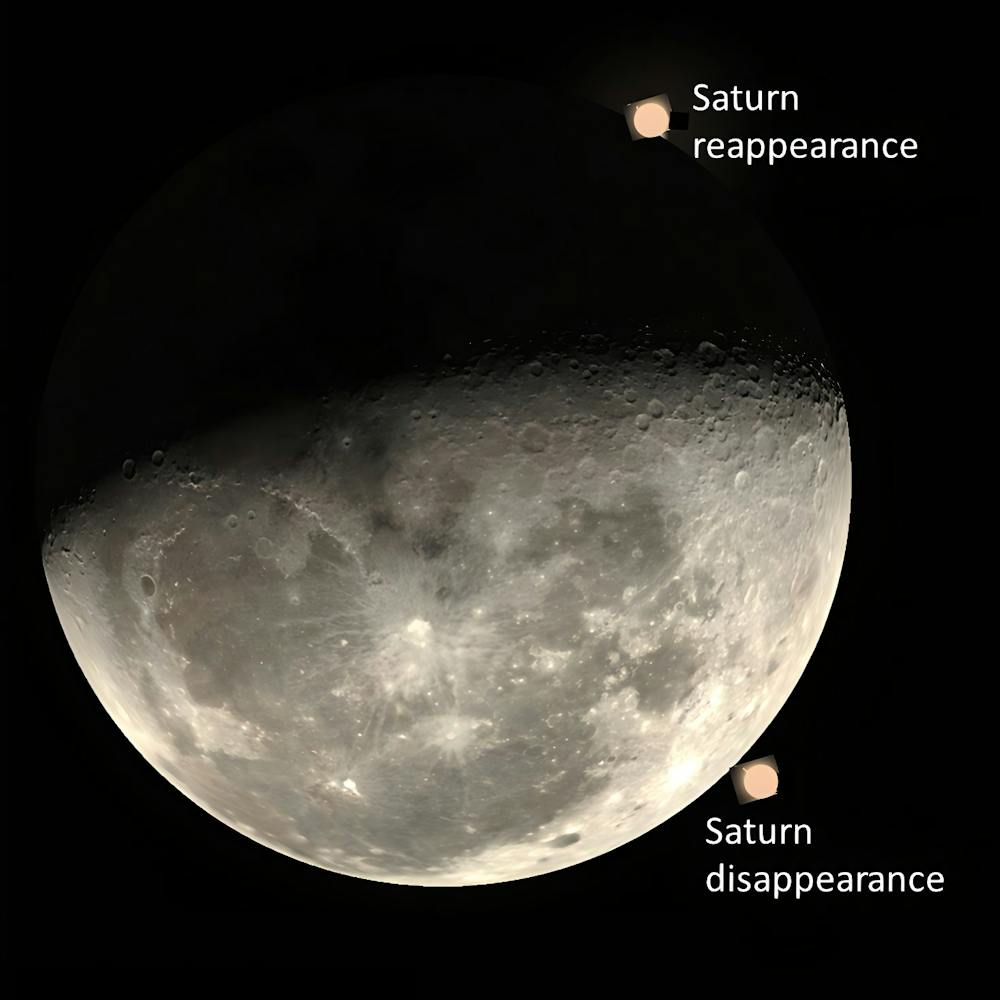
Diagram showing Saturn disappearing behind the Moon and later reappearing.

The occultation or covering of Saturn on Thursday 27 June 2024. (Image: Nick Lomb / Stellarium)

Another close approach is in the early morning of Thursday 15 August, when the red planet Mars is less than a Moon-width from the giant planet Jupiter.

September and October – supermoons

There will be two supermoons during 2024. The Moon has a path that sometimes takes it further from Earth and sometimes closer.

Recently, a time when the full Moon coincides with the Moon at its closest point to Earth has become known as a supermoon. At this time the Moon is slightly larger in the sky than usual.

It’s best to look at moonrise, as an illusion in our brains makes the Moon appear larger when it’s near the horizon. The supermoons in 2024 are on Wednesday 18 September and Thursday 17 October.

October – Comet C/2023 A3 (Tsuchinshan-ATLAS)

Comets visible to the naked eye are rare and exciting events. A comet with the impressive name of Comet C/2023 A3 (Tsuchinshan-ATLAS), discovered in January 2023, is approaching the Sun and Earth, and may become bright enough to be easily seen. As yet, it is unknown whether this will happen – comets are notoriously fickle.

At a distance of 71 million kilometres, the comet will be closest to Earth on Sunday 13 October. However, for the next six days a bright Moon will make sighting it unlikely.

By Saturday 19 October, the Moon will have moved out of the way. That evening and the following few evenings will give us the best chance to see it. Look low in the west.

January and May – constellations

Not only these highlighted events can be seen in the sky. There are star pictures or constellations that still stand out in the sky of bright cities.

Orion, the Hunter, is a favourite Southern Hemisphere summer constellation, high in the northern sky on January evenings. It consists of four bright stars in a rectangle with a line of three stars, representing Orion’s belt, in the middle.
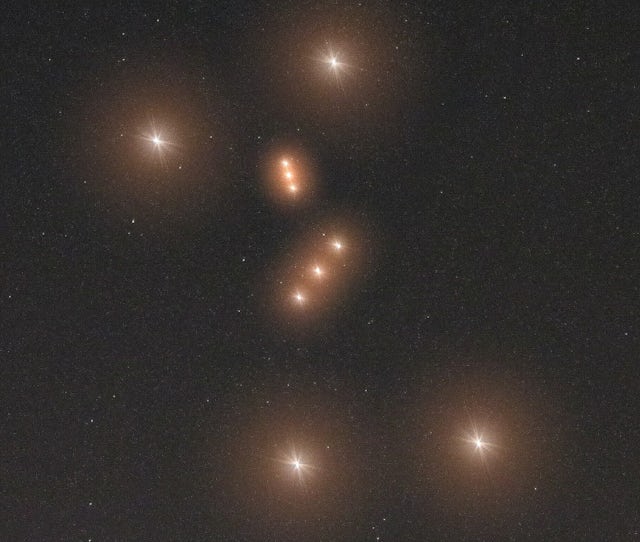
A photo of the constellation Orion.

The constellation Orion is named for a hunter from Greek myth. (Image: Nick Lomb)

According to Greek legend, Orion was a great hunter who vowed to kill all animals. To stop him carrying out his threat, one of the gods sent a scorpion to kill him. This ancient story with Scorpius, the Scorpion chasing Orion takes place above our heads each night.
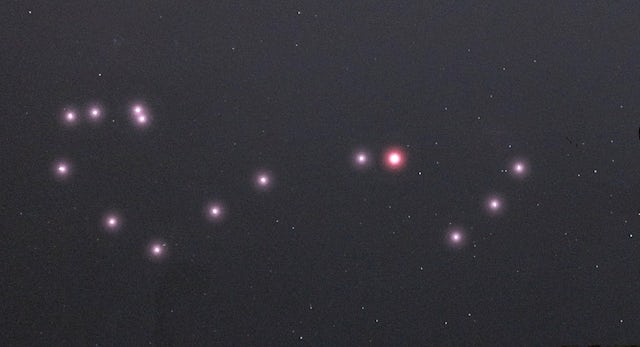
A photo of the constellation Scorpius.

The constellation Scorpius is named for its resemblance to a scorpion. (Image: Nick Lomb)

Scorpius is another spectacular constellation with a curved line of bright stars, with a red star forming the creature’s heart. In January, people who are up at around 3 am can see Scorpius rising in the east, while its quarry Orion is sinking in the west. Alternatively, if you don’t like early mornings you can see the same scene on May evenings after dusk.

The information in this article is from the 2024 Australasian Sky Guide. The guide contains monthly star maps and has much more information to assist with viewing and enjoying the night sky from Australia and New Zealand.The Conversation

This article is republished from The Conversation, the world’s leading publisher of research-based news and analysis. It was written by: Nick LombUniversity of Southern Queensland.

Want to see more stories from Australian Traveller in your Google search results?

  1. Click here to set Australian Traveller as a preferred source.
  2. Tick the box next to "Australian Traveller". That's it.
Nick Lomb
I have had a variety of research directions over my career. During my PhD project on short period variable stars, I developed the theory of least squares frequency analysis for unequally spaced data. This is now a standard method of numerical analysis, called the Lomb or Lomb-Scargle Periodogram, that is used in astronomy and other fields. Later at Sydney Observatory, the focus was on astrometry, that is, the positions and motions of stars and solar system objects. This work culminated in the publication of a star catalogue, of which I was co-author. Then, when the Observatory came under the auspices of the Museum of Applied Arts and Sciences, I became the Museum’s Curator of Astronomy. As such, I planned exhibitions and collected and looked after instruments and other items relating to astronomy. I was also involved with the media and with public education and outreach. On leaving the Observatory and the Museum, my research emphasis became the history of Australian astronomy, with my latest book, with Toner Stevenson, 'Eclipse Chasers', to be released in March 2023. As well, I continue to prepare the annual Australasian Sky Guide for Powerhouse Publishing and maintain my interest in combatting light pollution.
View profile and articles
hero media

8 Thredbo hiking experiences you can only have in summer

    Kassia Byrnes Kassia Byrnes
    Thredbo in summer is a nature lover’s dream of show-stopping alpine beauty, cool mountain air and magical moonlit adventure.

    For many of us, Thredbo calls to mind shimmering slopes and snow-dusted gums, but come summer, this Alpine resort transforms into a playground of an entirely different kind. A cool mountain retreat despite the season, Thredbo summer hikes are astonishingly beautiful, criss-crossing over dramatic peaks, pristine glacial lakes and abundant flora and fauna.

    From approachable tracks for novice walkers to more challenging hikes across the Main Range and even journeys under moonlight, Thredbo puts on an unforgettable show of natural splendour all summer. Lace up your walking boots and take the chairlift from Thredbo village to embark on a self-guided exploration or a tour of the Snowy Mountains’ most compelling landscapes.

    These eight unforgettable hiking experiences are only available in summer and offer an alpine adventure like you’ve never experienced before.

    1. Full Moon Hike to Mt Kosciuszko

    Full Moon Hike to Mt Kosciuszko
    Stand atop Mt Kosciuszko at full moon.

    There’s something almost mystical about hiking by the light of a full moon. This guided experience begins with a 15-minute chairlift ride, where you’ll admire the Thredbo Valley below, bathed in the fading sun.

    Once at the top, you’ll pass rivers, alpine lakes and spot nocturnal wildlife on your way to the Kosciuszko Lookout and Lake Cootapatamba. By the time you reach the summit, sunset is well underway as you watch day give way to night and the alpine landscape magically illuminated by the lunar glow. Enjoy a hot chocolate here before following the path back to Eagles Nest, brightened by the night sky.

    This 13-kilometre hike will take place on 3 January, 2 February, and 2 April in 2026.

    2. Super Full Moon Hike

    Super Full Moon Hike in thredbo
    Take in the might of a super full moon.

    The only thing that could level up the celestial beauty of a full moon hike would be a super full moon hike. Following the same route, you’ll meet the moon when it is largest and closest to Earth by ascending to the summit of Mount Kosciuszko at an elevation of 2228 metres. From such a height, it almost feels as though you could reach out and touch its glowing surface.

    Given the rarity and splendour of the super full moon, limited spots fill up fast for this awe-inspiring hike, so be sure to book the 5 December in advance.

    3. Lunar Eclipse Hike

    Thredbo Lunar Eclipse Hike
    See dazzling celestial displays.

    What could be more extraordinary than witnessing a lunar eclipse from Australia’s highest peak? Whether you’re a keen astronomer or simply revel in nature’s beauty, this guided 13-kilometre hike will place you on top of Mount Kosciuszko just as Earth passes between the sun and moon, throwing shade over the lunar surface before transforming it with a deep-red hue.

    It’s an epic place to witness one of our galaxy’s most spectacular and rare light shows. Apart from the dazzling celestial display, you’ll also enjoy walking through the moon-bathed landscape, an evening chairlift ride, and a hot chocolate at the summit.

    Book now for 3 March.

    4. New Moon Hike

    New Moon Hike Mt Kosciuszko
    Catch the changing skies of a new moon.

    A stargazer’s delight, the darkness of a new moon gives the Milky Way full permission to dazzle with its shimmering display. Both astronomers and photographers will relish this opportunity to observe and capture the starry skyscape from the lofty height of Australia’s highest peak, Mount Kosciuszko. Departing Thredbo Village at dusk and leaving its twinkling lights far below, you’ll arrive at the summit in time to see the sun slip away and the stars appear.

    Catch this hike during the new moon lunar phase on 20 December, 19 January, 17 February, 19 March or 17 April.

    5. Thredbo River Track

    Thredbo River Track
    Take yourself along the Thredbo River Track.

    Embark on a gentle entry into the Snowy Mountain scenery with an amble along the Thredbo River. This self-guided hike hugs the river and wanders along the valley floor, revealing snow gum forests, swimming holes and little waterfalls that make for revitalising cold plunges in the summer heat.

    6. Merritts Nature Track

    Merritts Nature Track thredbo summer hikes
    Stop at swimming holes along the way.

    On warm summer days, venturing into the cooler air of Thredbo’s alpine tracks offers relief from the heat. Particularly if you set course for the four-kilometre Merritts Nature Track, where there are opportunities to take a refreshing dip in swimming holes along the way.

    The two-to-three-hour self-guided hike meanders through towering ancient trees (dubbed the ‘Pixie Forest’ by locals), takes in stunning mountain vistas and is soundtracked by the melody of birdsong. Stop for a picnic and discover a hidden natural infinity pool, the location of which is given away by the roar of a cascading waterfall.

    7. Mt Kosciuszko Summit Tour

    Follow a guide along Mt Kosciuszko's summit.
    Follow a guide along Mt Kosciuszko’s summit.

    While you can easily steer yourself to Australia’s most iconic peak without a guide, following an expert guide to the summit of Mount Kosciuszko will colour your experience with a deeper knowledge of the landscape and its wild inhabitants. The 13-kilometre return trail puts the alpine scenery on display with 360-degree views from the highest spot in the country.

    The walk begins at the top of the Kosciuszko Chairlift and takes around four to six hours to complete, but is gentle enough to be embarked upon by all ages.

    8. Snowies Alpine Walk Experience

    Snowies Alpine Walk Experience
    Join a two- or three-day experience along Snowies Alpine Walk.

    If you’re looking to truly untether from daily life and embark on a real immersion in Thredbo’s stunning alpine scenery, pack your hiking boots for the newest multi-day walk in the mountains. The Snowies Alpine Walk can be tackled over two or three days and includes nightly accommodation in the iconic Thredbo Alpine Hotel, daily buffet breakfast, packed lunch and dinner vouchers, plus daily transfers to and from trail heads in a brand-new Defender.

    The two-day experience covers 24 kilometres, while the three-day experience almost doubles that at 44 kilometres. Along the way, explore barely trod landscapes, vast high-country plains and uplifting mountain horizons.

    Discover the full offering of summer hikes in Thredbo at thredbo.com.au.