New Qantas Frequent Flyer changes could mean big discounts

hero media
Qantas has announced new changes to its Frequent Flyer program. This is how it affects you.

Qantas Frequent Flyer changes have been announced, from how many points reward program members can earn to how to earn them, to the number of seats available to book via the reward program. So what does it mean to the average member?

1. Earn more points on domestic flights

Deciphering rewards programs can be somewhat of a tangled web, although Australian Traveller has a comprehensive guide to help you make the most of your Frequent Flyer points. But now there’s one more way to earn decent points – the number of points members will earn on Qantas domestic flights will increase by up to 25 per cent.

Qantas will also be removing the cap on the number of points that can be earned for tiered members travelling in premium cabins. Overall, the airline predicts this will mean almost four billion extra points delivered to members every year.

“Travel remains the number one priority for our members in how they earn and redeem their points, with 13,000 Classic Reward seats booked every day," said Qantas Loyalty CEO Andrew Glance. “These changes are designed to further enhance the ways our members can book Classic Reward seats and the destinations and cabins they can access when they fly".
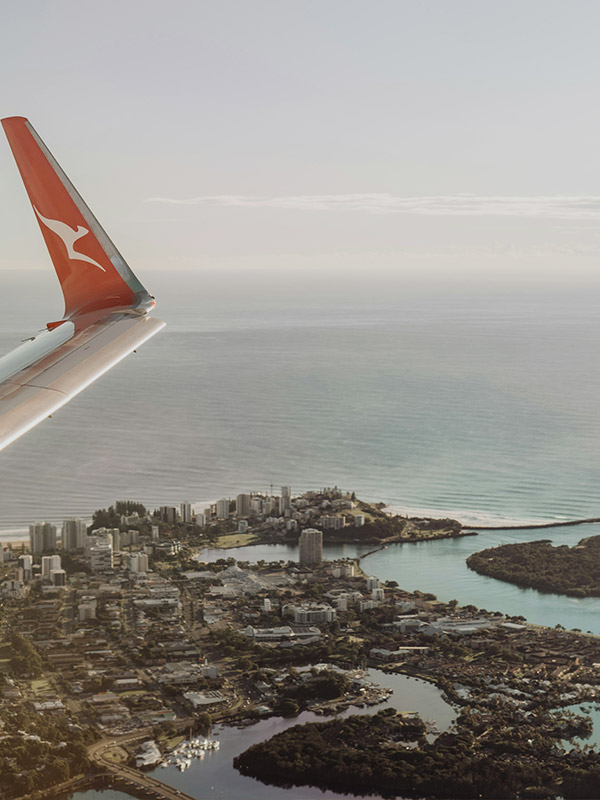
tip of qantas plane wing flying over australian beach
Qantas domestic flights will increase. (Image: Josh Withers)

2. Cheaper domestic and NZ flights

There is very good news for local flights. Qantas will be introducing economy reward seats on Jetstar’s short-haul domestic flights in Australia and New Zealand from 5700 points – that’s 2300 points cheaper than the previous cheapest seat.

“This is just the beginning of a broader suite of changes to Jetstar rewards that will deliver even greater value for members in 2025 and beyond," said Glance.

jetstar plane flying
Spend less points on Jetstar’s domestic flights. (Image: Hendri Lidayani)

Need tips, more detail or itinerary ideas tailored to you? Ask AT.

AI Prompt

3. Bigger savings before August 2025

Of course, at the same time, it was announced that the number of points needed for Classic Rewards and Classic Upgrades will increase right along with the above rewards, cancelling each other out somewhat.

This point increase won’t take effect until 5 August 2025, and Qantas Classic Reward seats are open to bookings up to 11 months in advance. This means, as long as you book before then (for flights that leave up until June 2026) you can still secure the lower point rate.
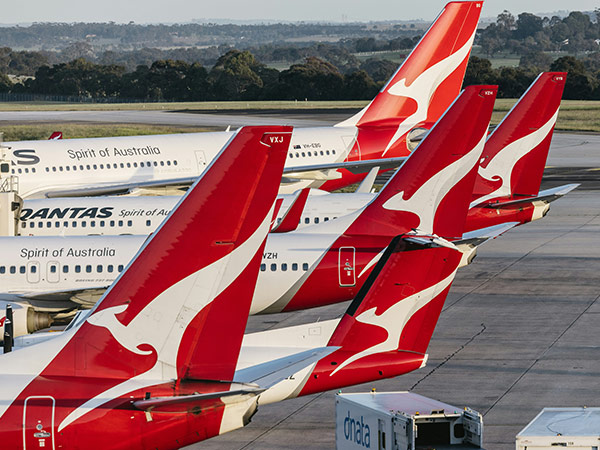
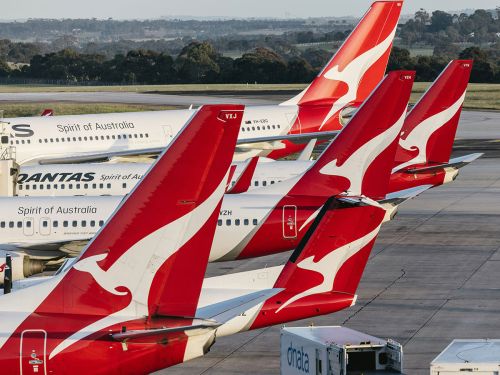
qantas plane tails at airport
Book before August to save. (Image: Josh Withers)

4. More seats across the network

The final main change to care about, is that Qantas will be adding up to one million Classic Reward seats (those that are paid for in part with points) in economy across Finnair, Air France, KLM and Iberia, thanks to a new partnership with Hawaiian Airlines (aka more flights equals more seats).

“We now have partnerships with over 45 airlines, giving members greater flexibility and choice in how they want to be rewarded," said Glance. “The addition of Hawaiian Airlines and more premium cabin seats with Finnair, Air France, KLM and Iberia will later this year begin unlocking up to 1 million additional Classic seats and more opportunities for our members to use their points".

inside jetstar cabin
Get access to more seats across the network. (Image: Jackie Alexander)

Want to see more stories from Australian Traveller in your Google search results?

  1. Click here to set Australian Traveller as a preferred source.
  2. Tick the box next to "Australian Traveller". That's it.
Kassia Byrnes
Kassia Byrnes is the Native Content Editor for Australian Traveller and International Traveller. She's come a long way since writing in her diary about family trips to Grandma's. After graduating a BA of Communication from University of Technology Sydney, she has been writing about her travels (and more) professionally for over 10 years for titles like AWOL, News.com.au, Pedestrian.TV, Body + Soul and Punkee. She's addicted to travel but has a terrible sense of direction, so you can usually find her getting lost somewhere new around the world. Luckily, she loves to explore and have new adventures – whether that’s exploring the backstreets, bungee jumping off a bridge or hiking for days. You can follow her adventures on Instagram @probably_kassia.
View profile and articles

This luxe trawler tour is redefining Victoria’s seafood experience

    Chloe Cann Chloe Cann
    Victoria’s ‘mussel capital’ is the source of exceptional shellfish used by top chefs far and wide. Step aboard a beautifully refurbished trawler to see how these plump and juicy bivalves are sustainably cultivated.

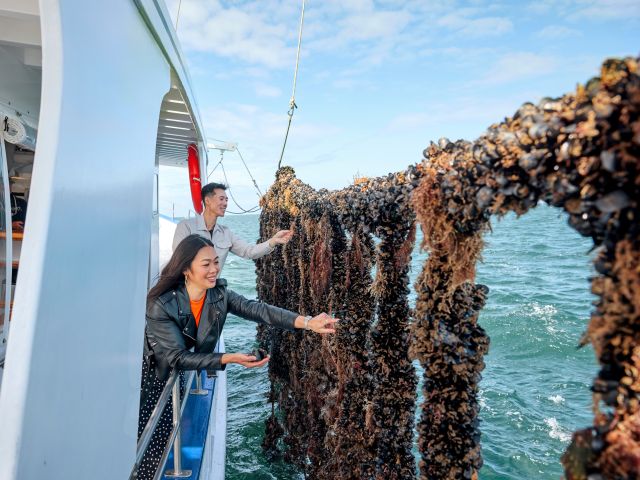
    A curtain is slowly winched from the placid, teal waters just off Portarlington, like a floating garland beside our boat. The ropes heave with blue mussels, the star attraction of our tour. But as we reach to pluck our own, it’s quickly clear they’re not alone; a mass of weird and wonderful creatures has colonised the ropes, turning them into a living tapestry. ‘Fairy’ oysters, jelly-like sea squirts, and tiny, wriggling skeleton shrimp all inhabit this underwater ecosystem.

    We prize our bivalve bounty from the ropes, and minutes later the mussels arrive split on a platter. The plump orange morsels are served raw, ready to be spritzed with wedges of lemon and a lick of chilli as we gaze out over the bay. They’re briny, tender and faintly sweet. “This wasn’t originally part of the tour,” explains Connie Trathen, who doubles as the boat’s cook, deckhand and guide. “But a chef [who came onboard] wanted to taste the mussels raw first, and it’s now become one of the key features.”

    A humble trawler turned Hamptons-style dreamboat

    inspecting bivalve bounty from the ropes
    Inspecting the bounty. (Image: Visit Victoria/Hannyn Shiggins)

    It’s a crisp, calm winter’s day, and the sun is pouring down upon Valerie, a restored Huon pine workhorse that was first launched in January 1980. In a previous life she trawled the turbulent Bass Strait. These days she takes jaunts into Port Phillip Bay under the helm of Lance Wiffen, a fourth-generation Bellarine farmer, and the owner of Portarlington Mussel Tours. While Lance has been involved in the fishing industry for 30-plus years, the company’s tour boat only debuted in 2023.

    holding Portarlington mussels
    See how these plump and juicy bivalves are sustainably cultivated.

    It took more than three years to transform the former shark trawler into a dreamy, Hamptons-esque vessel, with little expense spared. Think muted green suede banquettes, white-washed walls, Breton-striped bench cushions, hardwood tables, bouquets of homegrown dahlias, and woollen blankets sourced from Waverley Mills, Australia’s oldest working textile mill. It’s intimate, too, welcoming 12 guests at most. And yet there’s nothing pretentious about the experience – just warm, down-to-earth Aussie hospitality.

    As we cruise out, we crack open a bottle of local bubbles and nibble on the most beautifully curated cheese platter, adorned with seashells and grey saltbush picked from the water’s edge that very morning. Australasian gannets soar overhead, and I’m told it’s not uncommon for guests to spot the odd seal, pod of dolphins, or even the occasional little penguin.

    The sustainable secret behind Victoria’s best mussels

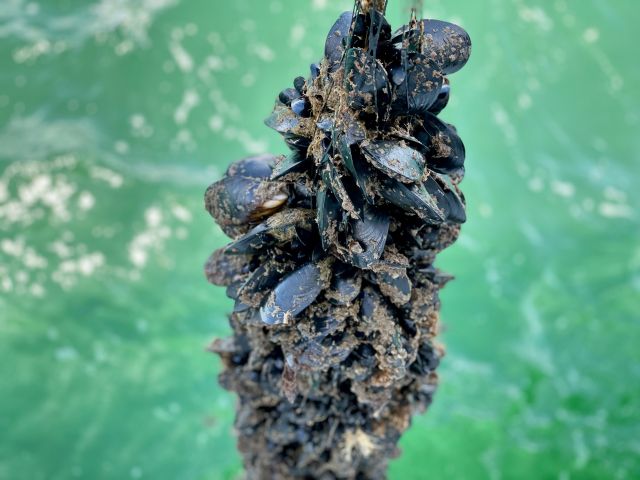
    blue mussels off Portarlington
    Blue mussels sourced just off Portarlington.

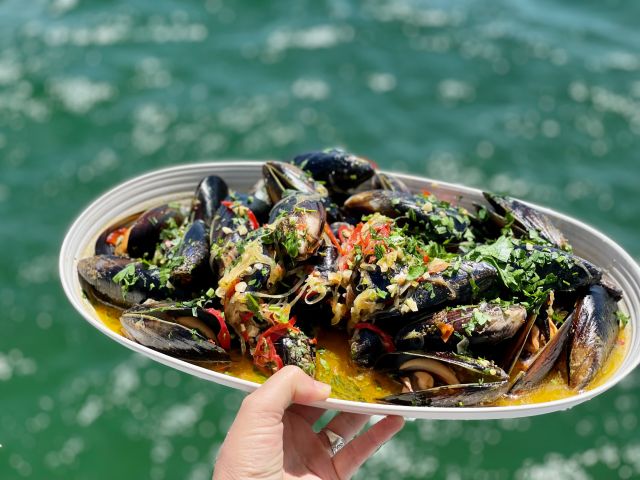
    Connie and Lance both extol the virtues of mussels. They’re delicious. A lean source of protein and packed with omega-3 fatty acids, vitamin B12, iron, selenium, and zinc. They’re cooked in a flash (Connie steams our fresh harvest with cider and onion jam). And they’re also widely regarded as one of the most sustainable foods in the world.

    Portarlington mussels with lemon and chilli
    Mussels served with lemon and chilli.

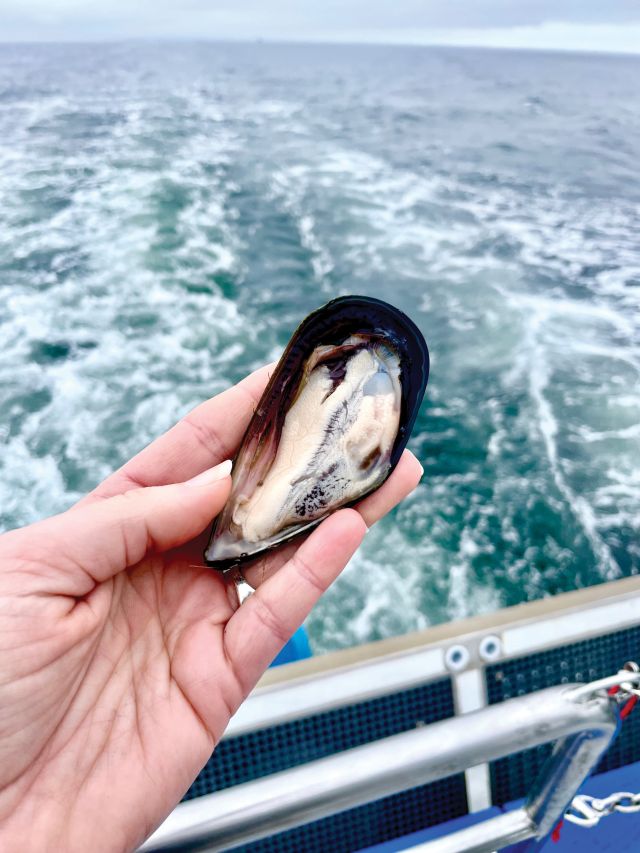
    “Aquaculture is [often] seen as destructive, so a lot of our guests are really surprised about how environmentally friendly and sustainable our industry is,” Lance says. “[Our mussels] would filter 1.4 billion litres of water a day,” he adds, explaining how mussels remove excess nitrogen and phosphorus from the water. “And through biomineralisation, we lock carbon into mussel shells.”

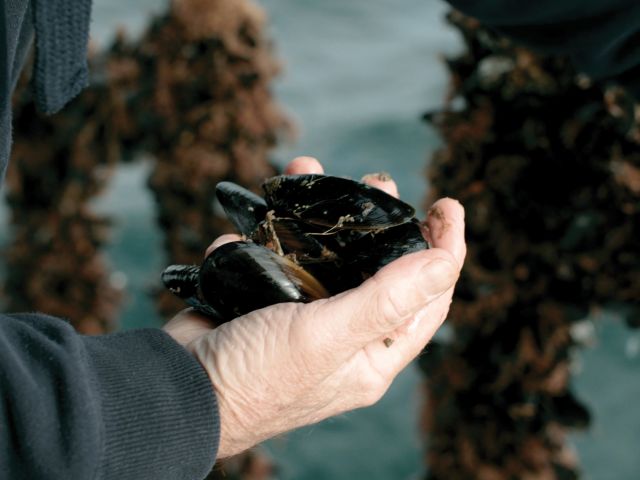
    a hand holding a Portarlington mussel
    Mussels are a sustainable food.

    Despite their glowing list of accolades, these molluscs have long been seen as the oysters’ poorer cousins. “It was a really slow start,” explains Lance, who says that in the early days of his career, “you could not sell mussels in Victoria”.

    But word has slowly caught on. Chefs as globally acclaimed as Attica’s Ben Shewry and even René Redzepi of Noma, Denmark, have travelled to these very waters just to try the shellfish at the source, sharing only the highest praise, and using Lance’s mussels in their restaurants.

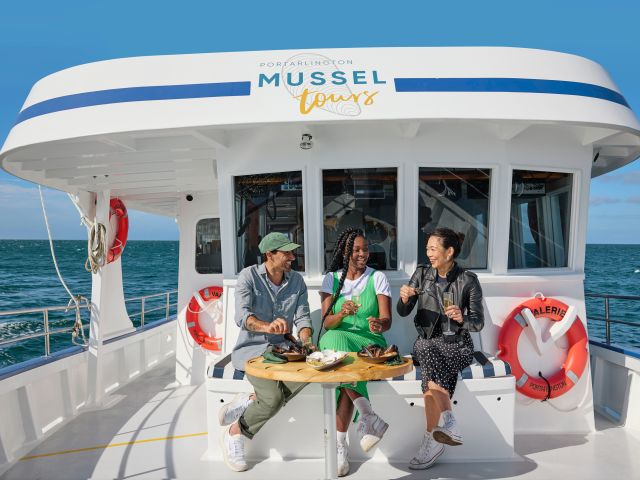
    guests sampling Portarlington mussels onboard
    Sampling the goods onboard. (Image: Visit Victoria/Hannyn Shiggins)

    According to Lance there’s one obvious reason why the cool depths of Portarlington outshine other locations for mussel farming. “The water quality is second to none,” he says, noting how other regions are frequently rocked by harvest closures due to poor water quality. “We grow, without a doubt, some of the best shellfish in the world.” And with Lance’s bold claims backed up by some of the industry’s greatest names, perhaps it won’t be much longer until more Aussies uncover the appeal of Portarlington’s mussels.