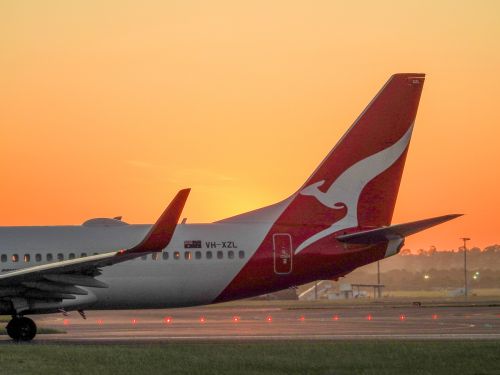
The Chairman’s Lounge: Did Alan Joyce really destroy Qantas?

hero media
Investigative journalist Joe Aston’s “blistering exposé" on the machinations of former Qantas CEO Alan Joyce and Chairman Richard Goyder in The Chairman’s Lounge sparked controversy for its precise accusations of greed at the expense of customers and staff through the pandemic.

The most common questions I’ve been asked in the past three months are, ‘Have you read The Chairman’s Lounge?’ and ‘What did you think of it?’. To be blunt, Aston’s chronicling of Qantas’ survival of the pandemic and then many challenges and failings on the road to record profits was like revisiting a nightmare for me.
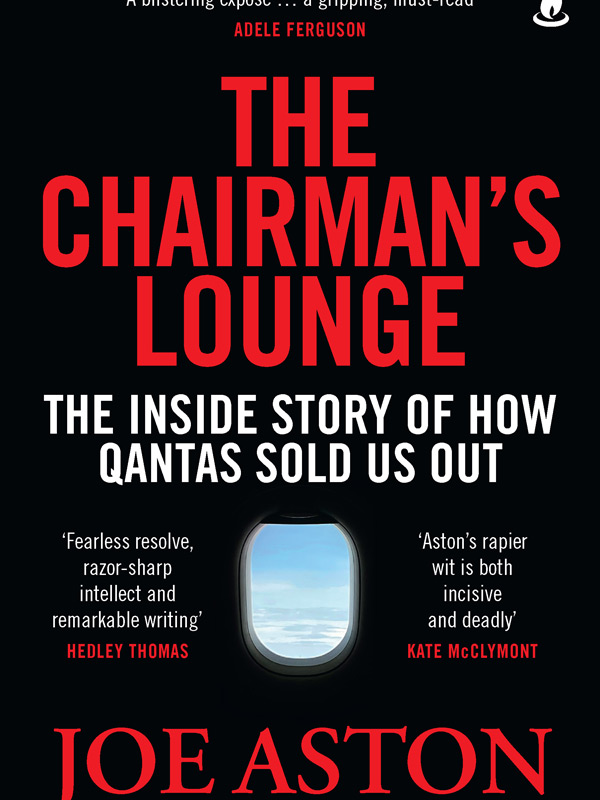
the book cover of The Chairman's Lounge inside story of how Qantas sold us out by Joe Aston
The Chairman’s Lounge by Joe Aston. (Image: Simon & Schuster Australia)

Firstly, don’t hate me, but I have sympathy for Alan Joyce

Remembering the pressure of those COVID times for me and my business makes me feel sick. I have great empathy for any travel executive or operator, Joyce included, who was forced to make decisions when faced with these unique and unprecedented challenges. Every interaction either personally or at events I attended with Joyce led me to believe he really did care about the Qantas brand, customers and most of all, people. Most of the Qantas staff I spoke with, particularly prior to 2021, felt very positive towards him. Joyce’s achievements are now largely forgotten and in their place are the disastrous last years of his tenure.

the front page of ABC Media Watch featuring Former Qantas CEO Alan Joyce
An ABC Media Watch segment on former Qantas CEO Alan Joyce.

And for Aston, a well-known Joyce-hater (he denies this, a claim not many, me included believe) and poison pen columnist, to write his Qantas obituary as a 332-page “scathing, unflinching takedown" is a shame. He damns Joyce with faint praise and diminishes many of his achievements. Aston appeared to take delight in flaying Australian executives in public while his ability to run a business has never been tested.

How can he really sit in judgment when he has not sat in the chair? In my experience, and to quote renowned business podcaster Scott Galloway, “Boards and CEOs are never as dumb as you think they are and you are never as smart as you think you are".
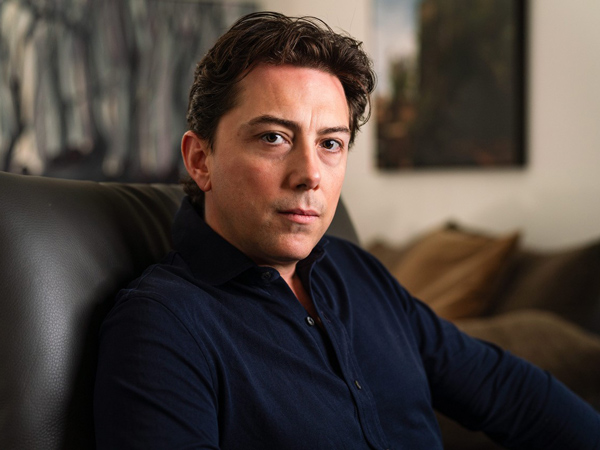
Investigative journalist Joe Aston
Investigative journalist Joe Aston and author of The Chairman’s Lounge. (Image: Stephen Blake)

I enjoyed the read but I feel Joyce deserved a more even-handed telling of his story.

Stranger still for me, I attended many of the events noted in the book. Just as the wheels were starting to come off for Joyce and the Qantas brand, one particular interaction I had with former Chairman Richard Goyder distils the entire 2020 – 2023 episode into one fateful sentence.
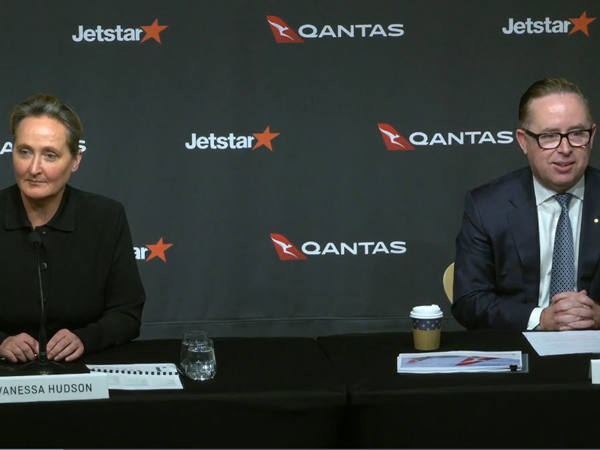
Qantas CEO Vanessa Hudson sitting beside Alan Joyce
Qantas CEO Vanessa Hudson alongside Alan Joyce.

“We ripped $1 billion of costs out of the business."

This was Goyder’s response to me on the 23rd of June 2022 in Perth. I happened to be standing in line with him at a cocktail event to celebrate the inaugural Perth to Rome flight scheduled to take off the next day. I said I wanted to have a better business coming out of COVID and I asked, “Do you think Qantas is?" He replied in a nanosecond: “Mate, absolutely. We ripped $1 billion dollars of costs out of the business."

I was shocked. Goyder unequivocally equated stripping out $1 billion dollars in costs with a better business. Yet the media world was awash with negative Qantas stories: lost baggage, inability to use credits, hours-long wait times on call centres, flight cancellations.

Roy Morgan has just reported the Qantas brand had slipped from the 6th most trusted brand in the country to the 16th in just three months. (It was just the beginning of the brand freefall from highly trusted to almost least trusted).

Meanwhile, the courts had decided that Qantas had illegally sacked its international ground-handling staff. Yet Goyder was absolutely convinced that Qantas was a better business as evidenced by the reduced costs.
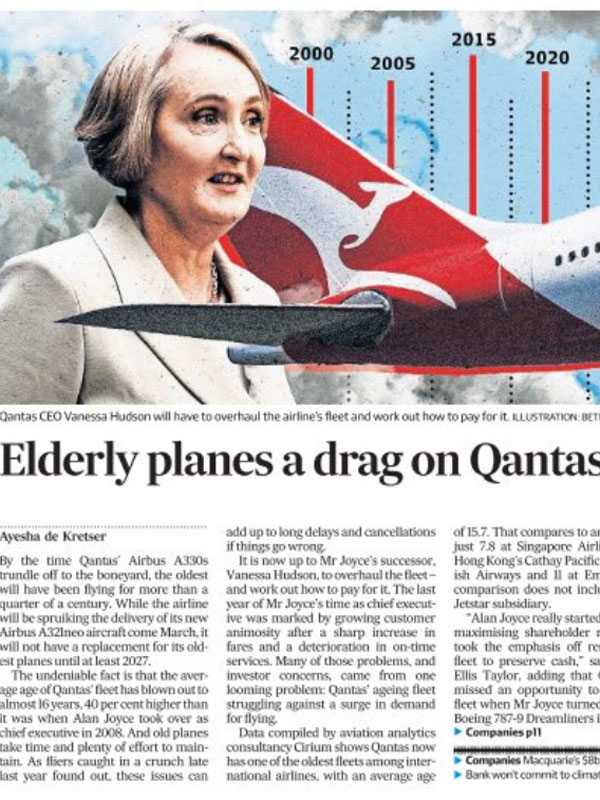
Mr Joyce's successor Vanessa Hudson on Australian Financial Review front page
Joyce’s successor Vanessa Hudson will have to overhaul the fleet.

Need tips, more detail or itinerary ideas tailored to you? Ask AT.

AI Prompt

So what actually did Joyce and Goyder do to “sell us out"?

Aston details many crimes and misdemeanours in The Chairman’s Lounge. These are probably the four most egregious found in the book.

1. Airfare credits were treated like a free loan

Qantas failed to tell customers they were entitled to a cash refund until the Australian Consumer Commission (ACC) instructed them to be more transparent. Then the refund option was buried in the communication to customers and by virtue of chronic understaffing, made hard to get.

2. Illegally sacking baggage handlers in 2020

Not only was this illegal, but a bad decision made even worse by Joyce and his in-house legal execs’ intransigence and arrogance insisting on launching appeals within an hour of a judgement. They did not pause to absorb a judgement that clearly indicated they were legally “cooked", to use a technical term.

Aston suggests the appeals were not designed to necessarily win but to delay any compensation payments to boost profits and Joyce’s bonus in 2023.

3. Claiming to have not collected bonuses to only come back and collect them later

In 2023 Joyce was intent on collecting delayed long-term bonuses from 2021 and 2022 when the airline was making huge losses which he had claimed to have forfeited.

For clarity, Qantas’ losses were $1.7 billion and $1.8 billion in 2021 and 2022.

4.  Stripping $1 billion in costs for bonuses while ruining the product

As evidenced by my conversation with Goyder, Qantas didn’t let the COVID crisis go to waste.

Not only did Joyce illegally achieve the cost savings in the case of the baggage handlers, but he also failed to make provisions for the return-to-service costs in staffing, training, and actual hardware.

The disastrous under-investment in customer experience triggered the brand freefall.

Weekly travel news, experiences
insider tips, offers, and more.

Is The Chairman’s Lounge a fair report?
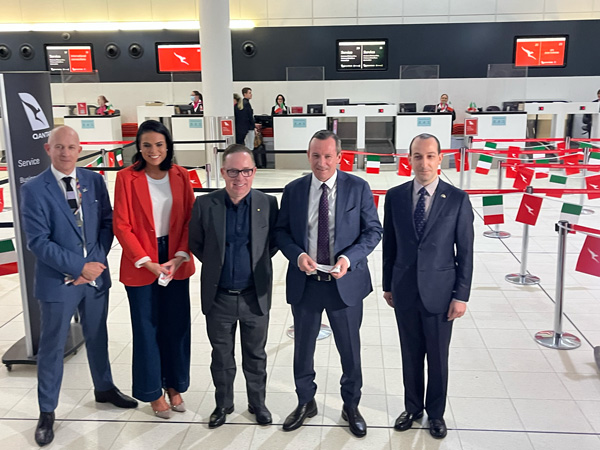
former Qantas CEO Alan Joyce with the Qantas team
Former Qantas CEO Alan Joyce with the Qantas team. (Image: Quentin Long)

Many CEOs would think spinning the message, striving to reduce costs and investment to boost short-term profits to inflate your own bonuses or even claiming historical unpaid bonuses from loss-making years in future profit-making years as relatively normal in the no-holds-barred world of capitalism and free markets. It doesn’t pass the pub test and disgusts me, but many, many CEOs have been far more greedy, ruthless and jaw-droppingly self-serving.

Full-contact capitalism only works when the right guardrails are in place. In this case, it was reassuring that one arm of accountability, the law, turned up and adjudicated the illegal sacking of workers.

But why did it take a union to roll the dice in court, three times, to be the only guardrail for what seemed an exhaustive list of line calls at best, outright greed and disgust for customers at worst?

Aston correctly points out that the guardrails for these decisions were the remit of the Qantas board and, again correctly, in particular Richard Goyder.

Goyder eventually fell on his sword as well, departing 16 September 2024.

Qantas flies up and on
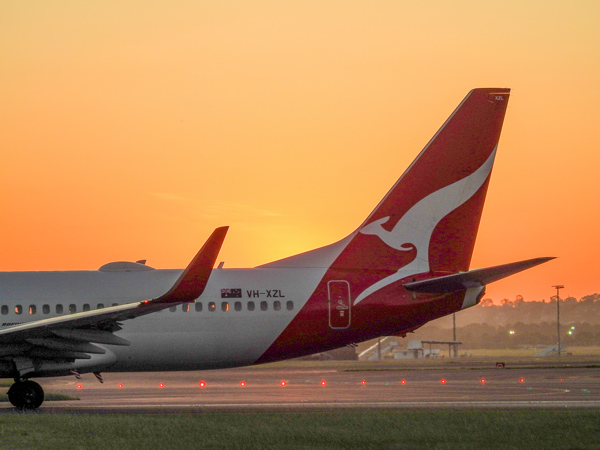
the Qantas plane at sunset
Qantas continues to fly despite its brand challenges. (Image: Getty/SCM Jeans)

As for our national carrier? Well, Joyce definitely didn’t kill it as Qantas is still flying.

On the 4th September 2023, the day before Joyce’s early departure, the Qantas share price closed at $5.65.

On the 16th September, when Goyder left it closed at $7.03.

At the time of writing in January 2025 it is trading at $8.86 off a record high of $9.40 on the 13th  January 2025.

So it is healthy financially (some would say more than when Joyce was in charge).

There is still some way to go for the national carrier to restore public trust. That’s the nature of trust: easy to lose, hard to regain. According to Roy Morgan, in December 2024 it was fourth in the most distrusted brands. Aussies love Qantas which is why it hurts even more when the flying kangaroo lets us down. But the nadir has been reached (well it appears to have been). In the fullness of time, I think we will fall back in love.

Want to see more stories from Australian Traveller in your Google search results?

  1. Click here to set Australian Traveller as a preferred source.
  2. Tick the box next to "Australian Traveller". That's it.
Quentin Long
Quentin Long is the Co-Founder and Managing Director of Australian Traveller Media. Quentin is a sought-after travel media commentator. He is Australia’s most trusted source for travel news and insights, having held weekly radio segments across the country since 2006, and regularly appearing on Channel 9’s Today and A Current Affair programs from 2010. Don't ask him his favourite travel experience as that's like asking him to choose a favourite child. However he does say that Garma Festival is the one travel experience that changed him the most.
View profile and articles
hero media

The Macedon Ranges is Victoria’s best-kept food and wine secret

    Emily McAuliffe Emily McAuliffe
    Located just an hour north-west of Melbourne, the largely undiscovered Macedon Ranges quietly pours some of Australia’s finest cool-climate wines and serves up some of Victoria’s best food.

    Mention the Macedon Ranges and most people will think of day spas and mineral springs around Daylesford, cosy weekends away in the countryside or the famous Hanging Rock (of enigmatic picnic fame). Or they won’t have heard of the Macedon Ranges at all.

    But this cool-climate destination has been inconspicuously building a profile as a high-quality food and wine region and is beginning to draw serious attention from oenophiles and epicureans alike.

    The rise of Macedon Ranges wine

    liquid gold barrels at Kyneton Ridge Estate Winery
    Barrels of liquid gold at Kyneton Ridge Estate Winery. (Image: Chloe Smith Photography)

    With elevations ranging from 300 to 800 metres, Macedon Ranges vineyards are among the highest in the country. This altitude, combined with significant day/night temperature swings, makes for a slow ripening season, in turn nurturing wines that embody elegance and structure. Think crisp chardonnays, subtle yet complex pinot noirs and delicate sparkling wines, along with niche varietals, such as gamay and nebbiolo.

    Despite the region’s natural advantages – which vary from estate to estate, as each site embodies unique terroir depending on its position in relation to the Great Dividing Range, soil make-up and altitude – the Macedon Ranges has remained something of an insider’s secret. Unlike Victoria’s Yarra Valley or Mornington Peninsula, you won’t find large tour buses here and there’s no mass marketing drawing crowds.

    Many of the 40-odd wineries are family-run operations with modest yields, meaning the wineries maintain a personal touch (if you visit a cellar door, you’ll likely chat to the owner or winemaker themselves) and a tight sales circle that often doesn’t go far beyond said cellar door. And that’s part of the charm.

    Though wines from the Macedon Ranges are just starting to gain more widespread recognition in Australia, the first vines were planted in the 1860s, with a handful of operators then setting up business in the 1970s and ’80s. The industry surged again in the 1990s and early 2000s with the entry of wineries, such as Mount Towrong, which has an Italian slant in both its wine and food offering, and Curly Flat, now one of the largest estates.

    Meet the new generation of local winemakers

    the Clydesdale barn at Paramoor.
    The Clydesdale barn at Paramoor. (Image: Chloe Smith Photography)

    Then, within the last 15 years, a new crop of vignerons like Andrew Wood at Kyneton Ridge Estate, whose vineyard in 2024 was the first in the Macedon Ranges to be certified by Sustainable Winegrowing Australia; Geoff Plahn and Samantha Reid at Paramoor, who have an impressive cellar door with a roaring fire and studded leather couches in an old Clydesdale barn; and Ollie Rapson and Renata Morello at Lyons Will, who rapidly expanded a small vineyard to focus on top-shelf riesling, gamay, pinot noir and chardonnay, have taken ownership of local estates.

    Going back to the early days, Llew Knight’s family was one of the pioneers of the 1970s, replacing sheep with vines at Granite Hills when the wool industry dwindled. Knight is proud of the fact that all their wines are made with grapes from their estate, including a light, peppery shiraz (some Macedon wineries purchase fruit from nearby warmer areas, such as Heathcote, particularly to make shiraz) and a European-style grüner veltliner. And, as many other wineries in the region do, he relies on natural acid for balance, rather than an additive, which is often required in warmer regions. “It’s all about understanding and respecting your climate to get the best out of your wines,” he says.

    farm animals atKyneton Ridge Estate
    Curious residents at Kyneton Ridge Estate. (Image: Chloe Smith Photography)

    Throughout the Macedon Ranges, there’s a growing focus on sustainability and natural and low-intervention wines, with producers, such as Brian Martin at Hunter Gatherer making waves in regenerative viticulture. Martin previously worked in senior roles at Australia’s largest sparkling winemaking facility, and now applies that expertise and his own nous to natural, hands‑off, wild-fermented wines, including pét‑nat, riesling and pinot noir. “Wild fermentation brings more complexity,” he says. “Instead of introducing one species of yeast, you can have thousands and they add different characteristics to the wine.”

    the vineyard at Kyneton Ridge Estate Winery
    The estate’s vineyard, where cool-climate grapes are grown. (Image: Chloe Smith Photography)

    Most producers also focus on nurturing their grapes in-field and prune and pick by hand, thus avoiding the introduction of impurities and the need to meddle too much in the winery. “The better the quality of the fruit, the less you have to interfere with the natural winemaking process,” says Wood.

    Given the small yields, there’s also little room for error, meaning producers place immense focus on quality. “You’re never going to compete in the middle [in a small region] – you’ve got to aim for the top,” says Curly Flat owner Jeni Kolkka. “Big wineries try to do things as fast as possible, but we’re in no rush,” adds Troy Walsh, owner and winemaker at Attwoods. “We don’t use commercial yeasts; everything is hand-harvested and everything is bottled here, so we bottle only when we’re ready, not when a big truck arrives.” That’s why, when you do see a Macedon Ranges product on a restaurant wine list, it’s usually towards the pointy end.

    Come for the wine, stay for the food

    pouring sauce onto a dish at Lake HouseDaylesford
    Dining at Lake House Daylesford is a treat. (Image: Chloe Smith Photography)

    If wine is the quiet achiever of the Macedon Ranges, then food is its not-so-secret weapon. In fact, the area has more hatted restaurants than any other region in Victoria. A pioneer of the area’s gourmet food movement is region cheerleader Alla Wolf-Tasker, culinary icon and founder of Daylesford’s Lake House.

    For more than three decades, Wolf-Tasker has championed local producers and helped define what regional fine dining can look like in Australia. Her influence is palpable, not just in the two-hatted Lake House kitchen, but in the broader ethos of the region’s dining scene, as a wave of high-quality restaurants have followed her lead to become true destination diners.

    the Midnight Starling restaurant in Kyneton Ridge Estate Winery
    The hatted Midnight Starling restaurant is located in Kyneton. (Image: Chloe Smith Photography)

    It’s easy to eat well, whether at other hatted restaurants, such as Midnight Starling in the quaint town of Kyneton, or at the wineries themselves, like Le Bouchon at Attwoods, where Walsh is inspired by his time working in France in both his food offering and winemaking.

    The beauty of dining and wine touring in the Macedon Ranges is that it feels intimate and unhurried. You’re likely to meet the winemaker, hear about the trials of the latest vintage firsthand, and taste wines that never make it to city shelves. And that’s worth getting out of the city for – even if it is just an hour down the road.

    dishes on the menu at Midnight Starling
    Delicate dishes on the menu at Midnight Starling. (Image: Chloe Smith Photography)

    A traveller’s checklist

    Staying there

    the accommodation at Cleveland Estate, Macedon Ranges
    Stay at the Cleveland Estate. (Image: Chloe Smith Photography)

    Soak up vineyard views from Cleveland Estate near Lancefield, embrace retro charm at Kyneton Springs Motel or indulge in lakeside luxury at the Lake House.

    Eating there

    Enjoy a four-course menu at the one-hatted Surly Goat in Hepburn Springs, Japanese-inspired fare at Kuzu in Woodend or unpretentious fine dining at Mount Monument, which also has a sculpture park.

    Drinking there

    wine tasting at PassingClouds Winery, Macedon Ranges
    A tasting at Passing Clouds Winery. (Image: Chloe Smith Photography)

    Settle in for a tasting at Boomtown in Castlemaine, sample local drops at the cosy Woodend Cellar & Bar or wine-hop around the many cellar doors, such as Passing Clouds.

    the Boomtown Winery and Cellar Bar signage
    Boomtown Winery and Cellar Bar. (Image: Chloe Smith Photography)

    Playing there

    a scenic river in Castlemaine
    Idyllic scenes at Castlemaine. (Image: Chloe Smith Photography)

    Wander through the seasonal splendour of Forest Glade Gardens, hike to the summit of Hanging Rock, or stroll around the tranquil Sanatorium Lake.

    purple flowers hanging from a tree
    Purple flowers hanging from a tree. (Image: Chloe Smith Photography)