New life is being breathed into a family farm handed through generations with innovative practices, a collection of strategically placed shipping containers and some serious upcycling.
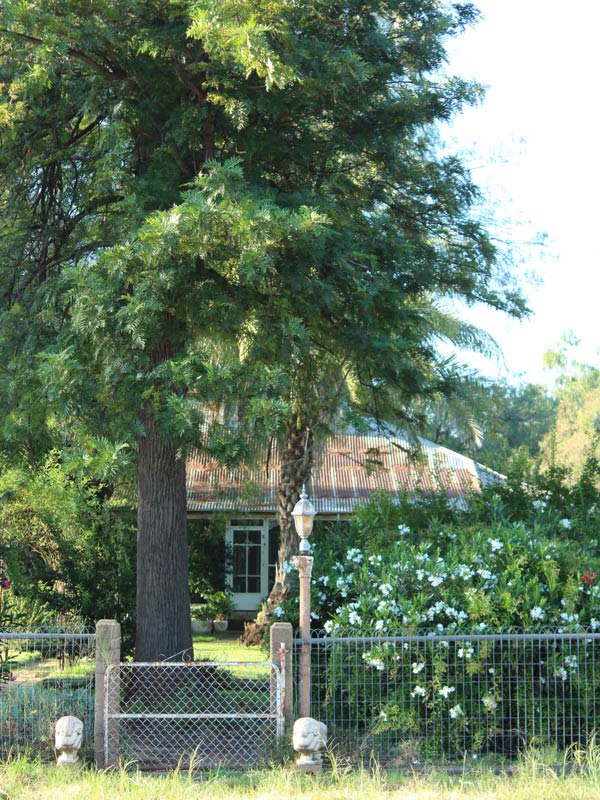
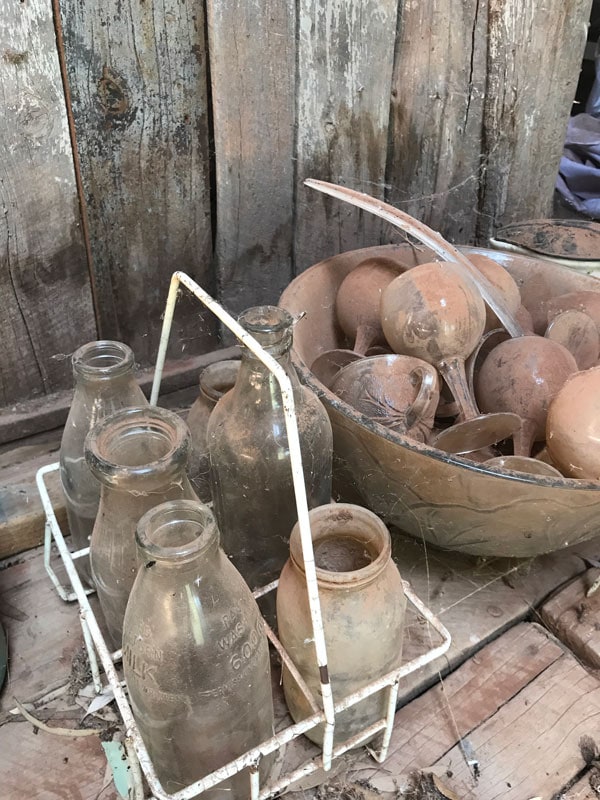
I’m jealous. Standing amid the ephemera of 144 years of living and aspiring and upgrading, the dusty, discarded objects crammed into an original shearing shed at Callubri Station, a 11,500-hectare working farm in Buddabadah, about 50 kilometres outside of the central NSW town of Nyngan, look like priceless treasure to a dedicated thrifter like myself. I would gladly take most of it off the hands of owners Angie and Mike Armstrong, but Angie has other ideas.
The huge set of wooden-framed windows leaning up against a wall that were snapped up from a local school renovation are earmarked for a future project (another set is already installed in Angie and Mike’s pretty homestead on the property). The old shearing tools will be styled up as interesting objets d’art. A dust-covered wool-sorting table will eventually host convivial communal meals. Even the shed itself will be recycled, as a wedding and events space when Angie can find the time to get around to it.
Callubri Station’s sustainable practices
In an environment where farming is an increasingly challenging lifestyle to maintain, the Armstrongs are charting a sustainable future by reusing the old and embracing the new.
Mike, whose family purchased the farm back in 1878, subsequently passing it down through four generations, focuses his attention, experience and interest in innovative practices on harvesting crops including wheat (sold commercially to a local flour mill), oats, barley and lupin (much of which will be cleverly buried in covered underground pits and stored in silos to be used as feed and to drought-proof the property in the future).
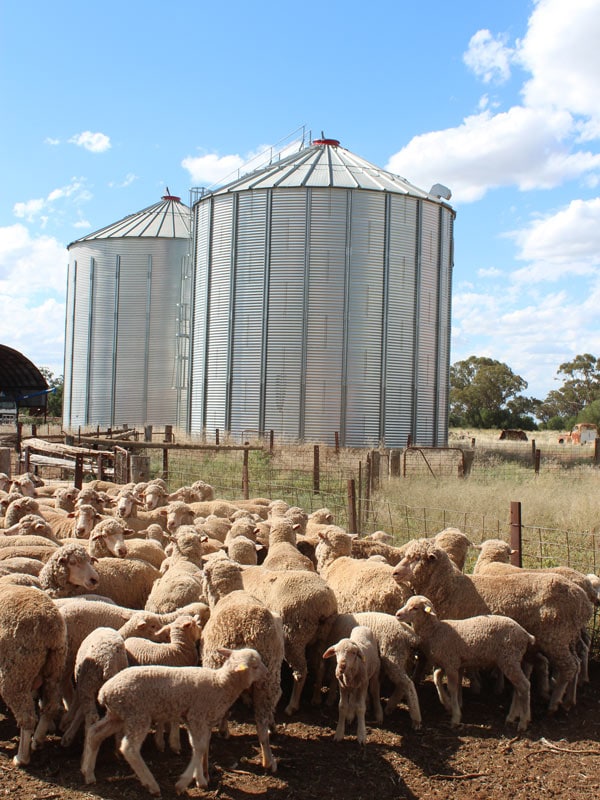
He also maintains the property’s 12,000-odd merino sheep, which produce proudly non-mulesed fleece certified as part of the Responsible Wool Standard, a voluntary program that addresses the welfare of sheep and the land they graze on.
Meanwhile, Angie, whose ready smile and innate desire to feed people makes her the ideal host, has conjured up a unique boutique accommodation offering through vision, passion and sheer will.
First impressions
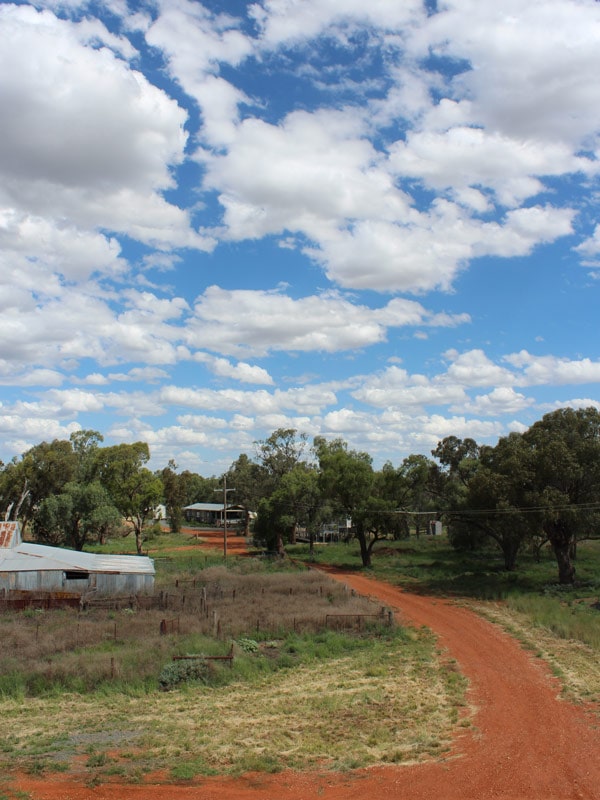
I am destined for one of Callubri’s ‘rooms’ when I board an early- morning light-plane flight that cruises over the NSW landscape as it morphs from coastal green to taupe, calico and rusty red, before landing on a lonely bitumen airstrip surrounded by endless expanses of nothing. The final leg of the journey to Callubri Station navigates a flat, scrubby landscape punctuated by the tiny town of Tottenham.
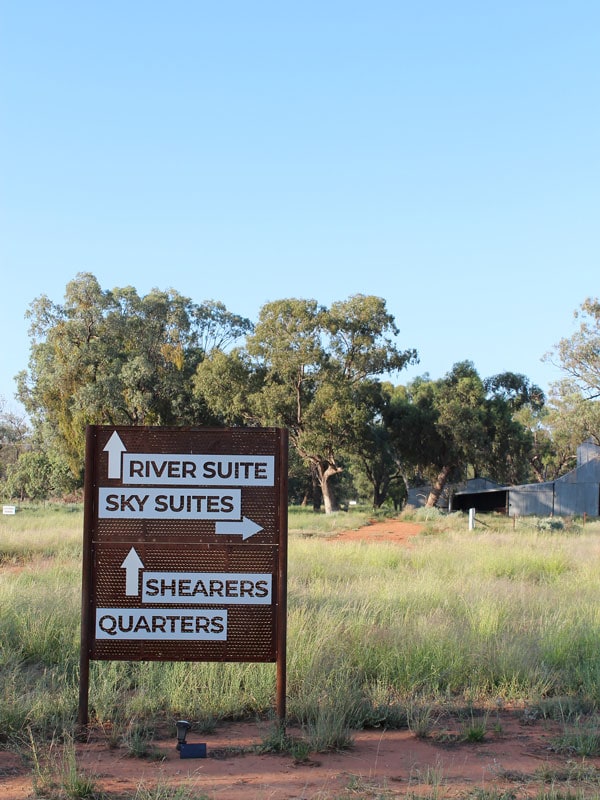
Angie is on hand as a one-woman welcoming party as we pull up to the Shearer’s Quarters, the central hub for guests on the property, where lunch and dinner are served (as well as morning tea breaks of home baking, referred to as smoko), and the starting point for venturing out around the property on tours and activities (usually after polishing off a freshly baked sweet treat). The structure is one of the many recycled and repurposed pieces that have been utilised on the property, a former Officer’s Mess relocated here following the Second World War to house journeying shearers.
The rustic nature of the building is instantly welcoming and sets the tone for a stay at Callubri, with its seating area of leather Chesterfields, wide coffee table groaning with books and games and food and flowers, and help-yourself kitchen, all adjoining a dining room set with long tables, bentwood chairs and vintage church doors at the end of its long expanse. The space is decorated in country chic, with vignettes of found and vintage pieces, many collected from around the property or handed down through Mike’s family.
The room: The Sky Suites
But I’m itching to see the most celebrated repurposed pieces on the property, a collection of single-trip shipping containers that have been stacked like giant metal Lego blocks to create The Sky Suites.
Approaching the structure, which sits incongruously in the outback landscape, thousands of kilometres from the oceans that these vessels were designed for, I get the kind of frisson of anticipation that is elicited by seeing something totally unique and exciting.
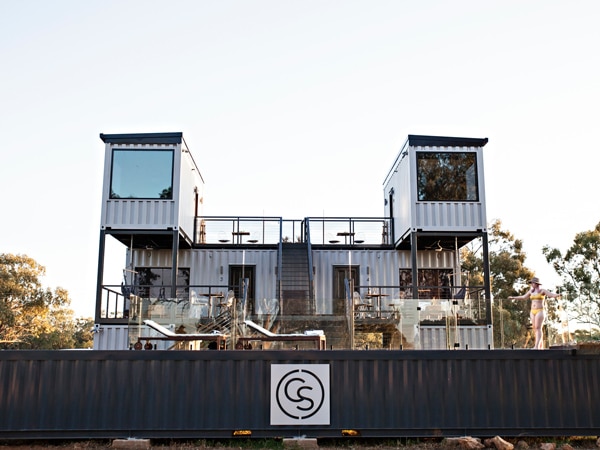
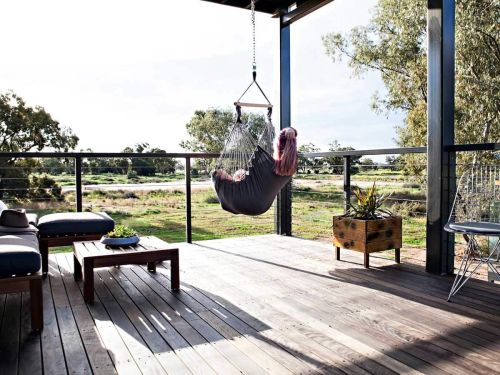
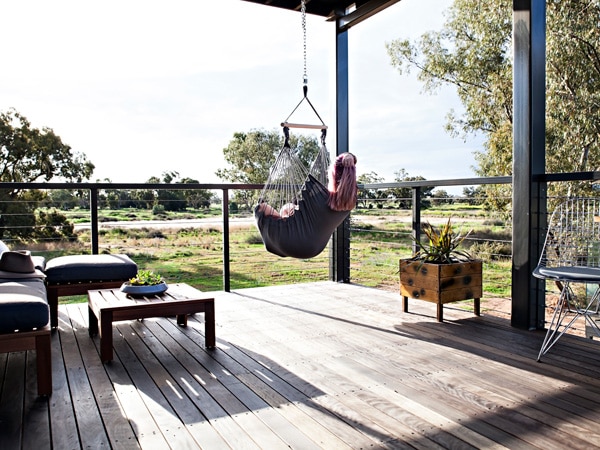
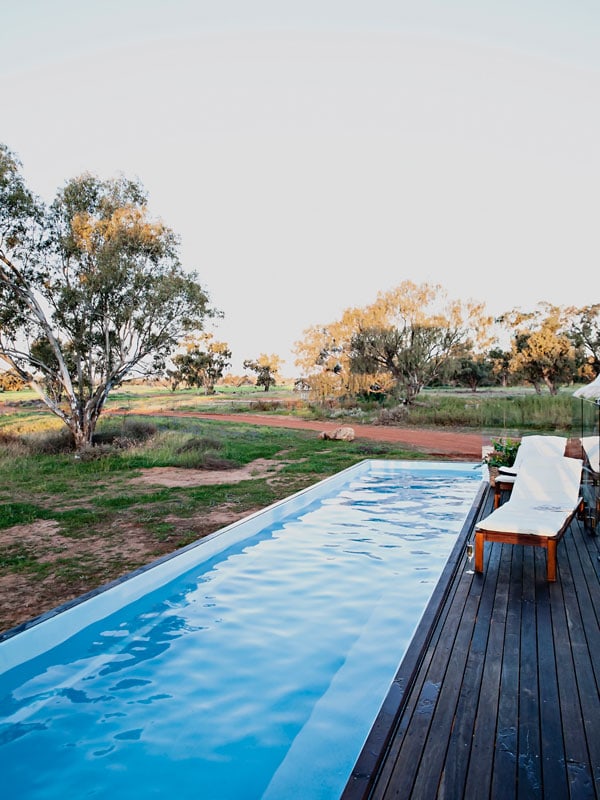
The accommodation block is anchored by a slim 12-metre mineral lap pool (also fashioned from a shipping container), with a central metal staircase climbing past the elevated suites on level one, with their inviting hanging chairs, to the rooms above.
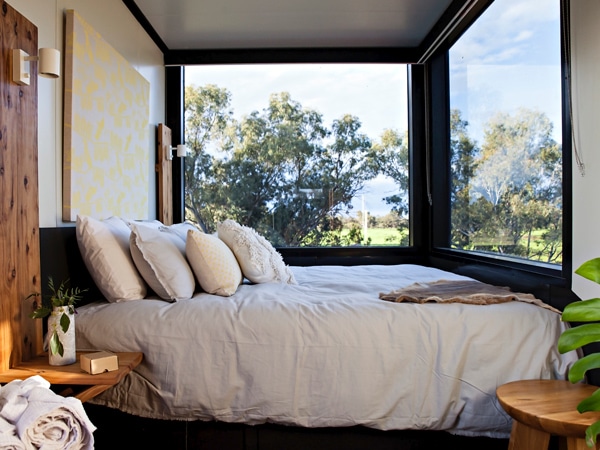
The interiors belie the utilitarian nature of their foundations, fitted with giant double-glazed picture windows in front of which a wide, downy cushion-topped king bed, complete with tactile cotton linens, has been set. The walls are decorated with arresting artworks, while the bedside tables are fashioned from wood handcrafted by Angie’s dad. The modest kitchenette is well-appointed enough to accommodate the fixings for breakfast, from local French press coffee to homemade granola, freshly baked sourdough bread and pastries, and local milk and OJ, and the en suite bathroom comes with a rain shower and an ingenious drawstring bag filled to straining with essentials that, should you have forgotten to pack them, would require an hour-plus round trip to buy.
Need tips, more detail or itinerary ideas tailored to you? Ask AT.
AI Prompt
Callubri Station experiences
While it would be easy to fritter away time on Callubri dipping in and out of the pool and soaking up the serenity, the appeal of a station stay lies in the privilege of seeing how those who live on the land exist, removing the subjectivity and allowing for temporary immersion in someone else’s day-to-day.
With cold water onboard, Mike takes the wheel of a 4WD and we head out into the expanse of the property. Tracking along wire fences and through gates that present like a tangle of metal veins on the dry landscape, I’m sure we make for a quizzical sight to the flocks of sheep gathered together in the shade and the kangaroos that periscope above the flaxen grass at the sound of our approach.
As we drive, Mike explains how he ended up returning to the family farm, having spent time working in banking (albeit focusing on rural and farming loans), including in the north of England. It was his desire to work for himself that made him determined to return to Callubri in order to build on the foundations of his ancestors, eventually taking over the day-to-day running of the farm from his father.
We pull up alongside a collection of gigantic wheat harvesters being used to complete the tail end of the harvest, which has been delayed and protracted due to unseasonal heavy rains. The bulk of the wheat has already been sent off to be made into high-quality flour for bread production, with the remaining crop being reduced to feed quality.
Climbing into the cab of one of the behemoth machines, one of Mike’s farmhands, an Irishman transplanted to the heat and dust of the Aussie outback, takes me on a lap up and down the wheat field. The stringy stalks swallowed up by the giant rotors in front of me are converted into infinite plump grains that gush out of a funnel behind us at lightning speed. It is loud, hot work and, by the time I climb down again, I have a new appreciation of the real toil that goes into making a ‘simple’ loaf of bread.
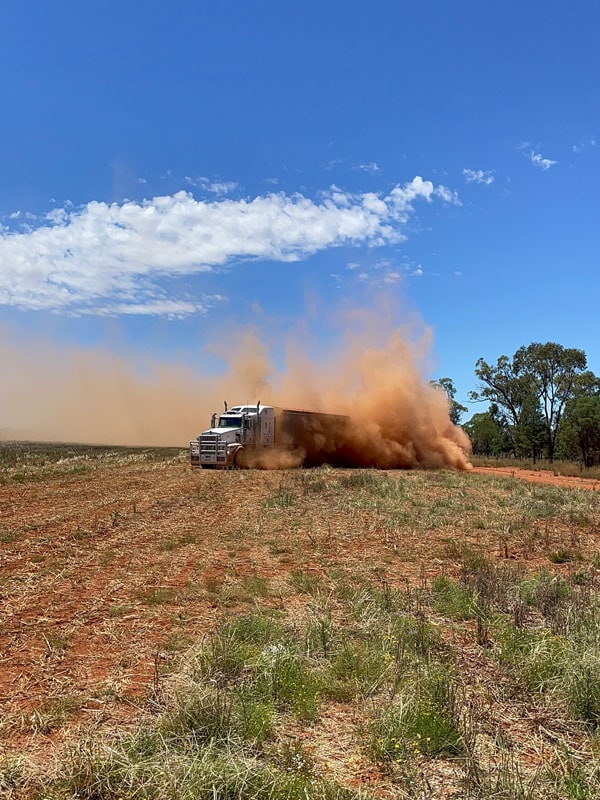
In the distance, the progress of a road train that has arrived to transport the grain can be tracked by the pillowy plumes of thick orange and brown dust that float skyward in its wake.
We also stop at a pen where a flock of jittery ewes and lambs have been corralled. Mike explains that the male lambs will be sold in order to maintain a predominantly female flock so that the breeding process is strictly controlled, resulting in contented sheep, good genetics and quality fleece. The intricacies of deadlines, spreadsheets and sustainable practices hint at the constancy of focus required by modern farming.
The food at Callubri Station
While Mike’s family heritage largely informs the success of the farming side of the station, Angie’s background is integral to the gracious hospitality experienced when staying at Callubri. Having grown up in Victoria’s Yarra Valley, she was raised on outstanding produce and food.
Angie’s love of making and serving food motivated her to start her own successful catering company, The Cocky’s Wife, after meeting Mike and relocating to outback NSW. The accommodation and events offering she is in the process of building at Callubri Station is a natural progression.
With her small team, Angie conjures up meals that are as flavoursome and considered as any you would find in a top city eatery. Lunch consists of bountiful cheese and charcuterie boards with homemade pickles, relishes and freshly baked bread. Dinner is a communal occasion with sophisticated yet hearty dishes that feature local produce from the surrounding area. With dessert polished off, I pick my way back through the inky outback darkness and a silence so thick I almost feel it brushing up against me. I ignore the window blinds and fall asleep gazing at the stars.
Weekly travel news, experiences
insider tips, offers, and more.
The upcycling ethos at Callubri
The next morning, it’s Angie’s turn to play tour guide, walking us around the farm buildings that are scattered close to the Shearer’s Quarters with her too-cute son in tow in his mini Akubra. Old barns are filled with superannuated tools, work-worn saddles and everyday elements that hint at the familial scenes that have played out here for nearly a century and a half: children’s toys, old prams and household items of differing vintages. In another shed, Angie points out stacks of metal boxes that house farm records that hark back to their beginnings; it is a rich archive that she has only just started to work her way through.
We walk around one of the family’s original horse-drawn buggies, which is in surprisingly good condition after sitting dormant for a century. Of course, Angie has plans to restore it. It will join the original Model T Ford Mike had pointed out in a garage the day before; Angie’s dad put it on a trailer and drove it back to Victoria to restore shortly after my visit.
According to Mike, his grandfather was the originator of the upcycling ethos at Callubri, never throwing anything old away – cars, bikes, stoves, wood, farm equipment – believing that a bit here and a piece there could be used to make something workable again. It is a philosophy Angie is happy to embrace.
Nearby garden beds are made out of old wrought-iron beds, in which she will grow produce to be used in the kitchen. There are plans to convert the charming old cook’s hut into a day spa with treatment rooms out back. And, of course, there’s the old shearing shed with its dust-caked glassware, farm paraphernalia and old train seats, all of which I am confident will be stylishly reborn in pursuit of Mike and Angie’s vision of a future for their family and for the farm they love that is built on the rich (if not a little rusty in places) legacy of the past.
A traveller’s checklist
Getting There
It takes roughly seven hours to drive from Sydney to Callubri Station, or 35 minutes from Nyngan Airport.
Staying There
All-Inclusive packages in a Sky Suite, including all meals and one guided activity per day, start at $745 per person twin share per night, with a minimum two-night booking.
Want to see more stories from Australian Traveller in your Google search results?
- Click here to set Australian Traveller as a preferred source.
- Tick the box next to "Australian Traveller". That's it.

Leigh Ann Pow
View profile and articles