The drive between Boulia and Winton in Queensland’s West covers some of the most spectacular land in our country, but few are lucky enough to see it, writes Rachel Bartholomeusz
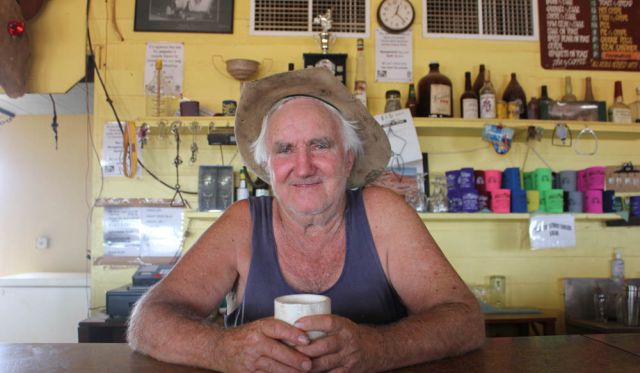
It’s mid-morning at the Middleton Hotel, halfway between Boulia and Winton and in the middle of nowhere. Behind the bar sits 73-year-old publican Lester Cain, a cold stubbie in his hand and a worn Akubra on his head. Les is the stuff of a filmmaker’s dreams: a larger-than-life outback character with a repertoire of dry one-liners. But when director Ivan Sen came to Middleton to film 2016 drama Goldstone, a follow-up to Mystery Road, it wasn’t Lester that had caught his eye.
It was the spectacular and powerful landscape of Queensland’s remote Channel Country. “I auditioned, but they told me I’d be better suited to romance," says Les. You get the impression he’s had plenty of time to work on that line.
Middleton
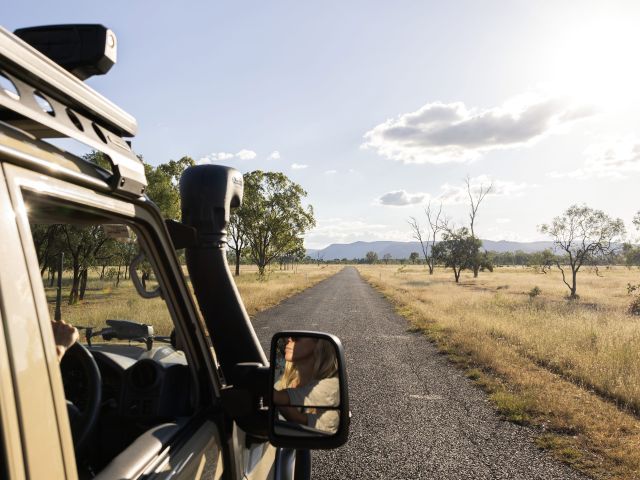
Middleton itself is little more than a pub, with a population of three: Les and his wife, Valerie, and their daughter. It’s the only stop on the 362-kilometre, five-hour drive between the towns of Boulia and Winton.
Les gives us a petrol top-up from an emergency tank he keeps for just such purposes, our fuel tank too small to last these long outback drives.
The ‘Hilton Hotel’, a free camping space across from his pub, is empty today.
“Most Australians aren’t interested in the desert, mate," says Les.
“Maybe they’re a bit frightened of travelling so far, and when they get here, they think there might be nothing to see. But they don’t know."
Channel Country
The Boulia to Winton drive is Channel Country at its most fascinating; a powerful region that covers more than a quarter of Queensland, as beautiful as any reef or rainforest or beach.
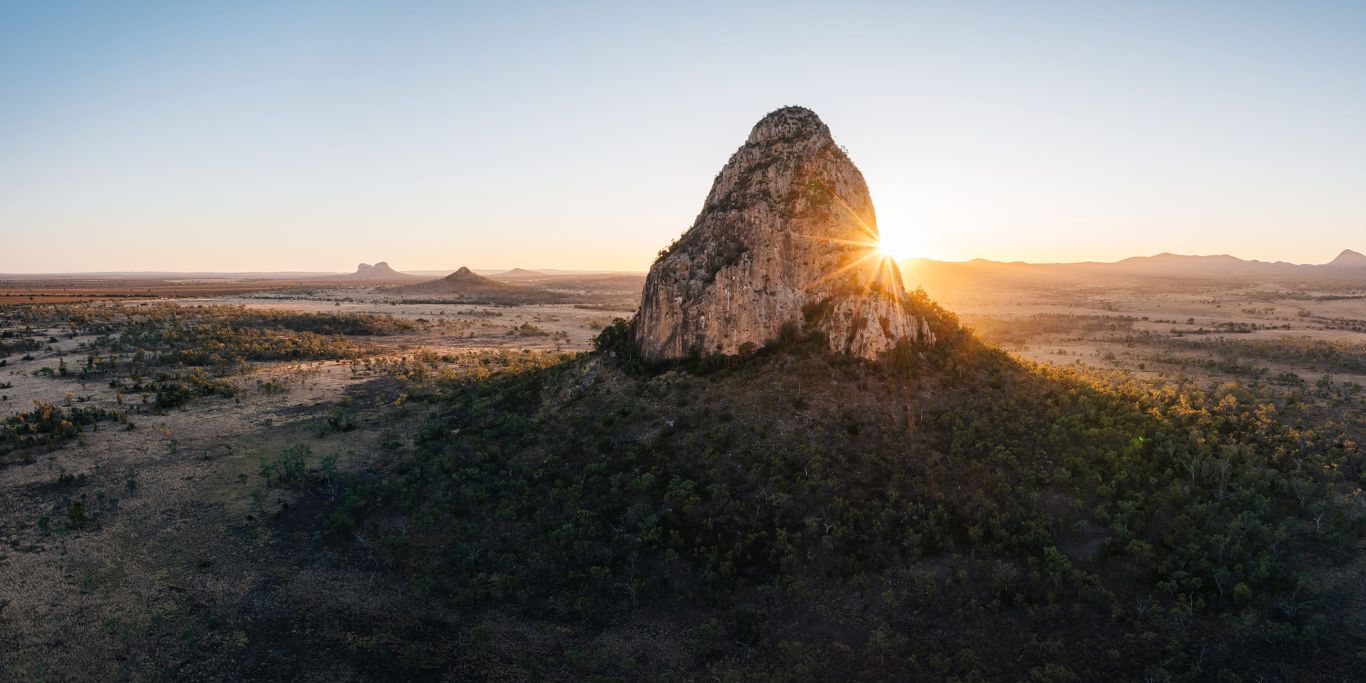
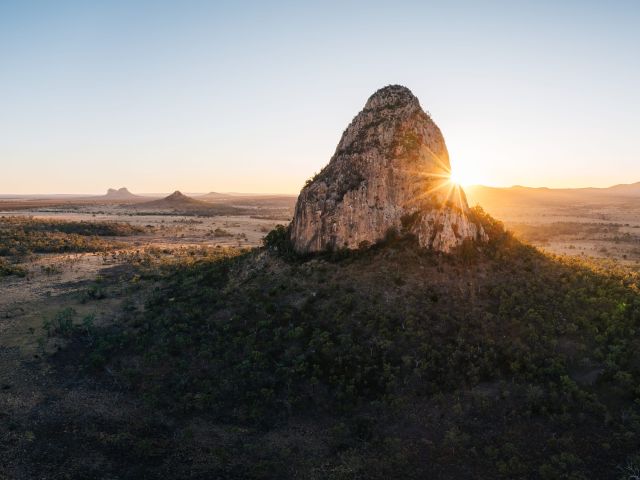
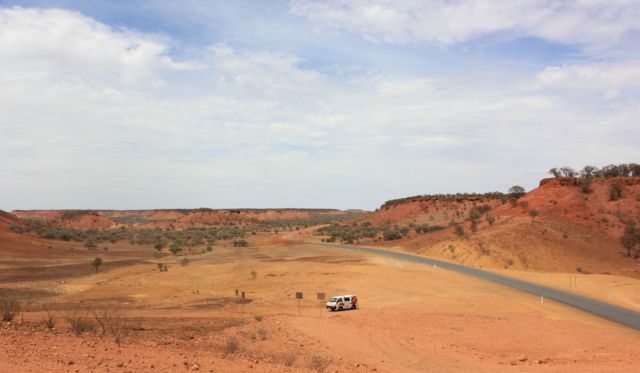
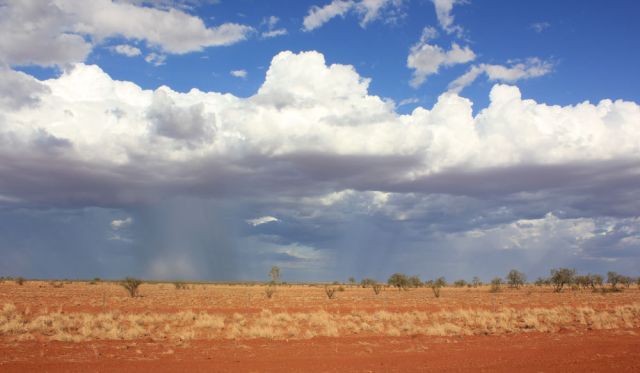
Red plains extend to the horizon, covered in small dry clumps of Mitchell grass. There’s literally nothing, and everything, to see. The impossibly flat earth is broken occasionally by mesas, outcrops left behind by an ancient inland sea.
As we drive through, the sky turns a bruised black-green, and washes everything in a magnificent light. A storm rolls in, but it doesn’t rain. It will, a few months later, and the country is transformed. Channel Country is a desert that floods, a land of extremes. Its entire ecosystem must take advantage of short deluges of water and withstand long droughts.
The meaning behind the name
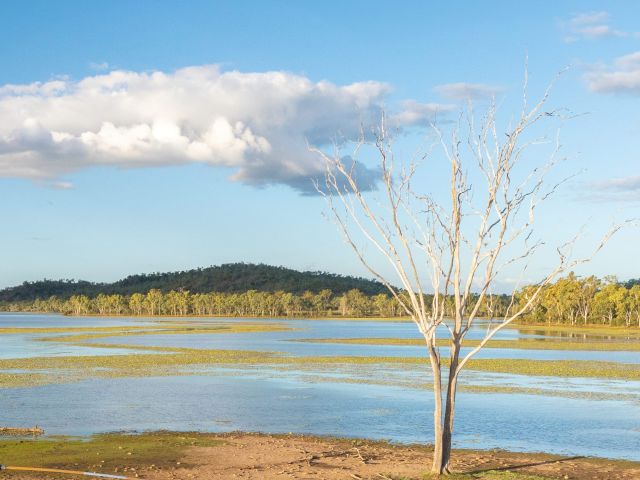
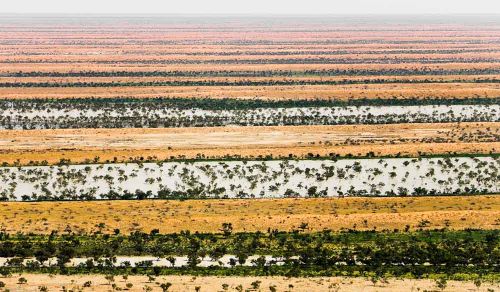
It takes its name from the braided channels of water that run through the flat plains, occasionally spilling into billabongs and lakes. Water is carried from monsoons in the north across the land towards the Lake Eyre basin. It rarely reaches that far south, though, absorbed into the earth instead.
As the channels make their slow course across the country, a wave of life and a burst of greenery follows. To see it dry, anyone would think it was barren.

But those few that live out here know better: this is some of the best cattle-fattening land in Australia.
The winter rains of 2016 were a good start, but not quite enough. Graziers here pray for a flood, the kind that would be disastrous in other parts. Once the water subsides, the land is flushed with grasses that will produce prized cattle.
Boulia to Winton
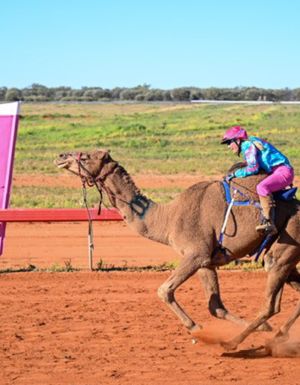
There are cattle stations here larger than whole countries, Lebanon for instance, some mustered by helicopters, and we pass a lonely letterbox every few hundred kilometres. We head east out of Boulia, a town of around 300 people that swells to thousands every July for the Boulia Camel Races.
Burke and Wills brought Australia’s first camels here when they came past on their fabled 1860 expedition, and Boulia sits on the Burke river, named for the explorer.
The land of the Min Min Light
A red stump marks the beginning of the Simpson Desert to the west, behind us.
‘For the next 120 kilometres towards Winton you are in [the] land of the Min Min Light,’ reads a large sign on the road out of Boulia.
Sightings of this light have been recorded between Boulia and Winton since 1918, though local indigenous mythology indicates the phenomenon was around much earlier. At night, on the lonely roads out here, an unexplained light with no apparent source has been known to follow travellers, always remaining the same distance away. Scientific theories suggest it has something to do with atmospheric refraction and that’s what I hold on to as we pull off the road to camp for the night.
It’s not until later I realise the lone tree we’ve camped near is a coolabah: this is Waltzing Matilda country after all, the landscape that inspired Banjo Paterson’s bush ballad. Flat red dirt stretches endlessly in every direction and it seems as though you can see to the edge of the world. Sunset turns the whole world a blazing, vivid orange: earth and sky all the same hue. After a year on the road, travelling the world, this is the most beautiful thing that I’ve seen.
Later, a noise in the darkness makes me jump for the torch: its beam reflects hundreds of glowing orbs, suspended in mid-air. Not the Min Min, but the doleful eyes of a silent herd of cows that has appeared from nowhere.
Lester Cain has seen the Min Min Light. He describes it as being like headlights coming towards you, and yet there is no one, and nothing, for hundreds of kilometres. “I wouldn’t say it’s eerie, it’s just a light," he says. You need more than a mysterious light on a dark road to scare Lester.
Earlier this year, Les survived the bite of a deadly brown snake in his pub. The joke in neighbouring Winton and Boulia is that the snake was probably worse off than this local hero. As you drive towards Middleton, his pub rises like a mirage on the heat-hazed horizon, but instead of water, there’s XXXX Gold. We drink ice-cold stubbies in Styrofoam coolers, and Les says he better have another one, too, while he whips us up a hamburger.
The isolated life
It seems absurd if you were to hear Les’s broad, slow accent, or sense the complete isolation, or eat his spaghetti on toast, but the scene is oddly reminiscent of being in a Japanese izakaya: just a few stools, a small menu and a supremely hospitable host. Les is a one-man-show and a beer with him is worth the drive alone.
Middleton was once one of nine stops on the outback Cobb & Co coach route, where tired horses would be replaced with fresh ones, but the lively town that sprang up around the post has long since disappeared. Beyond the 140-year-old pub there’s an old dance hall and a windmill, a phone box, and nothing more.
“I’ve always lived in isolated places," says Les.
Born in Camooweal, even further west, he has spent his life on the land, working for drovers, and catching and selling the feral camels that roam the outback, a vestige from the camel trains once used to transport goods into Australia’s interior. Les settled down to life as a publican a decade ago. He’ll regale you with tales of his pub being turned into a movie set for the likes of Jackie Weaver, David Wenham and Aaron Pedersen, and speaks in awe of the landscape: the real star of the film, which he’s yet to see.
East of his pub, the landscape will become even more beautiful, “The best scenery for a thousand kilometres," he says. Beyond, historic Winton awaits, with its wide main street and grand country pubs with wrap-around balconies. It’s the birthplace of Qantas and Waltzing Matilda, the soil nearby littered with dinosaur fossils.
“It depends what blows your hair back, some people are right into dinosaurs," says Les. “And mate, if you’re into dinosaurs, it’s the dinosaur capital of Australia out there." Much to see, it turns out.
We wrench ourselves from our bar stools, and Les walks us to our campervan. He waves goodbye, leaning against the porch of his pub. “It’s about the journey, not the destination," says Les. “I once saw a bus drive through here with a sticker on it saying that."
About the ‘Matilda Country’:
Winton’s proudest claim is being the birthplace of Waltzing Matilda.
According to the town’s Waltzing Matilda Centre (the only museum in the world dedicated to a song, and recently rebuilt after a fire), Banjo Paterson wrote the ballad while staying on a shearing station in Winton, supposedly inspired by the local countryside and the true story of a unionist who suicided in a waterhole.
Winton’s North Gregory Hotel held the song’s first public performance in 1895.