Here are the best places to swim around Australia

hero media
Caroline Clements and Dillon Seitchik-Reardon took a year off work to live the Aussie dream: travelling the country in search of the best swimming spots, from beaches to lakes to gorges. Here, they talk us through some favourites from their resulting book Places We Swim, a loving homage to our national obsession with the water.

For many of us in Australia, it is impossible to separate ourselves from the water. A thousand sensory memories flood back with every slop of sunscreen: windy days picking sand from our lunch and the feeling of salt water drying on our skin, scratching us under our clothes. As people of the world’s driest inhabited continent it’s no surprise that water should have such an elevated role in our society. It’s a fixation that has defined us since the beginning, whether we are coastal or inland dwellers.


Our fascination with water remains a critical part of our social identity. Through Places We Swim (Hardie Grant Travel, $39.99) we’ve tried to capture the very best possible representation of the country – we wanted it to be as democratic as possible. Swimming cuts through age, class, gender, religion and ethnicity. After all, what is more equalising than being outdoors in near nakedness among strangers?


In this way, swimming is a natural access point to understanding the Australian experience. On a hot day, any swimming hole in the country will provide a cross section of all people. Whether it’s the beach, an ocean pool, a lake, river, gorge, dam, waterfall, hot spring or billabong, these bodies of water and the surrounding landscapes reveal our better selves. Each place tells a story of its community.


The idea of documenting our swims is something that we had been indirectly working on through years of road trip adventures. However, it was only when our far-fetched pitch was accepted by our publisher that it coalesced into a book. We had always talked about driving a big lap around the country and suddenly found the perfect excuse to do so. Writing a book about the best places to swim in Australia felt like the ultimate study on our cultural connection to water, and maybe the best job we’d ever have. Here is a snapshot of some of our favourites.

Beach

Bay of Fires, Tasmania

It might not be what you expect but Tasmania is home to some of Australia’s best beaches. You just have to be OK with the immune-boosting power of cold water. And if you like white sand, perfectly clear water and going to the beach but not sharing it with other people, this is the place for you.

Pool

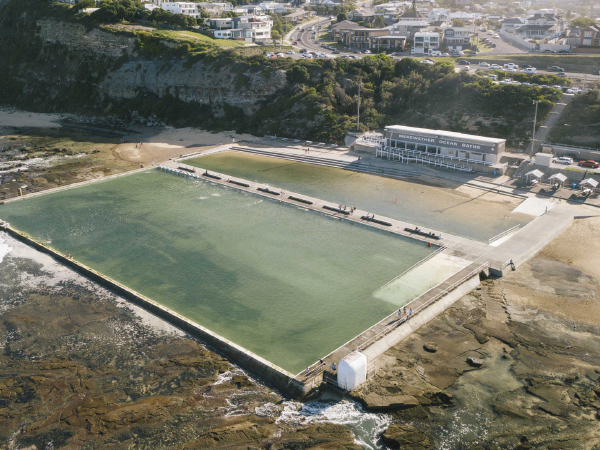
Merewether Ocean Baths, New South Wales

Newcastle has a long history of popular swimming spots, but Merewether baths is our favourite. The complex opened in 1935 and is the largest in the southern hemisphere. It’s also open year-round, 24 hours a day and is free to enter.
Lake

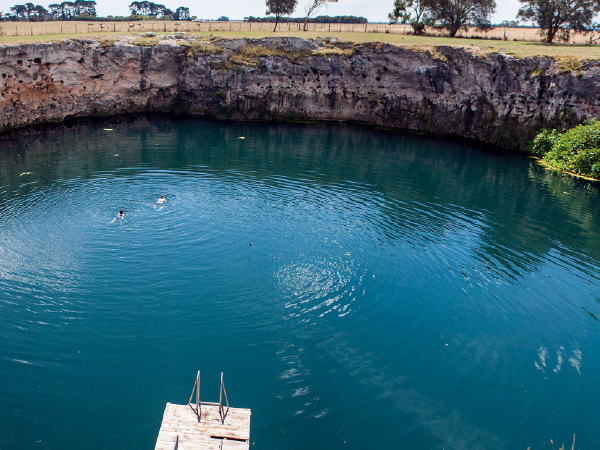
Little Blue Lake, South Australia

Little Blue Lake, also known as Baby Blue, sits in an unassuming paddock south of Mount Gambier. This lake is actually a sinkhole, formed by the gradual collapse of an underground cave. The pool’s average depth is about 35 metres and is popular for diving, though surface swimming is more our speed.
Hot Spring

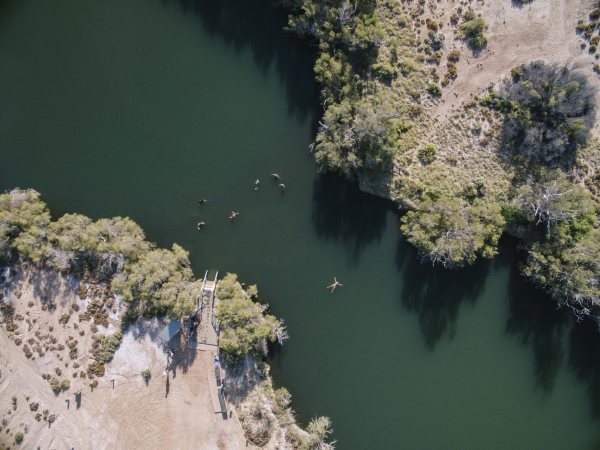
Dalhousie Springs, South Australia

Early morning is the best time to visit Dalhousie Springs, where the water temperature is 38°C. This group of 60 artesian thermal springs might be one of the most remote places in the book – sitting on the western fringe of the Simpson Desert – but is the perfect place to soak in warm waters after a long car ride. A true oasis.
Gorge

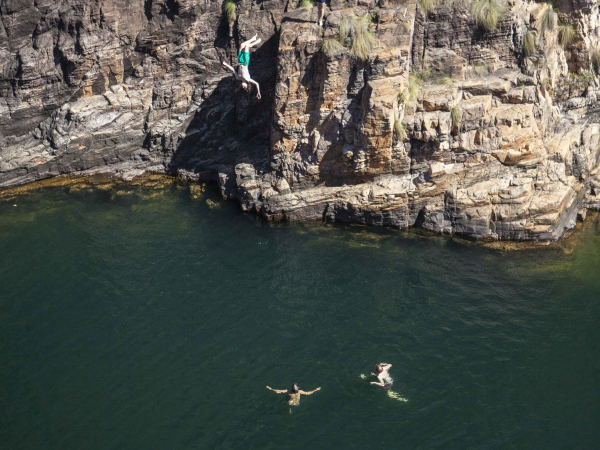
Maguk gorge, Northern Territory

The jewel in the crown of the Kakadu swimming spots, Maguk is a deep, wide gorge where sheer cliffs drop into what seems like a bottomless pool. Find a rocky platform to sit on in the sun, or jump from the ledges (though we didn’t tell you that).
hero media

A must-visit list of Victoria’s most iconic spots

From natural wonders to historical sites, we’ve rounded up Victoria’s most epic icons that deserve a place on your itinerary.

Grampians (Gariwerd) National Park

Mount William peak in Grampians (Gariwerd) National Park
Mount William is the highest peak in the Grampians (Gariwerd) National Park. (Image: Matt Donovan)

From towering mountains to crystal cascades and ancient rock art sites, the Grampians (Gariwerd) National Park is a playground for both outdoor adventurers and nature lovers. Don’t miss the views from the highest peak Mount William or the iconic Pinnacle.

Murray River

A paddle steamer down the Murray in Echuca
The wonders of the Murray are best experienced on board a paddle steamer. (Image: Visit Victoria)

A natural icon of majestic proportions, the Murray River flows for a staggering 2700 kilometres, making it one of the world’s longest navigable rivers. Meandering through Victoria before flowing out to sea at Goolwa in South Australia, the river is home to diverse wildlife, picturesque towns and secluded creeks and beaches.

Twelve Apostles, Port Campbell

the Twelve Apostles, Great Ocean Road
The Twelve Apostles are a star attraction on the Great Ocean Road. (Image: Tourism Australia/Two Palms/Harry Pope)

These limestone sea stacks are arguably Victoria’s most famous icon . After an $8-million upgrade to its lookout, The Blowhole near Loch Ard Gorge/Poombeeyt Kontapool (meaning breath of the whale) has recently reopened. A brand-new Twelve Apostles Visitor Experience Centre, complete with rooftop lookout, will open in 2026.

You Yangs, Geelong

kangaroos in You Yangs
Kangaroos enjoy dusk in the You Yangs. (Image: Tourism Australia)

Rising 300-plus metres from the flat volcanic plains between Melbourne/Naarm and Geelong, the You Yangs are massive granite boulders named for the local Wadawurrung word ‘Youang’, meaning ‘big hills’. Hiking, biking, rock climbing and horse-riding are popular within this regional park.

Redwood Forest, Yarra Valley

Redwood Forest, Yarra Valley
Yarra Valley’s soaring Redwood Forest. (Image: Tourism Australia)

Near the town of Warburton, an extraordinary forest of some 1500 Californian Redwoods stands among native orchids, eucalypt trees and rich birdlife. Planted in the 1930s, these 55-metre-plus trees can live for 2000 years and will grow to be some of the world’s tallest.

Wilsons Promontory, Gippsland

the Wilsons Promontory
Wilsons Promontory is home to the incredible Skull Rock formation. (Image: Tourism Australia)

The Prom, as it’s known locally, is the southernmost tip of mainland Australia. This 50,000-hectare reserve comprises granite mountains and forest, fringed by sandy beaches and surrounded by a marine park rich in marine biodiversity. It’s also home to the incredible and imposing Skull Rock formation.

Hanging Rock Reserve, Macedon Ranges

the Hanging Rock Reserve, Macedon Ranges
Enigmatic Hanging Rock. (Image: Visit Victoria/ Rob Blackburn)

This six-million-year-old volcanic rock  was thrown into the national spotlight thanks to the 1967 novel and consequent 1975 film based on the fictional disappearance of schoolgirls in 1901. Mystery aside, visitors can walk the steep 105-metre summit, fish for trout and go twitching.

Sovereign Hill, Ballarat

exploring Sovereign Hill
Step back in time at Sovereign Hill. (Image: Tourism Australia)

Cry ‘eureka!’ at Sovereign Hill , a living museum to the prosperous Gold Rush era of the 1850s, during which Ballarat produced the most gold in the world. Visitors to this much-loved attraction can walk historic  streets, enter a gold mine and try panning for the good stuff, too.

The Great Stupa, Bendigo

Great Stupa, Bendigo
The Great Stupa in Bendigo. (Image: Tourism Australia)

Who’d have thought the largest Buddhist temple in the Western world would be tucked away in Bendigo’s bushland? Welcoming visitors to explore, this sacred Buddhist pagoda is an epicentre for Tibetan culture, architecture, art and interfaith harmony.

Cape Schanck Lighthouse, Mornington Peninsula

the Cape Schanck Lighthouse from above
Heritage-listed Cape Schanck Lighthouse. (Image: Tourism Australia/Two Palms/Harry Pope)

Ensuring the safe passage of ships in the notoriously treacherous Bass Strait since 1859, this heritage-listed lighthouse overlooks dramatic volcanic coast and wild beaches. The surrounding reserve is home to a plethora of wildlife including little penguins, seals and echidnas.