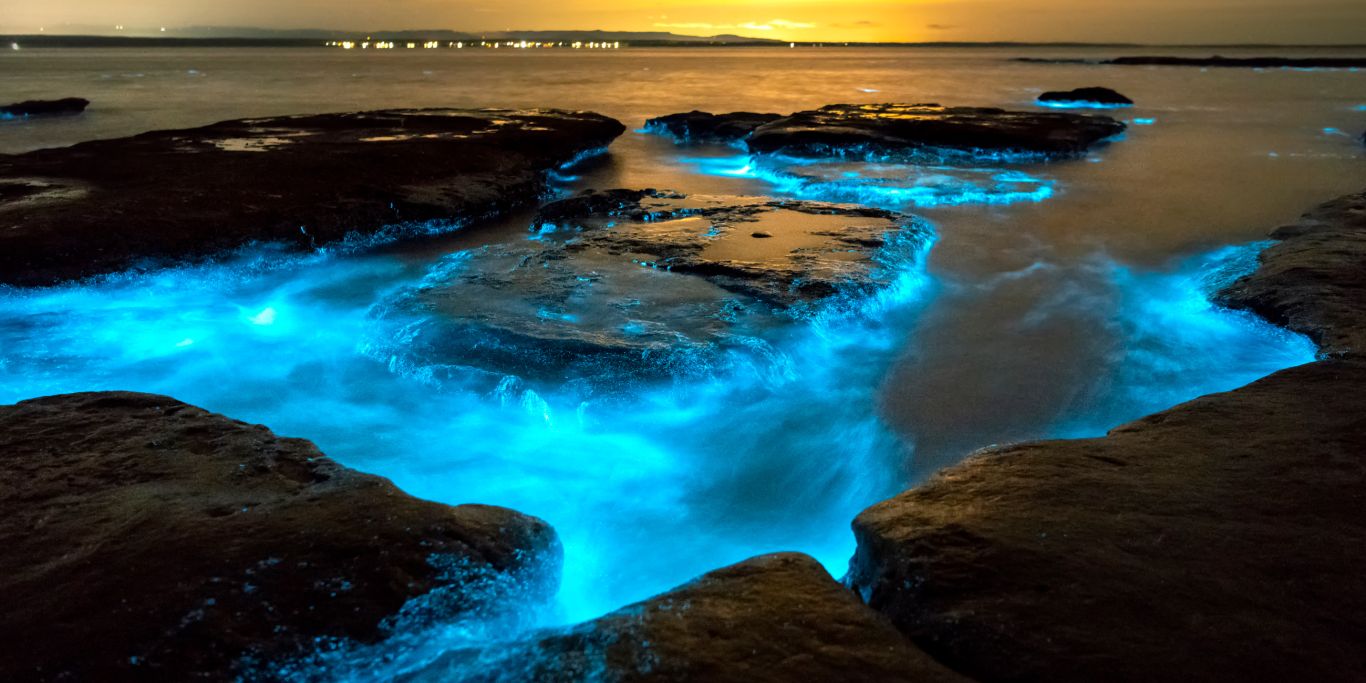
hero media

Where to see the best bioluminescence in Australia

A dazzling underwater world reveals itself after dark – and we know where to find it.

There are chemical reactions that bake your bread, rust your bike, and turn your water from still to sparkling. But perhaps one of the most magical chemical reactions on Planet Earth is that which lights up living things from the inside out: bioluminescence.

What is bioluminescence caused by?
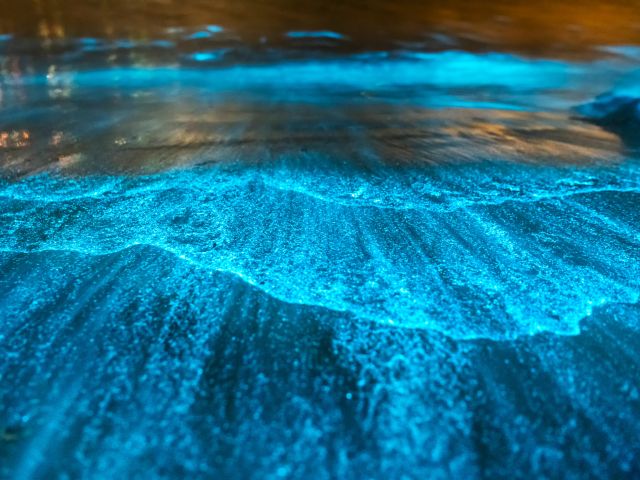
a bright and brilliant blue ocean at night
A chemical reaction in the water causes an ethereal glow. (Image: Getty/RugliG)

Bioluminescence is a primarily marine phenomenon, occurring in certain types of fish, plankton, jellyfish and other deep-sea invertebrates. It can take place on land, but this is much rarer, with fireflies, foxfire mushrooms and glow worms being amongst the most famous examples. In order to be bioluminescent, all these species share an important chemical duo: the molecule luciferin and the enzyme luciferase. When luciferin reacts with oxygen, catalysed by the luciferase as a spark might ignite a match, the reaction releases energy in the form of cold light from inside the organism. The colour of this light depends on the arrangement of luciferin molecules, although the colour you can most expect to see is a bright, brilliant blue.

Where in Australia can you see bioluminescence?
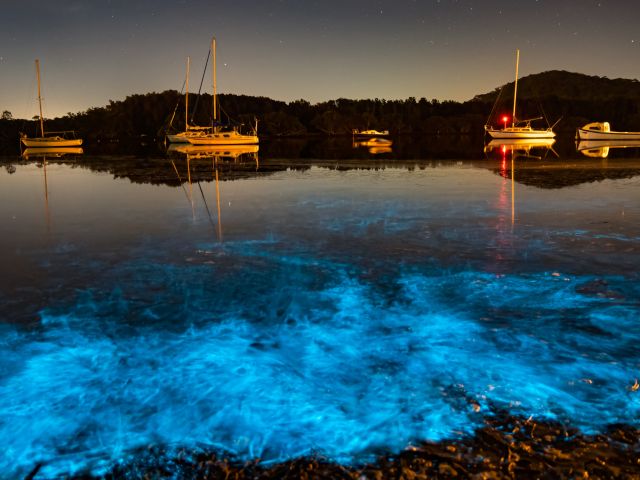
ocean water glows at night
Find dazzling waters in Tasmania, Victoria and New South Wales. (Image: Getty/Merrillie)

Thanks to nutrient-rich currents and greedy plankton, this sparkly show tends to hug the country’s south-eastern states, making Tasmania, Victoria and New South Wales the leading hotspots for seeing bioluminescence in Australia. Sightings in South Australia and Western Australia aren’t impossible (Port Lincoln on the Eyre Peninsula and Marina Mindarie near Perth have had documented flares), but it’s far, far rarer. Meanwhile, instead of glowing waves, the Northern Territory and Queensland are two of your best bets for spotting fireflies. Taking previous displays and recent sightings of bioluminescence into account, here’s a run-down of where to try first…

Tasmania

Noctiluca scintillans – an algae species that shows up red in daylight but transforms into a glittering blue after dark – seem especially fond of Australia’s island state. Best of all, you really don’t have to go far from Hobart to catch a glimpse. Seven Mile Beach, Montagu Bay, Howrah Beach and Ralphs Bay have all lit up on calm summer nights. Meanwhile, just off the eastern coast of Bruny Island, Storm Bay has even had recent sightings of the dazzling moon jellyfish. On the state’s eastern edge, brilliant pictures of both the red and blue blooms have been taken around Eaglehawk Neck, Pirates Bay and Port Arthur. If you’d rather be taken to the action, Tassie local and bioluminescent expert Dr Lisa Gershwin – who holds a literal PHD in ‘Jellyfish’ – runs a guided Glow Tour from Hobart , with dates throughout the year.

Victoria

A four-hour drive from Melbourne, the Gippsland Lakes region is a reliable spot for our electric-blue Noctiluca scintillans, particularly around the Lakes National Park. That said, inner-city spots like St Kilda and Port Melbourne have been seeing increasing flares of bioluminescence in Port Phillip Bay, making the glow surprisingly accessible without leaving the city. See also: the Mornington Peninsula, spots along the Surf Coast (particularly around Lorne and Wye River) and the Otways, whose dark, damp forests make them prime catch for glow worms, too.

New South Wales

New South Wales is home to perhaps Australia’s most famous bioluminescence hotspot: Jervis Bay, an almost three-hour drive south from Sydney. A perfect cocktail of shallow waters, sheltered beaches, minimal light pollution and an abundance of microscopic algae makes it a bio-spotter’s best chance at seeing the phenomenon up close. From Jervis Bay, the Noctiluca scintillans can appear all along the coast as far north as Lake Macquarie, propelling spots around Palm Beach and Wollongong into the spotlight. Closer to Sydney, Manly Beach and Shelley Beach are becoming increasingly blue come nightfall.

And if you want to get really serious, there’s a Bioluminescence Australia Facebook group you can join for live updates of activity around the country.

What time of year can I see bioluminescence in Australia?
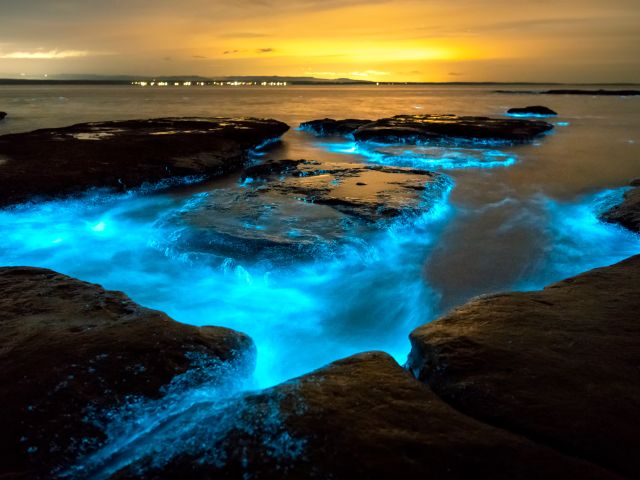
bright blue waters caused by bioluminescence
Bioluminescence is more active after the rain. (Image: Getty/RugliG)

While the phenomena can strike at any time of year, warm water makes for the best bioluminescent bedfellow, since heat stimulates the growth, reproduction and activity of our glow-in-the-dark microorganisms. In Australia, this means the late summer months heading into autumn (February to April) generally produce more frequent sightings. For ultimate sparkle-spotting conditions, bioluminescence is more active after a period of rainfall (rain washes nutrients from the land into the water, helping to trigger algae blooms), and is best viewed on a moonless light, with minimal light pollution.

Is it safe to touch bioluminescent water?
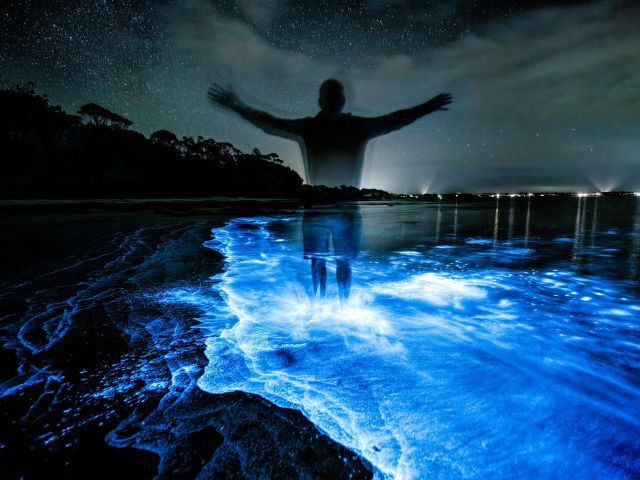
ocean water glows bright blue with a human silhouette in the background
Touching or disturbing the water too much can stress the light-emitting organisms. (Image: Trevor Mckinnon/Unsplash)

On the whole, it’s not recommended – bioluminescent organisms and the ecosystems they inhabit tend to be extremely delicate and vulnerable. Plus, by touching bioluminescent organisms in order to encourage the light, you are by default having to stress and disturb them – akin to poking a lion to make it roar. Some species are even toxic, and can cause skin irritation. Having said this, many glow-in-the-dark tours around the world do permit gentle touching, so long as no sunscreen, lotions or perfume is worn. Many will see you glide through bioluminescent waters on kayaks. The best advice? Exercise your own judgement and practice responsible tourism.

Hannah Ralph
Hannah Ralph is an award-winning travel editor turned freelance writer. She’s currently chasing stories across Australia, until reality (and her inexplicable fondness for chilly British weather) demands a return to the UK, where her globe-trotting career began more than a decade ago. Following a formative start as Features Assistant at The Sunday Times Travel Magazine, Hannah went on to hone her aviation chops for several years on the British Airways editorial team, serving as Editor and Deputy Editor on numerous titles, including the flagship in-flight mag, High Life. She later returned to The Times and Sunday Times as an in-house Travel Writer. Now freelance, Hannah finds herself a roaming reporter with bylines for Mr & Mrs Smith, The Telegraph, Business Traveller UK, National Geographic Traveller, Eurostar’s Metropolitan magazine, and more. Her mission? To track down all of Australia’s greatest, most unforgettable stays – and live what might just be the most glamorous gap year yet.
See all articles
hero media

6 reasons the best way to experience the Kimberley is by cruise

This remote corner of Australia is one of the world’s last frontiers. This is how to see it properly.

Vast, rugged and deeply spiritual, the Kimberley coast in Australia’s North West feels a world away from everyday Australia – and there are countless ways to explore it. But if you want to reach ancient rock art, hidden gorges and lonely waterfalls, it has to be by boat. Whether you’re aboard a nimble expedition vessel or a luxury yacht with all the trimmings, exploring by the water brings exclusive experiences, shows unique views and makes travel easier than any other mode. And that’s just the beginning of Australia’s North West cruises.

The True North Adventure Cruise in between sandstone cliffs.
Adventure starts where the road ends.

1. Discover Broome, and beyond

Explore your launchpad before you set sail: Broome. Here camels and their riders stride along the 22 kilometres of powdery Cable Beach at sunset. That’s just the start.

At Gantheaume Point, red pindan cliffs plunge into the turquoise sea, whose low tide uncovers fossilised dinosaur footprints. Broome’s pearling history runs deep. Japanese, Chinese, Malay and Aboriginal divers once worked these waters, and their legacy lives on in boutiques where South Sea pearls still shine.

If the moon’s right, you may catch the Staircase to the Moon over Roebuck Bay. Or simply kick back with a cold beverage and a film under the stars at Sun Pictures , screening since 1916.

Ride a camel along Cable Beach as the sun sinks into the Indian Ocean, casting golden light across the sand and sea.
Ride a camel along Cable Beach. (Image: Nick Dunn)

2. Unmatched access to The Kimberley

Once you’re onboard, expect a backstage pass to some of the most isolated places on Earth. No roads. No ports. No phone reception.

At Horizontal Falls/ Garaanngaddim, 10-metre tides surge through twin gorges like a natural waterpark ride that’ll make your palms sweat. Then there’s Montgomery Reef/ Yowjab: a giant living platform of coral and seagrass, where the sea pulls back to reveal waterfalls, sea turtles and ospreys.

Up north, King George Falls/ Oomari rage 80 metres down red cliffs. Zodiac boats often nudge in closer so you can feel the spray on your sun-warmed cheeks. You might even fly in to reach Mitchell Falls/ Punamii-unpuu, a four-tiered cascade where you can swim in freshwater pools above the drop.

Come spring, some itineraries veer west to Rowley Shoals: an atoll chain of white sand and reef walls. Then it’s up the winding Prince Regent River to King Cascade/ Maamboolbadda, tumbling over rock terraces, and into a Zodiac to view the Gwion Gwion rock art, whose slender, ochre-painted figures are older than the pyramids.

A cruise drifts beneath King George Falls, where sheer sandstone cliffs frame the thunderous plunge into turquoise waters.
Get closer to the Kimberley than ever before.

3. Taste the Kimberley with onboard hospitality

You might spend your days clambering over slippery rocks or charging past waterfalls. But when you’re back on the water, it’s a different story. Meals are chef-prepared and regionally inspired: grilled barramundi, pearl meat sashimi, mango tarts, and bush tomato chutney. One night it’s barefoot beach barbecues with your shipmates; the next, alfresco dining on the ship.

Small expedition ships each have their own personality, but many carry just 12 to 36 guests, making being out on the water a whole other experience. You might sink into a spa on the foredeck or sip coffee in a lounge while watching crocodiles cruise by. It’s choose-your-own-relaxation, Kimberley style.

4. Expert-led excursions through the Kimberley

These voyages are led by people who know the Kimberley like the back of their sunburnt hand. Attenborough-esque naturalists might gently tap your shoulder to point out rare birds or tell the story beneath a slab of rock. Historians can explain exactly how that rusted World War II relic came to rest here.

If your ship has a helipad, you might chopper straight to a waterfall-fed swimming hole. If not, you’ll still be hopping ashore for that wet landing at a secret creek.

Then come the evenings: songlines shared by Traditional Owners under the stars, or astronomy sessions that link what’s overhead with what’s underfoot and what’s within.

A small group glides through Kimberley’s rugged coastline by boat, passing ancient cliffs.
Explore with naturalists and historians by your side.

5. Relax in luxurious lodgings

Just because you’re off-grid doesn’t mean you have to rough it. These Kimberley vessels are small in size, but mighty in luxury. True North’s ships come with their own helicopters and a no-sea-days policy, so you’re always in the thick of it. Try the luxurious offerings from Ocean Dream Charters for exploration in style. Kimberley Quest offers a fast boat for easy, off-ship adventures. On the larger end of the scale, Coral Expeditions has open-deck bars and curated wine cellars. And then there’s Ponant’s luxury yachts sleek and incredibly stylish French sailing yachts.

A helicopter soars above the sea, with a sleek cruise ship gliding in the distance.
See the Kimberley from sky to shore.

6. The adventure continues with pre- and post-cruise experiences

You’ve already come this far – so, why not go further? Broome makes it easy to ease in before you board, or wind down when your voyage ends, and there is no reason to stop there.

Head an hour and a half south to Eco Beach to stay off-grid and off the clock. Join a Yawuru guide for a mangrove walk or ocean forage. Dive even deeper into Broome’s pearling past at Willie Creek or Cygnet Bay, where divers and craftspeople still pull the seawater-slicked gems from the deep.

If you’re still craving adventure, it’s time to go further. Soar over the Buccaneer Archipelago, or detour inland with a 4WD trip along the Gibb River Road. Book a scenic flight over the Bungle Bungles. Or – because you never know when you’ll be back – do all three.

aerial of people walking on eco beach in the kimberley western australia
Stay off grid at Eco Beach. (Image: Tourism WA)

Find out more about your trip to Australia’s North West at australiasnorthwest.com .