Business class v economy: Is it worth the extra cash?

hero media
Like any economy-class flyer will tell you, boarding a large plane is a bit like taking a pauper to Fifth Avenue – an insight into the luxuries money could buy, if only you had it.

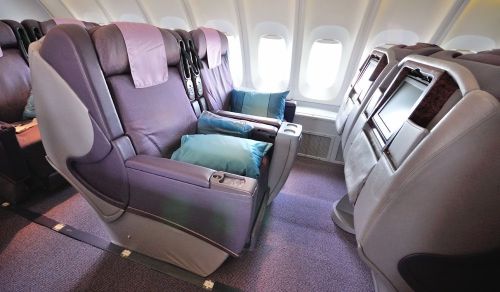
The first time I boarded a plane I couldn’t understand why people complained about long haul flights, I walked in to find rows of roomy seats that could double as single beds, mini televisions and more buttons and gadgets than a Transformer. This is was going to be all kinds of fun! Then I realised I was walking through business…


As I walked down the aisle the seats suddenly became cramped into rows of eight, not six, the cry of babies became louder and overhead storage compartments were already so packed the doors couldn’t close, let alone fit my items.


Oh, so this is why they call it cattle class.


Over the years I’ve since learned to look straight ahead and ignore the lushness of business en route to my seat at the rear. In fact, on occasion I have secretly scoffed at business customers – clearly with more money than sense.


But when I was recently offered a business seat with Qantas on a return flight from Western Australia, I wasn’t quite so unaffected. Alright, guilty – I did a Lleyton Hewitt-esque “come on!", marked it down in my diary, then counted down the days. Having only ever flown economy, just what was so good about business that warranted the quadrupled price tag?


I arrive at Perth’s airport, fresh off a connecting flight, and have 15 minutes to enjoy the glory of the business lounge. So condensing the experience which any sophisticated traveller would typically enjoy over an hour, my travel companions and I race in, peruse one of the many magazine and newspaper stands, scoff down a complimentary bowl of crispy snacks from the bar and a glass of champagne, all before darting to the boarding gates. Moral of the story – arrive at the airport early so you have time to actually enjoy the lounge at leisure.


As we board the plane, it feels quite alien taking only a couple steps before the stewardess says “Right here, Miss Jenkins".


Ah, my seat. My beautiful, spacious seat. Pillowy and wide, and with more leg room than I know what to do with. I test out every way I can maneovour my lair for the next five hours, flick almost every switch I can find (which the old-hand business traveller next to me isn’t quite so excited by), and read over the menu at least nine times before takeoff. I am a child on a sugar high.


During the safety briefing, I’m even excited when the voiceover announces “emergency life jackets in business are found under your leg rest" – yes, leg rest!


But it’s not just the almighty seats that make the business experience. The differences between it and economy vary in obviousness, but they all add up. The aisles are wider, the bathrooms are lovelier, the blankets are softer and thicker and the menu, oh now that’s something special.


Don’t get me wrong, the food in economy is far from substandard, but it certainly doesn’t match menu offerings like pistachio-encrusted salmon fillet, slow-cooked braised beef cheeks, passionfruit panna cotta or crème brulee. Even the faultless staff seem happier.


There’s the larger in-built flat-screen television for every seat too – with an extended range of entertainment options no less – and even the head phones are of higher quality.


But back to the seat – the fact that you can lie completely flat in the seats for a proper mid-flight nap alone almost justifies the inflated price tag.


So is it worth it? If it’s a long-haul flight and you genuinely have the disposable income – absolutely. Even if it’s just once if your life that you splurge.


I was almost disappointed when we landed. It’s going to be tough going back to economy.

This luxe trawler tour is redefining Victoria’s seafood experience

Victoria’s ‘mussel capital’ is the source of exceptional shellfish used by top chefs far and wide. Step aboard a beautifully refurbished trawler to see how these plump and juicy bivalves are sustainably cultivated.

A curtain is slowly winched from the placid, teal waters just off Portarlington , like a floating garland beside our boat. The ropes heave with blue mussels, the star attraction of our tour. But as we reach to pluck our own, it’s quickly clear they’re not alone; a mass of weird and wonderful creatures has colonised the ropes, turning them into a living tapestry. ‘Fairy’ oysters, jelly-like sea squirts, and tiny, wriggling skeleton shrimp all inhabit this underwater ecosystem.

We prize our bivalve bounty from the ropes, and minutes later the mussels arrive split on a platter. The plump orange morsels are served raw, ready to be spritzed with wedges of lemon and a lick of chilli as we gaze out over the bay. They’re briny, tender and faintly sweet. “This wasn’t originally part of the tour,” explains Connie Trathen, who doubles as the boat’s cook, deckhand and guide. “But a chef [who came onboard] wanted to taste the mussels raw first, and it’s now become one of the key features.”

A humble trawler turned Hamptons-style dreamboat

inspecting bivalve bounty from the ropes
Inspecting the bounty. (Image: Visit Victoria/Hannyn Shiggins)

It’s a crisp, calm winter’s day, and the sun is pouring down upon Valerie, a restored Huon pine workhorse that was first launched in January 1980. In a previous life she trawled the turbulent Bass Strait. These days she takes jaunts into Port Phillip Bay under the helm of Lance Wiffen, a fourth-generation Bellarine farmer, and the owner of Portarlington Mussel Tours . While Lance has been involved in the fishing industry for 30-plus years, the company’s tour boat only debuted in 2023.

holding Portarlington mussels
See how these plump and juicy bivalves are sustainably cultivated.

It took more than three years to transform the former shark trawler into a dreamy, Hamptons-esque vessel, with little expense spared. Think muted green suede banquettes, white-washed walls, Breton-striped bench cushions, hardwood tables, bouquets of homegrown dahlias, and woollen blankets sourced from Waverley Mills, Australia’s oldest working textile mill. It’s intimate, too, welcoming 12 guests at most. And yet there’s nothing pretentious about the experience – just warm, down-to-earth Aussie hospitality.

As we cruise out, we crack open a bottle of local bubbles and nibble on the most beautifully curated cheese platter, adorned with seashells and grey saltbush picked from the water’s edge that very morning. Australasian gannets soar overhead, and I’m told it’s not uncommon for guests to spot the odd seal, pod of dolphins, or even the occasional little penguin.

The sustainable secret behind Victoria’s best mussels

blue mussels off Portarlington
Blue mussels sourced just off Portarlington.

Connie and Lance both extol the virtues of mussels. They’re delicious. A lean source of protein and packed with omega-3 fatty acids, vitamin B12, iron, selenium, and zinc. They’re cooked in a flash (Connie steams our fresh harvest with cider and onion jam). And they’re also widely regarded as one of the most sustainable foods in the world.

Portarlington mussels with lemon and chilli
Mussels served with lemon and chilli.

“Aquaculture is [often] seen as destructive, so a lot of our guests are really surprised about how environmentally friendly and sustainable our industry is,” Lance says. “[Our mussels] would filter 1.4 billion litres of water a day,” he adds, explaining how mussels remove excess nitrogen and phosphorus from the water. “And through biomineralisation, we lock carbon into mussel shells.”

a hand holding a Portarlington mussel
Mussels are a sustainable food.

Despite their glowing list of accolades, these molluscs have long been seen as the oysters’ poorer cousins. “It was a really slow start,” explains Lance, who says that in the early days of his career, “you could not sell mussels in Victoria”.

But word has slowly caught on. Chefs as globally acclaimed as Attica’s Ben Shewry and even René Redzepi of Noma, Denmark, have travelled to these very waters just to try the shellfish at the source, sharing only the highest praise, and using Lance’s mussels in their restaurants.

guests sampling Portarlington mussels onboard
Sampling the goods onboard. (Image: Visit Victoria/Hannyn Shiggins)

According to Lance there’s one obvious reason why the cool depths of Portarlington outshine other locations for mussel farming. “The water quality is second to none,” he says, noting how other regions are frequently rocked by harvest closures due to poor water quality. “We grow, without a doubt, some of the best shellfish in the world.” And with Lance’s bold claims backed up by some of the industry’s greatest names, perhaps it won’t be much longer until more Aussies uncover the appeal of Portarlington’s mussels.