From ocean to plate: catch and cook on the South Coast

hero media
Elisha Kennedy dives into the catch-and-cook philosophy, literally, by taking a hands-on tour through the bountiful waters of NSW’s Far South Coast.

We had always planned to make our road trip to the base of the New South Wales south coast our ‘seafood holiday’. As city-dwellers, my partner and I relished the opportunity to cast our phones aside and drive to a place where the ocean is sapphire blue and you can pick up a dozen delicious oysters from a roadside stall for under $10.


That is our idea of heaven, but we wanted more than just buying our meals – we wanted to physically catch our own. We’re both competent at fishing and were keen to try something more hands-on, but how would we know where to look? What to bring? Or what to do with it when we found it? Easy – ask a local.


Scott Proctor grew up on the Sapphire Coast and has spent a large portion of his life either in the ocean, or learning about it. After studying marine science at the University of Wollongong, he returned to his hometown of Pambula, deciding to share his passion for the sustainable seafood that is available there through his tour company, Australia’s Coastal Wilderness Adventures (ACWA).


Through ACWA, Scott offers small-group marine experiences including snorkelling, prawning and ocean to plate. We chose the ocean-to-plate experience, which incorporates a targeted dive for abalone, lobsters, mussels, crayfish and sea urchins followed by a cook-up of the seafood harvest for lunch. The market value alone to buy this produce is hundreds of dollars, but it was the opportunity to pick the brains of a local marine expert that really had us hooked.


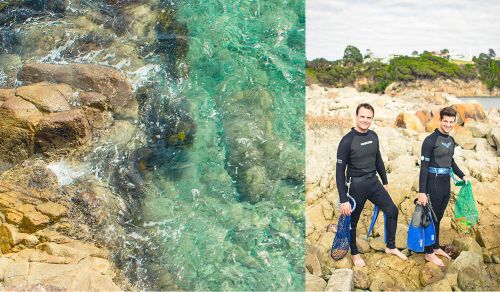
We met Scott at the Eden Visitor Information Centre, and from here he drove us to a remote access point to Twofold Bay. All necessary gear, equipment and a fishing licence is provided and, after kitting up, we clambered over rocks to the shore.


A quick verbal run-through from Scott on snorkelling and breathing techniques, and we were in practising our dives. It doesn’t take long to get the hang of it, and we improved with each resurfacing. When we felt comfortable in depths of several metres, Scott led us further offshore to begin ‘the hunt’. We snorkelled through a changing ocean landscape: rocky walls, seagrass beds and shallow reefs.


The bay was teeming with marine life. On our two-hour dive we encountered wobbegong sharks, eastern rock lobsters, black and red spined urchins, starfish, abalone, blue mussels and a variety of fish species. But only some of those are good eating, and we were after a meal.


The prized abalone hide in crevices, cementing themselves between the curves of rocks in the deep. The smaller ones are plentiful here in the bays of Eden, but the minimum legal size to keep is 11.7 centimetres, and finding the larger ones takes patience. What we were really after were lobsters, and finding them is no easy feat. They’re extremely well camouflaged and surprisingly strong. Scott’s well-trained eye spots them, lying low in the crayweed – given away only by their thin and reddish antennae. A quick and agile grab secured them, and we kept them in netted bags attached to our weight belts. Deeper offshore we found mussel beds, easy enough to twist off the rocks – if you can hold your breath long enough to do so.


Between the three of us we bag two crayfish, four abalone and 40 mussels. Scott chats about the importance of bag limits, encouraging you to take “just enough for lunch", and he always varies dive locations. “It’s crucial not to harvest too much from the same area," he tells us. “It might be tempting but it’s not sustainable, for you or the ecology."


We carted our harvest up the hill to Eden’s Rotary Park lookout, to cook what we would go on to confidently claim as the best meal of our lives. After two hours of intense swimming and diving in the salty ocean we had worked up a healthy appetite and, as we readied lunch together, Scott demonstrated the best ways to prepare and cook our catch.


We couldn’t believe the immense satisfaction and overall sense of wellbeing we gained from a single meal. You haven’t tasted fresh until you’ve eaten seafood that your own hands have plucked out of the ocean and thrown into the frypan in a matter of minutes. Our catch is paired with a local sourdough from Wild Rye’s Baking Co in Pambula and oysters fresh from the Merimbula leases. “It’s so important for me to support the local producers," Scott explains. “In this way, we’re working together." Everything we ate for lunch came from the local region – even the tomatoes were grown in Scott’s family’s backyard.


At the end of our ocean-to-plate experience, our bodies felt fit and full. In such a short amount of time we had gained a skillset that could feed us for many meals to come, and that is an invaluable experience.

 

hero media

7 things you must experience on a getaway to Echuca Moama

Those dreaming of a river escape that’s less rush and more rest will discover the perfect getaway in Echuca Moama.

Best known for summer river holidays, Echuca Moama dishes up extraordinary options for those craving good food, experiences and culture. Discover how best to spend your getaway in this gorgeous river town.

1. Find unique stays in Echuca Moama

Goolwa River Retreat villas
Bathe under the stars at Goolwa River Retreat.

An adventure here starts with the perfect place to stay. Echuca Moama is famous for its luxury houseboats. Be spoilt for choice with amenities like spas, chef’s kitchens and en-suites onboard Murray River Houseboats and Echuca Luxury Houseboats .

For those who prefer to stay on dry land to sleep, there’s no shortage of accommodation options to suit every taste and budget. The villas at Goolwa River Retreat offer spectacular views of the Murray Riverfront, cosy evenings by the fire pit. And, a truly unique and luxurious experience: bathing under the stars in an outdoor bathtub.

Families travelling with young kids will appreciate the fully self-contained cabins, which sleep up to six, at NRMA Echuca Holiday Park . Complete with BBQ facilities and a kids’ playground, Echuca Holiday Park is the perfect base for families exploring the Echuca Moama region.

More adventurous guests can experience off-grid serenity at Carriages Water Front Retreat , where they can slumber among the redgums in a lovingly converted vintage train carriage.

If you prefer a more central place to stay, the Mercure Port of Echuca is located just five minutes from the Port of Echuca on foot and offers comfortable rooms, as well as easy access to all the region has to offer.

2. Explore the Murray River

PaddlesteamerS on the Murray River
Jump aboard one of Echuca Moama’s famous paddlesteamers.

A trip to Echuca Moama isn’t complete without seeing the Murray River. Take in views from the water, with Murray River Paddlesteamers and Echuca Paddlesteamers Or combine sightseeing with lunch at a local winery or brewery on a Wharf to Winery or Port to Plate cruise .

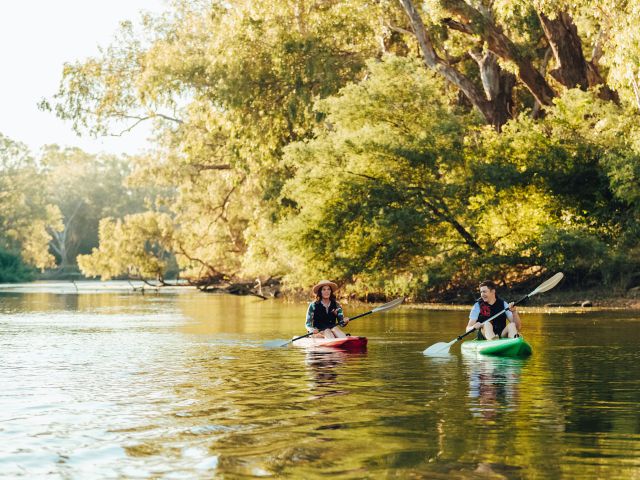
Those who prefer an active holiday can hire a stand-up paddleboard with Echuca SUP  to explore the river. Duck under the historic Echuca Moama Bridge and listen out for local wildlife. At the end of your paddleboarding trip, you’ll find a shuttle service to return you to the car park.

Kayaking is another great option if you like to combine seeing the sights with a full-body workout. Hire a kayak from River Country Adventours , or join a river safari for a guided experience.

3. Go hiking and biking in Echuca Moama

two bikers riding on the 19-kilometre Waranga Rail Trail
Peddle along the 19-kilometre Waranga Rail Trail.

On foot or by bike, there are plenty of trails to explore the region. Embark on a guided e-bike tour with Green Pedal (or hire an e-bike and go it alone) to explore the 19-kilometre Waranga Rail Trail . Traverse through beautiful bushland and the scenic Waranga Basin. Bakeries and picnic areas in the historic town of Rushworth provide the perfect place for refreshments.

Day trip to the lookout at Whroo Forest, near the now-abandoned Whroo township, located on historic Balaclava Hill. The Hill was once the site of Victoria’s largest open-cut gold mine and home to a thriving town. Today, the area offers picturesque walking tracks and picnic sites.

4. Taste Echuca Moama’s best dining options

lobster dish on the table at opa in echuca moama
Taste delicious, authentic Greek at Opa. (Image: Visit Victoria)

Whether you like a candlelit dinner or a coffee in the sunshine, Echuca Moama is ready to delight your taste buds.

Pop into Opa for authentic Greek fare with views of the town from its upstairs balcony. Enjoy seasonal produce at The Mill , offering everything from global street food and share plates to classic dinner and dessert options inside a historic building.

Discover a local secret at Monkee and Co , a relaxed Asian-fusion restaurant serving up classics like Banh Mi and dumplings.

Start the day with excellent coffee and waterfront views at the family-run Watson St Pavilion .

5. Drink at Echuca Moama’s best bars

two people drinking cockatails at paradise bar in echuca moama
Cheers to neon at Paradise Bar.

Top-notch tipples can be found at Paradise Bar , a new cocktail bar serving up handcrafted cocktails to delight the taste buds in the heart of Echuca. The menu features classics like mojitos, margs, and spritzers. As well as Paradise’s own creations featuring funky ingredients like bubble gum syrup and an Old Fashioned with truffle oil.

Bar Lee at the Echuca Distillery is the place to go to watch the sun go down at the rooftop bar, taste Echuca’s locally made spirits and nibble your way through an exceptional selection of share plates.

For river views, excellent service and a more than extensive wine menu, head to Social Wine Bar . You’ll find a laid-back atmosphere in the riverfront beer garden that sprawls out under an ancient pine tree and a cosy interior perfect for hiding away on a cool evening.

6. Follow local art trails

Silo Art Trail
Jump in the car and follow the Silo Art Trail.

The region’s silos have been transformed into impressive, towering canvases depicting local fauna, Echuca’s historical links to industry and the building of the local railroad. Follow the Silo Art Trail by car, which takes between three and four hours.

Rochester Mural Park is home to an annual lineup of changing murals, while the Rochester Mural Festival showcases established and emerging artists.

7. Dive into local history

Echuca Port Museum and Penny Tourism
See the historic Port of Echuca.

The Echuca Moama region is bursting with history. Among its historical treasures is the Port of Echuca . Interactive displays showcase the port’s importance to historical trade along the river, industrial sites like the Evans Brothers Sawmill and the Port of Echuca railway station with its very own heritage steam train.

The displays pay homage to the site’s significance to the local Yorta Yorta People and their ancestral connection to the land where the Murray, Campaspe and Goulburn Rivers meet.

Explore the port independently or join a guided tour to learn from Echuca’s history buffs.

Learn more and start planning the perfect holiday to Echuca Moama at visitechucamoama.com.au.