The weirdest (and funniest) place names in Australia

hero media
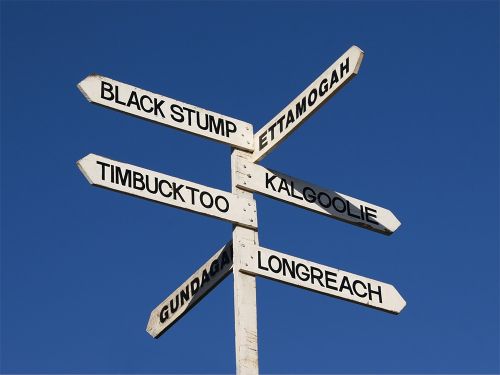
There are some weird and wonderfully named places and landmarks out there beyond the back of Bourke. AT swears all of them are real, unlike the mythical BrisVegas or Ballafornia. Each and every one can be found scattered somewhere across this ochre landscape we call the outback.

Useless Loop, WA

Useless Loop was named on Nicolas Baudin’s expedition of 1801-1803 by Henri-Louis de Saulces de Freycinet (not to be confused with his more famous navigator brother, Louis-Claude de Saulces de Freycinet). The impetuous Frenchman gave it the name “Havre Inutile", or Useless Harbour, because a large sandbar blocked off any boat from entering, thus making it useless. But he was wrong!


The cove at Useless Loop has since been transformed into a solar salt farm that offers the world the highest-grade salt available. That’ll learn ya, Henri-Louis de Saulces de Freycinet!

Come by Chance, NSW

Situated in the Pilliga region of NSW, George and William Colless were plesantly surprised when they stumbled upon a large vacant block, whilst originally en route somewhere more promising, and were able to buy it. The two men were compelled to don the station, Come By Chance, and the station grew into a town and somewhere along the way added a race club.

Wee Waa, NSW

This small town was the first to arise on the banks of the Namoi River and is the birthplace of the cotton industry in Australia. Given that the area is blanketed by what appears to be a white Christmas of cotton blooms in April, the Aboriginal meaning of Wee Waa is anything but chilly and tranquil. It is, ironically, “Fire for Roasting".

Chinamans Knob, VIC & NSW

Somewhere out there, locked in a tax-funded office, a group of busybody do-gooders is plotting the downfall of our most politically incorrect place names. Up near the top would be not one, but two Chinamans Knobs!


But they’ll have their work cut out for them. According to Geoscience Australia, there are some 364 place names with the word Chinaman and some 624 with Knob. Don’t believe us?

The Gunbarrel Highway, NT, SA & WA

There have been many fanciful tales on how the Gunbarrel Highway got its name. Not least because of marauding gangs robbing settlers at gunpoint. Nor the fact the highway was the main service point to weaponising the Woomera atomic testing facility in the 50’s and 60’s.


Instead, the Gunbarrel Highway got her name from the chief surveyor, Len Beadell, who liked to draw as many double straight lines as possible to maximize fuel efficiency and joked that his team would be called the “Gunbarrel Construction Company." The name stuck.

Marvel Loch, WA

Never has Australia’s love of a punt been so obvious. Marvel Loch is a small, outback-dwelling town located nowhere near a lake, river or a body of water of any significance, let alone a Scottish Loch of the marvellous variety. Instead, Marvel Loch, a mining town, began life in 1906 and was named after the winning horse of the 1905 Caulfield Cup.

Snowtown, SA

Never has a town been so misleading in its naming. Travel to this place with your snowboard or skis and you’ll risk being bitterly disappointed. Not only are there no mountains, but you can also forget about the fluffy white stuff.


Instead, this typical country town is plopped smack bang in the middle of a flat, fertile wheat plain. It was named on a whim by the then State Governor in 1878, after his friend, Thomas Snow. Once again, nepotism leads us astray.

Monkey Mia, WA

How can a town famous for dolphins be named after monkeys? There’s no debate that “Mia" is the local Aboriginal term for home or shelter, but after that it gets a bit murky. Some believe it was simply named for a schooner called Monkey which may, or may not, have moored in the bay.


Others believe it comes from local pastoralists’ slang for sheep. The more fanciful tale has it that Malay pearlers brought pet monkeys with them to work, and Monkey Mia is named after one such simian that jumped overboard and attempted to swim ashore. Whatever the truth, AT promises to continue the search for wild monkeys in the surrounding hills. Just in case.

Runners-up:

1. Running Jump Creek, Vic

2. Little Mount Horror, Tas

3. Scented Knob, WA

4. Wanka Creek, Qld

5. Fiddletown, NSW

6. Bong Bong, Qld & NSW

7. Greg Greg, NSW

8. Big Dick Bore, WA

9. Dead Cat Gully, NSW

10. Linger And Die Hill, NSW

This luxe trawler tour is redefining Victoria’s seafood experience

Victoria’s ‘mussel capital’ is the source of exceptional shellfish used by top chefs far and wide. Step aboard a beautifully refurbished trawler to see how these plump and juicy bivalves are sustainably cultivated.

A curtain is slowly winched from the placid, teal waters just off Portarlington , like a floating garland beside our boat. The ropes heave with blue mussels, the star attraction of our tour. But as we reach to pluck our own, it’s quickly clear they’re not alone; a mass of weird and wonderful creatures has colonised the ropes, turning them into a living tapestry. ‘Fairy’ oysters, jelly-like sea squirts, and tiny, wriggling skeleton shrimp all inhabit this underwater ecosystem.

We prize our bivalve bounty from the ropes, and minutes later the mussels arrive split on a platter. The plump orange morsels are served raw, ready to be spritzed with wedges of lemon and a lick of chilli as we gaze out over the bay. They’re briny, tender and faintly sweet. “This wasn’t originally part of the tour,” explains Connie Trathen, who doubles as the boat’s cook, deckhand and guide. “But a chef [who came onboard] wanted to taste the mussels raw first, and it’s now become one of the key features.”

A humble trawler turned Hamptons-style dreamboat

inspecting bivalve bounty from the ropes
Inspecting the bounty. (Image: Visit Victoria/Hannyn Shiggins)

It’s a crisp, calm winter’s day, and the sun is pouring down upon Valerie, a restored Huon pine workhorse that was first launched in January 1980. In a previous life she trawled the turbulent Bass Strait. These days she takes jaunts into Port Phillip Bay under the helm of Lance Wiffen, a fourth-generation Bellarine farmer, and the owner of Portarlington Mussel Tours . While Lance has been involved in the fishing industry for 30-plus years, the company’s tour boat only debuted in 2023.

holding Portarlington mussels
See how these plump and juicy bivalves are sustainably cultivated.

It took more than three years to transform the former shark trawler into a dreamy, Hamptons-esque vessel, with little expense spared. Think muted green suede banquettes, white-washed walls, Breton-striped bench cushions, hardwood tables, bouquets of homegrown dahlias, and woollen blankets sourced from Waverley Mills, Australia’s oldest working textile mill. It’s intimate, too, welcoming 12 guests at most. And yet there’s nothing pretentious about the experience – just warm, down-to-earth Aussie hospitality.

As we cruise out, we crack open a bottle of local bubbles and nibble on the most beautifully curated cheese platter, adorned with seashells and grey saltbush picked from the water’s edge that very morning. Australasian gannets soar overhead, and I’m told it’s not uncommon for guests to spot the odd seal, pod of dolphins, or even the occasional little penguin.

The sustainable secret behind Victoria’s best mussels

blue mussels off Portarlington
Blue mussels sourced just off Portarlington.

Connie and Lance both extol the virtues of mussels. They’re delicious. A lean source of protein and packed with omega-3 fatty acids, vitamin B12, iron, selenium, and zinc. They’re cooked in a flash (Connie steams our fresh harvest with cider and onion jam). And they’re also widely regarded as one of the most sustainable foods in the world.

Portarlington mussels with lemon and chilli
Mussels served with lemon and chilli.

“Aquaculture is [often] seen as destructive, so a lot of our guests are really surprised about how environmentally friendly and sustainable our industry is,” Lance says. “[Our mussels] would filter 1.4 billion litres of water a day,” he adds, explaining how mussels remove excess nitrogen and phosphorus from the water. “And through biomineralisation, we lock carbon into mussel shells.”

a hand holding a Portarlington mussel
Mussels are a sustainable food.

Despite their glowing list of accolades, these molluscs have long been seen as the oysters’ poorer cousins. “It was a really slow start,” explains Lance, who says that in the early days of his career, “you could not sell mussels in Victoria”.

But word has slowly caught on. Chefs as globally acclaimed as Attica’s Ben Shewry and even René Redzepi of Noma, Denmark, have travelled to these very waters just to try the shellfish at the source, sharing only the highest praise, and using Lance’s mussels in their restaurants.

guests sampling Portarlington mussels onboard
Sampling the goods onboard. (Image: Visit Victoria/Hannyn Shiggins)

According to Lance there’s one obvious reason why the cool depths of Portarlington outshine other locations for mussel farming. “The water quality is second to none,” he says, noting how other regions are frequently rocked by harvest closures due to poor water quality. “We grow, without a doubt, some of the best shellfish in the world.” And with Lance’s bold claims backed up by some of the industry’s greatest names, perhaps it won’t be much longer until more Aussies uncover the appeal of Portarlington’s mussels.