10 beautiful camping spots on Kangaroo Island

hero media
Camping on Kangaroo Island includes options that range from rustic log cabins and glampsites to pared-back places to pitch your tent.

Kangaroo Island has a mix of privately owned caravan parks, council-run sites and conservation areas and national parks where you can throw up a tent or pull in with your caravan. Here are some of the best Kangaroo Island camping spots.
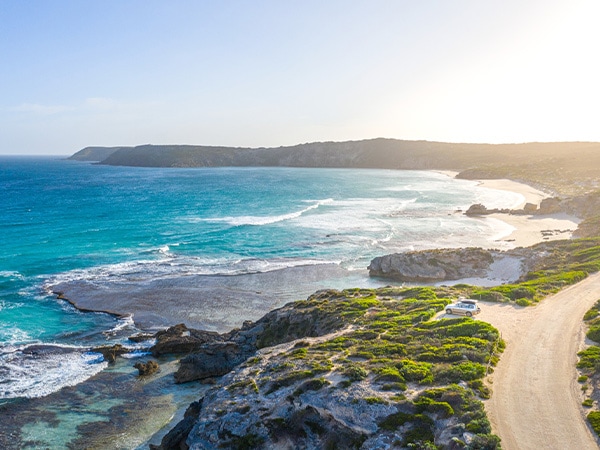
Pennington Bay, Kangaroo Island, South Australia, Australia
See amazing views of Pennington Bay on your camping trip. (Image: Isaac Forman)

1. Kangaroo Island Seafront Holiday Park

Roughing it has never been so appealing. Forget tinned spaghetti. Stock up on permaculture produce from Petite Provenance, and artisanal goods from Vivonne Bay General Store, one of the best places to eat on Kangaroo Island, before settling into your glamping tent at Kangaroo Island Seafront Holiday Park .
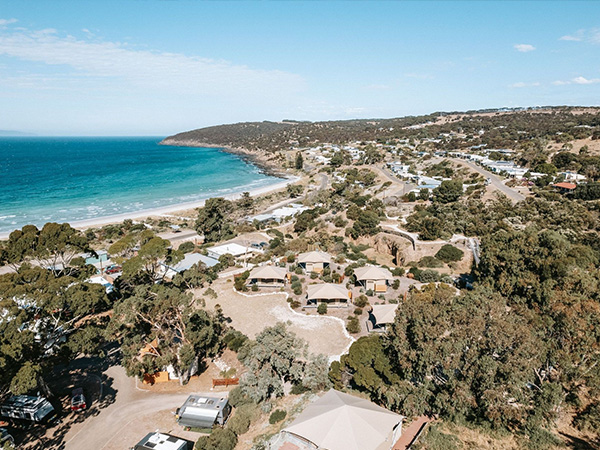
 

Glamp or camp at Kangaroo Island Seafront Holiday Park.

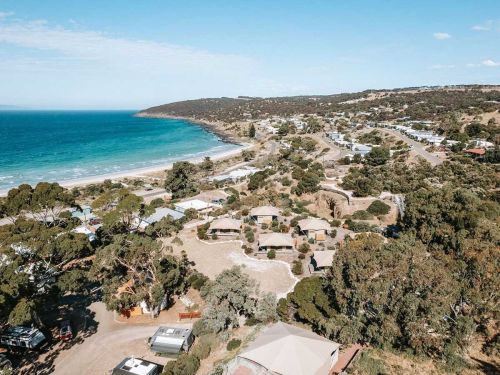
Located 300 metres from the SeaLink Ferry , the campground has views over Hog Bay Beach and the ruffled sea surging through Backstairs Passage.
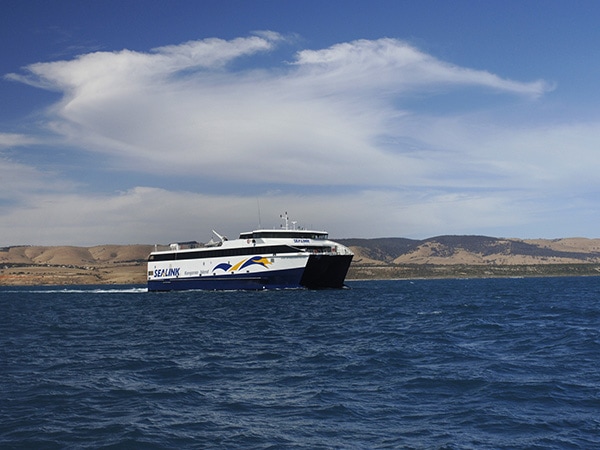
SeaLink Ferry, Kangaroo Island, South Australia
From the SeaLink Ferry, the campground has views over Hog Bay Beach. (Image: South Australian Tourism Commission/Adam Bruzzone)

Accommodation options include Eco Luxury Tents, Eco Family Tents and Oceanview Villas as well as powered campsites for caravans and camping.
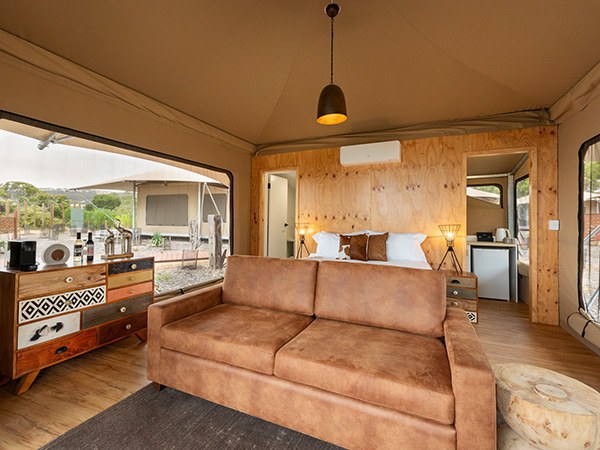
Inside an Eco Luxury Tent at Seafront Holiday Park.

2. Western KI Caravan Park & Wildlife Reserve

You will find your days start to vanish rather quickly when you’re out and about enjoying the wide, open spaces and nature trails that loop around the Western KI Caravan Park . The campground has powered and unpowered tent sites, as well as modern and well-maintained shower blocks and a children’s playground. Got a gammy back? Say goodbye to your sleeping bag and bunker down in the self-contained log cabins or luxury cabins.
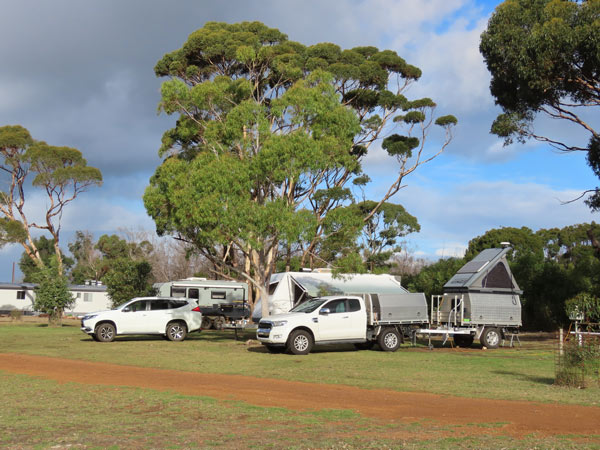
Western KI Caravan Park, Kangaroo Island, South Australia
Enjoy the wide, open spaces and nature trails.

3. Discovery Lagoon Caravan and Camping Grounds

Eco campers and caravanners will appreciate the fact the Discovery Lagoon Caravan and Camping Grounds is run entirely on renewable energy. The campground is surrounded by red river gums on a 40-hectare property that is about three kilometres from Emu Bay Beach, where you can set sail on a fishing charter and see the sea open up. The campsite also has two one-bedroom eco glamping cottages which are designed for couples.
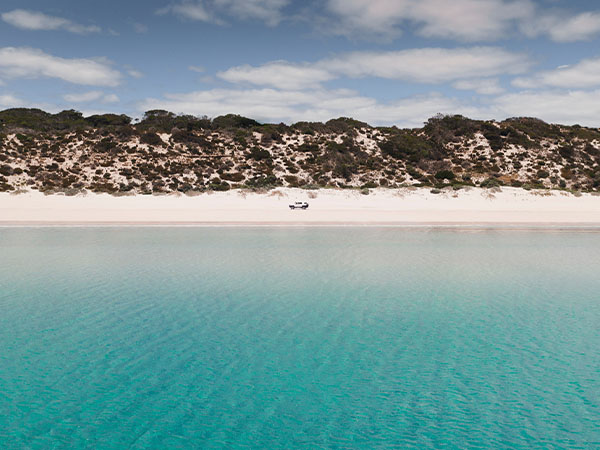
Emu Bay, Kangaroo Island, South Australia, Australia
Three kilometres from Emu Bay Beach, you can set sail on a fishing charter and see the sea open up. (Image: @jay.bevs)

4. Harveys Return

Harveys Return Campground is a short (steep) hike away from Harveys Bay, going from green to cyan as it traces the original horse cart track used by the Cape Borda lighthouse keepers on the northwest tip of the island. The bare bush campground has sheltered picnic tables, gas barbecue facilities and toilets and is surrounded by a grove of eucalyptus trees with leaves that flicker in the light. Walk through the scrubby grey-green terrain to get to the lighthouse, built in 1858.

5. American River Campground

This council-run campground is located near a boat ramp near a narrow neck of the American River, which, incidentally, is not a river, and has capacity for just 15 or so campers. Like many of the campgrounds on Kangaroo Island, the American River Campground is basic, making it well suited for old-school campers: there are toilets and hot showers, sheltered picnic tables and powered and non-powered sites, too. Rise at dawn to cast a line in the ‘river’.
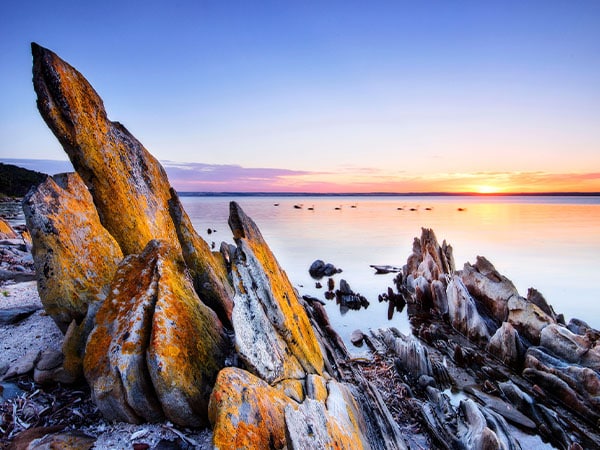
American River, Kangaroo Island, South Australia, Australia
The American River Campground is well suited for old-school campers. (Image: South Australian Tourism Commission)

6. D’Estrees Bay Campgrounds

There are five campsites scattered across four campgrounds located within the vast tract of wilderness at D’Estrees Bay. The Big Sand Dune Campground has just one campsite, and is the campground of choice for hard-core campers who like to sleep under a sky confetti’d with stars with not another soul around. It’s the stillness and solitude that is most luxurious at this site which accommodates camper trailers and tents and offers easy access to Southern Kangaroo Island Marine Park.

7. Duck Lagoon Campground

Bird-watchers will appreciate the purpose-built bird hide and observation platform at Duck Lagoon Camp Ground , a small reserve near Cygnet River that is a haven for migratory birds. Enjoy a quiet walk along the banks of the lagoon and read the interpretative signage about the area’s history as squadrons of birds (such as Australian pelicans) fly overhead. Walk along the shore and note the presence of pied oystercatchers, royal spoonbills and black swans in your little black bird book.
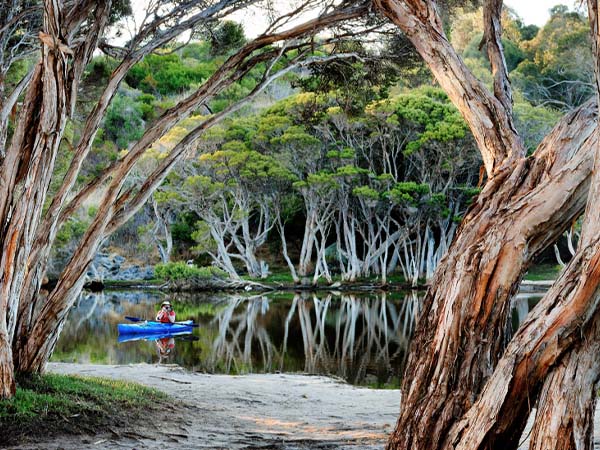
Duck Lagoon Campground, Kangaroo Island, South Australia, Australia
The Duck Lagoon is a haven for migratory birds.

8. Western River Cove Campground

The Western River Cove Campground is situated on the rugged north coast of Kangaroo Island, about an hour’s drive from Kingscote. A footbridge runs like a corridor through the campground over the river that runs through it and down onto the white sand. The Western River Campground is not suitable for caravans and has no powered sites, but like all the council-run grounds, it is pet-friendly.
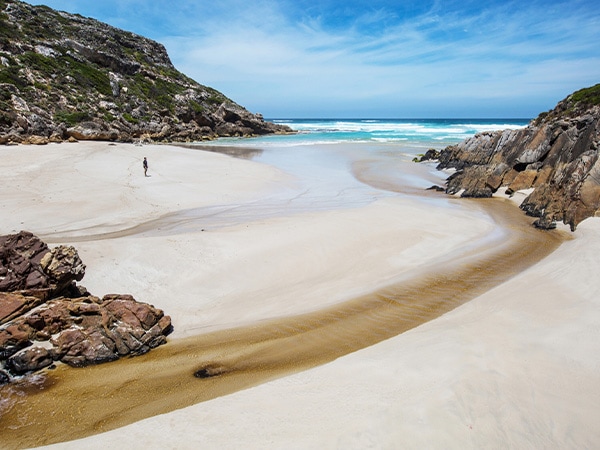
Western River Cove Campground, Kangaroo Island, South Australia
See the rugged north coast of Kangaroo Island.

9. Browns Beach Campground

Browns Beach Campground occupies a prime piece of real estate on Nepean Bay, just 15 minutes’ drive from Penneshaw. Set up your camp chair, pour yourself a glass of Dudley Kangaroo Porky Flat Shiraz, and sit in the sunshine on your own private patch of sand on the dunes overlooking Brown Beach. The family-friendly beach is located on the north coast of Dudley Peninsula and is hard to beat for beachside camping nirvana.
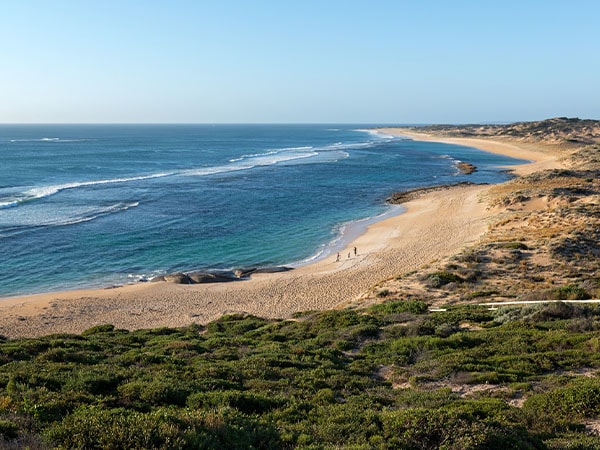
Aerial view of Browns Beach, Kangaroo Island, South Australia, Australia
Sit in the sunshine on your own private patch of sand on the dunes overlooking Brown Beach. (Image: South Australian Tourism Commission)

10. Vivonne Bay Campground

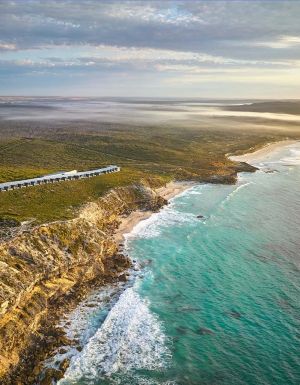
The six-kilometre U-shaped beach at Vivonne Bay is regularly ranked as one of Australia’s best. From above, the bay presents like a colour catalogue of all the possible blues and greens. Get amongst it by surfing, fishing, snorkelling, playing classic catches or beach cricket, just a few of the many excellent things to do on this corner of Kangaroo Island. Located about 45 minutes from Kingscote, the campground is accessible for caravans and has both powered and unpowered campsites.
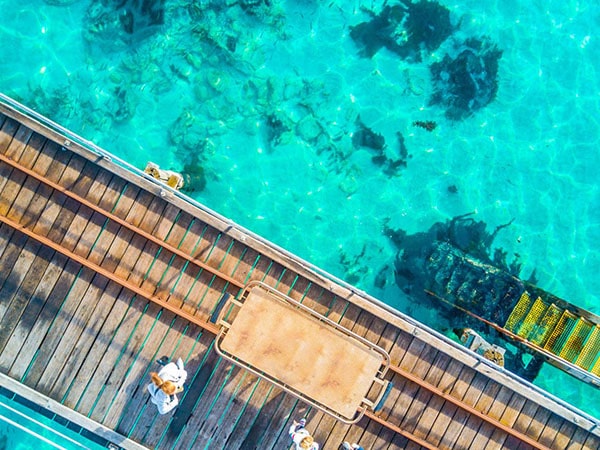
Vivonne Bay, Kangaroo Island, South Australia, Australia
Witness the colour catalogue of all the possible blues and greens.
If you are looking to mix up your stay on Kangaroo Island, spend a night at one of our luxury accommodation recommendations or one of our picks of best places to stay.
Carla Grossetti
Carla Grossetti avoided accruing a HECS debt by accepting a cadetship with News Corp. at the age of 18. After completing her cadetship at The Cairns Post Carla moved south to accept a position at The Canberra Times before heading off on a jaunt around Canada, the US, Mexico and Central America. During her career as a journalist, Carla has successfully combined her two loves – of writing and travel – and has more than two decades experience switch-footing between digital and print media. Carla’s CV also includes stints at delicious., The Sydney Morning Herald, and The Australian, where she specialises in food and travel. Carla also based herself in the UK where she worked at Conde Nast Traveller, and The Sunday Times’ Travel section before accepting a fulltime role as part of the pioneering digital team at The Guardian UK. Carla and has been freelancing for Australian Traveller for more than a decade, where she works as both a writer and a sub editor.
See all articles
hero media

Inside Geelong’s glow-up from factory town to creative capital

Abandoned mills and forgotten paper plants are finding second lives – and helping redefine a city long underestimated. 

Just 15 years ago, Federal Mills was a very different place. Once among the most significant industrial sites in Victoria, the historic woollen mill was one of a dozen that operated in Geelong at the industry’s peak in the mid-20th century, helping the city earn its title as ‘wool centre of the world’. But by the 1960s global competition and the rise of synthetic fabrics led to the slow decline of the industry, and Federal Mills finally shuttered its doors in 2001. Within a few years, the abandoned North Geelong grounds had become makeshift pastoral land, with cows and goats grazing among the overgrown grass between the empty red-brick warehouses. It was a forgotten pocket of the city, all but two klicks from the bustle of the CBD.  

Geelong cellar door wine bar
Geelong has shed its industrial identity to become an innovative urban hub with reimagined heritage spaces. (Image: Ash Hughes)

Federal Mills: from forgotten factory to creative precinct 

Today, the century-old complex stands reborn. The distinctive sawtooth-roof buildings have been sensitively restored. An old silo is splashed with a bright floral mural, landscapers have transformed the grounds, and the precinct is once again alive with activity. More than 1000 people work across 50-plus businesses here. It’s so busy, in fact, that on a sunny Thursday morning in the thick of winter, it’s hard to find a car park. The high ceilings, open-plan design, and large multi-paned windows – revolutionary features for factories of their time – have again become a drawcard.  

Paddock Bakery andPatisserie
Paddock Bakery and Patisserie is housed within the historic wool factory. (Image: Gallant Lee)

At Paddock , one of the precinct’s newer tenants, weaving looms and dye vats have been replaced by a wood-fired brick oven and heavy-duty mixers. Open since April 2024, the bakery looks right at home here; the building’s industrial shell is softened by ivy climbing its steel frames, and sunlight streams through the tall windows. Outside, among the white cedar trees, families at picnic benches linger over dippy eggs and bagels, while white-collar workers pass in and out, single-origin coffee and crème brûlée doughnuts in hand. 

Geelong: Australia’s only UNESCO City of Design 

Paddock Bakery
Paddock Bakery can be found at Federal Mills. (Image: Gallant Lee)

“A lot of people are now seeing the merit of investing in Geelong,” says Paul Traynor, the head of Hamilton Hospitality Group, which redeveloped Federal Mills. A city once shunned as Sleepy Hollow, and spurned for its industrial, working-class roots and ‘rust belt’ image, Geelong has long since reclaimed its ‘Pivot City’ title, having reinvented itself as an affordable, lifestyle-driven satellite city, and a post-COVID migration hotspot.  

And the numbers stand testament to the change. In March 2025, and for the first time in its history, Greater Geelong became Australia’s most popular regional town for internal migration, overtaking Queensland’s Sunshine Coast. Current forecasts suggest Geelong will continue to outpace many other Australian cities and towns, with jobs growing at double the rate of the population.

Tourism is booming, too. The 2023-24 financial year was Geelong and The Bellarine region’s busiest on record, with 6.4 million visitors making it one of the fastest-growing destinations in the country. It’s not hard to see why: beyond the city’s prime positioning at the doorstep of the Great Ocean Road, Geelong’s tenacity and cultural ambition stands out.  

As Australia’s only UNESCO City of Design, Geelong is swiftly shaking off its industrial past to become a model for urban renewal, innovation, sustainability and creative communities. The signs are everywhere, from the revitalisation of the city’s waterfront, and the landmark design of the Geelong Library and Heritage Centre and Geelong Arts Centre, to the growing network of local designers, architects and artists, and the burgeoning roster of festivals and events. That’s not even mentioning the adaptive reuse of storied old industrial buildings – from Federal Mills, to Little Creatures’ brewery ‘village’ housed within a 1920s textile mill – or the city’s flourishing food and wine scene.  

The rise of a food and wine destination  

boiler house
Restaurant 1915 is housed within a restored former boiler house. (Image: Harry Pope/Two Palms)

Traynor credits now-closed local restaurant Igni, which opened in 2016, as the turning point for Geelong’s hospo industry. “[Aaron Turner, Igni’s chef-patron] was probably the first guy, with all due respect, to raise the bar food-wise for Geelong,” he says. “People now treat it really seriously, and there’s clearly a market for it.” While Igni is gone, Turner now helms a string of other notable Geelong venues, including The Hot Chicken Project and Tacos y Liquor, all within the buzzy, street art-speckled laneways of the CBD’s Little Malop Street Precinct. Many others have also popped up in Igni’s wake, including Federal Mills’ own restaurant, 1915 Housed within the cavernous boiler house, 1915’s interior is dramatic: soaring, vaulted ceilings with timber beams, exposed brick, a huge arched window. The share plates echo the space’s bold character, playing with contrast and texture, with dishes such as a compressed watermelon tataki, the sweet, juicy squares tempered by salty strands of fried leeks, and charred, smoky snow peas dusted with saganaki on a nutty bed of romesco. 

Woolstore
The Woolstore is a new restaurant and bar housed within a century-old warehouse. (Image: Amy Carlon)

 The Woolstore , one of The Hamilton Group’s most recent hospo projects, opened in February. It occupies a century-old riverside warehouse and exudes a more sultry, fine dining ambience. Much like Federal Mills, the blueprint was to preserve the original brickwork, tallowwood flooring and nods to the building’s former life. That same careful consideration extends to the well-versed, affable waitstaff as well as the kitchen. Head chef Eli Grubb is turning out an eclectic mix of ambitious and indulgent mod Oz dishes that deliver: strikingly tender skewers of chicken tsukune, infused with hints of smoke from the parrilla grill, and glazed with a moreish, sweet gochujang ‘jam’; nduja arancini fragrant with hints of aniseed and the earthy lick of sunny saffron aioli; and golden squares of potato pavé, adorned with tiny turrets of crème fraîche, crisp-fried saltbush leaves, and Avruga caviar, to name but a few stand-out dishes.  

Woolstore menu
Woolstore’s menu is designed for sharing.

Breathing new life into historic spaces  

On the city’s fringe, hidden down a winding side road with little fanfare, lies a long-dormant site that’s being gently revived. Built from locally quarried bluestone and brick, and dating back to the 1870s, the complex of original tin-roofed mill buildings is lush with greenery and backs onto the Barwon River and Buckley Falls; the audible rush of water provides a soothing soundtrack. Fyansford Paper Mill is one of few complexes of its time to survive intact. It feels steeped in history and spellbindingly rustic.  

“We were looking for an old industrial place that had some charm and romance to it,” explains Sam Vogel, the owner, director and winemaker at Provenance Wines which moved here in 2018. When he first viewed the building with his former co-owner, it was in such a state of disrepair that the tradie tenant occupying the space had built a shed within it to escape the leaking roof and freezing winter temperatures. “To say it was run down would be an understatement,” he notes. “There was ivy growing through the place; the windows were all smashed. It was a classic Grand Designs project.” 

Provenance Wines
Provenance Wines moved to Fyansford Paper Mill in 2018. (Image: Cameron Murray Photography)

The team has since invested more than a million dollars into their new home. Where paper processing machinery once sat, wine barrels are now stacked. Vaulted cathedral ceilings are strung with festoon lights, and hidden in plain sight lies a shadowy mural by local street artist de rigueur Rone – one of only three permanent works by the artist.

While the award-winning, cool-climate pinot noir, riesling and chardonnay naturally remain a key draw at Provenance, the winery’s restaurant is a destination in itself. Impressed already by whipsmart service, I devour one of the most cleverly curated and faultlessly executed degustations I’ve had in some time. It’s all prepared in a kitchen that is proudly zero-waste, and committed to providing seasonal, ethical and locally sourced meat and produce under head chef Nate McIver. Think free-range venison served rare with a syrupy red wine jus and a half-moon of neon-orange kosho, shokupan with a deeply savoury duck fat jus (a modern Japanese take on bread and drippings), and a golden potato cake adorned with a colourful confetti of dehydrated nasturtiums and tomato powder, and planted atop a sea urchin emulsion.  

handcrafted pieces
Bell’s handcrafted functional pieces on display.

The complex is home to a coterie of independent businesses, including a gallery, a jeweller, and its latest tenant, ceramicist Elizabeth Bell, drawn here by the building’s “soul”. “There’s so much potential for these buildings to have new life breathed into them,” says Bell, whose studio is housed within the old pump room. “Even people in Geelong don’t know we’re here,” she says. “It’s definitely a destination, but I like that. It has a really calming atmosphere.”  

A Melbourne transplant, Bell now feels at home in Geelong, which offers something Melbourne didn’t. “If this business was in Melbourne I don’t think it would’ve been as successful,” she notes. “It’s very collaborative in Geelong, and I don’t think you get that as much in Melbourne; you’re a bit more in it for yourself. Here it’s about community over competition.”  

Elizabeth Bell
Ceramicist Elizabeth Bell has a store in Fyansford Paper Mill.