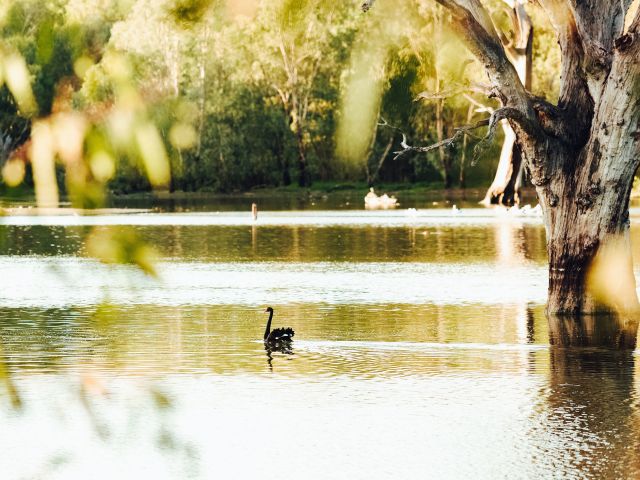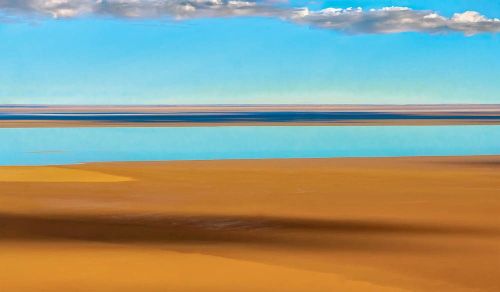
Kati Thanda-Lake Eyrethe where, what, when and how

hero media
The often dry Kati Thanda-Lake Eyre is an outback enigma, famous for its rare and beautiful floodscapes. A scenic flight over Australia’s largest salt lake is near the top of the outback bucket list so here is everything you need to know: where and when to go, how to get there and just what you’ll see on a scenic flight – wet or dry.

The classic Kati Thanda-Lake Eyre scenic flight

A scenic flight in a small plane is the easiest and best way to truly understand the vast expanse of Kati Thanda-Lake Eyre. There are plenty of companies willing to fly you from further afield, but some of the best ‘local’ scenic flight operators include:

Wrightsair – from William Creek

Bush Pilots Australia from Marree and Hawker (Flinders Ranges)

• Air Wilpena (Flinders Ranges)

For more of a splash-out, you can always include it on your 10-day, around-Australia air safari itinerary. See: Is this Australia’s Greatest Air Adventure?

What are the chances of seeing the lake in flood?

There is a common myth that Kati Thanda-Lake Eyre is entirely dry except for when the big floods happen, like those of 2010/11. While Kati Thanda has only reached capacity three times in the past century, there is often some water somewhere within the 9690-square-kilometre basin.

In 2010 and 2011 the lake’s depth maxed out at 2.2 metres, enough water to fill up its central areas such as Belt Bay. The last time it was considered ‘full’ was way back in 1974 – at a depth of around six metres.

“Around one in 10 years you can expect the big days," says Trevor Wright, whose company Wrightsair has been taking passengers up over the lake since the early ’90s from the nearby town of William Creek. “You might get a run for a couple of years [of a lot of water] and then go a decade without much. Then it becomes a great, white expanse of reflecting salt as opposed to the magical colours."
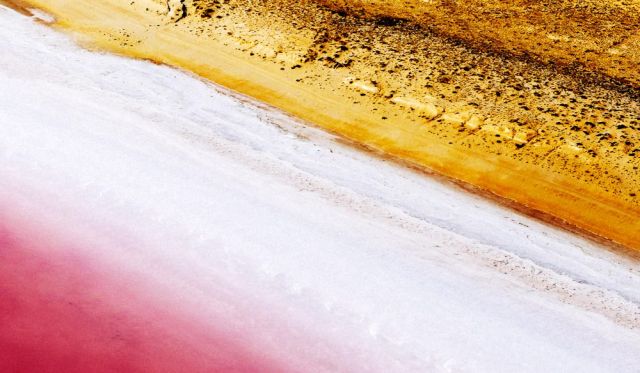
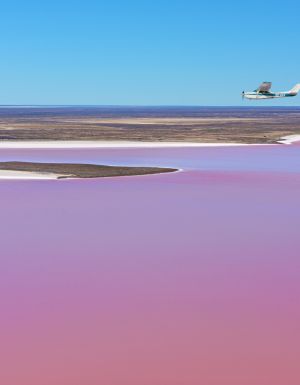
All the colours of Lake Eyre (photo: Elise Hassey)
All the colours of Lake Eyre (photo: Elise Hassey).

Felicity Brown, chief pilot for Chinta Air, which operates scenic flights from Ceduna and the Flinders Ranges in South Australia, reckons the lake has some water in it about half the time she flies over.

For the lake to truly fill up local rain is important (within 150 to 200 kilometres), but for a big year you also need a torrent from further afield; ideally monsoon rains and perhaps a follow-up cyclone in northern Australia that will get the rivers flowing into Lake Eyre North.

Is it worth flying over when it’s dry?

Yes, yes and yes. It’s an entirely different experience from the intense rainbow of the flooded lake.

“When there’s no water, especially early in the morning or late in the evening, the lake is sort of like Uluru in that it dramatically changes colour," says Trevor Wright. “At certain times of day, with the very soft light, the white underneath turns a bluish colour, like the sea. Then the peninsulas come out, like continents, so it feels like you’re flying across the world."
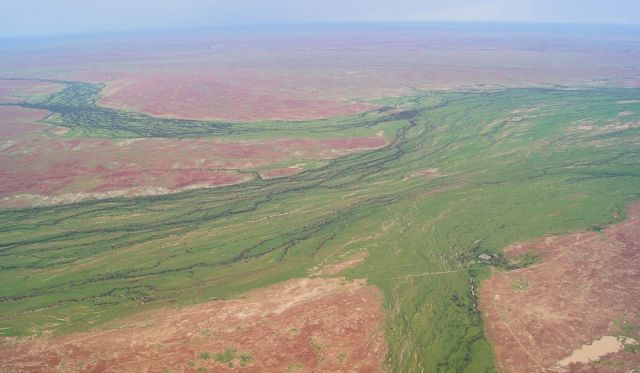
Green channels, Macumba River, Lake Eyre
Green channels, Macumba River, Lake Eyre.

“It’s pretty spectacular at any time," agrees Felicity Brown. “The sheer expanse of the lake is the thing that strikes everyone who flies over it – water or not.

“If it’s dry, you get this glimmering white salt pan stretching out off into the distance or if it’s rained, the water stretches off to the horizon, looking like the inland sea that I’m sure some of the early explorers thought it was."

Highlights – what’s to see?

When the rains and monsoon waters align, the outback in and around Lake Eyre comes to life, attracting fish and birdlife en masse. If you’re lucky, you’ll also catch an eyeful of the famous pink hue off the lake, caused by a micro algae known as dunaliella salina, common in salt water and other pink lakes of Australia.

“The best part of a flight over Lake Eyre is flying over the creeks and the waterways leading into the lake – that’s where you’ll see the most birdlife," says Felicity Brown. “Things like pelicans (in a big year) and all sorts, like banded stilts and wrens, plus plenty of the usual outback birds, like crows and galahs."

One of the most popular routes for scenic flights is to head up the Warburton Groove and Warburton River and come back down the Birdsville Track (you may need to take an extended flight to reach this area, depending on where you take off from). There’s plenty to see on Eyre’s periphery too.
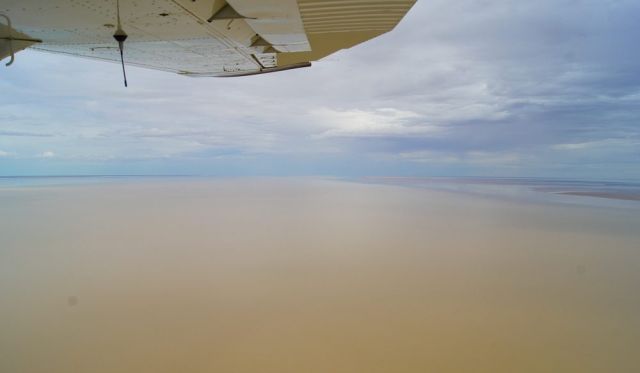
Warburton Groove (Kati Thanda) Lake Eyre North.
Looking up Warburton Groove (Kati Thanda) Lake Eyre North.

“My highlights are the huge erosion on the dunes at the north end of the lake in the Tirari Desert," says Trevor Wright. “The diversity of coloured sandstone is amazing."

Can I drive to Kati Thanda-Lake Eyre?

Yes. Kati Thanda-Lake Eyre’s two hubs are the tiny towns of Marree (95 kilometres south) and William Creek (60 kilometres south-east), where you can arrange scenic flights.

At William Creek (at the centre of Australia’s largest cattle station, Anna Creek) there is a hotel, garage, restaurant (when it’s busy) and a caravan park with en-suite rooms and camping. It is on the Oodnadatta Track and offers easy access to the lowest point in the lake (and in Australia), which is 15 metres below sea level. William Creek can be accessed via Coober Pedy (170 kilometres) by the unsealed William Creek Road (okay for 2WD when it’s dry).

Marree is more accessible from the Flinders Ranges side, and is the starting point of the Birdsville Track (685 kilometres north of Adelaide). There is accommodation, fuel and, of course, a pub here. It’s possible to drive to Marree from the Flinders only passing a couple of short stretches of gravel.
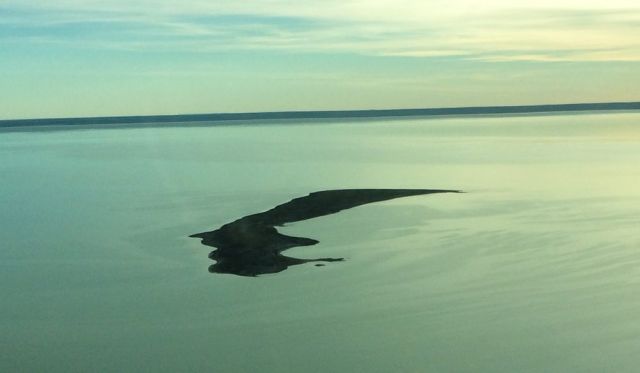
Silcrete Island, Belt Bay, near the lowest point in Australia (on Lake Eyre). photo: Wrightsair.

Note: Obviously a 4WD is preferable for both these journeys, especially if you want to drive to the lake’s edge (no driving on the lake). The public access routes (pastoral tracks) are suitable for 4WDs only. Plan well ahead if you’re planning a summer trip out this way (fuel, water, food, extra spares etc) because the temperature can head into the 50s (yes, 50s) between November to March.

Strange, strange lake indeed

In the big deserted patch of outback Australia, strange, strange things can happen.

“From time to time you see unidentified flying objects around the lake because you’re in a really remote area," says Trevor Wright. “It gets really dark at night and tends to accentuate anything that’s moving through the area.

“About five or six times a year, in the right weather conditions, you can also get a salt fog over the lake. So up to about 100 metres it’s like being in a thick impenetrable fog, but it’s actually salt. It’s spooky."

When there’s water in the lake, flying over it can bring its own challenges too.

“You have to be really on your guard when it’s overcast and it’s a blanketed dark sky," says Wright. “You can lose your horizon, and the water will blend into the horizon – it’s just one big expanse. You can also lose your depth perception. But you just use your instruments so it’s still safe."

There’s even a Lake Eyre Yacht Club

Bob Backway founded the Lake Eyre Yacht Club (LEYC) in 2000. There are 230 members, from all over Australia, and even one from Texas.

The Marree-based club holds a regatta that can include 100 people, like back in 2010 when “for the first time in 20 years Cooper Creek made it to Lake Eyre," according to Commodore Bob, who says he sails on Eyre in some capacity about every two years.

People first started sailing there in earnest during the big floods of 1974. And when this part of the outback is in flood, the sailors go crazy.
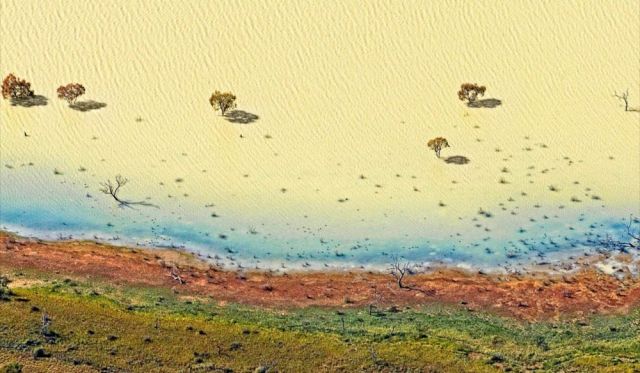
Desert River by Peter Elfes
Desert River from Peter Elfes’ The Green Desert.

“In a good year there are hundreds of other lakes, and a couple of thousand kilometres of temporary rivers, some as big as the Murray, in the desert and it’s sort of a competition to find a new lake and sail in it," says Bob. “You can go out over the horizon so when you run aground you stand up and can’t see anything but water and you have to use your compass to get back."

The facts: Eyre by numbers

• Is 144 kilometres long and 77 kilometres wide (Lake Eyre North). Lake Eyre South is 64 kilometres long east-west and 24 kilometres wide

• Is Australia’s lowest point (15 metres below sea level) and its drainage basin covers 15 per cent of the continent. The two lakes are joined by the 15-kilometre-long Goyder Channel

• Is Australia’s largest salt lake and the 13th largest lake in the world

• Is located in northern South Australia but its catchment area extends to New South Wales, Queensland and the Northern Territory.

• Eyre hosted the 1964 world land-speed record by Sir Donald Campbell, in the Bluebird (710 kilometres per hour).

hero media

7 Kimberley experiences that need to be on your bucket list

From thundering waterfalls to ancient Indigenous art, Kimberley’s raw beauty will take your breath away.

Wild, pristine, and shaped by nature, the Kimberley Coast is one of Australia’s most spectacular landscapes. A remote and rugged frontier that remains a bucket list destination for many travellers. Its most breathtaking attractions – including Montgomery Reef, King George Falls and Horizontal Falls – are accessible only by sea or air, making a guided expedition cruise aboard Silversea’s luxury expedition ship, Silver Cloud, the ideal way to explore it.

From its intricate intertidal zones to ancient rock art, extreme tides and rare wildlife found nowhere else in Australia – or the world – this journey offers an unparalleled exploration of one of Earth’s last true wildernesses.

Why Silversea?

Silversea offers a 10-day expedition departing Broome, or an extended 16-day expedition voyage from Indonesia, including landings on the hidden gems of Palopo Sulawesi and Komodo. Accompanied by expert guides and specialists in marine biology, history and geology, guests gain a deeper understanding of the Kimberley’s dramatic landscapes, rich cultural heritage and extraordinary biodiversity.

Silversea offers one of the experiential travel industry’s leading crew-to-guest ratios. Along with all-suite accommodation (80 per cent with private verandah), 24-hour butler service, a swimming pool and four dining options. Silver Cloud also has an experienced crew of multilingual expedition guides and specialists in marine biology, history and geology to enhance your Kimberley Experience.

silversea cruise ship pool deck
Take a dip in the pool deck.

1. Koolama Bay

​​Before visitors see King George Falls, they hear them – a growing rumble in the distance, steady and foreboding as the Zodiac glides through the gorge, the sound echoing off sheer rock formations. At 80 meters tall, the twin cascades carve through the red cliffs, churning the waters below in a spectacular finale – but Koolama Bay holds secrets beyond its striking scenery.

Named after a ship that beached here following an aerial attack by Japanese bombers in World War II, the bay may seem desolate, yet it teems with life. With Silversea’s expert guides on their 10-day Kimberley itinerary, guests gain a sharper eye for its hidden wonders – rock wallabies darting across the cliffs, crocodiles lurking among dense green mangroves, and high above, the silhouette of a bird of prey circling the sky.

King George Falls at koolama bay excursion on Silversea Kimberley Cruise
Take a shore excursion to see King George Falls.

2. Freshwater Cove / Wijingarra Butt Butt

Connect with Country on a wet landing at Freshwater Cove, also known as Wijingarra Butt Butt. Considered one of the most special experiences on both the 16-day and 10-day Kimberley cruises, Silversea guests are welcomed by the traditional Indigenous custodians of the land, painted with traditional ochre, and invited to take part in a smoking ceremony.

Located on the mainland near Montgomery Reef, Wijingarra Butt Butt holds deep cultural significance to the local Indigenous community. Here, rock formations along the shore represent spiritual ancestors, and guests are guided to a nearby rock overhang filled with ancient art, where traditional owners share the stories and meaning behind these sacred paintings.

welcome to country on freshwater cove during silversea kimberley cruise
Take part in a smoking ceremony. (Image: Tim Faircloth)

3. Vansittart Bay (Jar Island)

Modern history, ancient culture and mystery converge in Vansittart Bay, which is also known as Jar Island. Here, the first thing to catch the eye is the dented, silver fuselage of a World War II-era C-53 plane – a striking relic of the past. Yet, the true cultural treasures lie just a short hike away where two distinct styles of Indigenous rock art – Gwion Gwion and Wandjina – can be found.

The Wandjina figures, deeply connected to Indigenous traditions, stand in stark contrast to the enigmatic Gwion Gwion (Bradshaw) paintings, which date back more than 12,000 years. Significantly different in form and style, the two different styles create a striking juxtaposition, offering a rare glimpse into the region’s rich and complex past.

aerial view of Vansittart Bay, See it in you Silversea Kimberley Cruise.
Explore ancient Gwion Gwion rock art at Vansittart Bay. (Image: Janelle Lugge)

4. Horizontal Falls

Part illusion, part natural phenomenon, the Kimberley’s much-lauded Horizontal Falls aren’t a waterfall, but a tidal and geographic spectacle that visitors have to see to comprehend. Known as Garaanngaddim, the phenomenon occurs when seawater rushes through two narrow gaps- one just twenty metres wide, and the other seven metres in width, between the escarpments of Talbot Bay.

With each tidal shift,  the force of the water creates whirlpools, furious currents and the illusion of a horizontal cascade as thousands of gallons of water are pushed and pulled in through the gap every six hours with relentless movement, making this one of the Kimberley ’s most mesmerising natural wonders.

Horizontal Falls are described as "One of the greatest wonders of the natural world". They are formed from a break in-between the McLarty Ranges reaching up to 25m in width. The natural phenomenon is created as seawater builds up faster on one side of the gaps than the other, creating a waterfall up to 5m high on a King tide.
Watch whirlpools and furious currents collide. (Image: Janelle Lugge)

5. Montgomery Reef

As the tide turns in Montgomery Reef, magic happens. With the Kimberley’s legendary tides varying up to ten metres, at low tide the submerged reef almost appears to rise from the depths: exposing up to four metres of the sandstone reef.

The impact is otherworldly: as the water drains, waterfalls cascade on either side of the channel,  turtles left exposed scramble and dive, and fish leap in search of sanctuary in shallow pools. Meanwhile, the dinner bell rings for the migratory seabirds dugongs, reef sharks and dolphins that scavenge and feast in the area.

Using zodiacs, guests cruise through one of the world’s most significant inshore reef systems navigated by experienced guides, exploring the most intricate and fascinating parts of a 300-square-kilometre-wide biodiversity hotspot.

aerial view of boat going along Montgomery Reef
Witness seabirds, dolphins and reef sharks on the hunt.

6. Mitchell Falls by Helicopter

Experiencing the Kimberley by sea allows you to feel the power of the tides, but travelling by helicopter reveals the sandstone tapestry of the Kimberley, a landscape geologists believe is over 1.8 billion years old.

One of Silversea’s most popular optional excursions , guests who opt to fly into the interior from the onboard helipad soar up above the rust-coloured landscape of the Mitchell plateau, taking in one of Australia’s most scenic waterfalls: Mitchell Falls, a series of four emerald-coloured pools gently cascades into each other, before plunging down to the river below.

Seeing the landscape from above reveals a landscape weaved and shaped by the power of the freshwater wet season, juxtaposed to the constant lapping of the relentless and powerful tide on the coast.

aerial view of mitchell falls on silversea helicopter excursion
See emerald pools cascade into the river below. (Image: Tim Faircloth)

7. Indigenous Art Caves, Wandjina Art

The Kimberley Region of Western Australia is home to some of the most striking and significant

Indigenous rock art in Australia. Dotted throughout the landscape are caves, cliffs and rock overhangs depicting the striking, ethereal image of Wandjina, the rainmaker spirit and creation being central to many of the Dreamtime stories in this region.

Some of the paintings are regularly repainted by traditional custodians, while others are believed to be over 4,000 years old. Each artwork serves as both a cultural record and a living connection to the past, offering a rare opportunity to engage with the enduring traditions of the Kimberley’s Indigenous communities.

Freshwater Cover Rock Art the kimberleys
Walk among cultural records preserved in stone. (Image: Tim Faircloth)

See the best of this incredible part of the world on a Silversea Kimberley cruise. Book your 10- or extended 16-day expedition voyage at silversea.com