hero media

The mesmerising story of Hanging Rock explained

Is the film/book Picnic at Hanging Rock real or imagined? Australian Traveller’s rock hound, Kerry van der Jagt, steps back in time to investigate this and other geological questions about the Macedon Ranges enigma.  

Short answer: A picnic spot in Victoria where schoolgirls disappeared.

Long answer: Hanging Rock is located around 80km to the north of Melbourne in the Hesket Plains near Mt Macedon. It’s 718m above sea level and 105m above the surrounding plain. It’s also one of the best examples in the world of a volcanic feature known as a mamelon (French for nipple).

It was formed six million years ago (in the Tertiary period) when a stiff type of lava formed a rounded pile of layers on the surface as it was squeezed through a narrow vent in the Earth’s surface.

The type of lava is unique in that it has an extremely high soda content. Over the years the action of rainwater has formed an unusual rock known as solvsbergite (soda trachyte).

The same rock type is also found at the nearby Camel’s Hump at Mt Macedon. The mamelon has been exposed to weathering, which has resulted in the rock formation that can be seen today. These include: Stonehenge, McDonald’s Lookout and The Eagle.

Aerial view of Hanging Rock
Aerial view of the impressive Hanging Rock formation. (Image: Visit Victoria)

Is Picnic at Hanging Rock real or imagined?

Hanging Rock is best known from Joan Lindsay’s narrative, Picnic at Hanging Rock (1967), about the mysterious disappearance of a group of local schoolgirls during an excursion to the Rock on February 14, Valentines Day 1900. And like any decent Australian mystery, the bodies were never found!

The author, in the opening to the first edition, states: “Whether Picnic at Hanging Rock is fact or fiction my readers must decide for themselves." At the time of the incident, organised searches for the three students and their teacher were carried out but only one girl was ever found.

Clearly she’s leaving the mystery open. My take is that the schoolgirls (and Miss McCraw) were crushed under a slab of rock that fell during a mini landslide, or they fell down a deep crevice or chimney. Either way, Hanging Rock is an eerie place and an extraordinary geological formation.

Today it remains a mystery shrouded in tales that flick between folklore and fact. The novel was eventually made into a movie directed by Peter Weir in 1975 and received international acclaim. A new adaption of Lindsay’s novel was turned into a six-part television series, starring Natalie Dormer aired in 2018.

A scene from Peter Weir's film adaption of Picnic at Hanging Rock. (Image: Atlantic/Allstar)
A scene from Peter Weir’s 1975 film adaption of Picnic at Hanging Rock. (Image: Atlantic/Allstar)

Fast facts about Hanging Rock

You probably know: Annual events such as art exhibitions, movie nights under the stars, car shows, concerts, craft markets and family-friendly festivals are held at Hanging Rock.

But did you know: The type of rock, solvsbergite, is extremely unusual and, outside of the Macedon region, is only found in Norway and Sweden.

And did you also know: During filming of Picnic at Hanging Rock, watches and clocks of the cast and crew behaved badly. Some stopped, others ran fast, some slow.  In Joan Lindsay’s novel, the watches of the schoolgirls stopped at noon (cue Twilight Zone music).

What else can you do at Hanging Rock Reserve?

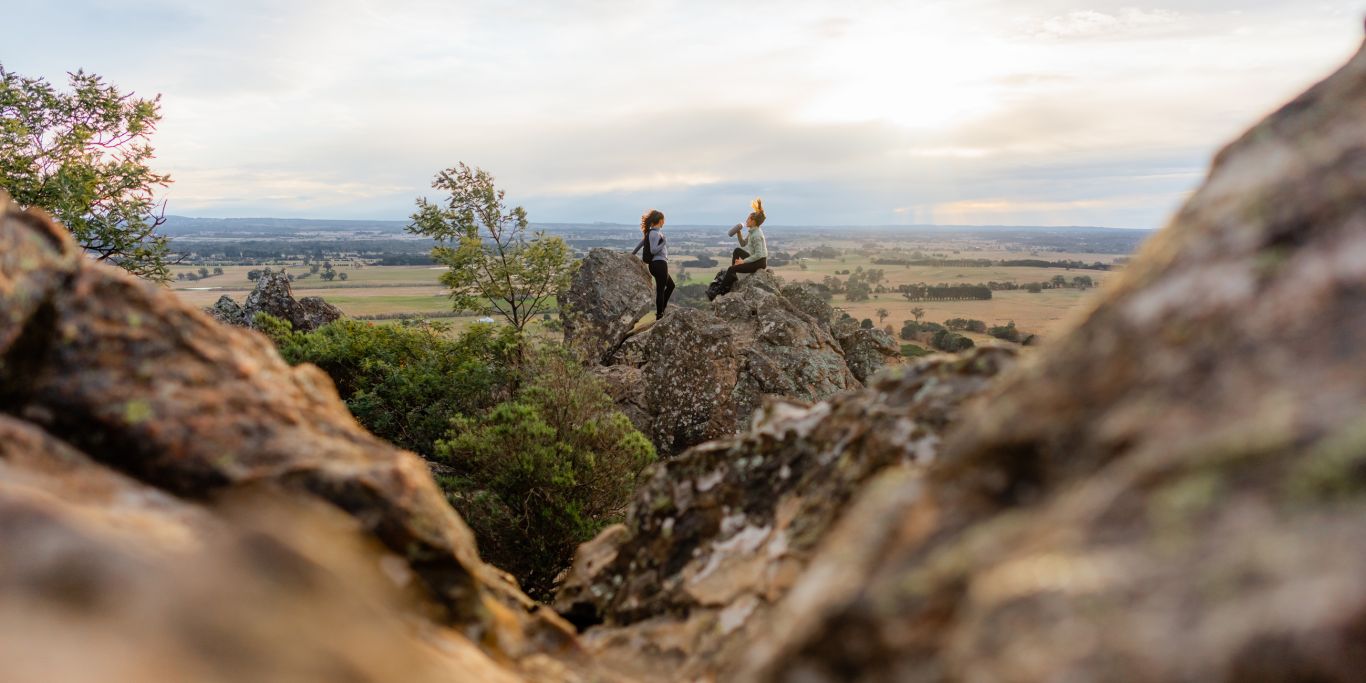
Many folks take the relaxed route and set up for the day at one of the many BBQs (they’re free to use) scattered throughout the scenic reserve and simply admire the views of the soaring monoliths. The famous Pinnacle Walk to the summit is a popular activity as is the nocturnal ranger-guided walking tour.

Two women at the Summit of Hanging Rock.
The Pinnacle Walk to the summit. (Image: Visit Victoria)

There are three dedicated walks to enjoy at Hanging Rock: The Pinnacle Trail, Base Walking Trail and the Creek Walking Trail. Each trail showcases the reserve’s distinctive beauty; expect to see granitic boulders, curious mammals, and unique volcanic rock formations. The Pinnacle Trail to the summit is quite the highlight! Note: the pathways are quite wide and people of average fitness will reach the top relatively easily in about an hour.

Kangaroos at Hanging Rock
Curious kangaroos at the base of Hanging Rock. (Image: Visit Victoria)

The ranger-guided Hanging Rock night walking tour offers the opportunity to see gliders, koalas, wallabies and more exploring their natural surroundings. So, if adventuring after dark is your thing, this tailored tour will surely appeal.

This article was originally written by Kerry van der Jagt and updated by Roxanne Williams.

Roxanne Andrews
Roxanne Andrews is a freelance travel writer and editor based in Yamba, Australia. Topics of expertise include; sports tourism, luxury travel, arts & culture, cuisine & dining, wellness, the adventure sector and all things marine. A professional scribe who occasionally goes gonzo to capture the moment.
See all articles
hero media

A must-visit list of Victoria’s most iconic spots

From natural wonders to historical sites, we’ve rounded up Victoria’s most epic icons that deserve a place on your itinerary.

Grampians (Gariwerd) National Park

Mount William peak in Grampians (Gariwerd) National Park
Mount William is the highest peak in the Grampians (Gariwerd) National Park. (Image: Matt Donovan)

From towering mountains to crystal cascades and ancient rock art sites, the Grampians (Gariwerd) National Park is a playground for both outdoor adventurers and nature lovers. Don’t miss the views from the highest peak Mount William or the iconic Pinnacle.

Murray River

A paddle steamer down the Murray in Echuca
The wonders of the Murray are best experienced on board a paddle steamer. (Image: Visit Victoria)

A natural icon of majestic proportions, the Murray River flows for a staggering 2700 kilometres, making it one of the world’s longest navigable rivers. Meandering through Victoria before flowing out to sea at Goolwa in South Australia, the river is home to diverse wildlife, picturesque towns and secluded creeks and beaches.

Twelve Apostles, Port Campbell

the Twelve Apostles, Great Ocean Road
The Twelve Apostles are a star attraction on the Great Ocean Road. (Image: Tourism Australia/Two Palms/Harry Pope)

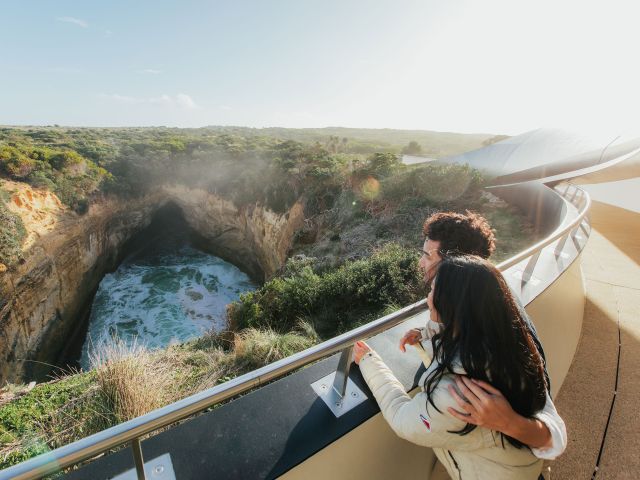
These limestone sea stacks are arguably Victoria’s most famous icon . After an $8-million upgrade to its lookout, The Blowhole near Loch Ard Gorge/Poombeeyt Kontapool (meaning breath of the whale) has recently reopened. A brand-new Twelve Apostles Visitor Experience Centre, complete with rooftop lookout, will open in 2026.

You Yangs, Geelong

kangaroos in You Yangs
Kangaroos enjoy dusk in the You Yangs. (Image: Tourism Australia)

Rising 300-plus metres from the flat volcanic plains between Melbourne/Naarm and Geelong, the You Yangs are massive granite boulders named for the local Wadawurrung word ‘Youang’, meaning ‘big hills’. Hiking, biking, rock climbing and horse-riding are popular within this regional park.

Redwood Forest, Yarra Valley

Redwood Forest, Yarra Valley
Yarra Valley’s soaring Redwood Forest. (Image: Tourism Australia)

Near the town of Warburton, an extraordinary forest of some 1500 Californian Redwoods stands among native orchids, eucalypt trees and rich birdlife. Planted in the 1930s, these 55-metre-plus trees can live for 2000 years and will grow to be some of the world’s tallest.

Wilsons Promontory, Gippsland

the Wilsons Promontory
Wilsons Promontory is home to the incredible Skull Rock formation. (Image: Tourism Australia)

The Prom, as it’s known locally, is the southernmost tip of mainland Australia. This 50,000-hectare reserve comprises granite mountains and forest, fringed by sandy beaches and surrounded by a marine park rich in marine biodiversity. It’s also home to the incredible and imposing Skull Rock formation.

Hanging Rock Reserve, Macedon Ranges

the Hanging Rock Reserve, Macedon Ranges
Enigmatic Hanging Rock. (Image: Visit Victoria/ Rob Blackburn)

This six-million-year-old volcanic rock  was thrown into the national spotlight thanks to the 1967 novel and consequent 1975 film based on the fictional disappearance of schoolgirls in 1901. Mystery aside, visitors can walk the steep 105-metre summit, fish for trout and go twitching.

Sovereign Hill, Ballarat

exploring Sovereign Hill
Step back in time at Sovereign Hill. (Image: Tourism Australia)

Cry ‘eureka!’ at Sovereign Hill , a living museum to the prosperous Gold Rush era of the 1850s, during which Ballarat produced the most gold in the world. Visitors to this much-loved attraction can walk historic  streets, enter a gold mine and try panning for the good stuff, too.

The Great Stupa, Bendigo

Great Stupa, Bendigo
The Great Stupa in Bendigo. (Image: Tourism Australia)

Who’d have thought the largest Buddhist temple in the Western world would be tucked away in Bendigo’s bushland? Welcoming visitors to explore, this sacred Buddhist pagoda is an epicentre for Tibetan culture, architecture, art and interfaith harmony.

Cape Schanck Lighthouse, Mornington Peninsula

the Cape Schanck Lighthouse from above
Heritage-listed Cape Schanck Lighthouse. (Image: Tourism Australia/Two Palms/Harry Pope)

Ensuring the safe passage of ships in the notoriously treacherous Bass Strait since 1859, this heritage-listed lighthouse overlooks dramatic volcanic coast and wild beaches. The surrounding reserve is home to a plethora of wildlife including little penguins, seals and echidnas.