Road trip: Perth to Wave Rock

hero media
On a road trip through the Golden Outback, explore Mulka’s Cave, Wave Rock and the Humps. Uncover the history of Hyden and York; towns that have managed to etch themselves into WA’s landscape. 

Part 1: Perth to Wave Rock


Forget a journey from A to B; it’s far more relaxing to make stops (especially the unplanned ones) along the way. York is the oldest inland town in Western Australia, and has retained a lot of its original streetscape. There’s an old-fashioned sweet shop, a few eclectic cafes and a motor museum.


It’s on the road from York to Quairading that I have my aforementioned ‘aha!’ road trip moment. The landscape drastically changes from patchwork farmland to a shock of ghostly salt lakes dotted with grey, leafless trees.


We pull over for a closer look and – as we later find out – the trees are dead due to the rising water table, a result of the mass clearing for agriculture over the last 50 years.


Still reeling from the stark beauty of the landscape, we almost fly past a little black and white sign directing us to a section of fence formerly known as The Rabbit Proof Fence. We’ve heard of the movie, but it’s a slice of Australian history we don’t know much about.


On completion in 1907 it stretched for 3236.8 kilometres and was the longest fence in the world. It’s mind-boggling to imagine an attempt to stop a plague of rabbits by erecting not one but three fences, and all because of the introduction of 24 rabbits in 1859.


We follow the Tin Horse Highway towards Hyden and argue about whether the horse-themed steel sculptures dotting the roadside are the work of one artist, or individual creations by each landowner (it turns out it’s the latter). Regardless, it’s a fun distraction to get us to our resting spot for the night.


“I think you need something a bit tough to make your life worthwhile,’’ says Sheenagh Collins; a third-generation Hyden local, general manager of Wave Rock Motel, owner of Wave Rock Resort and impromptu tour guide.


We’re lying on the tray of her ute, gazing at the billions of stars and imagining life in 1924 when Sheenagh’s grandfather, Mick Mouritz, was among the first to settle in the area.


Lured from Ireland with the promise of a two-storey house and rich, productive farmland, he arrived to uncleared scrubland and nowhere to live.


“He and my grandmother lived in a mud hut for 15 years before they could afford to build a proper house, but they were genuinely happy. They had goals and they worked hard to achieve them,’’ she says.


“If you have purpose and you work hard, that right there is the secret to living a long and happy life. That’s my belief anyway."


Hyden, like many towns in the Southern Wheatbelt, doesn’t have much more than a fire station, supermarket and town hall, but its locals are fiercely proud of their town and seem genuinely happy.


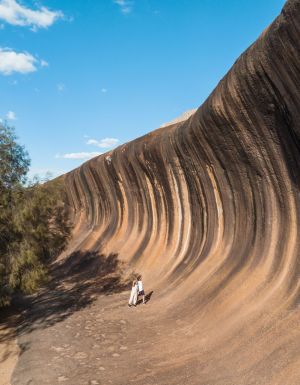
With more than 140,000 visitors a year, Wave Rock is the area’s main tourist attraction, but it’s at the Humps 16 kilometres down the road that we feel most in awe.


Having escaped the buzzy tour buses, we find an immediate sense of isolation. A neat grid of ghostly gum trees sits adjacent to a narrow dirt path that leads to Mulka’s Cave, inside which are aboriginal hand stencils believed to represent women and children.


According to Noongar legend, the cave was the hiding place for an evil cannibal, Mulka, who was later killed by tribe members.


It’s as we’re digesting this information that we wander on past the cave, squeezing between two rocks to an immediate landscape change – there’s an entire valley made of granite.


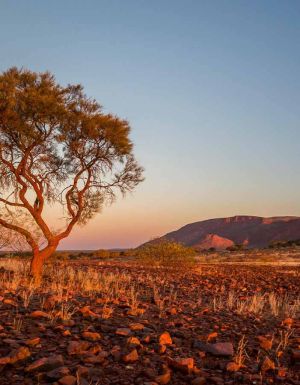
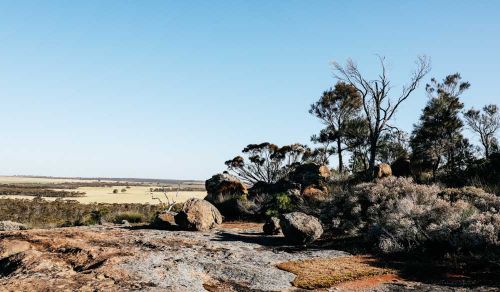
We hike along the ridge, eventually realising we’ve discovered the Humps. Moss and lichen stain the rocks, little clusters of pebbles dot the gently undulating rock face and there’s a whisper to the wind.


We reach the summit and view green crops as far as the eye can see. The human impact is apparent, yet it’s as if we’re the first ones there.

CONTINUE ON THE GOLDEN OUTBACK ROAD TRIP


Part 2: Wave Rock to Hopetoun 


Part 3: Hopetoun to Esperance


Part 4: Esperance to Kalgoorlie


The details: Perth to Wave Rock, WA


Staying there: Wave Rock Motel – Basic rooms, perfect for a one-night stay. 2 Lynch Street, Hyden

hero media

7 Kimberley experiences that need to be on your bucket list

From thundering waterfalls to ancient Indigenous art, Kimberley’s raw beauty will take your breath away.

Wild, pristine, and shaped by nature, the Kimberley Coast is one of Australia’s most spectacular landscapes. A remote and rugged frontier that remains a bucket list destination for many travellers. Its most breathtaking attractions – including Montgomery Reef, King George Falls and Horizontal Falls – are accessible only by sea or air, making a guided expedition cruise aboard Silversea’s luxury expedition ship, Silver Cloud, the ideal way to explore it.

From its intricate intertidal zones to ancient rock art, extreme tides and rare wildlife found nowhere else in Australia – or the world – this journey offers an unparalleled exploration of one of Earth’s last true wildernesses.

Why Silversea?

Silversea offers a 10-day expedition departing Broome, or an extended 16-day expedition voyage from Indonesia, including landings on the hidden gems of Palopo Sulawesi and Komodo. Accompanied by expert guides and specialists in marine biology, history and geology, guests gain a deeper understanding of the Kimberley’s dramatic landscapes, rich cultural heritage and extraordinary biodiversity.

Silversea offers one of the experiential travel industry’s leading crew-to-guest ratios. Along with all-suite accommodation (80 per cent with private verandah), 24-hour butler service, a swimming pool and four dining options. Silver Cloud also has an experienced crew of multilingual expedition guides and specialists in marine biology, history and geology to enhance your Kimberley Experience.

silversea cruise ship pool deck
Take a dip in the pool deck.

1. Koolama Bay

​​Before visitors see King George Falls, they hear them – a growing rumble in the distance, steady and foreboding as the Zodiac glides through the gorge, the sound echoing off sheer rock formations. At 80 meters tall, the twin cascades carve through the red cliffs, churning the waters below in a spectacular finale – but Koolama Bay holds secrets beyond its striking scenery.

Named after a ship that beached here following an aerial attack by Japanese bombers in World War II, the bay may seem desolate, yet it teems with life. With Silversea’s expert guides on their 10-day Kimberley itinerary, guests gain a sharper eye for its hidden wonders – rock wallabies darting across the cliffs, crocodiles lurking among dense green mangroves, and high above, the silhouette of a bird of prey circling the sky.

King George Falls at koolama bay excursion on Silversea Kimberley Cruise
Take a shore excursion to see King George Falls.

2. Freshwater Cove / Wijingarra Butt Butt

Connect with Country on a wet landing at Freshwater Cove, also known as Wijingarra Butt Butt. Considered one of the most special experiences on both the 16-day and 10-day Kimberley cruises, Silversea guests are welcomed by the traditional Indigenous custodians of the land, painted with traditional ochre, and invited to take part in a smoking ceremony.

Located on the mainland near Montgomery Reef, Wijingarra Butt Butt holds deep cultural significance to the local Indigenous community. Here, rock formations along the shore represent spiritual ancestors, and guests are guided to a nearby rock overhang filled with ancient art, where traditional owners share the stories and meaning behind these sacred paintings.

welcome to country on freshwater cove during silversea kimberley cruise
Take part in a smoking ceremony. (Image: Tim Faircloth)

3. Vansittart Bay (Jar Island)

Modern history, ancient culture and mystery converge in Vansittart Bay, which is also known as Jar Island. Here, the first thing to catch the eye is the dented, silver fuselage of a World War II-era C-53 plane – a striking relic of the past. Yet, the true cultural treasures lie just a short hike away where two distinct styles of Indigenous rock art – Gwion Gwion and Wandjina – can be found.

The Wandjina figures, deeply connected to Indigenous traditions, stand in stark contrast to the enigmatic Gwion Gwion (Bradshaw) paintings, which date back more than 12,000 years. Significantly different in form and style, the two different styles create a striking juxtaposition, offering a rare glimpse into the region’s rich and complex past.

aerial view of Vansittart Bay, See it in you Silversea Kimberley Cruise.
Explore ancient Gwion Gwion rock art at Vansittart Bay. (Image: Janelle Lugge)

4. Horizontal Falls

Part illusion, part natural phenomenon, the Kimberley’s much-lauded Horizontal Falls aren’t a waterfall, but a tidal and geographic spectacle that visitors have to see to comprehend. Known as Garaanngaddim, the phenomenon occurs when seawater rushes through two narrow gaps- one just twenty metres wide, and the other seven metres in width, between the escarpments of Talbot Bay.

With each tidal shift,  the force of the water creates whirlpools, furious currents and the illusion of a horizontal cascade as thousands of gallons of water are pushed and pulled in through the gap every six hours with relentless movement, making this one of the Kimberley ’s most mesmerising natural wonders.

Horizontal Falls are described as "One of the greatest wonders of the natural world". They are formed from a break in-between the McLarty Ranges reaching up to 25m in width. The natural phenomenon is created as seawater builds up faster on one side of the gaps than the other, creating a waterfall up to 5m high on a King tide.
Watch whirlpools and furious currents collide. (Image: Janelle Lugge)

5. Montgomery Reef

As the tide turns in Montgomery Reef, magic happens. With the Kimberley’s legendary tides varying up to ten metres, at low tide the submerged reef almost appears to rise from the depths: exposing up to four metres of the sandstone reef.

The impact is otherworldly: as the water drains, waterfalls cascade on either side of the channel,  turtles left exposed scramble and dive, and fish leap in search of sanctuary in shallow pools. Meanwhile, the dinner bell rings for the migratory seabirds dugongs, reef sharks and dolphins that scavenge and feast in the area.

Using zodiacs, guests cruise through one of the world’s most significant inshore reef systems navigated by experienced guides, exploring the most intricate and fascinating parts of a 300-square-kilometre-wide biodiversity hotspot.

aerial view of boat going along Montgomery Reef
Witness seabirds, dolphins and reef sharks on the hunt.

6. Mitchell Falls by Helicopter

Experiencing the Kimberley by sea allows you to feel the power of the tides, but travelling by helicopter reveals the sandstone tapestry of the Kimberley, a landscape geologists believe is over 1.8 billion years old.

One of Silversea’s most popular optional excursions , guests who opt to fly into the interior from the onboard helipad soar up above the rust-coloured landscape of the Mitchell plateau, taking in one of Australia’s most scenic waterfalls: Mitchell Falls, a series of four emerald-coloured pools gently cascades into each other, before plunging down to the river below.

Seeing the landscape from above reveals a landscape weaved and shaped by the power of the freshwater wet season, juxtaposed to the constant lapping of the relentless and powerful tide on the coast.

aerial view of mitchell falls on silversea helicopter excursion
See emerald pools cascade into the river below. (Image: Tim Faircloth)

7. Indigenous Art Caves, Wandjina Art

The Kimberley Region of Western Australia is home to some of the most striking and significant

Indigenous rock art in Australia. Dotted throughout the landscape are caves, cliffs and rock overhangs depicting the striking, ethereal image of Wandjina, the rainmaker spirit and creation being central to many of the Dreamtime stories in this region.

Some of the paintings are regularly repainted by traditional custodians, while others are believed to be over 4,000 years old. Each artwork serves as both a cultural record and a living connection to the past, offering a rare opportunity to engage with the enduring traditions of the Kimberley’s Indigenous communities.

Freshwater Cover Rock Art the kimberleys
Walk among cultural records preserved in stone. (Image: Tim Faircloth)

See the best of this incredible part of the world on a Silversea Kimberley cruise. Book your 10- or extended 16-day expedition voyage at silversea.com