Continuing on with her Golden Outback road trip, Jenny Ringland takes the road less travelled and explores stunning Fitzgerald River National Park, one of the largest parks in WA.
Part 2: Wave Rock to Hopetoun
It’s a 3.5-hour drive to Hopetoun via Lake King and Ravensthorpe. Passing Lake King, we’re met by the same eerie scene of dead trees and cracks of salt.
According to Sheenagh, the government matches dollar for dollar the money farmers spend on regeneration. However, few have participated in the scheme.
“Farmers don’t have that money to spare. We’ve only just come out of a 10-year drought where so many farmers were forced off the land. Spending money on regeneration isn’t a priority and you can’t blame them,’’ she says.
More stories of hardship greet us at Hopetoun – this time thanks to the sale of BHP’s nickel mine in 2010, but there’s a recurring theme emerging. Everyone seems happy.
It’s a tiny coastal village with a bakery, cafe-slash-small-goods store and a self-serve laundromat, petrol station and hot shower depot for independent campers passing through. However it’s Fitzgerald River National Park that demands our attention.
We’re surprised to learn that it’s one of the largest and most botanically significant parks in Australia, home to nearly 20 per cent of WA’s flora species.
Even more surprising is that we literally have the park to ourselves. We follow a 1.7-kilometre walking trail to Hamersley Beach and at each turn the sound of crashing waves intensifies.
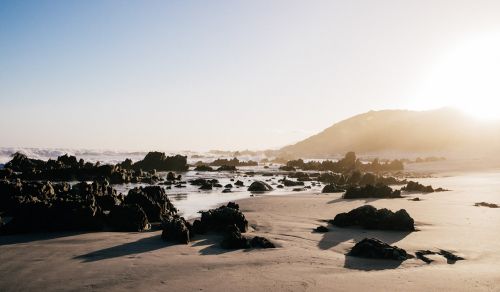
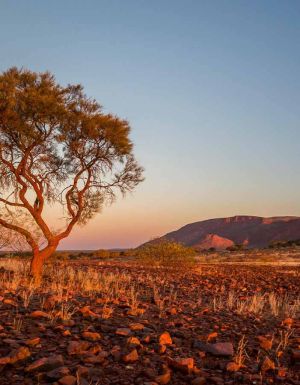
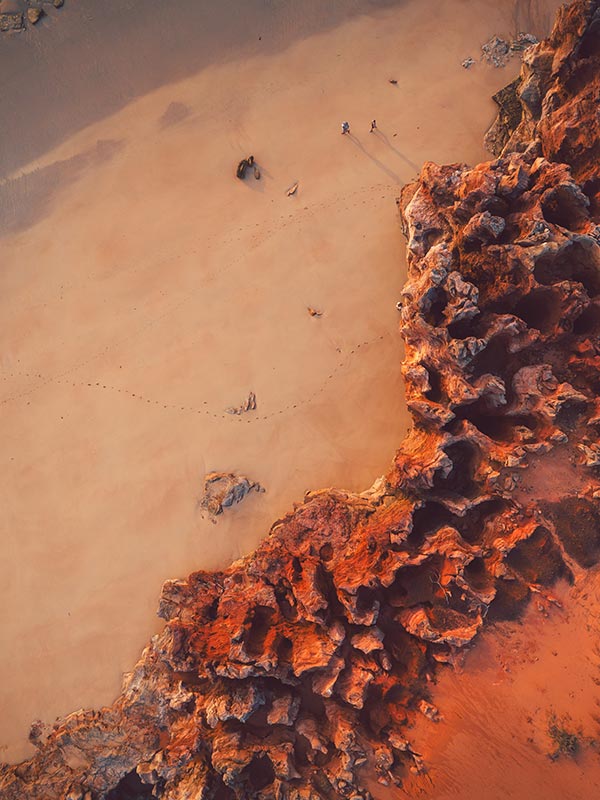
We weave past Hamersley Inlet, which has a lovely protected spot for camping and arrive to find an extreme coastline, sand dotted with prehistoric-looking rocks jutting from the ground, and sea mist swirling. We feel quickly transported back millions of years.
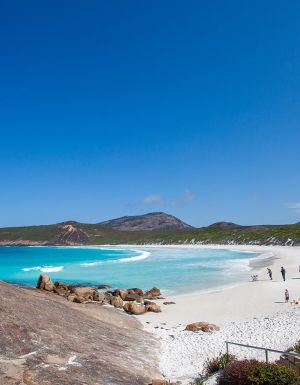
The park has it all: desert-like sand dunes, jaw-droppingly beautiful beaches, and days’ worth of walking to do. So why is it that we have the place to ourselves?
“We’re just one of many national parks in WA," says Rick Besso, owner of local accommodation Wavecrest.
“We have a lot of competition and to get to Hopetoun it’s a detour, but we’re hoping we can attract more of the independent travellers, the grey nomads… you know? It’s really beautiful here," Rick says. Yep, we hear you.
This remote corner of Australia is one of the world’s last frontiers. This is how to see it properly.
Vast, rugged and deeply spiritual, the Kimberley coast in Australia’s North West feels a world away from everyday Australia – and there are countless ways to explore it. But if you want to reach ancient rock art, hidden gorges and lonely waterfalls, it has to be by boat. Whether you’re aboard a nimble expedition vessel or a luxury yacht with all the trimmings, exploring by the water brings exclusive experiences, shows unique views and makes travel easier than any other mode. And that’s just the beginning of Australia’s North West cruises.
Adventure starts where the road ends.
1. Discover Broome, and beyond
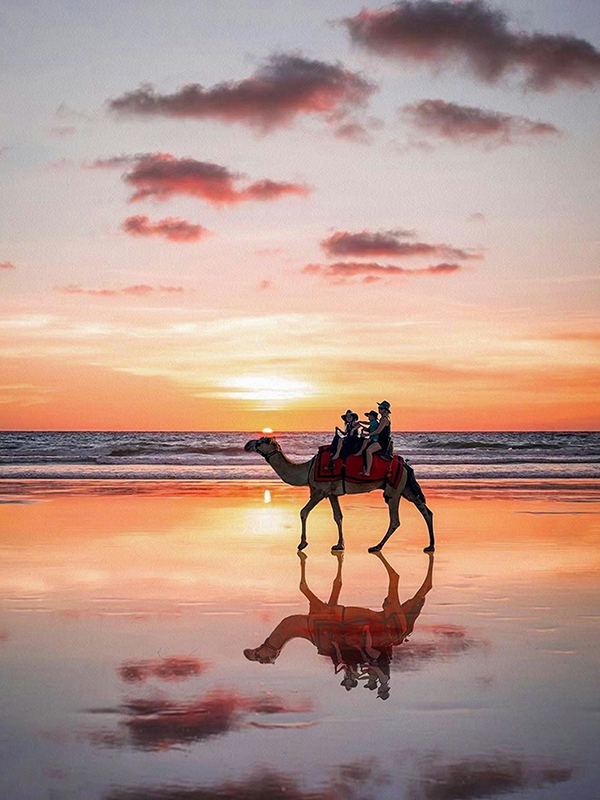
Explore your launchpad before you set sail: Broome. Here camels and their riders stride along the 22 kilometres of powdery Cable Beach at sunset. That’s just the start.
At Gantheaume Point, red pindan cliffs plunge into the turquoise sea, whose low tide uncovers fossilised dinosaur footprints. Broome’s pearling history runs deep. Japanese, Chinese, Malay and Aboriginal divers once worked these waters, and their legacy lives on in boutiques where South Sea pearls still shine.
If the moon’s right, you may catch the Staircase to the Moon over Roebuck Bay. Or simply kick back with a cold beverage and a film under the stars at Sun Pictures , screening since 1916.
Ride a camel along Cable Beach. (Image: Nick Dunn)
2. Unmatched access to The Kimberley
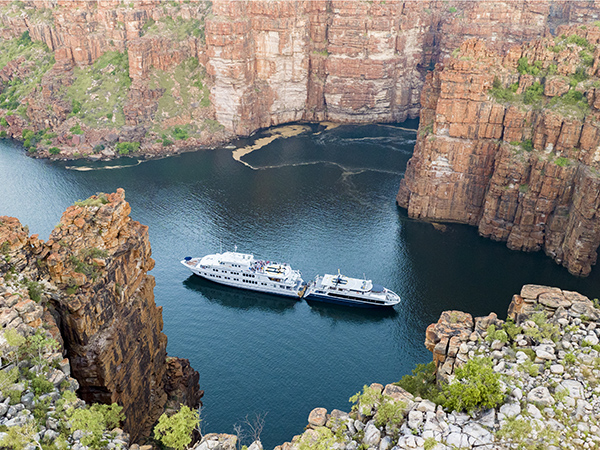
Once you’re onboard, expect a backstage pass to some of the most isolated places on Earth. No roads. No ports. No phone reception.
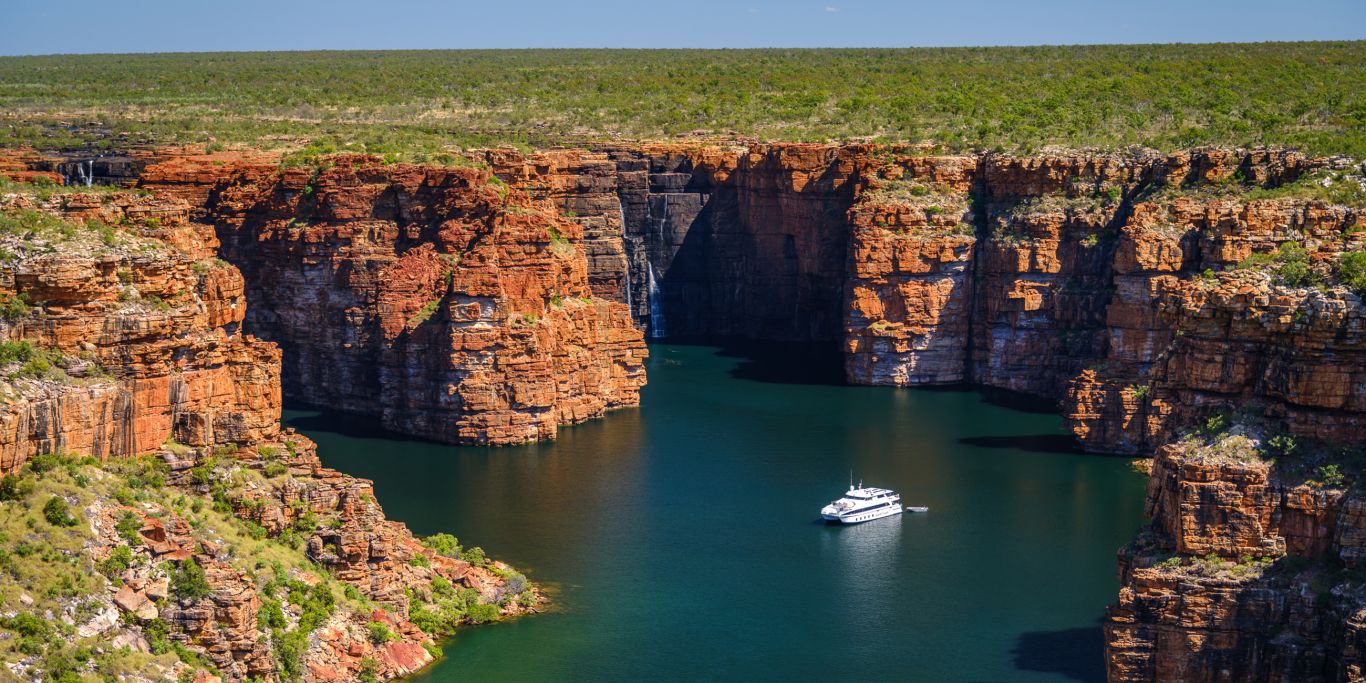
At Horizontal Falls/ Garaanngaddim, 10-metre tides surge through twin gorges like a natural waterpark ride that’ll make your palms sweat. Then there’s Montgomery Reef/ Yowjab: a giant living platform of coral and seagrass, where the sea pulls back to reveal waterfalls, sea turtles and ospreys.
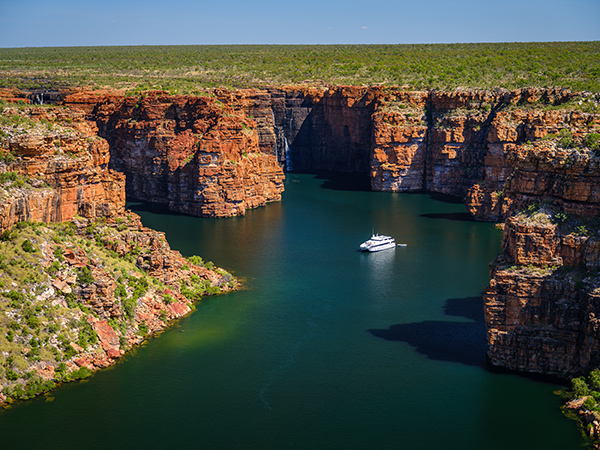
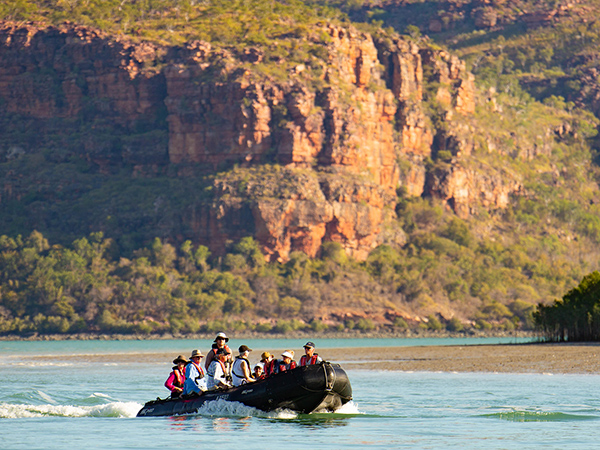
Up north, King George Falls/ Oomari rage 80 metres down red cliffs. Zodiac boats often nudge in closer so you can feel the spray on your sun-warmed cheeks. You might even fly in to reach Mitchell Falls/ Punamii-unpuu, a four-tiered cascade where you can swim in freshwater pools above the drop.
Come spring, some itineraries veer west to Rowley Shoals: an atoll chain of white sand and reef walls. Then it’s up the winding Prince Regent River to King Cascade/ Maamboolbadda, tumbling over rock terraces, and into a Zodiac to view the Gwion Gwion rock art, whose slender, ochre-painted figures are older than the pyramids.
Get closer to the Kimberley than ever before.
3. Taste the Kimberley with onboard hospitality
You might spend your days clambering over slippery rocks or charging past waterfalls. But when you’re back on the water, it’s a different story. Meals are chef-prepared and regionally inspired: grilled barramundi, pearl meat sashimi, mango tarts, and bush tomato chutney. One night it’s barefoot beach barbecues with your shipmates; the next, alfresco dining on the ship.
Small expedition ships each have their own personality, but many carry just 12 to 36 guests, making being out on the water a whole other experience. You might sink into a spa on the foredeck or sip coffee in a lounge while watching crocodiles cruise by. It’s choose-your-own-relaxation, Kimberley style.
4. Expert-led excursions through the Kimberley
These voyages are led by people who know the Kimberley like the back of their sunburnt hand. Attenborough-esque naturalists might gently tap your shoulder to point out rare birds or tell the story beneath a slab of rock. Historians can explain exactly how that rusted World War II relic came to rest here.
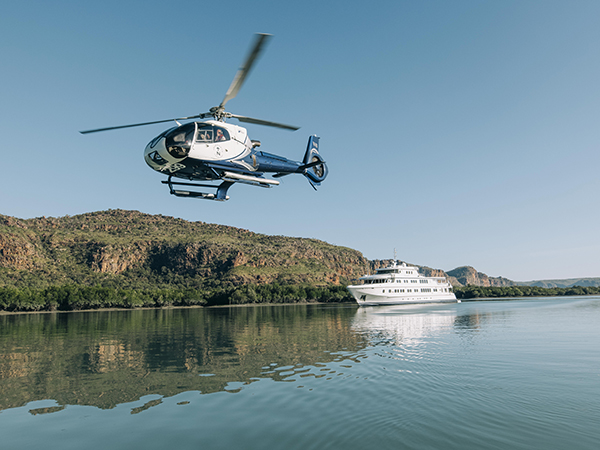
If your ship has a helipad, you might chopper straight to a waterfall-fed swimming hole. If not, you’ll still be hopping ashore for that wet landing at a secret creek.
Then come the evenings: songlines shared by Traditional Owners under the stars, or astronomy sessions that link what’s overhead with what’s underfoot and what’s within.
Explore with naturalists and historians by your side.
5. Relax in luxurious lodgings
Just because you’re off-grid doesn’t mean you have to rough it. These Kimberley vessels are small in size, but mighty in luxury. True North’s ships come with their own helicopters and a no-sea-days policy, so you’re always in the thick of it. Try the luxurious offerings from Ocean Dream Charters for exploration in style. Kimberley Quest offers a fast boat for easy, off-ship adventures. On the larger end of the scale, Coral Expeditions has open-deck bars and curated wine cellars. And then there’s Ponant’s luxury yachts – sleek and incredibly stylish French sailing yachts.
See the Kimberley from sky to shore.
6. The adventure continues with pre- and post-cruise experiences
You’ve already come this far – so, why not go further? Broome makes it easy to ease in before you board, or wind down when your voyage ends, and there is no reason to stop there.
Head an hour and a half south to Eco Beach to stay off-grid and off the clock. Join a Yawuru guide for a mangrove walk or ocean forage. Dive even deeper into Broome’s pearling past at Willie Creek or Cygnet Bay, where divers and craftspeople still pull the seawater-slicked gems from the deep.
If you’re still craving adventure, it’s time to go further. Soar over the Buccaneer Archipelago, or detour inland with a 4WD trip along the Gibb River Road. Book a scenic flight over the Bungle Bungles. Or – because you never know when you’ll be back – do all three.