The Western Australian silo trail just waiting to be driven

hero media
In the heart of the Western Australian wheatbelt region, radical expressions of art have transformed grain silos into art galleries, and small towns into destinations.

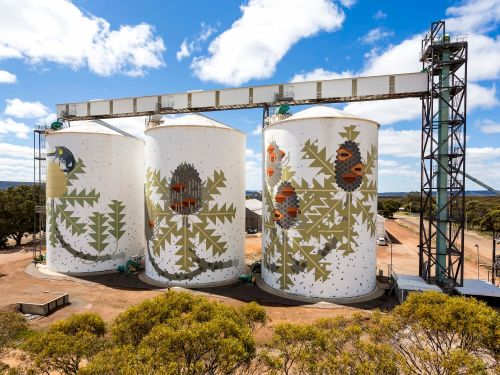
In August of 2016, Fremantle artist Amok Island was given 31 days and the biggest canvas in the small Western Australia Wheatbelt town of Ravensthorpe to create a traffic stopper. As a result, three CBH Group grain silos bear a mural of the town’s famous banksia wildflowers. While Ravensthorpe has flirted with mining over the years – BHP Billiton spent a turbulent year in pursuit of nickel in the late 2000s – the local wildflowers are a constant affair, blooming every year from August to November. Now, Ravie’s banksias are in bloom all year round. And they’re 25 metres high.


Silo art trails have popped up around Australia as the hot new way to see the countryside and get a culture fix at the same time. The Australian road trip is a dream we’ve exalted to almost sacred status but the reality is that, between spectacles, there’s often a whole lot of nothing out there, so to see something – anything – counts as a win for many day-trippers. Even a tumbledown shack can be cause for excitement in the furthest reaches of the outback, so you can imagine the kind of consternation the sight of an intricate and evocative piece of art splashed across the side of a concrete juggernaut would inspire among those fresh from the two-tone Nullarbor Plain.


In 2015, as part of Perth collective FORM’s festival of art and ideas, international artists Hense (USA) and Phlegm (UK) created Australia’s first ever silo mural. Eight grain silos in the town of Northam were transformed into towers of colour, and sirens for passersby.


In the years since, FORM has extended the experiment into a self-guided art trail that runs across seven towns in the Wheatbelt, from Northam, an hour and a half east of Perth, to Albany on the south coast, and even out to Merredin, on the cusp of the goldfields. Initially, it was hoped the silos would cause drivers to stop for a better look, and in the process, bring new life to towns slightly off the beaten tourist track. An unexpected side effect of FORM’s venture has gone one better: inspiration has emerged from the towns themselves.
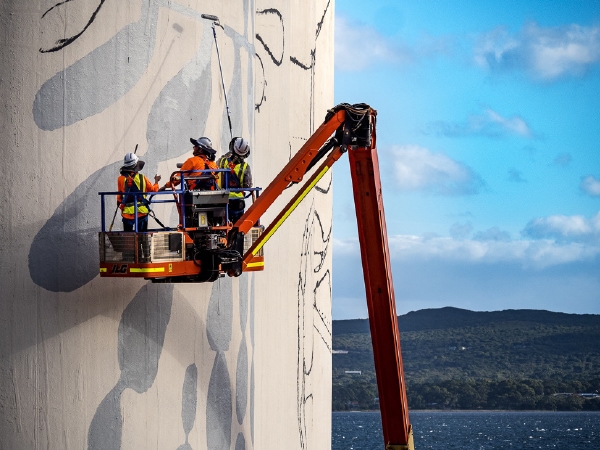
It begins with a giant brushstroke

Newdegate

An hour and a half north-west of Ravensthorpe, two boys cheer on their friend as he grinds his skateboard along a railing in the small town of Newdegate. Immersed in their tricks, they don’t pay any mind as our bus pulls up across the road from the skate park.


At Newdegate’s edge, Perth muralist Brenton See’s bold interpretations of the region’s wildlife – the western bearded dragon, the malleefowl, the thigh-spotted tree frog and the red-tailed phascogale – tower over us as the setting sun swiftly casts its lengthening shadow across the town.


The animals are rendered in black and white, but the backgrounds are an explosive burst of colour. Back in town, the skate park clashes in a similar way. Spearheaded by the community and professionally designed by Skate Sculpture, the park is just one of the small but crucial additions that have popped up in the wake of the silo trail. The Happy Little Caravan food truck is another, emerging to serve both the needs of a small town and any tourists that stop by.

Pingrup

At the tiny town of Pingrup, 40 minutes south-west, I’m sitting in an artisan cafe seemingly ripped straight from the laneways of Melbourne. My lime milkshake arrives in a biodegradable cup complete with paper straw. There’s no Red Bull, no Mrs Mac in sight. If I’m this shocked, I can only imagine how passing truckies feel.
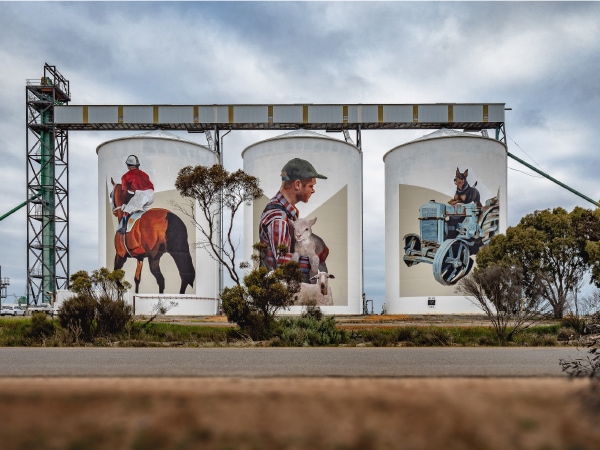
Pingrup’s agricultural heritage comes to life in the form of a horse and jockey

“The silos inspired us," says Stephanie Clarke-Lloyd, manager of The Store Cafe 6343. When the silo trail came to Pingrup in 2018, Miami street artist Evoca1 channelled the town’s spirit with eloquence, simplicity, and 230 litres of paint. The visualisation of Pingrup’s agricultural heritage – a dog on a tractor, a horse and jockey, and a man cradling a lamb – spurred the local community resource centre to revitalise the town’s disused cafe. Much of the menu is comprised of family recipes, and there’s a strong focus on fresh, local produce.


“Everything here is locally sourced, or as local as we can get, even if it means driving a long way to pick up certain supplies," Steph says. “It’s just the way we want it to be."


The cafe’s guestbook reveals a steady stream of satisfied visitors from around the state, around the country and around the world.


“Ripper food! Will stop every time on way to Albany! 10/10," raves Leo from Sydney. Grace from the UK celebrates the “great vibe", while another patron simply offers “What a surprise!" along with a sketch of their truck.

Northam

On the road to Northam, we pass an unpainted silo site. At this point, it’s a strange sight to see them so clean, so quiet. That silence serves as the voice of the nearby community. Did they not want a mural here? We drive on.


When Northam arrives, an overcast sky hangs above 16 38-metre-high silos in the centre of a working grain station. The leftmost four silos depict Phlegm’s trademark fantastical flying contraptions, while to the right, Hense’s territory is marked with Day-Glo colours and eclectic textures. The eight silos in the middle are untouched, for now.
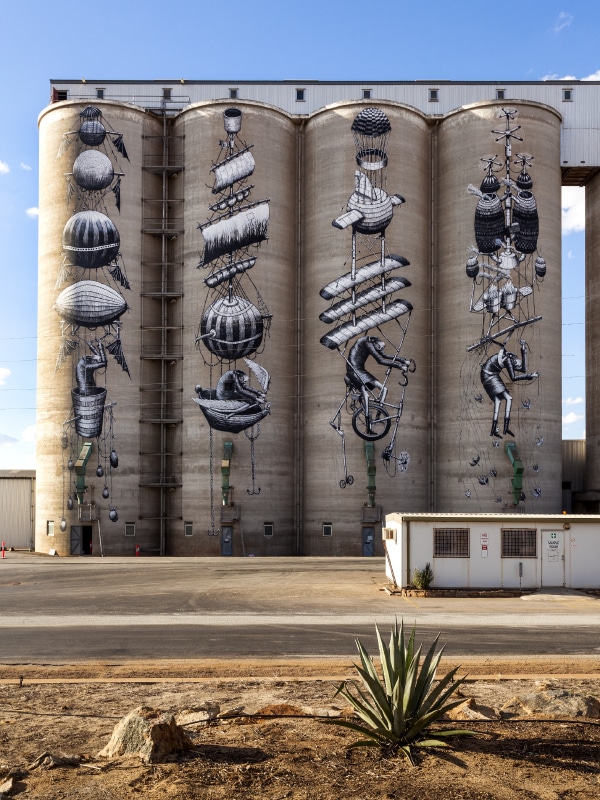
Phlegm’s magnificent flying machines in Northam

These were the first silo murals in Australia, but their voices belong to the artists. The dissonant designs have little to do with the town itself, but they seem to have acted as a call for new creative energy in Northam.


The Shamrock Hotel, a Victorian-era pub on the main drag, is swathed in a cocoon of scaffolding as we pull up beside it – a canvas of another kind. We’re met by Nigel Oakey, owner and managing director of the Dome cafe chain, who explains we’re actually looking at the Farmer’s Home Hotel. “That was its name when it was first built," he says. “And that’ll be its name again when we’re done."


Oakey has answered the silos’ call. When he first arrived, the Shamrock and its 150-year history spoke loudest. Now, Oakey and his team are interpreters, converting the disused pub into a
five-star property that realises its history while serving a modern purpose. It’s the same approach he used to great success with the Premier Mill Hotel in Katanning, three hours south.
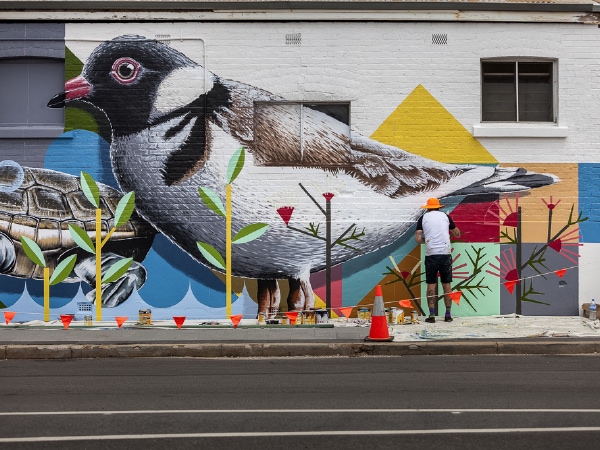
The silos of Katanning may be free of art, but the walls make up for it

“We employ a historian full time to research the property, and we use as much of that as we can during the restoration."


The voice of the town’s past is strong enough, Oakey believes, for the Farmer’s Home to put Northam on the map as a luxury getaway destination. In a few months, he’ll know.

Albany

For the grain behind the murals, Albany is the end of the line. It’s our final stop too, and we find ourselves face to face with an enormous ruby seadragon. For years it was nearly impossible to spot one in the wild; the species was first officially recorded in 2016. The mural caused a stir among locals who believed it should have featured the diggers who left the port city on their way to the First World War. Instead, Singapore artists Yok and Sheryo paid tribute to Albany’s newest resident. It doesn’t speak for the community; it’s a silent shout from the deep.


Unlike the other silo spots, Albany is a city. It has a voice that projects from its streets and from within its heritage buildings. The silo had to shout just to be heard above the din. That shout echoes north across the Wheatbelt, along the rest of the trail. You can hear it as the kettle boils in the Store Cafe 6343, as board grinds on metal in Newdegate, and in the squeal of the brakes as the mining trucks return to Ravensthorpe.
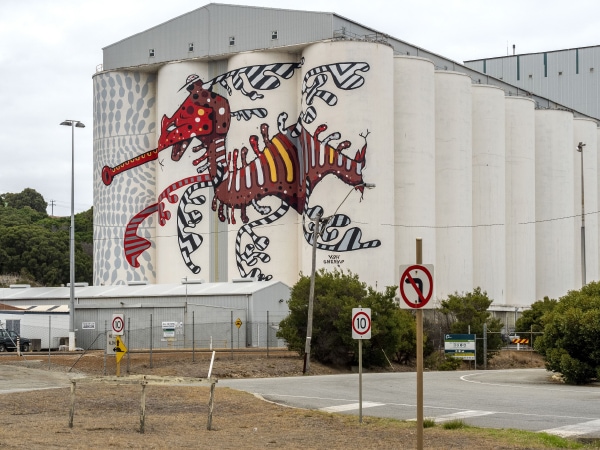
The slightly controversial ruby seadragon of Albany

Back in Northam, a car with interstate plates hurtles past us as we observe the silos. It’s not the first. But after a moment, the car slows and pulls
to the side of the road to have a look. They must have heard it, too.

Details

Getting there

The Public Silo Trail is a self-guided driving tour that can start and end wherever you’d like. Northam is the closest to Perth, an hour and a half drive’s east.

Staying there

The beautifully restored Premier Mill Hotel in Katanning is central to many of the silo towns.

hero media

7 Kimberley experiences that need to be on your bucket list

From thundering waterfalls to ancient Indigenous art, Kimberley’s raw beauty will take your breath away.

Wild, pristine, and shaped by nature, the Kimberley Coast is one of Australia’s most spectacular landscapes. A remote and rugged frontier that remains a bucket list destination for many travellers. Its most breathtaking attractions – including Montgomery Reef, King George Falls and Horizontal Falls – are accessible only by sea or air, making a guided expedition cruise aboard Silversea’s luxury expedition ship, Silver Cloud, the ideal way to explore it.

From its intricate intertidal zones to ancient rock art, extreme tides and rare wildlife found nowhere else in Australia – or the world – this journey offers an unparalleled exploration of one of Earth’s last true wildernesses.

Why Silversea?

Silversea offers a 10-day expedition departing Broome, or an extended 16-day expedition voyage from Indonesia, including landings on the hidden gems of Palopo Sulawesi and Komodo. Accompanied by expert guides and specialists in marine biology, history and geology, guests gain a deeper understanding of the Kimberley’s dramatic landscapes, rich cultural heritage and extraordinary biodiversity.

Silversea offers one of the experiential travel industry’s leading crew-to-guest ratios. Along with all-suite accommodation (80 per cent with private verandah), 24-hour butler service, a swimming pool and four dining options. Silver Cloud also has an experienced crew of multilingual expedition guides and specialists in marine biology, history and geology to enhance your Kimberley Experience.

silversea cruise ship pool deck
Take a dip in the pool deck.

1. Koolama Bay

​​Before visitors see King George Falls, they hear them – a growing rumble in the distance, steady and foreboding as the Zodiac glides through the gorge, the sound echoing off sheer rock formations. At 80 meters tall, the twin cascades carve through the red cliffs, churning the waters below in a spectacular finale – but Koolama Bay holds secrets beyond its striking scenery.

Named after a ship that beached here following an aerial attack by Japanese bombers in World War II, the bay may seem desolate, yet it teems with life. With Silversea’s expert guides on their 10-day Kimberley itinerary, guests gain a sharper eye for its hidden wonders – rock wallabies darting across the cliffs, crocodiles lurking among dense green mangroves, and high above, the silhouette of a bird of prey circling the sky.

King George Falls at koolama bay excursion on Silversea Kimberley Cruise
Take a shore excursion to see King George Falls.

2. Freshwater Cove / Wijingarra Butt Butt

Connect with Country on a wet landing at Freshwater Cove, also known as Wijingarra Butt Butt. Considered one of the most special experiences on both the 16-day and 10-day Kimberley cruises, Silversea guests are welcomed by the traditional Indigenous custodians of the land, painted with traditional ochre, and invited to take part in a smoking ceremony.

Located on the mainland near Montgomery Reef, Wijingarra Butt Butt holds deep cultural significance to the local Indigenous community. Here, rock formations along the shore represent spiritual ancestors, and guests are guided to a nearby rock overhang filled with ancient art, where traditional owners share the stories and meaning behind these sacred paintings.

welcome to country on freshwater cove during silversea kimberley cruise
Take part in a smoking ceremony. (Image: Tim Faircloth)

3. Vansittart Bay (Jar Island)

Modern history, ancient culture and mystery converge in Vansittart Bay, which is also known as Jar Island. Here, the first thing to catch the eye is the dented, silver fuselage of a World War II-era C-53 plane – a striking relic of the past. Yet, the true cultural treasures lie just a short hike away where two distinct styles of Indigenous rock art – Gwion Gwion and Wandjina – can be found.

The Wandjina figures, deeply connected to Indigenous traditions, stand in stark contrast to the enigmatic Gwion Gwion (Bradshaw) paintings, which date back more than 12,000 years. Significantly different in form and style, the two different styles create a striking juxtaposition, offering a rare glimpse into the region’s rich and complex past.

aerial view of Vansittart Bay, See it in you Silversea Kimberley Cruise.
Explore ancient Gwion Gwion rock art at Vansittart Bay. (Image: Janelle Lugge)

4. Horizontal Falls

Part illusion, part natural phenomenon, the Kimberley’s much-lauded Horizontal Falls aren’t a waterfall, but a tidal and geographic spectacle that visitors have to see to comprehend. Known as Garaanngaddim, the phenomenon occurs when seawater rushes through two narrow gaps- one just twenty metres wide, and the other seven metres in width, between the escarpments of Talbot Bay.

With each tidal shift,  the force of the water creates whirlpools, furious currents and the illusion of a horizontal cascade as thousands of gallons of water are pushed and pulled in through the gap every six hours with relentless movement, making this one of the Kimberley ’s most mesmerising natural wonders.

Horizontal Falls are described as "One of the greatest wonders of the natural world". They are formed from a break in-between the McLarty Ranges reaching up to 25m in width. The natural phenomenon is created as seawater builds up faster on one side of the gaps than the other, creating a waterfall up to 5m high on a King tide.
Watch whirlpools and furious currents collide. (Image: Janelle Lugge)

5. Montgomery Reef

As the tide turns in Montgomery Reef, magic happens. With the Kimberley’s legendary tides varying up to ten metres, at low tide the submerged reef almost appears to rise from the depths: exposing up to four metres of the sandstone reef.

The impact is otherworldly: as the water drains, waterfalls cascade on either side of the channel,  turtles left exposed scramble and dive, and fish leap in search of sanctuary in shallow pools. Meanwhile, the dinner bell rings for the migratory seabirds dugongs, reef sharks and dolphins that scavenge and feast in the area.

Using zodiacs, guests cruise through one of the world’s most significant inshore reef systems navigated by experienced guides, exploring the most intricate and fascinating parts of a 300-square-kilometre-wide biodiversity hotspot.

aerial view of boat going along Montgomery Reef
Witness seabirds, dolphins and reef sharks on the hunt.

6. Mitchell Falls by Helicopter

Experiencing the Kimberley by sea allows you to feel the power of the tides, but travelling by helicopter reveals the sandstone tapestry of the Kimberley, a landscape geologists believe is over 1.8 billion years old.

One of Silversea’s most popular optional excursions , guests who opt to fly into the interior from the onboard helipad soar up above the rust-coloured landscape of the Mitchell plateau, taking in one of Australia’s most scenic waterfalls: Mitchell Falls, a series of four emerald-coloured pools gently cascades into each other, before plunging down to the river below.

Seeing the landscape from above reveals a landscape weaved and shaped by the power of the freshwater wet season, juxtaposed to the constant lapping of the relentless and powerful tide on the coast.

aerial view of mitchell falls on silversea helicopter excursion
See emerald pools cascade into the river below. (Image: Tim Faircloth)

7. Indigenous Art Caves, Wandjina Art

The Kimberley Region of Western Australia is home to some of the most striking and significant

Indigenous rock art in Australia. Dotted throughout the landscape are caves, cliffs and rock overhangs depicting the striking, ethereal image of Wandjina, the rainmaker spirit and creation being central to many of the Dreamtime stories in this region.

Some of the paintings are regularly repainted by traditional custodians, while others are believed to be over 4,000 years old. Each artwork serves as both a cultural record and a living connection to the past, offering a rare opportunity to engage with the enduring traditions of the Kimberley’s Indigenous communities.

Freshwater Cover Rock Art the kimberleys
Walk among cultural records preserved in stone. (Image: Tim Faircloth)

See the best of this incredible part of the world on a Silversea Kimberley cruise. Book your 10- or extended 16-day expedition voyage at silversea.com