The zoo stay with all the creature comforts

hero media
A unique hotel in Canberra, Jamala Wildlife Lodge, lets you stay alongside some of the rarest animals on the planet (By: Leigh Ann Pow)

One of the many reasons that people check in to hotels is a little solitude from the Sturm und Drang of everyday life. But lying in my luxuriously appointed hotel room in the dead of night.


I am almost willing the silence to be broken.


And then I hear it, an almighty commotion from the room next door. It’s hard to tell if it’s an argument and at any other hotel I’d be demanding that the disturbance be dealt with, but instead I just lie there in awe.


You see, the occupants of Bungalow 1 next door are not quarrelling newlyweds, they are a pride of lions. It’s the kind of experience that safari camps in Africa pride themselves on delivering.


But I’m not in Africa. My 11-year-old and I are at Jamala Wildlife Lodge, a 10-minute drive from the centre of Canberra.


Part of the privately owned National Zoo and Aquarium, Jamala Wildlife Lodge is the passion project of Richard and Maureen Tindale, who, in 1998, bought an aquarium and small native wildlife park after it went into receivership.


Almost immediately they set about expanding the property, with a mission of housing animals in as comfortable surroundings as possible, aiming for best practice when it came to animal welfare.


Many of the animals they initially brought into the zoo had spent their lives in circuses and were in desperate need of love. In the 17 years since, the zoo has continued to take in animals in dire straits, growing in size and contributing to international breeding programs, while educating visitors on the importance of wildlife conservation.


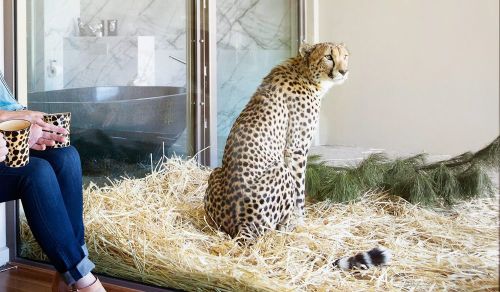
The lodge offers guests the chance to spend time with some of the most endangered animals in the world, from the comfort of five-star facilities. All of the rooms scattered around the zoo are directly adjacent to an animal enclosure, with just floor-to-ceiling walls of glass separating man from beast.


The rooms in the central uShaka Lodge overlook the likes of lemur, hyena, shark, and cheetah; six Giraffe Treehouses allow guests to feed the resident giraffe, Hummer, from their balconies; and the Jungle Bungalows look out over lions, cheetah, tiger and brown bear (conversely the animals can look in at the humans, including in the bath).


Our room, Bungalow 2, is directly adjacent to the Malayan Sun Bear enclosure, and when we enter (walking past a cute as a button red panda munching on bamboo) we find Arataki, the man of the house, sprawled outside the window determinedly working his way into a coconut with his enormous claws.


His partner Otay was rescued from Cambodia where she was being held in a cage until she was old enough to be sold to a restaurant – their paws are made into soup. It is impossible not to be totally transfixed, given that a Malayan sun bear is mere centimetres away.


Later at dinner, which is taken as a group safari-style back at uShaka Lodge, the zoo’s keepers coax a pair of white lions up into an enclosure on the verandah where pre-dinner drinks are taken.


The majestic beasts are close enough to reach out and touch (not advisable). While this kind of encounter may seem contrived and the opposite to being ‘in the wild’, many of these animals have never actually been in the wild.


It is a fact that hits home the next morning when we set out on a behind-the-scenes tour of the zoo. We stop at the Sumatran tiger enclosure and hear about their plight: deforestation in pursuit of money from palm oil harvesting is wiping out the big cat’s habitat at a sickening rate. In a mere 20 years, the only place you will be able to see these tigers is in zoos; they will be totally extinct in the wild.


And that’s where the gimmick of sleeping next to lions and tigers and bears becomes a serious attempt to stem the tragic flow of animals that are endangered. The funds raised from the room rates at Jamala go straight back into the zoo, allowing it to continue to strengthen its breeding program.


As we wrench ourselves away from Arataki and Otay to check out of our room in the late morning we glimpse the young couple who spent the previous night beside the raucous lion family. Like most of the other guests they look happy, if not just a little tired.


More information:


See JamalaWildlife Lodge


Finding the cool in Canberra


This luxe trawler tour is redefining Victoria’s seafood experience

Victoria’s ‘mussel capital’ is the source of exceptional shellfish used by top chefs far and wide. Step aboard a beautifully refurbished trawler to see how these plump and juicy bivalves are sustainably cultivated.

A curtain is slowly winched from the placid, teal waters just off Portarlington , like a floating garland beside our boat. The ropes heave with blue mussels, the star attraction of our tour. But as we reach to pluck our own, it’s quickly clear they’re not alone; a mass of weird and wonderful creatures has colonised the ropes, turning them into a living tapestry. ‘Fairy’ oysters, jelly-like sea squirts, and tiny, wriggling skeleton shrimp all inhabit this underwater ecosystem.

We prize our bivalve bounty from the ropes, and minutes later the mussels arrive split on a platter. The plump orange morsels are served raw, ready to be spritzed with wedges of lemon and a lick of chilli as we gaze out over the bay. They’re briny, tender and faintly sweet. “This wasn’t originally part of the tour,” explains Connie Trathen, who doubles as the boat’s cook, deckhand and guide. “But a chef [who came onboard] wanted to taste the mussels raw first, and it’s now become one of the key features.”

A humble trawler turned Hamptons-style dreamboat

inspecting bivalve bounty from the ropes
Inspecting the bounty. (Image: Visit Victoria/Hannyn Shiggins)

It’s a crisp, calm winter’s day, and the sun is pouring down upon Valerie, a restored Huon pine workhorse that was first launched in January 1980. In a previous life she trawled the turbulent Bass Strait. These days she takes jaunts into Port Phillip Bay under the helm of Lance Wiffen, a fourth-generation Bellarine farmer, and the owner of Portarlington Mussel Tours . While Lance has been involved in the fishing industry for 30-plus years, the company’s tour boat only debuted in 2023.

holding Portarlington mussels
See how these plump and juicy bivalves are sustainably cultivated.

It took more than three years to transform the former shark trawler into a dreamy, Hamptons-esque vessel, with little expense spared. Think muted green suede banquettes, white-washed walls, Breton-striped bench cushions, hardwood tables, bouquets of homegrown dahlias, and woollen blankets sourced from Waverley Mills, Australia’s oldest working textile mill. It’s intimate, too, welcoming 12 guests at most. And yet there’s nothing pretentious about the experience – just warm, down-to-earth Aussie hospitality.

As we cruise out, we crack open a bottle of local bubbles and nibble on the most beautifully curated cheese platter, adorned with seashells and grey saltbush picked from the water’s edge that very morning. Australasian gannets soar overhead, and I’m told it’s not uncommon for guests to spot the odd seal, pod of dolphins, or even the occasional little penguin.

The sustainable secret behind Victoria’s best mussels

blue mussels off Portarlington
Blue mussels sourced just off Portarlington.

Connie and Lance both extol the virtues of mussels. They’re delicious. A lean source of protein and packed with omega-3 fatty acids, vitamin B12, iron, selenium, and zinc. They’re cooked in a flash (Connie steams our fresh harvest with cider and onion jam). And they’re also widely regarded as one of the most sustainable foods in the world.

Portarlington mussels with lemon and chilli
Mussels served with lemon and chilli.

“Aquaculture is [often] seen as destructive, so a lot of our guests are really surprised about how environmentally friendly and sustainable our industry is,” Lance says. “[Our mussels] would filter 1.4 billion litres of water a day,” he adds, explaining how mussels remove excess nitrogen and phosphorus from the water. “And through biomineralisation, we lock carbon into mussel shells.”

a hand holding a Portarlington mussel
Mussels are a sustainable food.

Despite their glowing list of accolades, these molluscs have long been seen as the oysters’ poorer cousins. “It was a really slow start,” explains Lance, who says that in the early days of his career, “you could not sell mussels in Victoria”.

But word has slowly caught on. Chefs as globally acclaimed as Attica’s Ben Shewry and even René Redzepi of Noma, Denmark, have travelled to these very waters just to try the shellfish at the source, sharing only the highest praise, and using Lance’s mussels in their restaurants.

guests sampling Portarlington mussels onboard
Sampling the goods onboard. (Image: Visit Victoria/Hannyn Shiggins)

According to Lance there’s one obvious reason why the cool depths of Portarlington outshine other locations for mussel farming. “The water quality is second to none,” he says, noting how other regions are frequently rocked by harvest closures due to poor water quality. “We grow, without a doubt, some of the best shellfish in the world.” And with Lance’s bold claims backed up by some of the industry’s greatest names, perhaps it won’t be much longer until more Aussies uncover the appeal of Portarlington’s mussels.