There’s a whole other side to the Australian coast that few see – but here’s how to get a scuba view with a difference worth diving for.
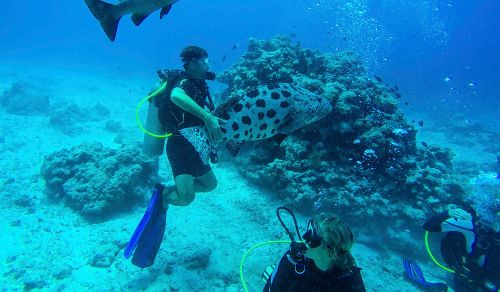
1. Underwater Photography Workshop, Port Stephens, NSW
Mastered the art of taking photos on land (or not)? Either way, you can now get snap happy underwater with this Dive 2000’s unique photography workshop.
Over a weekend at beautiful Port Stephens, you’ll improve your underwater photo skills as trained instructors teach you practical knowledge and techniques on capture styles, equipment, composition and lighting plus more. The quality ‘selfies with the fish’ you’ll bring back will impress the kids to no end… Suitable for intermediate divers; from $395 per adult.
2. Project Manta, Lady Elliot Island, Queensland
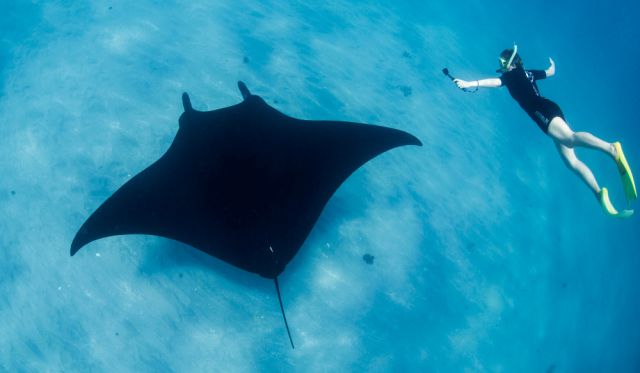
In the waters of Lady Elliot Island of the GBR, you can combine your love of scuba diving with doing good, contributing to the world’s first manta identification database (while frolicking with them in the water).
Glide along with the elegant manta rays.
Over eight days, you’ll photograph the mantas, study their habitat and help out leading scientists, in between unwinding at the very lovely Lady Elliot Island Eco Resort. See Earthwatch. Suitable for intermediate divers; from $3595 per adult.
3. Freshwater cave Diving, Mt Gambier, SA
Never heard of this experience? Good – the locals want to keep it that way! Diving Mt Gambier’s outrageously clear sinkholes is a truly unique experience: spot the rare pygmy perch and aquatic eels in Ewens Ponds, or head to the popular Piccaninnie Pond, where you can swim through the 30-metre-high, underwater limestone chamber aptly nicknamed The Cathedral.
Hopefully you’ll spot some tortoises on your way, too. Suitable for beginners, diving permits from $11 per adult; See Mount Gambier Point attractions
Need tips, more detail or itinerary ideas tailored to you? Ask AT.
AI Prompt
4. East Coast Dive Trail, Tasmania
It’s not the first thing that comes to mind when you think of Tasmania, but the east coast of this southern state offers 11 surprisingly great dive sites. From the northern town of Binalong Bay to Tasman Island, you’ll find shipwrecks, seahorses and everything in between in these turquoise waters; hire a car for a few days, make it a DIY scuba crawl and hop from location to location experiencing the sites (and sights) along the way.
Most are suitable for beginners. See Discover Tasmania for more information.
5. Dive with the wild sea lions, Baird Bay, SA
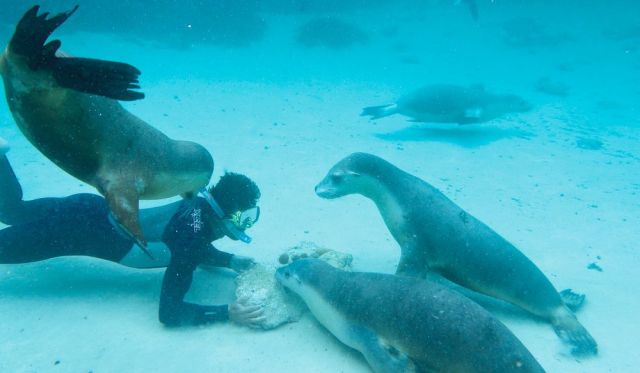
We just had to include this dive, which was voted one of our 100 Greatest Holidays of Australia. The wild Australian sea lions at Baird Bay are playful, cheeky and said to be more intrigued by us than we are of them.
Just sea lion around: Baird Bay, South Australia.
Play with them in the clear lagoons just off the Eyre Peninsula, experiencing their distinctive antics – and the local aquatic flora – at the same time. There are also bottlenose dolphins in the area, so you may get lucky and see both! Suitable for beginners; from $150 per adult, $75 per child; bairdbay.com
Want to see more stories from Australian Traveller in your Google search results?
Slow down and find your rhythm on a Murray River journey through time and place.
Trust is a funny thing. It seems not that long ago that my mother was insisting on pouring the milk into my cereal bowl, because she didn’t trust me not to slosh it over the table, and yet here I am on the Murray River at Mildura in far north-west Victoria, being handed the keys to a very new and very expensive luxury houseboat.
After a crash course in how not to crash, I’m at the wheel of the good ship Elevate – pride of the All Seasons fleet – guiding her upstream past red-ochre cliffs as pelicans glide above the rippled river and kookaburras call from reedy banks. There’s a brief moment of breath-holding while I negotiate a hairpin turn around a jagged reef of skeletal, submerged gum trees, before a cheer rings out and calm descends as the timeless river unfurls in front of us.
The Murray River winding through Yarrawonga. (Image: Rob Blackburn)
Setting sail from Mildura
Home to a large number of bird species, including pelicans. (Image: The Precint Studios)
A journey along the Murray River is never less than magical, and launching from Mildura makes perfect sense. Up here the river is wide and largely empty, giving novice skippers like myself the confidence to nudge the 60-tonne houseboat up to the riverbank where we tie up for the night, without fear of shattering the glass elevator (the boat is fully wheelchair accessible) or spilling our Champagne.
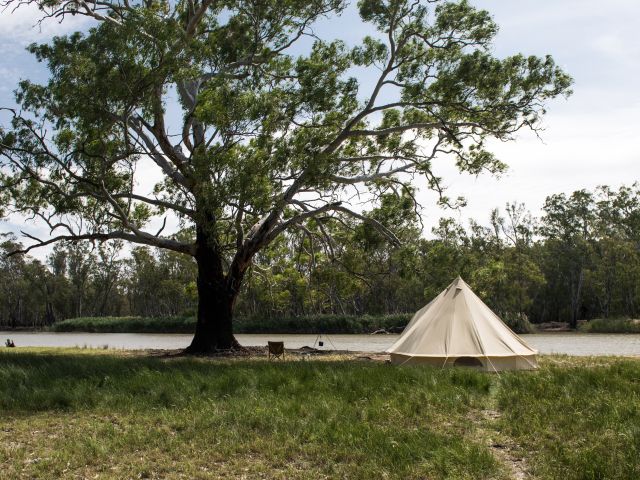
My friends and I spend three days on the water, swimming and fishing, sitting around campfires onshore at night, and basking in air so warm you’d swear you were in the tropics. The simplicity of river life reveals an interesting dichotomy: we feel disconnected from the world but at the same time connected to Country, privileged to be part of something so ancient and special.
Stop one: Echuca
A historic 19th-century paddlesteamer cruises along the Murray River. (Image: Visit Victoria)
The six-hour drive from Melbourne to Mildura (or four hours and 20 minutes from Adelaide) is more than worth it, but you don’t have to travel that far to find fun on the river. Once Australia’s largest inland port, Echuca is the closest point on the Murray to Melbourne (two hours 45 minutes), and you’ll still find a plethora of paddlesteamers tethered to the historic timber wharf, a throwback to the thriving river trade days of the 19th century. The PS Adelaide, built in 1866 and the oldest wooden-hulled paddlesteamer operating in the world, departs daily for one-hour cruises, while a brand-new paddlesteamer, the PS Australian Star, is launching luxury seven-night voyages in December through APT Touring.
The town is also a hot food and wine destination. St Anne’s Winery at the historic Port of Echuca precinct has an incredibly photogenic cellar door, set inside an old carriage builders’ workshop on the wharf and filled with huge, 3000-litre port barrels. The Mill, meanwhile, is a cosy winter spot to sample regional produce as an open fire warms the red-brick walls of this former flour mill.
Stop two: Barmah National Park
Camping riverside in Barmah National Park, listed as a Ramsar site for its significant wetland values. (Image: Visit Victoria/Emily Godfrey)
Just half-an-hour upstream, Barmah National Park is flourishing, its river red gum landscape (the largest in the world) rebounding magnificently after the recent removal of more than 700 feral horses. The internationally significant Ramsar-listed wetland sits in the heart of Yorta Yorta Country, with Traditional Owners managing the environment in close partnership with Parks Victoria. Walkways weave through the forest, crossing creeks lined with rare or threatened plants, passing remnants of Yorta Yorta oven mounds and numerous scar trees, where the bark was removed to build canoes, containers or shields.
The Dharnya Centre (open weekdays until 3pm) is the cultural hub for the Yorta Yorta. Visitors can learn about the ecological significance of the Barmah Lakes on a 90-minute river cruise, led by a First Nations guide, or take a one-hour, guided cultural walking tour along the Yamyabuc Trail.
Stop three: Cobram
Yarrawonga Mulwala Golf Club Resort. (Image: Visit Victoria)
Continue east to Cobram to find the southern hemisphere’s largest inland beach. Swarming with sun-seekers in summer, the white sand of Thompson’s Beach is shaded by majestic river red gums and dotted with hundreds of beach umbrellas, as beachgoers launch all manner of water craft and set up stumps for beach cricket. But the beach is at its most captivating at sunset, when the crowds thin out, the glassy river mirrors the purple sky, and the canopies of the gum trees glow fiery orange.
The region is also home to some fine resorts and indulgent retreats. Yarrawonga Mulwala Golf Club Resort has two riverside championship golf courses, luxury apartments and self-contained villas. While not strictly on the Murray, the historic wine town of Rutherglen is rife with boutique (and unique) accommodation, including an exquisitely renovated red-brick tower in a French provincial-style castle at Mount Ophir Estate. Fans of fortified wines can unravel the mystery of Rutherglen’s ‘Muscat Mile’, meeting the vignerons and master-blenders whose artistry has put the town on the global map for this rich and complex wine style.
Stop four: Albury-Wodonga
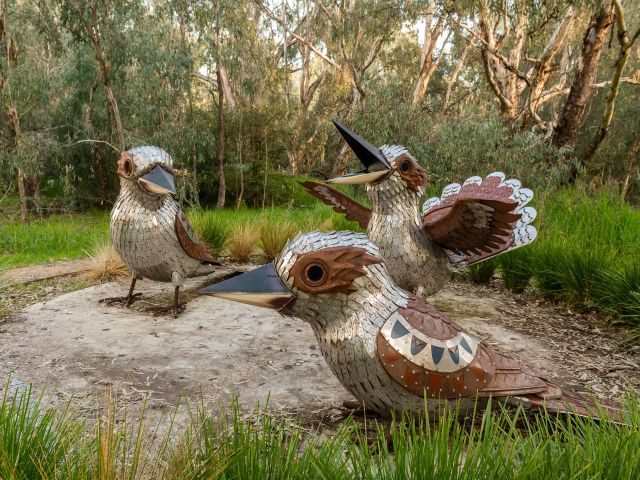
First Nations Yindyamarra Sculpture Walk is part of the Wagirra Trail. (Image: Carmen Zammit)
Follow the river far enough upstream and you’ll arrive at the twin border cities of Albury-Wodonga. The Hume Highway thunders through, but serenity can be found along the five-kilometre Yindyamarra Sculpture Walk – part of the Wagirra Trail that meanders through river wetlands just west of Albury in Wiradjuri country. Fifteen sculptures by local First Nations artists line the trail, conveying stories of reconciliation, enduring connection to culture, local Milawa lore and traditional practices. It feels a long way from Mildura, and it is, but the pelicans and kookaburras remind us that it’s the same river, the great conduit that connects our country.
A traveller’s checklist
Staying there
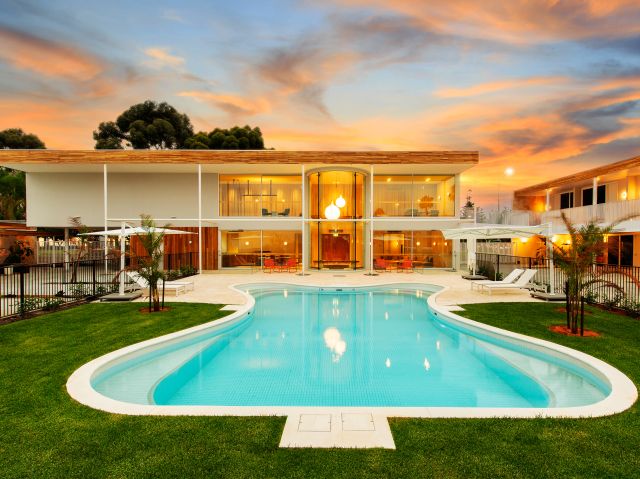
New Mildura motel Kar-rama. (Image: Iain Bond Photo)
Kar-Rama is a brand-new boutique, retro-styled motel in Mildura, with a butterfly-shaped pool and a tropical, Palm Springs vibe. Echuca Holiday Homes has a range of high-end accommodation options, both on the riverfront and in town.
Playing there
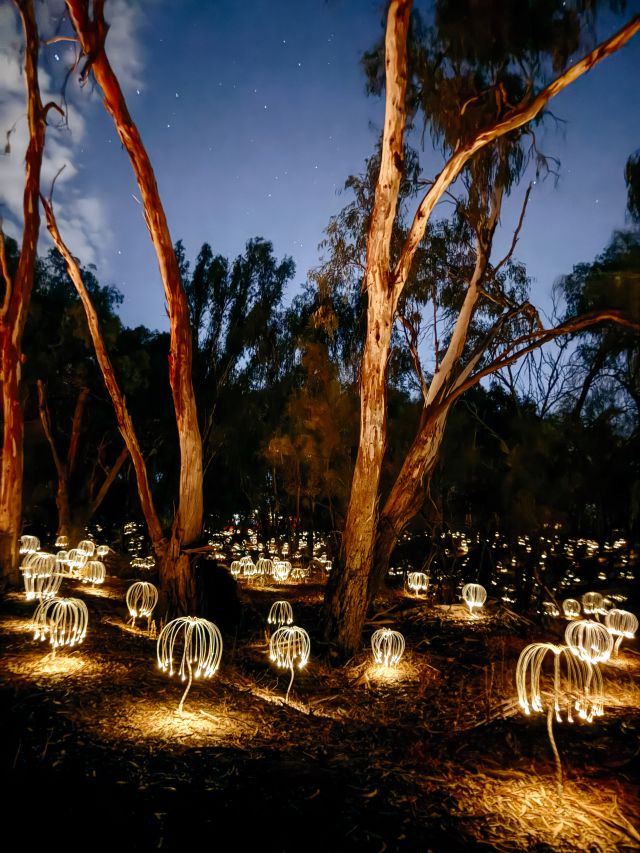
Bruce Munro’s Trail of Lights in Mildura. (Image: Imogen Eveson)
Artist Bruce Munro’s Trail of Lights installation, comprising more than 12,000 illuminated ‘fireflies’, is currently lighting up Mildura’s Lock Island in the middle of the Murray. Murray Art Museum Albury (MAMA) is a hub for contemporary art, with a rotating roster of exhibitions, and is a major outlet for young and First Nations artists.
Eating there
Mildura’s diverse demographic means it’s a fantastic place to eat. Andy’s Kitchen is a local favourite, serving up delicious pan-Asian dishes and creative cocktails in a Balinese-style garden setting. Call in to Spoons Riverside in Swan Hill to enjoy locally sourced, seasonal produce in a tranquil setting overlooking the river.