9 of the most haunted places to visit in Australia

hero media
Here are the most haunted places in Australia to spook yourself silly (or avoid, if you’d rather not).

Eerie noises, unexplained breezes, doors that open without reason. There are many haunted places in Australia where a dark past seemingly carries into the present. From sites of tragic accidents to places that lay witness to mass killings, there are plenty of ghost towns and locations where you can do ghost tours in Australia, or simply visit to see if your hairs stand on end.

1. Princess Theatre, Melbourne, Victoria

Melbourne’s Princess Theatre’s ghost is so prolific a seat is reserved for him on the opening night of performances. In 1887, Frederick Baker, known as ‘Federici’, took a leading role in the opera Faust. In his final scene, Federici fell through an on-stage trapdoor after suffering a heart attack and soon died backstage. Onlookers were none the wiser, assuming it was part of the show. Some even say he came out to take a final bow when the performance ended.

Over subsequent years, there were many reports of strange light flickering in the theatre and a number of people have said they felt something brush past them in an empty corridor. Strangest of all are the reported sightings of Federici himself in the theatre, often at night, where he is reportedly seen to be watching shows and critiquing performances.
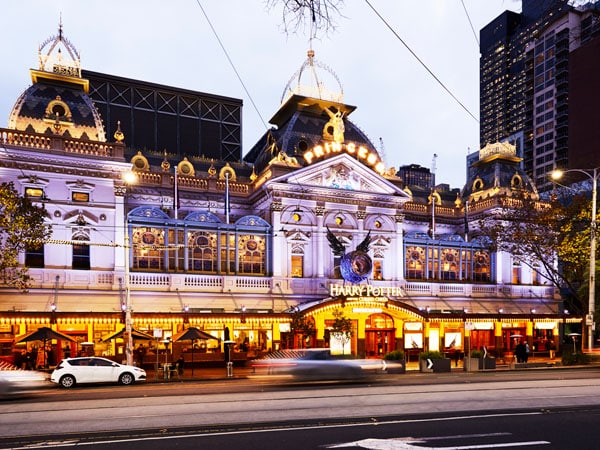
the Princess Theatre in Melbourne, Victoria
Princess Theatre is reportedly haunted by its own phantom of the opera named Frederick Baker.

2. Port Arthur, Tasmania

World Heritage-listed Port Arthur served as a convict settlement for almost 50 years, and more than 1000 people died at Port Arthur during this time.
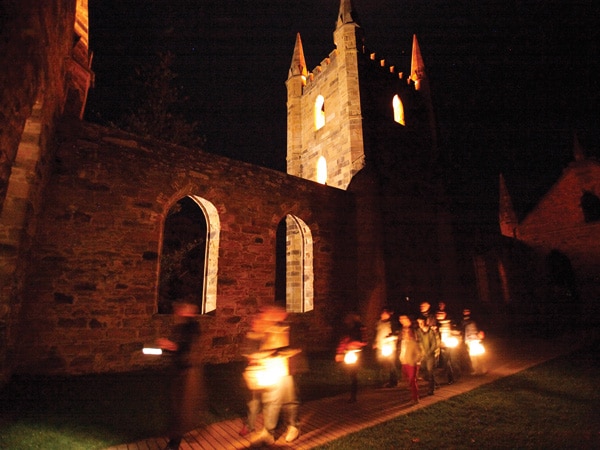
people touring around Port Arthur with lit lanterns
Lanterns brighten up Port Arthur as darkness falls. (Image: Tourism Tasmania & Simon Birch)

A series of unexplained events at the site have been reported since the arrival of free settlers and have been noted by soldiers and other visitors in more recent times. The old punishment cell in particular is known to be a hotspot for unusual activity.

Take a lantern-lit ghost tour at Port Arthur after dark and read about the experience here.
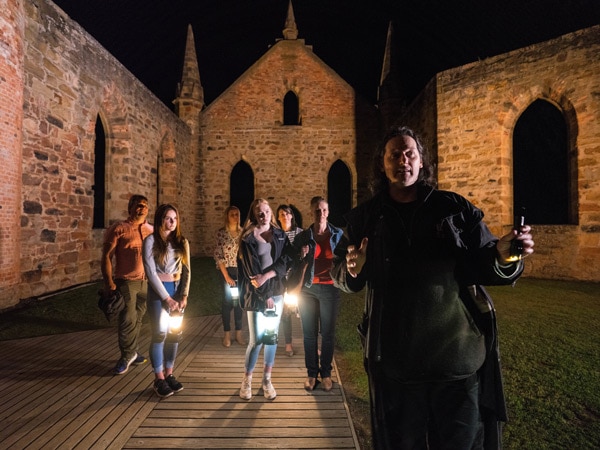
people holding lanterns on a guided ghost tour in Port Arthur
Join the lantern-lit ghost tour at Port Arthur after dark. (Image: Alastair Bett)

3. Aradale Lunatic Asylum, Ararat, Vic

This abandoned lunatic asylum (which we would now more appropriately call a psychiatric unit or mental health hospital) in Ararat is believed to be haunted, with many deaths occurring in the facility during its 126 years of use.

People have reported being pushed and tickled and have heard strange banging noises. Along with patients who died in the facility, the site is also said to be haunted by a former nurse. Ghost tours are offered at Aradale.

4. North Kapunda Hotel, South Australia

The North Kapunda Hotel has a solid reputation for being haunted. Kapunda, a one-hour drive north of Adelaide, was a busy mining town in the early 1800s and the pub opened in 1849 to service the region.

Many stories of crime are linked to the hotel, including a few murders. A ghostly woman, thought to be a sex worker killed in the pub, and a little girl, thought to be her daughter, are said to haunt the halls. Apparently, the ghost of a miner who died after having his leg amputated in the hotel can sometimes be seen cycling along nearby streets.

Ghost Crime Tours offer a ‘paranormal lockin ’ at the hotel, where you’ll be kitted with equipment to try to get a reading on paranormal activity in the building.
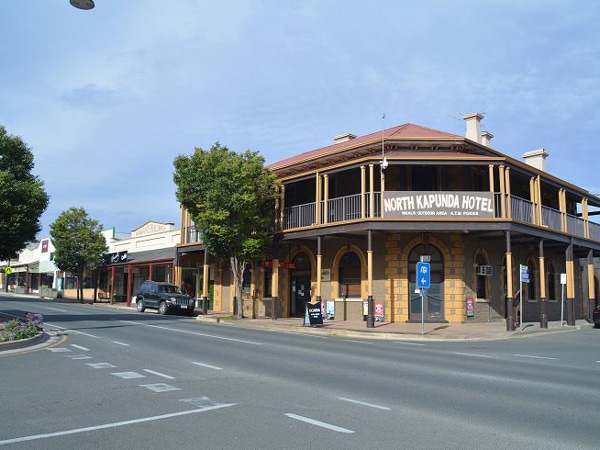
the property exterior of North Kapunda Hotel, South Australia
North Kapunda Hotel is one of the most haunted pubs in Australia.

5. Monte Cristo Homestead, Junee, NSW

The Monte Cristo Homestead was constructed by Christopher William Crawley, a farmer whose fortunes changed when he built a hotel near a new railway line in the 1800s. Crawley and his family members lived in the homestead… and some of them also died there. This includes Crawley himself and his wife, both from illness. Apparently neither of them have left the building since.
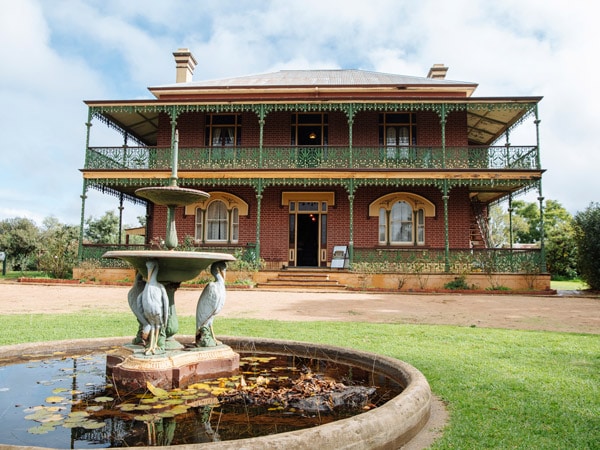
an old fountain fronting the Monte Cristo Homestead, Junee, NSW
The historic Monte Cristo Homestead is a two-storey late-Victorian-style manor. (Image: Destination NSW)

More tragically, it’s said one of Crawley’s maids threw herself off the balcony (or, was pushed) when she discovered she was pregnant with Crawley’s child. Another of Crawley’s illegitimate children, also born to a maid, is thought to haunt the property too. He’s supposedly joined by a stable boy who burned to death in an arson attack.
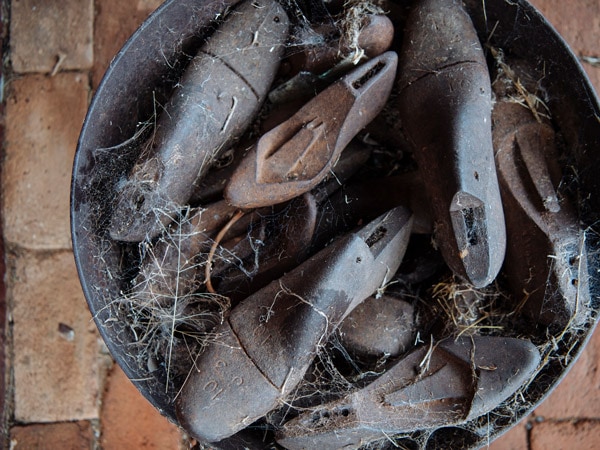
cobwebs covering old objects inside Monte Cristo Homestead, Junee, NSW
Creepy cobwebs cover the antiquities of the late Crawley family. (Image: Destination NSW)

These are just a few of the ghosts said to roam the property and you can try to feel their icy presence for yourself on a ghost tour at Monte Cristo.
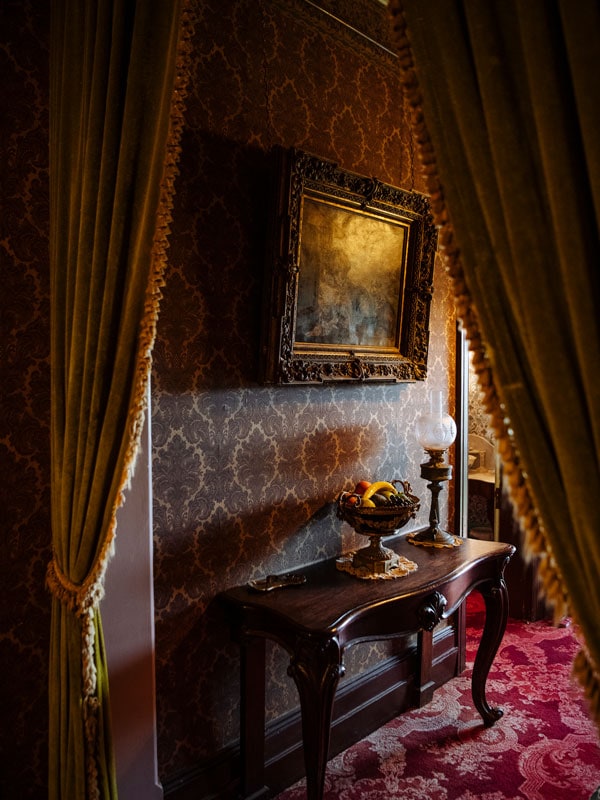
an elegant but haunted manor at Monte Cristo Homestead, Junee, NSW
Step inside the spooky elegant manor at Monte Cristo Homestead. (Image: Destination NSW)

6. Fremantle Arts Centre, Perth, Western Australia

The building now known as the Fremantle Arts Centre was built by convicts in the 1860s as an asylum for those suffering from mental illness and ‘poor’ women. Patients were treated more like prisoners and the facility became overcrowded, as it was deemed a ‘solution’ to deal with people suffering from a range of conditions, including menopause and sunstroke.
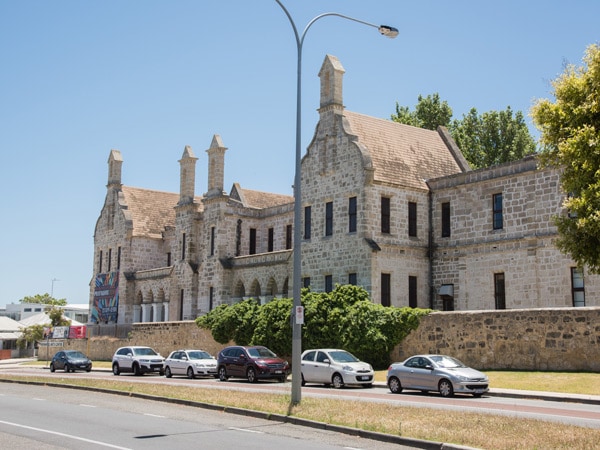
the gothic heritage building exterior at Fremantle Arts Centre in Perth, Western Australia
Fremantle Arts Centre is housed in a gothic heritage building in Perth, Western Australia.

The death of a woman at the hand of a violent inmate sparked the closure of the facility, and it was then used to house soldiers during WWII. This is when reports started of strange banging, whispering and crying at night. Staff who later came to work in the arts centre have reported sudden changes in temperature, thought to be the work of ghosts.
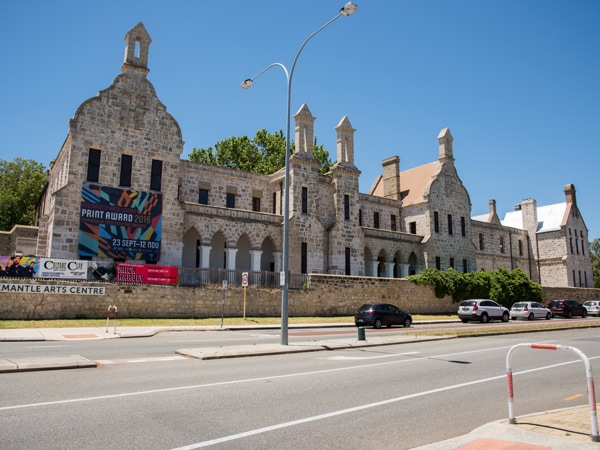
the exterior of Fremantle Arts Centre
Step back in time to the dark history of Fremantle Arts Centre.

7. National Film and Sound Archive, Canberra, ACT

Today, the National Film and Sound Archive (NFSA) celebrates and protects Australia’s audiovisual heritage, but, in a previous life, it was an anatomical institute. The building has housed many skeletons and other human and animal specimens, including Phar Lap’s heart and Ned Kelly’s skull.
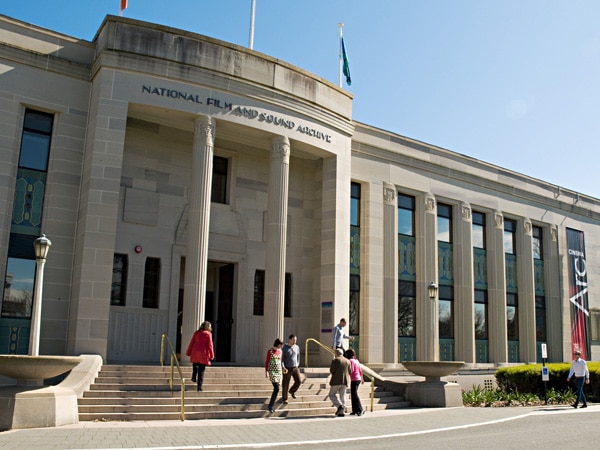
the entrance of National Film and Sound Archive, Canberra, ACT
NFSA preserves Australia’s vibrant audiovisual culture. (Image: National Film and Sound Archive)

As a result, many ghost hunters say it’s one of the most haunted places in Australia. In particular, the ghost of the founder and first director of the former Australian Institute of Anatomy, Sir Colin MacKenzie, is known to loiter in the halls on occasion. His ashes are housed in a wall behind a plaque that recognises him, so, whether in ghost form or not, he’s literally in the building.

The NFSA sometimes runs ghost tours, check the events page for details.
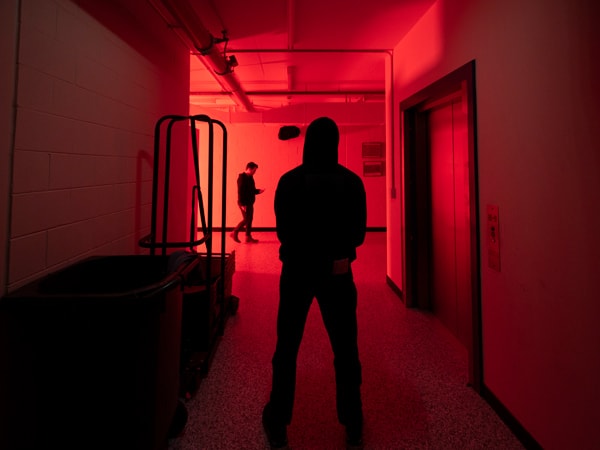
a ghost tour with cryptonaturalist Tim the Yowie Man
Experience an unnerving ghost tour with Tim the Yowie Man at NFSA. (Image: National Film and Sound Archive Ghost Tour)

8. Devil’s Pool, Babinda Boulders, Queensland

Devil’s Pool near Babinda in North Queensland is a stunningly beautiful place, but not all those who have been lured into its rainforest fringed, turquoise waters have come out alive. A notoriously dangerous swimming hole, 17 people have died here, mostly young men.

According to Aboriginal legend, a lovestruck woman named Oolana threw herself into the waters after being separated from her lover, Dyga, who, in a Romeo and Juliet-style tale, was from a different tribe.

Her spirit is believed to have never left the pool, and it’s said she now coaxes men in to join her in death. Some people have also reported unexplained crying in the area, thought to be Oolana crying out for Dyga.
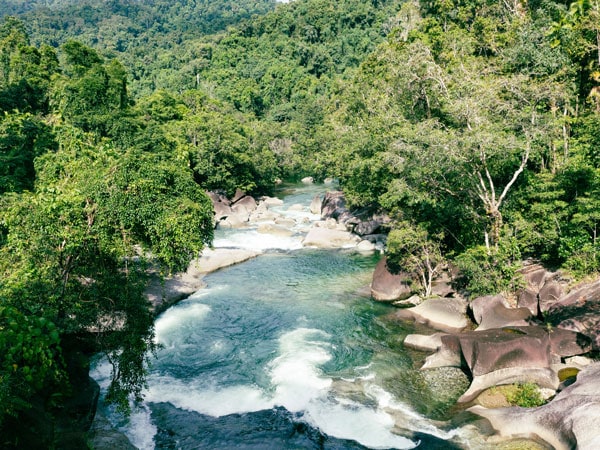
the Devil's Pool in Babinda Boulders, Queensland
Devil’s Pool is the said culprit behind tragic deaths in Babinda Creek.

9. Mushroom Tunnel, Picton, NSW

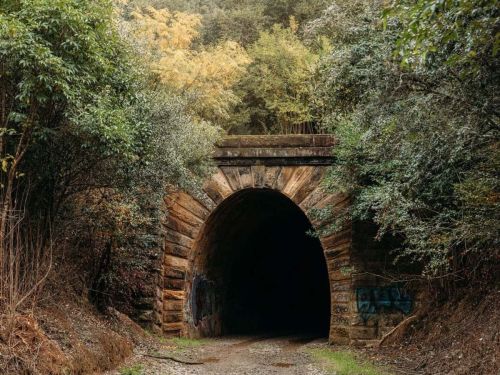
Picton, 90 minutes southwest of Sydney, is sometimes described as the most haunted town in Australia. When it was founded in 1821, the town was named Stonequarry, and its best-known landmark is the Mushroom Tunnel, formally known as the Redbank Range Railway Tunnel. It’s in this tunnel that a number of people have died – either accidentally or by suicide.
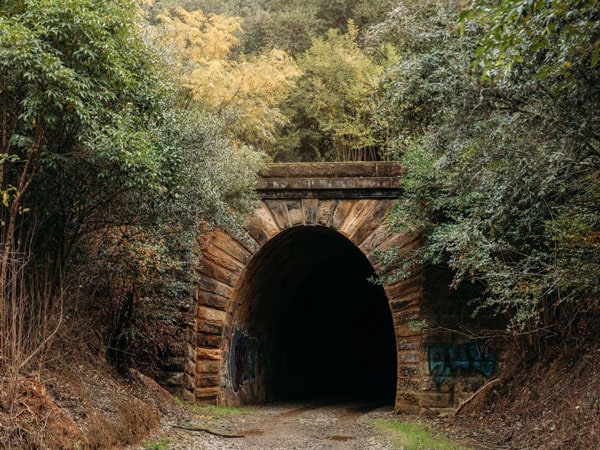
the dark entrance of Picton Mushroom Tunnel
Many visitors hear the eerie sounds of a steam train coming from the Picton Mushroom Tunnel.

The ghost of Emily Bollard, who was killed by a train in 1916, is perhaps the most famous. She is thought to be the white flowing figure of a woman with no face, who has reportedly been sighted on a number of occasions.

Elsewhere around Picton, a matron is said to haunt the old maternity ward; a young boy and girl and a bearded man are said to haunt the Wollondilly Shire Hall; and the jukebox at the Imperial Hotel has been known to fire up on its own, even when unplugged.

Organised ghost tours no longer run in Picton, but you can show up and try to see or feel the departed for yourself.
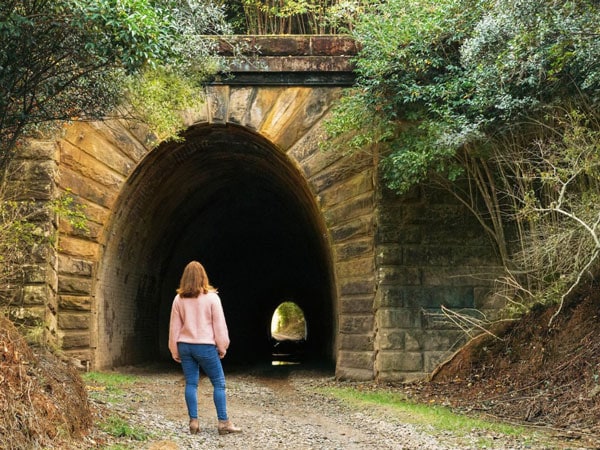
a woman standing at Mushroom Tunnel, Picton, NSW
Rumour has it that Mushroom Tunnel is cursed by a young woman.
Emily McAuliffe
Emily McAuliffe is a Melbourne-based freelance travel writer. She is on the board of the Australian Society of Travel Writers and her writing and photography has featured in many titles in Australia and abroad. She loves nothing more than touching down in a new destination or approaching a familiar place with fresh eyes.
See all articles

This luxe trawler tour is redefining Victoria’s seafood experience

Victoria’s ‘mussel capital’ is the source of exceptional shellfish used by top chefs far and wide. Step aboard a beautifully refurbished trawler to see how these plump and juicy bivalves are sustainably cultivated.

A curtain is slowly winched from the placid, teal waters just off Portarlington , like a floating garland beside our boat. The ropes heave with blue mussels, the star attraction of our tour. But as we reach to pluck our own, it’s quickly clear they’re not alone; a mass of weird and wonderful creatures has colonised the ropes, turning them into a living tapestry. ‘Fairy’ oysters, jelly-like sea squirts, and tiny, wriggling skeleton shrimp all inhabit this underwater ecosystem.

We prize our bivalve bounty from the ropes, and minutes later the mussels arrive split on a platter. The plump orange morsels are served raw, ready to be spritzed with wedges of lemon and a lick of chilli as we gaze out over the bay. They’re briny, tender and faintly sweet. “This wasn’t originally part of the tour,” explains Connie Trathen, who doubles as the boat’s cook, deckhand and guide. “But a chef [who came onboard] wanted to taste the mussels raw first, and it’s now become one of the key features.”

A humble trawler turned Hamptons-style dreamboat

inspecting bivalve bounty from the ropes
Inspecting the bounty. (Image: Visit Victoria/Hannyn Shiggins)

It’s a crisp, calm winter’s day, and the sun is pouring down upon Valerie, a restored Huon pine workhorse that was first launched in January 1980. In a previous life she trawled the turbulent Bass Strait. These days she takes jaunts into Port Phillip Bay under the helm of Lance Wiffen, a fourth-generation Bellarine farmer, and the owner of Portarlington Mussel Tours . While Lance has been involved in the fishing industry for 30-plus years, the company’s tour boat only debuted in 2023.

holding Portarlington mussels
See how these plump and juicy bivalves are sustainably cultivated.

It took more than three years to transform the former shark trawler into a dreamy, Hamptons-esque vessel, with little expense spared. Think muted green suede banquettes, white-washed walls, Breton-striped bench cushions, hardwood tables, bouquets of homegrown dahlias, and woollen blankets sourced from Waverley Mills, Australia’s oldest working textile mill. It’s intimate, too, welcoming 12 guests at most. And yet there’s nothing pretentious about the experience – just warm, down-to-earth Aussie hospitality.

As we cruise out, we crack open a bottle of local bubbles and nibble on the most beautifully curated cheese platter, adorned with seashells and grey saltbush picked from the water’s edge that very morning. Australasian gannets soar overhead, and I’m told it’s not uncommon for guests to spot the odd seal, pod of dolphins, or even the occasional little penguin.

The sustainable secret behind Victoria’s best mussels

blue mussels off Portarlington
Blue mussels sourced just off Portarlington.

Connie and Lance both extol the virtues of mussels. They’re delicious. A lean source of protein and packed with omega-3 fatty acids, vitamin B12, iron, selenium, and zinc. They’re cooked in a flash (Connie steams our fresh harvest with cider and onion jam). And they’re also widely regarded as one of the most sustainable foods in the world.

Portarlington mussels with lemon and chilli
Mussels served with lemon and chilli.

“Aquaculture is [often] seen as destructive, so a lot of our guests are really surprised about how environmentally friendly and sustainable our industry is,” Lance says. “[Our mussels] would filter 1.4 billion litres of water a day,” he adds, explaining how mussels remove excess nitrogen and phosphorus from the water. “And through biomineralisation, we lock carbon into mussel shells.”

a hand holding a Portarlington mussel
Mussels are a sustainable food.

Despite their glowing list of accolades, these molluscs have long been seen as the oysters’ poorer cousins. “It was a really slow start,” explains Lance, who says that in the early days of his career, “you could not sell mussels in Victoria”.

But word has slowly caught on. Chefs as globally acclaimed as Attica’s Ben Shewry and even René Redzepi of Noma, Denmark, have travelled to these very waters just to try the shellfish at the source, sharing only the highest praise, and using Lance’s mussels in their restaurants.

guests sampling Portarlington mussels onboard
Sampling the goods onboard. (Image: Visit Victoria/Hannyn Shiggins)

According to Lance there’s one obvious reason why the cool depths of Portarlington outshine other locations for mussel farming. “The water quality is second to none,” he says, noting how other regions are frequently rocked by harvest closures due to poor water quality. “We grow, without a doubt, some of the best shellfish in the world.” And with Lance’s bold claims backed up by some of the industry’s greatest names, perhaps it won’t be much longer until more Aussies uncover the appeal of Portarlington’s mussels.