Take it from a man who’s halfway round as we speak, lapping the continent is full of hurdles. Here’s how to leap them in style.
In my time in this country I’ve met a lot of people who haven’t seen much of Australia, even though they’ve lived here for years. Beyond the common comment “it’s just too far," many people think they don’t have the opportunity to simply get up and leave for any real length of time.
Nowadays, however, it’s more possible than ever. The house will rent out, the kids can be schooled as you travel and – if you’re willing to try new things – there are plenty of jobs to top up your funds as you go.
Even employers are easier to persuade into letting you have a year off. My wife and I simply thought, “What the hell – let’s go see all of Australia."
So we sold the house, gave up our jobs and decided to travel…
Why do it?
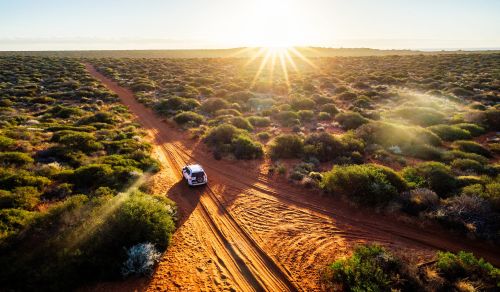
The big idea was freedom. To go where we wanted, when we wanted, to see Australia in all it’s varied beauty, to be able to find small hideaway beaches and to travel the outback. Above all to stop wherever we pleased and be able to survive, cook our own food, live cheaply and travel for as long as possible.
The only way to do this is to tour long term. There are more and more people doing this; take the Grey Nomads as an example. And why not? There’s everything you could ever want for on this island continent. The arid expanses of the outback call as keenly as the rainforests of the Daintree.
At around three months into our trip we realised it’s all about the planning we did (and didn’t do) in the beginning.
We know now we could have done more – in fact, lots more – but at least we did enough to give ourselves a good start. And in the end, there’s no substitute for experience, so take this advice: get drunk or lock yourself in a room . . . whatever it takes to map out your dreams. But, be realistic. You’re limited by time, so places thousands of kilometres apart might not be manageable if you’re travelling only for a month. We’d decided to make this our lifestyle, so we had no such time constraints.
Think again about how far you can get. We found that ability to stop and really explore new places to be the most rewarding, rather than following guidebook suggestions – which tend to be oversold. Harass any locals you can find for their favourite places. Map out where you really want to go but leave the timescale vague, so that if you want to spend an extra day somewhere you can.
The transport
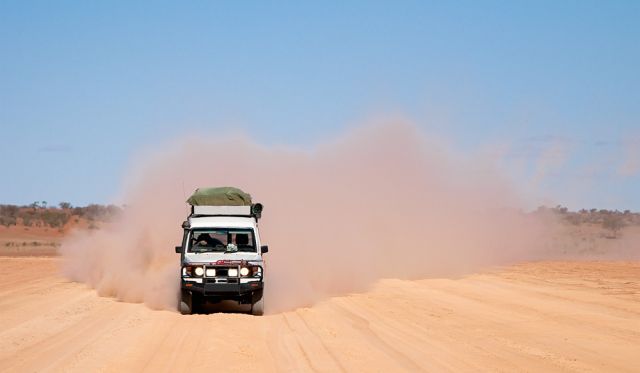
If you just want to stick to the main roads, a $2000 camper will do, but if you want to go feral, you must choose a 4WD. When I had my Lawrence of Arabia moment and envisioned my wife, my dog and myself crossing the shimmering deserts of central Australia, I honestly had no concept of what it entailed. I found you actually had to make it back from wherever you wanted go, so it turns out your truck is fantastically important.
If you’re planning on going remote, then it has to be a Toyota. They’re the workhorses of the outback – most remote garages will stock parts and their reliability is well known. We chose a Toyota Landcruiser Troopcarrier, known as a Troopy. It looks like a brick on wheels, but with the rear seats removed you can sleep in the back and store nearly the entire contents of your house.
Choosing your vehicle
Buying a touring truck is different than buying an everyday car. Will you be able to carry enough water? Can you store food? Can it handle the roads? Water consumption per person in hot weather should be a minimum of five litres each per day. Going to be away from civilization for five days? That’s an absolute minimum of 50 litres for the two of you – and that doesn’t include water for the dog or even brushing your teeth.
Without the right set-up, corrugations on outback roads will destroy your truck (and your mental state), literally shaking you to pieces. Letting your tyres down by ten percent will help, but remember you’ll need an air compressor to reinflate them.
Choosing your 4WD is a balance between price, condition and accessories; newer models might seem more attractive but if you then have to fit loads of accessories, your budget will balloon. If you look for a second-hander, it should come with at least some extras – although you may want to add more, as we did.
By not spending too much on the main buy, we had money left to fit whatever we wanted. Fancy a shower after a day on the beach? We can. Having a shower fitted was our big Luxury Buy ($1000), but worth every penny.
In the end we hammered our budget. We didn’t have time to shop around either and, in retrospect, were pretty thoroughly fleeced by some 4WD shops, so look hard and keep the wallet locked away until you’re damn sure of what you really want. Get written quotes and make sure any work is guaranteed. Don’t pay until you’ve thoroughly checked the work against everything you wanted done.
What to bring
Water
It’s possible to spend the cost of a small house on your vehicle – but keep in mind it is your house now. We decided we needed water aplenty, so we bought a poly-tank (polyethylene water tank) to go in the back.
We now carry about a 100 litres of water, which reduces any fears of ending up in the desert drinking our own urine. We also had a long-range fuel tank fitted, for two reasons: we won’t run out of fuel unless we’re stupid (in total we can travel 2000km); and over time we can save money by filling up with cheap petrol when we find it – you think prices in the cities are bad, wait until you reach the outback.
Technology
Other things we have are a fridge (and therefore a dual-battery system) storage drawers, a shower and UHF radio. We also picked up a cheap satellite phone on eBay to ensure our safety in areas with poor mobile reception, which is just about anywhere outside a city.
Camping gear
On the mechanical side, we had a service and new shocks fitted and the truck came with great tyres and up-rated suspension. Total cost? $24,000 the lot. It’s no more than you’d pay for a decent car – but we can go anywhere . . .
Your camping gear will also set you back a few bucks. Aim for quality gear; it’ll last longer and do the job better. But it’s a bit of a trial and error thing – we’re already on our second tent, which we use when staying somewhere for a few days. The first tent couldn’t even stand up to a light breeze, so we invested in a canvas model.
Storage
Think small. The rule seems to be as follows: the room you reckon you have always, always turns out to be less. You gather all your camping gear, your water, food, bedding, car spares, toolkit, CDs, everything else you can possibly think of . . . and the dog. Then you look again at the space you have. I know I said a Troopy has a cavernous rear, but even caverns get full. This must be the most mundane part of travelling, but also the part that may lead you to serious mental distress if you don’t get everything sorted.
Buy shares in a plastics company because storage boxes will be essential. Put your fruit in a box with lots of small holes in the top so it doesn’t sweat and the flies can’t get in.
You sit down to eat and realise the cutlery is somewhere in a box – you’re not sure which. You can always eat with your fingers, but the third time this happens you’ll be wondering where to source Valium.
Label your boxes with the contents. The herb and spice box is a great example; if you leave those little containers rolling around on their own, they’re apt to disappear come cooking time only to reappear in your bedding. Don’t ask why, they just do.
Tarp
You need to accept there’ll be things you haven’t thought of, or that go wrong very quickly. An example: you sleep in your truck and it starts to rain on all the gear you had to move outside to enable you to sleep in your truck in the first place. The simple answer to that one is: buy a tarpaulin.
If you’re anything like me, tarps will become your best friends. They provide wind shelter, protect your gear from rain and prevent dust from penetrating everything. The point here is that you need to be able to adapt and overcome these little adversities, or the entire experience can quickly turn sour.
A friendly disposition…
There are hundreds of other travellers on the roads. If you have a problem you need to sort out, talk to others – they often have great ideas and will help out if they can. At home you mightn’t have ever met your neighbours, but on the road there’s a great sense of community. You just need to open up a little.
Free is better than cheap
As we began our trip, fuel prices were just beginning their latest surge. Didn’t worry us. When you work out how little you’re spending overall, it seems not to matter so much. Once you’re self-sufficient, there are hundreds of free campsites dotted all over the country (try the excellent Camps Australia book).
If you make use of them, you’ll save yourself a fortune in campsite fees. The best free stops beat campsites hands down, but they take a bit of finding and much of your early education will be learning how to spot the good ones and avoid the bad. Stay away from stops by main roads. The noise of the big rigs passing at 3am will drive you nuts.
Despite blowing our budget, endless problems with 4WD accessory fitters, numerous trips to shops to take back rubbish camping gear and the now-solved mouldy tomato problem, the feeling that we can go anywhere we want is liberating. We’ve made loads of free one-night stops and also stayed in some places for weeks.
The first was at a campsite in a NSW state forest with no-one else around for miles. It was a slightly surreal experience, neither of us having been that far from people before, but now we actively seek out the isolation. We’ve found beautiful river stops no-one else seems to have visited for months. We’ve spent a few weeks on an idyllic secluded beach accessible only by 4WD and encountered no-one else for days.
Most of all, we’ve found a different way of life. One that relies not on TV for entertainment, but on the starry skies instead. Even in such a short time the changes have been profound. And we haven’t even reached the outback yet.