The lost art of the postcard

hero media
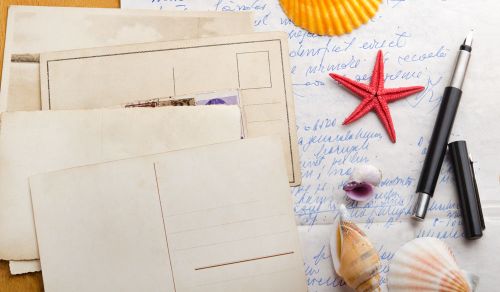
In a world of instant communication and oversharing, we long for the nostalgic act of sending a postcard by snail mail, writes Megan Arkinstall.

In 1895 The Sydney Morning Herald wrote, ‘In these degenerate days of postcards and typewriters, letter writing has become for many almost a lost art.’ Around 20 years earlier the NSW postal authorities issued the first postcard in Australia and they became the email or text message of the day.


People would use them to write short messages such as ‘See you this afternoon’ or to confirm meetings because, at the time, mail was delivered several times a day.


As years passed, messages became longer, despite the tiny writing space. During the two World Wars, postcards were used to send messages home; more than 900 postcards (decorative silk postcards were popular at the time) are held at the Australian War Memorial in Canberra.


When I was a child in the early ’90s, postcards were the chief way to share holiday stories with loved ones. Our annual family holiday was to Burleigh Heads on the Gold Coast; we would drive nine hours from our home in NSW – my Mum and Dad, two older sisters and me – listening to Madonna’s The Immaculate Collection or Roxette’s Joyride on cassette the whole way.


When we arrived, my parents would take us down to the local 7-Eleven store where we’d buy a Slurpee (the blue bubblegum flavour was my favourite) and some Gold Coast-themed postcards.


Nothing would beat the thrill of choosing the perfect postcard for each of my recipients; I would flick past the big-haired, hi-cut bikini girls (some sans bikini – oh my!) and choose something with dolphins or Dreamworld or the sparkly skyline of Surfers Paradise.


That night I’d sit in our holiday apartment and excitedly recount the day’s events to my Nan and Pop and some lucky friends, then copy their addresses from my address book (which I’d have on me, for this very purpose). And to be sure the postcards would beat us home, I’d pop them in the post box the very next day.


Fifteen years later, email was in and postcards were out. While on a three-month trip around Europe, I only purchased one postcard – a vintage one from Paris – and never put a stamp on it. Instead of heading to the nearest convenience store or market, I was paying €2 an hour to sit in an internet cafe.


Fast forward to 2016 and a string of holiday snaps posted to Instagram or Facebook is the way we now keep up-to-date with our friends’ and family’s whereabouts.


But, despite its convenience, some spontaneous words and a filtered selfie shared with a group (mainly made up of acquaintances, let’s be honest) is completely impersonal. Whereas a postcard was a conscious and thoughtful note sent to a few select and special people.


Being just a snapshot – not an entire chronicle of your holiday itinerary – the postcard created intrigue.


It was a challenge trying to fit in all the exciting things we’d done into the allotted space; I would always end up curling my last sentence around the address panel because Nanna needed to know that we had a barbecue after we played tennis and the next day we were going to Wet’n’Wild.


And can anyone honestly say that scrolling through a daily newsfeed is more enjoyable than receiving a colourful hand-written postcard in your letterbox? Not likely, especially when it’s sent from somewhere exotic… such as Ripley’s Believe It or Not!


Megan Arkinstall
Megan Arkinstall is a freelance travel writer who you’ll often find at the beach, bushwalking or boating with her young family. She loves reliving travel memories through writing, whether that be sipping limoncello in a sun-drenched courtyard of Monterosso or swimming with green turtles in the aquamarine waters of Tropical North Queensland.
See all articles

8 secret places in Western Australia you need to know about

    Kate BettesBy Kate Bettes
    hero media
    WA might be enormous, but the right insider knowledge brings its mysteries a whole lot closer.

    “Western Australia is a land of record-breakers,” says Carolyn Tipper, a Travel Director working on AAT Kings Western Australia tours. “It has the second-longest fault line, the second-largest meteorite crater, the second-fastest flowing river—it just keeps surprising you. And every area has its charm.”

    From tropics to deserts, Australia’s largest state is a land of extremes. You can’t see all of Western Australia in a lifetime, but with the right guide, you can discover its hidden pockets of magic.

    Carolyn wishes to reach her guests’ hearts. “I want them to enjoy and be in awe,” she says. “I want them to have the holiday of a lifetime.”

    1. Mimbi Caves

    You wouldn’t expect a Great Barrier Reef in the outback – but that’s what you’ll find at Mimbi Caves. Once part of a 350-million-year-old reef, these caves hold marine fossils, ancient Indigenous rock art, and Dreamtime stories shared by a Gooniyandi guide.

    “That’s when the real connection happens,” says Carolyn, who has taken guests through on the AAT Kings Wonders of the West Coast and Kimberley tour . “When guests connect, not just with the land, but with the people who have called it home for tens of thousands of years.”

    Eye-level view of traveller exploring Mimbi Caves.
    Walk through ancient limestone passages. (Image: Tourism Western Australia)

    2. Kalbarri National Park

    Nothing prepares you for the Kalbarri Skywalk: a 25-metre platform jutting over Murchison Gorge, 100 metres above the red cliffs and river below. From July to October, join the AAT Kings Untamed Pilbara and West Coast tour to see over 1000 wildflower species paint the park, and listen as an Indigenous guide shares their uses, bush foods and medicine plants.

    “I want our guests to have an emotional experience,” says Carolyn. “It’s not just about seeing the land, it’s about stepping into the stories.”

    An aerial view of the Kalbarri Skywalk, one of the secret places in Western Australia, with visitors on the edge.
    Stand on the Kalbarri Skywalk in Western Australia. (Image: Tourism Western Australia)

    3. Hamelin Bay Wines

    Margaret River isn’t just a top wine region – it’s a winner in every category. Where the Indian and Southern Oceans collide, granite cliffs rise, limestone caves sprawl and Karri forests tower. It almost distracts from the world-class Cabernet Sauvignon and Chardonnay.

    Almost.

    Out of over 100 cellar doors, AAT Kings pick Hamelin Bay Wines as a favourite. Hosted tastings of small-batch wines on the Western Wonderland tour end with a group meal. The menu shifting with the seasons.

    “Get off the beaten track to one of WA’s most relaxed venues for some amazing red and white signature wines,” explains Carolyn, “accompanied with upmarket pub food.”

    Spectacular views.

    A person raising a glass of Chardonnay against a glowing Western Australia sunset.
    Sip world-class wines at Hamelin Bay in Western Australia. (Image: Getty)

    4. Wildflower Guided Walk, Kings Park

    Western Australia is home to 12,000 native plant species – 3000 bloom in Kings Park’s Botanic Garden. Stroll past Kangaroo Paw, Banksia and blooms from the Goldfields, Stirling Ranges and Kimberley. “The diversity of Western Australia is immense,” says Carolyn, who leads guests through on the South Western Escape tour .

    Couple enjoying the view from the Lotterywest Federation walkway at Kings Park and Botanical Garden.
    Wander among thousands of native plant species. (Image: Tourism Western Australia)

    5. Hoochery Distillery

    Did you know that between Kununurra and Emma Gorge lies the state’s oldest continuously operating distillery? Well, the oldest legal one. Set on a family farm, Hoochery Distillery was hand-built using materials found on the property, conjuring up award-winning rum from local sugarcane, wet season rainwater and yeast.

    Today, visitors can sample a hearty nip of rum, along with whiskies and gins – all crafted using traditional, labour-intensive methods. It’s the ideal way to soak up the ‘spirit’ of the Kimberley on the AAT Kings’ Untamed Kimberley tour .

    People enjoying a rum tasting at one of the secret places in Western Australia.
    Sample award-winning rum. (Image: Tourism Western Australia)

    6. Geraldton

    The wildflowers of the Midwest will make your heart blossom. In Geraldton, the Helen Ansell Art Gallery brings the region’s botanicals to life in vivid colour and intricate detail. In nearby Mullewa, wander bushland trails lined with everlastings and native blooms. Further afield, Coalseam Conservation Park bursts into carpets of pink, white, and yellow each spring. Do it all on the Wildflower Wanderer tour with AAT Kings.

    woman walking through Wildflowers, Coalseam Conservation Park
    Chase vibrant wildflower trails. (Image: Tourism Western Australia)

    7. El Questro

    Wake up after a night under the stars at Emma Gorge Resort, ready to explore the mighty beauty of the El Questro Wilderness Park. With deep gorges, thermal springs, and cascading waterfalls, time slows here.

    Join the AAT Kings’ Wonders of the West Coast and Kimberley tour to drift through Chamberlain Gorge, where sheer sandstone walls glow burnt orange in the sun, archer fish flick at the surface, and rock wallabies peer down from ledges above. Then, step into Zebedee Springs, a secret oasis of warm, crystal-clear pools among prehistoric Livistona palms – a moment of pure, wild stillness.

    Emma Gorge Resort at El Questro.
    Wake to adventure at Emma Gorge Resort. (Image: Tourism Western Australia)

    8. Lake Argyle

    Once vast cattle country, Lake Argyle now sprawls like an inland sea – Western Australia’s largest freshwater lake, created by the damming of the Ord River. Scattered with over 70 islands, its glassy waters teem with life, like freshwater crocodiles, barramundi, bony bream, sleepy cod and over 240 bird species. That’s nearly a third of Australia’s avian population.

    Glide across the lake’s surface on a cruise as part of AAT Kings’ Untamed Kimberley tour , where the silence is only broken by the splash of fish and the call of birds. For Carolyn, this place is a perfect example of how WA’s landscapes surprise visitors. “Lake Argyle is a big puddle of water that became a game-changer,” she says. “Seeing it from a boat, coach, and plane is mind-blowing. It puts time, isolation and the sheer scale into perspective.”

    Aerial View of Triple J Tours on the Ord River, near Kununurra.
    Glide past islands on Western Australia’s largest freshwater lake. (Image: Western Australia)

    Discover more of Western Australia’s hidden gems and book your tour at aatkings.com.