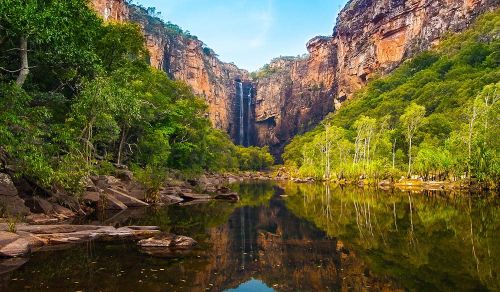
Kakadu photography: A professional shares where to get the best shots

Editor By Editor
hero media
Northern Territory photographer Tracy Ryan has a knack of capturing the majesty of Kakadu, in all its seasons and moods. Here are her top photography spots in the 20,000 square kilometre national park.

Kakadu’s ancient wetlands, escarpment, outliers, woodlands, and monsoon rainforests – home to our earliest Australians for more than 50,000 years – are a photographic and cultural adventure.

The national park recognises the local indigenous calendar of six seasons, where throughout the year the landscapes undergo spectacular changes.

The favourite time of year for photography enthusiasts to visit the park is ‘Wurreng’, in June and July (height of the dry season and its coolest time of year).

Yet, all year round, in all of the seasons, there is always somewhere spectacular to photograph.

Here are my favourite spots and the best time to photograph them. Enjoy!

1. South Alligator Region: Mamukala Wetlands (Sunrise)
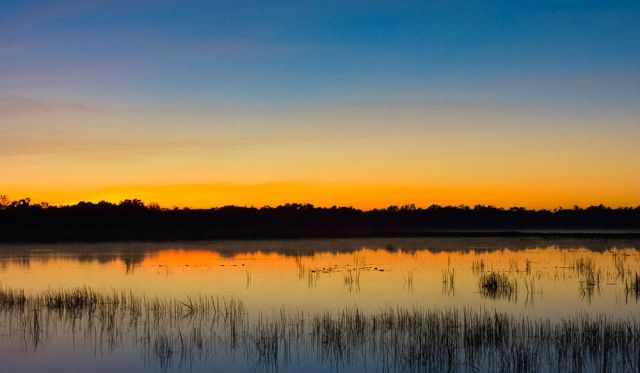
Dawn over the Mamukala Wetlands, Kakadu
Dawn Mamukala Wetlands, Kakadu (Photo: Tracy Ryan).

Make sure you get here early to photograph sunrise while waterbirds fly in for their first meal of the day. With the sun rising in a perfect spot opposite the well-covered observation platform, you will definitely be able to get that perfect shot.

The sun rises very fast in the Top End, so make sure you arrive before first light. Oh, and, cover up; the mosquitoes are huge, plentiful and are there for a morning meal as well.

Tips: Carry a tripod to keep your camera steady, set your ISO very high and use no flash. Also, a polarising filter can help to create vivid colours.

2. Nourlangie Region: Nawurlandja Lookout (Mid Morning)
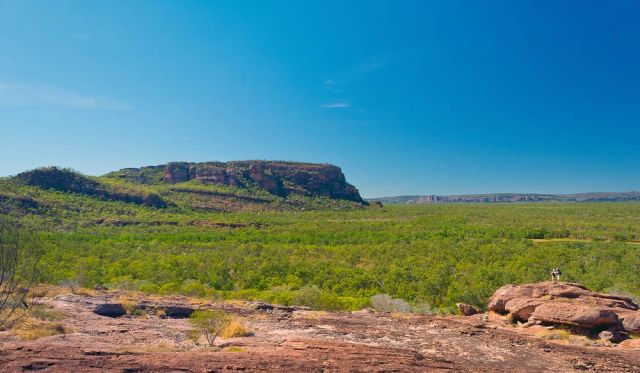
Nawurlandja Lookout, Kakadu
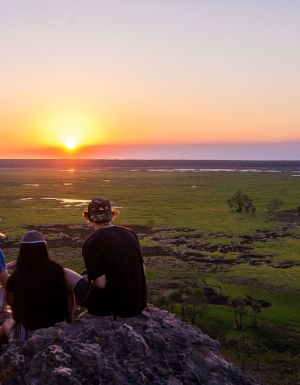
Look carefully and see the couple – that will give you a better sense of the Nawurlandja Lookout, Kakadu (Photo: Tracy Ryan).

Nawurlandja Lookout is a sensational spot, very easy to access yet still quite a secret. Not many people venture past the well known spot at Nourlangie – it’s only about a 500m walk up a slope.

The well signposted spot affords spectacular, expansive views, taking in Anbangbang Billabong, Nourlangie and an escarpment in the distance. On a clear day, you can see forever!

Tips: Use a good wide angle lens and a polarising filter to help create vivid blues and greens. Even with a ‘point and shoot’ camera on automatic you’ll get a sensational shot.

3. Nourlangie Region: Anbangbang Billabong (Early Afternoon to Late Afternoon)
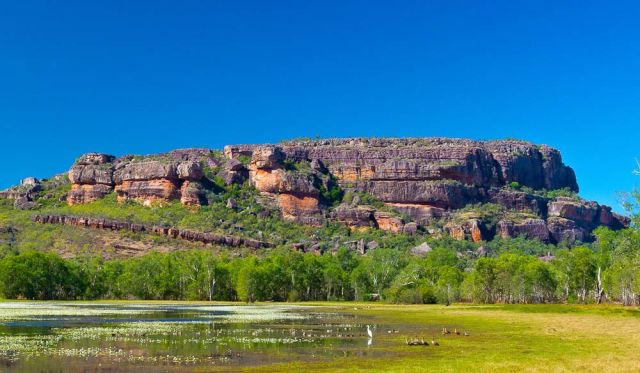
Anbangbang Billabong, Kakadu (Photo: Tracy Ryan).

If you can get into Anbangbang Billabong (check access) it is well worth visiting after Nawurlandja Lookout.

In Wurreng, it is more likely that you will be able to access the circular walk around the billabong.

If not, access is open along the entrance and down near the picnic areas. Head towards the end, look back, and you will see Nourlangie forming a spectacular backdrop to the billabong, which teems with birdlife and lilies. Beware of crocodiles! As the day progresses, the colours here change dramatically; the later you stay the more spectacular.

Tips: A wide angle lens and tripod are recommended.

4. Jim Jim Falls & Twin Falls Region (Midday & Later)
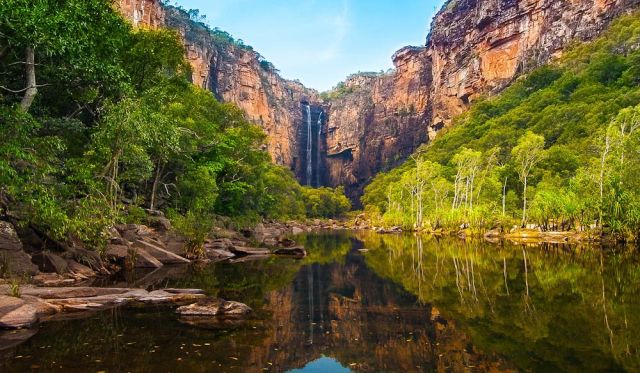
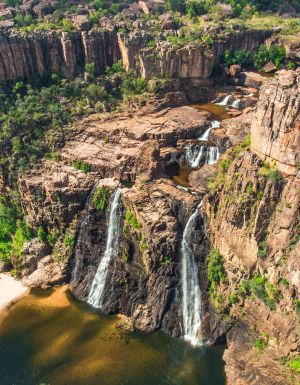
Jim Jim Falls, Kakadu (Photo: Tracy Ryan).

Spectacular Jim Jim Falls is accessible only by 4WD (check access) and takes two hours one way, with soft sand prevalent in the last 10km of the track.

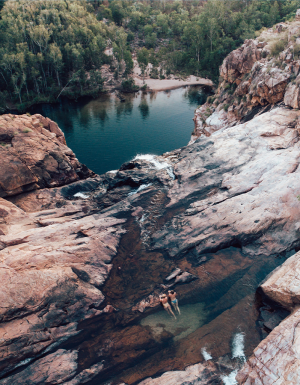
Then there is a 2km return walk to the falls through monsoon rainforest and over boulders (make sure you are fit, wear good shoes and take plenty of water!), taking you to a deep plunge pool where silica sand rests on the bottom, leftover from the ancient inland sea that once covered much of inland Australia.

Ensure you allow a day for this trip if you want to take your time to get some good shots. Crocodiles have been sighted in this area, so heed the information at the start of the walk. You will be able to capture amazing shots all along this walk, but the best opportunities are not too far from the car park, where you can capture the immensity of this ancient landscape and reflections in the water of the towering gorge.

Tips: Use a high ISO in low light, but a standard lens will suffice.

5. Yellow Water Region: Kakadu Animal Tracks Safari (Sunset)
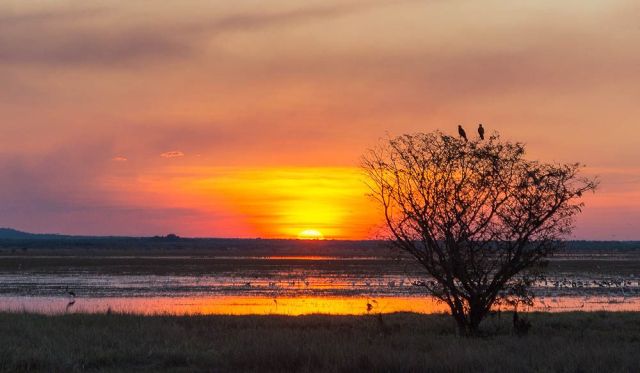
Goose Camp, Kakadu
Animal Tracks Safari’s Goose Camp, Kakadu at sunset (Photo: Tracy Ryan).


To capture the most spectacular sunset shots in Kakadu, head to my favourite place, Goose Camp – only accessible on a half day, Kakadu Animal Tracks Safari .

This safari has access to wildlife-rich wetlands and tropical savannah woodland and includes an unforgettable, awe-inspiring bird gathering spectacle, where magpie geese, ducks, pelicans, kites, black-necked stork and brolga can be seen feeding and settling down for the night. Buffalo and crocodile may also feature.

Tips: Make sure you take your long lenses if you want to capture intimate shots of the birdlife and a wide angle lens for sunset shots. Under exposure and a high ISO will make colours more vivid.

Tracy Ryan photography tours

Tracy Ryan is an award-winning landscape and nature photographer from Darwin.  Aside from bespoke photography tours Tracy also offers a one-off  aerial photography tours. See tracyryanphotography.com  for more information.

For more information on Kakadu & things to do in the NT, visit the official Northern Territory website at northernterritory.com

hero media

8 Red Centre locations to explore after seeing the new movie, Kangaroo

Spend a few days visiting the real-life Central Australian locations that inspired the new film everyone is talking about, and discover why Alice Springs is such an important part of Australian culture.

In the credits of the new Australian film Kangaroo , the first name under ‘cast’ should read ‘The Northern Territory ’. Not only is Alice Springs (and the surrounding landscape) integral to the movie itself, but the spiritual heart of Australia and its local Indigenous owners also inform the look and feel of every frame, explains Producer Trisha Morton-Thomas of Brindle Films, who also plays Charlie’s grandmother Gwennie.

“By setting Kangaroo in Alice Springs (Mparntwe), the film embraces how visible Aboriginal people are here, and the living Aboriginal culture that is woven through this community,” she explains.

still from kangarro film
See Kangaroo, then visit the real-life filming locations.

And while shooting in such a sacred part of the Northern Territory required extra planning, it was something the cast and crew were highly invested in.

“There are incredibly significant sacred sites and places of deep cultural stories in the area, that at times are very gender-specific, which we’ve kept out of the production,” she explains. “Even if overhead drone footage captures a sacred site that isn’t meant to be seen by other people outside of that clan, we’ve made sure to omit it from the film.”

If Kangaroo piqued your interest in a Central Australian holiday, we don’t blame you. Read on to discover eight places featured in the movie that you can visit in real life – and get planning. Don’t forget to pack sunscreen and a hat.

1. Alice Springs/ Mparntwe

artist at Many Hands Art Centre
Visit the galleries of Alice Springs, like Many Hands Art Centre. (Image: Tourism NT/ Helen Orr/ Many Hands Art Centre)

The red and dusty streets of the film’s fictional town of Silvergum were filmed on the outskirts of Alice Springs. And, while the art gallery featured in the film is fictional, Alice Springs is a hub of creativity. See the work of local artists at the Araluen Art Centre , Yubu Napa Art Gallery , Iltja Ntjarra (Many Hands) Art Centre and the famous Tjanpi Desert Weavers .

2. The Kangaroo Sanctuary & Kangaroo Rescue Centre

The Kangaroo Sanctuary Alice Springs, the inspiration for the Kangaroo move
Visit the movie’s inspiration at Kangaroo Sanctuary. (Image: Tourism NT/ Kangaroo Sanctuary)

Kangaroo was inspired by the journey of Chris ‘Brolga’ Barns, who founded the now world-renowned Kangaroo Sanctuary based in Alice Springs. For lead actor, Aussie Ryan Corr, the animals were central to the movie, alongside the landscapes.

“The animals in this story were a real calling point for me,” he explains. “What this story tries to tell us about the connection between humans and animals is beautiful.”

To gain a real insight into the fauna and flora of the Red Centre, you can visit the Kangaroo Sanctuary on a sunset tour, where you might even get the chance to hold a baby kangaroo.

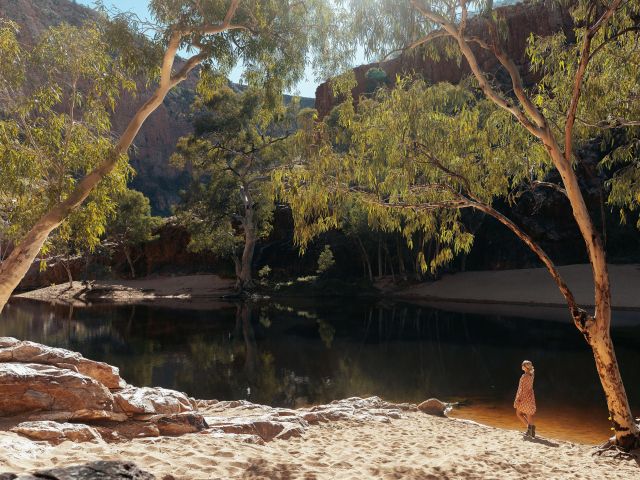
3. Ormiston Gorge

woman walking along the edge of Ormiston Gorge near alice springs
Take a dip in Ormiston Gorge. (Image: Tourism NT/ @domandjesso)

The film captures the raw beauty of the West MacDonnell Ranges, known in the Arrernte language as Tjoritja. This national park is rich in Indigenous culture and stark geological wonders.

Only a 15-minute drive from Alice Springs, Tjoritja offers visitors the chance to camp, hike and swim among ancient landscapes (most attractions are less than a three-hour drive away).

Ormiston Gorge , a cooling oasis in among the red desert sands, is one of the most popular destinations, no doubt because of the permanent swimming hole and towering red cliffs. From here, visitors can also embark on the beautiful Ormiston Pound Walk and the shorter – more accessible – Ghost Gum Walk. Bring your bathers – it’s safe for swimming.

4. Standley Chasm

woman walking through Standley Chasm near alice springs
Wander through Standley Chasm. (Image: Tourism NT)

The 1.2-kilometre walk to nearby Standley Chasm will be a highlight for any visitor as the imposing 40 metre-high chasm walls project strength and ancient wisdom.

Visit at midday to experience the path illumined by the midday sun. Not only will you fill your camera roll with vibrant red images of the gorge and its intoxicating shadows, but you can also camp nearby in a powered or unpowered site so you can watch the brilliance of the desert stars fill the night sky after dusk.

5. Simpsons Gap

three people walking on path through simpsons gap near alice springs
Walk the trails of Simpson’s Gap. (Image: Tourism NT/ Helen Orr)

Closer to Alice Springs, the photogenic Simpsons Gap is the perfect place to spot the endangered Black-footed Rock wallaby near the permanent watering hole. While swimming isn’t permitted, soaking up the sun and views certainly is.

Explore the area’s numerous walking trails, appreciate the soaring cliffs on either side of the ‘gap’ and pick out the shooting locations of Kangaroo in the area.

6. Ellery Creek Big Hole

aerial of Ellery Creek Big Hole near alice springs
Dive into Ellery Creek Big Hole. (Image: Tourism NT/ Tourism Australia)

When it comes to classic Northern Territory landscapes, you can’t go past Ellery Creek Big Hole/ Udepata : tall gum trees sidling up to a refreshing watering hole (fed by the West MacDonnell Ranges and surrounded by rugged red cliffs.

Swim in the cooling waters, hike the cliff tops, watch for birds and even stargaze as you camp here overnight. It’s locations like this that attracted the film’s director Kate Woods to the project.

“It humbles you to be in this environment: it’s so beautiful, so old and so vast,” she explains. “I was thrilled to get a chance to … shoot such a beautiful story in the incredible landscape of the Northern Territory.”

7. Larapinta Drive

aerial of Larapinta Drive into alice springs
Drive along Larapinta Drive. (Image: Tourism NT)

There is no better way to get a feel for how the characters arrived at the fictional Central Australian town of Silvergum than to travel along the iconic state road, Larapinta Drive.

Connecting Alice Springs to the mighty King’s Canyon in the west, via the historic community of Hermannsburg, this road takes in the West MacDonnell National Park, Alice Springs Desert Park and artist Albert Namatjira’s house, among other attractions. Take your time, bring a camera and prepare for numerous stops along the way.

8. Todd River

competitors in Henley on Todd Regatta, alice springs
Join in the fun of the quirky Henley on Todd Regatta. (Image: Tourism NT/ TImparja Creative)

Meandering through Alice Springs like a lazy Western Brown snake, the Todd River is a central part of Alice Springs culture. Known as an ‘intermittent river’, the Todd can go from a dry dusty riverbed to a flowing waterscape in less than 15 minutes after heavy rainfall.

When it’s dry, the famous Henley on Todd Regatta fills the sandy riverbed with handmade ‘boats’ carried by sailors. This is the world’s only dry river boating event, and it’s referenced in the ‘Silvergum Boat Race’ in the movie. Inspired by the real-life event, the characters built quirky “Flintstones-style boats” and competed in teams.

See Kangaroo in cinemas now, and start planning your NT getaway at northernterritory.com.