6 days solo on the Larapinta Trail

hero media
With only a week up her sleeve, Caro Ryan squeezes in the best of the Larapinta Trail’s wild swimming holes, classic ridgetop hikes and a summit sunrise that leaves her longing for more.

In my dreams I find myself out in the wilderness, taking on one of Australia’s long-distance hiking trails, The Larapinta Trail, in a single, unbroken journey. But, like so many of us, the realities of life dictate that my adventures are squeezed into bite-sized chunks of week-long forays, book-ended by a frantic rush to prepare, followed by an Everest of washing.

So, while the 223 kilometres of the Northern Territory’s Larapinta Trail can be swallowed whole in 14 to 20 days, I’m content with just six days and a taste of the best the Larapinta Trail has to offer.

Day 1 – Alice Springs and Section 10 (Ormiston Gorge to Finke River)

Piling into a minibus in Alice Springs, I take stock of my group for the next six days: an eclectic mix of Aussies aged between 40 and 60, including a few solo hikers, a married couple and a pair of friends who do a week-long hike together each year. We’re the types who love to feel the earth under our feet and to connect with wild places in a way that leaves our bodies feeling like they’ve moved, climbed or scrambled. It’s not long before we’re sharing stories as the van rushes west along the Namatjira Highway.
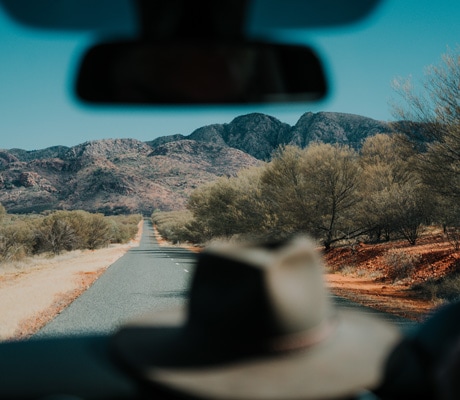
Larapinta Trail, Northern Territory
On the road to the start of the Larapinta Trail.

Arriving at Ormiston Gorge, we hit the trail along Section 10, which – at just 9.1 kilometres ­– is the shortest of Larapinta’s 12 sections. It’s a good introduction to this big sky country with a gentle ascent to a great lunch spot at Hilltop Lookout.

It’s late in the April to September hiking season so, after a few hours walking in 34°C temperatures, sliding into the cool, calm waters of the Finke River – the first of many wild-swimming opportunities – is the respite everyone has been waiting for.
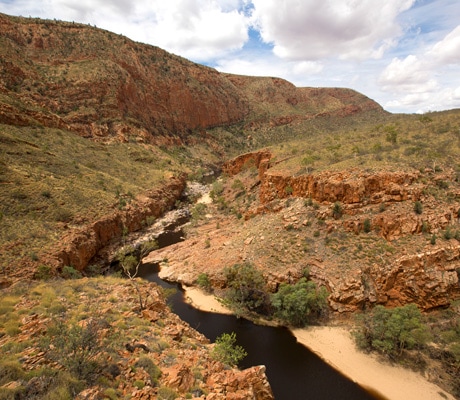
Ormiston Gorge, Northern Territory
Arriving at Ormiston Gorge at the start of the Larapinta Trail.

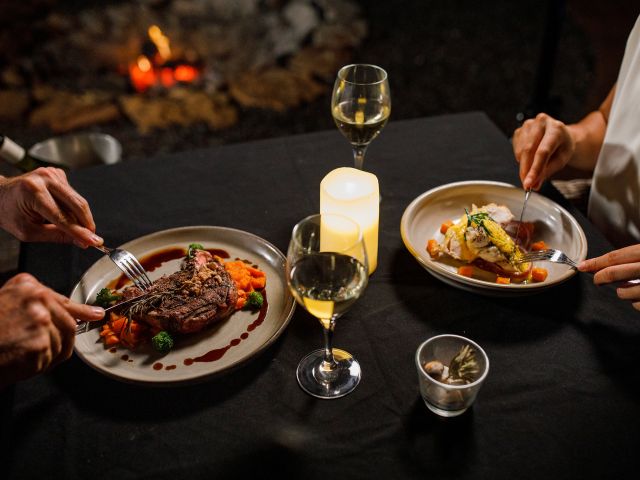
Later, at basecamp, with our bellies full after three delicious courses, I fight heavy eyelids, trying to stay awake to watch just a little more of the star-heavy sky as it presses down on me. Just one more satellite; one more shooting star. Fortunately, I still have five nights in the swag to take it all in.

Day 2 – Serpentine Gorge to Serpentine Chalet (section 8)

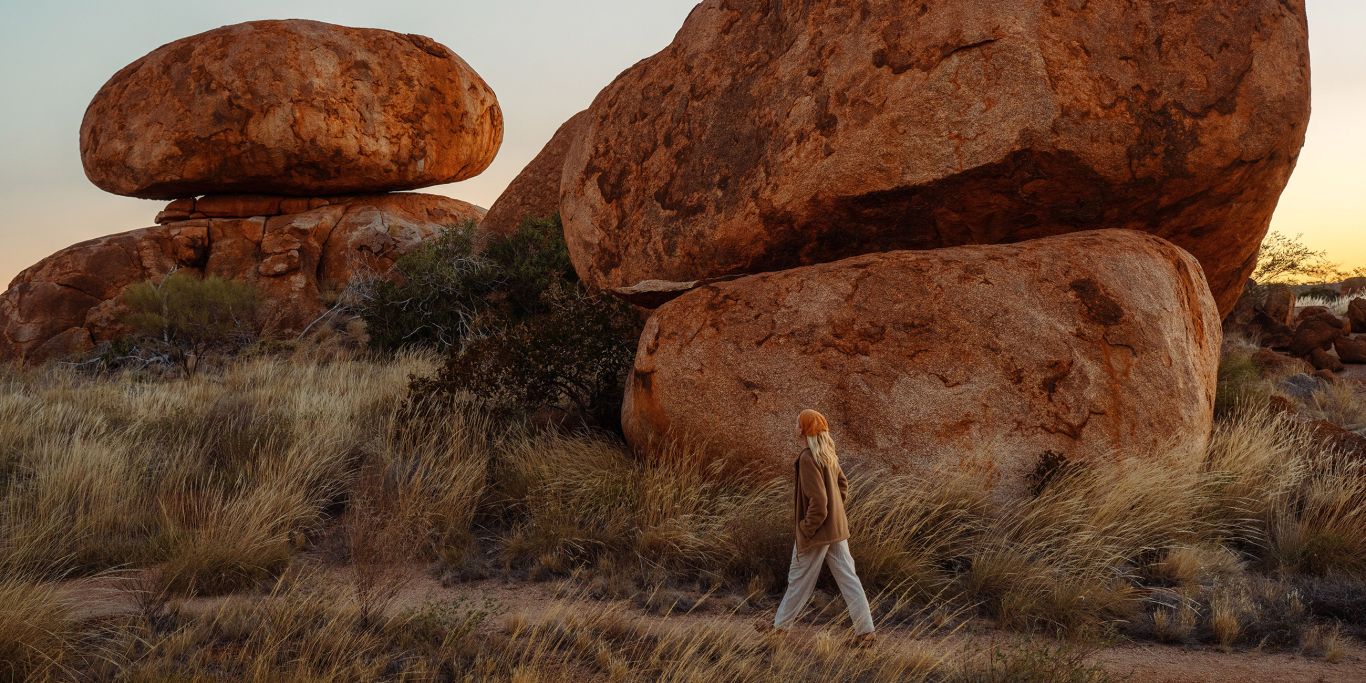
With three litres of water in our daypacks, we hit the trail before 8 am for the first real ascent (350 metres) up to the Heavytree Range. This is my type of hiking: skimming along broken, rocky ridgelines with 360-degree views that zigzag until we reach Counts Point lookout; the perfect little lunch spot. Here, our guide interlaces geological stories about how the landscape came to be with those of its traditional owners, the Arrernte people. Somehow, from up here, it all makes sense.
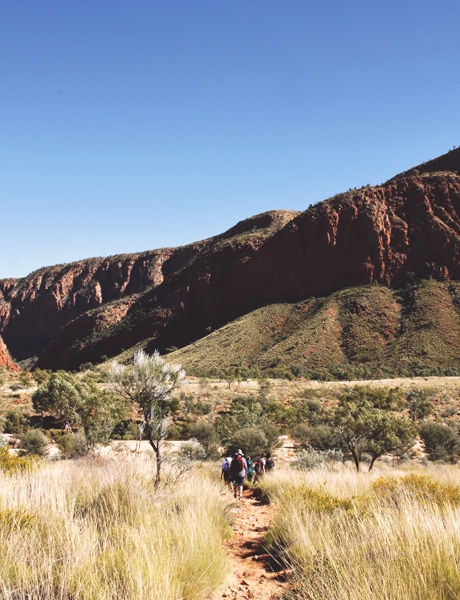
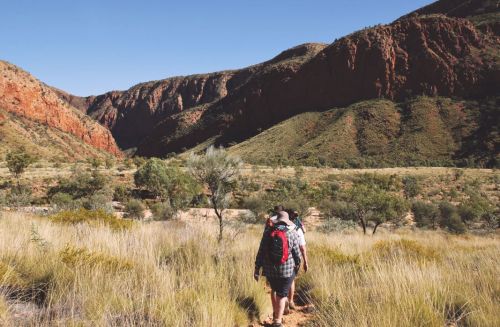
Larapinta Trail, Northern Territory
Hiking the Larapinta Trail.

We finish up at one of the chillier swimming holes. Brisk, but not bracing, the now-familiar ochre cliffs keep the setting sun at bay.

Need tips, more detail or itinerary ideas tailored to you? Ask AT.

AI Prompt

Day 3 – Serpentine Chalet Dam to Inarlanga Pass and the Ochre Pits (section 9)

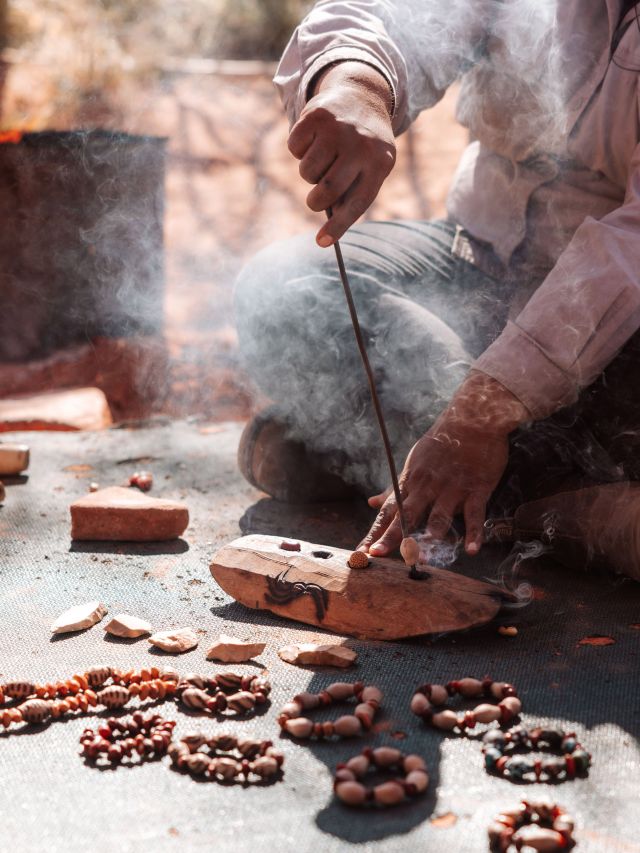
Conscious of the pre-dawn wakeup call tomorrow, we spend a gentle morning walking to Inarlanga Pass, learning about the ceremonial site’s significance along the way. A mildly technical (and fun) rock scramble leads us through a high-walled, open-sky tunnel, birthing us out into the vast channel between two ridges of the Tjoritja/West MacDonnell Ranges National Park. We return along the Arrernte Walking Track and a trailhead at the Ochre Pits, with its earthy rainbow-stained walls evidence of the site’s 40,000-year-old history.


By now, we’re used to having a post-walk swim and today delivers a chilly dip in the reed-edged waters of Glen Helen Gorge. Not content with simply an aquatic refreshment, we stop in at Glen Helen Homestead for the classic outback pub (and grub) experience (the works burger and a cold beer hits the spot).
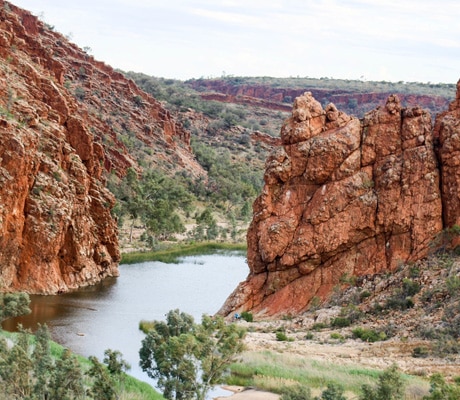
Glen Helen Gorge, Northern Territory
Today delivers a chilly dip in the reed-edged waters of Glen Helen Gorge.

Day 4 – Mount Sonder Sunrise

We’ve been ambling along towards Mount Sonder (the western end of the Larapinta) for the past four days, listening to the Arrernte stories of how she is a reclining pregnant woman, and today is our moment to finally meet her. With fresh batteries in our head torches, beanies on and jackets zipped to brave the surprisingly strong cold wind, we start the 8-kilometre, 680-metre ascent at 2.45 am. We make the summit just in time to see the boiling red sun start her ascent across the Territory sky. Only after turning my back do I see my favourite view of the entire trip: the bold dawn light has cast Sonder’s feminine shadow across the plains below.
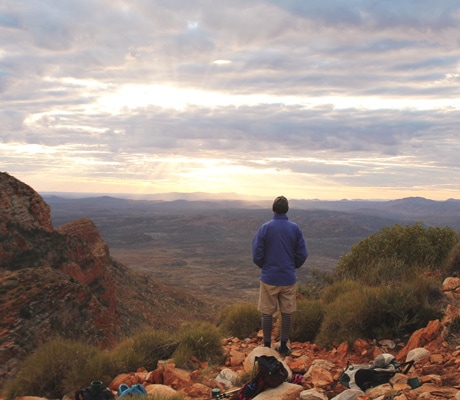
Mount Sonder summit
The summit of Mount Sonder at sunrise is a highlight of the Larapinta Trail.

Day 5 – Ormiston Gorge and The Pound Walk

Not strictly part of the Larapinta Trail, the seven-kilometre (3-4 hour) Ormiston Pound circuit walk is one of the best day walks of the West MacDonnell Ranges. Refreshed after yesterday’s lazy afternoon, we set off in an anti-clockwise circuit. Upon summiting the lookout, I ponder the pound’s bowl-like structure and notice the harsh, vibrant colours of the desert mixed in with the soft pastel mauves of an Albert Namitjira painting. The circuit ends by leading you through (yes, through) the chilly waters of Ormiston Gorge and back to the hubbub of the campground and kiosk.
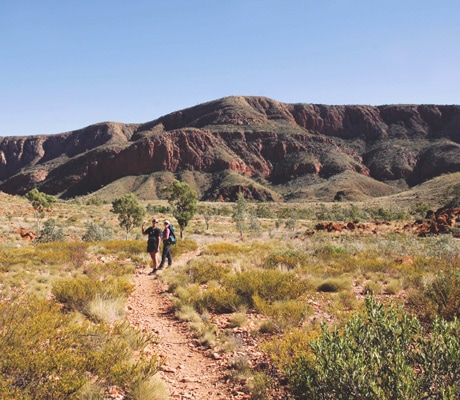
Ormiston Pound, Larapinta Trail
The Ormiston Pound circuit walk is one of the best day walks of the West MacDonnell Ranges.

Weekly travel news, experiences
insider tips, offers, and more.

Day 6 – Drive to Alice Springs via Ellery Creek Waterhole

The end of the trip and my Everest pile of washing is sadly not too far away. It’s just under a two-hour drive back to Alice Springs, but we’re not leaving without stopping for a final dip. The popular Ellery Creek Big Hole (waterhole) provides my final wild baptism, inspiring me to return one day to walk the full length of the epic Larapinta.
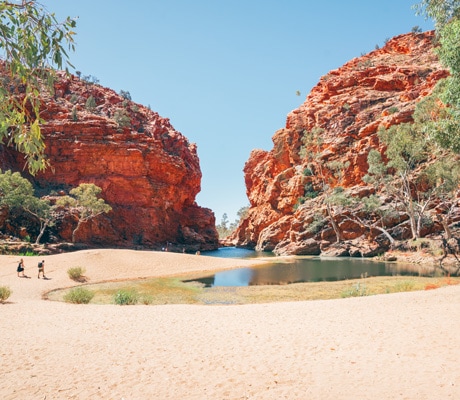
Ellery Creek Big Hole, Northern Territory
Be sure to stop for a final dip at the popular Ellery Creek Big Hole.

Details

Getting there: Virgin Australia flies to Alice Springs from Adelaide, Darwin and Brisbane, while Qantas flies direct from Darwin, Uluru, Sydney, Adelaide, Melbourne and Perth.

Staying there: You can bush camp along the full length of the Larapinta Trail at 29 designated campsites. All trailheads have a water supply and some have free gas BBQs.

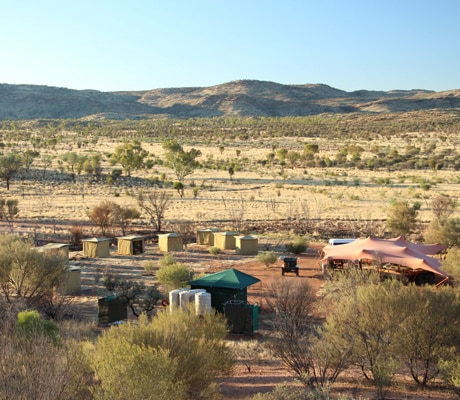
Several tour companies provide semi-permanent base camps as part of their itineraries. Check out Trek Larapinta, World Expeditions, Walking Country and Epicurious Travel.
World Expeditions
The Larapinta Trail camp with World Expeditions.

Eating there: Independent trekkers must bring all their own supplies, with food drops and logistics available. Fully guided tours provide all meals and snacks.

Hiking there: End-to-end trekking along the Larapinta Trail is for fit, experienced and well-equipped hikers only. If in doubt, go with a licensed tour operator for a shorter guided journey. The best time to go is during winter; be prepared for day temperatures in the mid-30s and cool nights of around 5°C. The trails consist of uneven, sharp and broken rocks that are unforgiving on shoes. Good hiking boots with quality soles are essential.

Always, always carry plenty of drinking water.

For more information read our outback survival guide and this Larapinta Trail safety information sheet.

Want to see more stories from Australian Traveller in your Google search results?

  1. Click here to set Australian Traveller as a preferred source.
  2. Tick the box next to "Australian Traveller". That's it.
Caro Ryan
Writer, producer, director, podcaster and search & rescue volunteer, Caro is driven by connecting people to wild places in meaningful ways. A passionate hiker, she’s all about teaching folk to look after themselves and their mates, inspiring them to protect the precious places we visit.
View profile and articles
hero media

Discovering East Arnhem: Australia’s most unique and rewarding corner

    Joanne Millares Joanne Millares

    Hard to reach and harder to forget, East Arnhem offers something rare in modern travel: the chance to slow down and experience Country on its own terms.

    The sky feels bigger in East Arnhem. It stretches wide and uninterrupted above rouged earth, stringybark woodland and beaches so empty they seem to belong to another era. The coastline curves for kilometres without a footprint and the horizon runs on forever.

    For comedian Lou Wall, the scale of the place was the first thing that hit them.

    “The sheer openness,” they say. “The sky feels infinite and the land stretches out endlessly. It’s pretty breathtaking visually.”

    But the physical landscape is only part of the story. The real reward isn’t only the scenery but the shift in perspective the journey brings. Visitors stop trying to tick off the destination and a real engagement takes over.

    “It made me never want to travel again,” Wall jokes. “In that I never wanted to leave East Arnhem.”

    Getting there

    Aerial shot of East Arnhem’s coastline as cars trace the curve of the shore.
    Sail along the remote coastline on an expedition cruise.

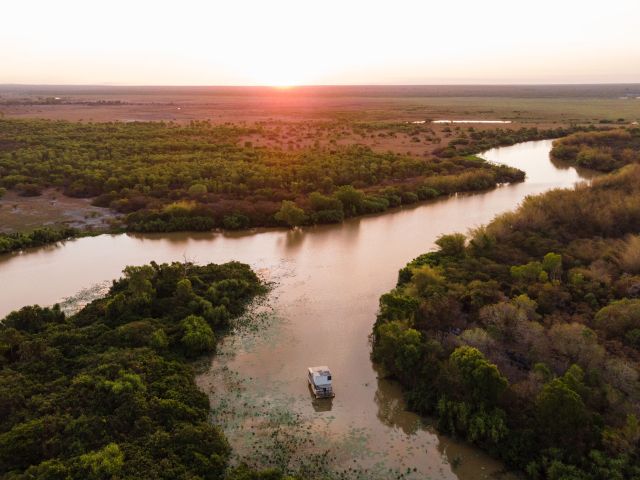
    Reaching East Arnhem is part of the adventure. Travellers typically fly into Gove Airport near Nhulunbuy via Darwin or Cairns, or arrive by expedition cruise along the remote coastline. Others make the journey overland along rutted dirt roads that cut through East Arnhem’s small pockets of monsoon forest.

    However you arrive, there’s a distinct feeling of crossing into somewhere different. Permits are required to visit the region, reflecting the fact that this is Yolŋu land where communities and traditional owners maintain deep cultural connections to Country.

    The extra planning becomes part of the experience. By the time visitors arrive, they understand they’re entering a place not just of respect, but also patience and curiosity.

    At one with nature

    East Arnhem’s  landscapes leave a strong imprint. For Wall, one place in particular still lingers in their memory: Ngalarrkpuy, also known as Lonely Beach, near Bawaka Homeland.

    “I genuinely felt like I was living inside an Instagram filter,” they say. “One of the most stunning feats of nature I’ve ever seen. The water was so clear I swear I could see even the fish smiling.”

    Across the region, natural experiences unfold at a slower pace. Fishing, beachcombing and island hopping reveal the rhythm of the coastline. The tides shape daily life and the vastness of the landscape makes even simple moments feel downright cinematic.

    For visitors with limited time, Wall says the Bawaka Homeland experience is unmissable.

    “I just left and I’m already planning when I can get back there.”

    The sense of remoteness is part of the appeal. In a country where many beaches are crowded and well-trodden, East Arnhem’s coastline still feels wonderfully wild.

    Immersing in local culture

    A visitor spends a meaningful moment alongside Yolŋu guides, gaining insight into their deep cultural knowledge and connection to the land.
    Experience authentic moments with the locals.

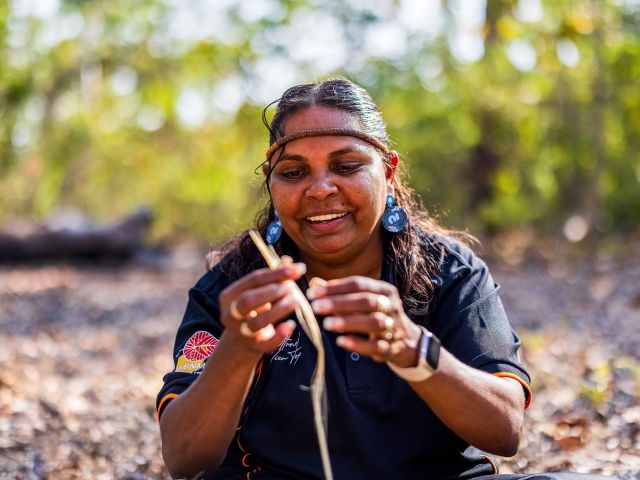
    Culture is woven through every experience in East Arnhem. Visitors have the opportunity to spend time on Country with Yolŋu guides and knowledge holders who share stories and traditions that have been passed down for generations.

    For Wall, one of the most powerful moments came during a conversation with a Yolŋu elder.

    “I got to meet a traditional elder, Mayalil, in Nhulunbuy,” they say. “Listening to her talk about her home made the land feel alive in ways I couldn’t have imagined.”

    The region is also home to internationally recognised Aboriginal art centres where artists shape works deeply connected to land and family knowledge.

    Music carries the same cultural energy. East Arnhem has produced globally recognised artists such as King Stingray and Baker Boy, blending Yolŋu language, storytelling and contemporary sound.

    Wall experienced this musical spirit first-hand.

    “A jam session around the fire was it for me,” they say. “Letting the deep joy and history of their music wash over me…  and meeting a few of the King Stingray musicians was unreal.”

    These moments of human connection often become the most memorable part of a visit.

    Spotting local wildlife

    An aerial view of the beach shows tiny figures lined up across the white sand, moving as if in a rhythmic dance.
    Step into a world where nature reigns.

    The wildlife of East Arnhem adds another layer to the experience. The region is home to an extraordinary range of animals, from waterbirds and turtles to dugongs, dolphins and the formidable saltwater crocodile.

    Wall admits they didn’t actually spot a croc during their visit.

    “Devastatingly, I didn’t see one,” they laugh. “But with all the stories from the locals I definitely gained a healthy respect for caution.”

    Some of the most memorable wildlife encounters can be surprisingly small., At Banubanu Beach Retreat on Bremer Island, Wall remembers walking along the beach one morning and watching it come alive.

    “As you walk through the sand you see hundreds of crabs scurrying into their holes as you pass by,” they say. “Such a small thing, but it was completely magical.”

    Moments like this reveal the quieter rhythms of East Arnhem, where even the smallest creatures seem to play a part in the landscape.

    Visitors who make the journey soon learn the most important travel tip of all.

    “Go in open-minded with a sense of curiosity,” Wall says. “Be prepared to ditch your plans. The land and the locals will guide you on an adventure no spreadsheets could ever compete with.”

    And most importantly, they add, don’t rush.

    “The land and people deserve your time and attention. You’ll be all the better for slowing down.”

    For more information on visiting East Arnhem, head to eastarnhem.com.au.