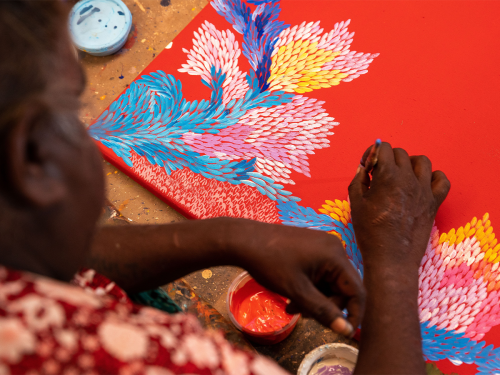
Your guide to the great Indigenous Red Centre art trail

hero media
The best thing about exploring the Indigenous art trail of the Red Centre can be described in one word: unique.

The geographical heart of Australia contains a myriad of diverse art experiences, from embracing the bulbous colourful pots at Hermannsburg to gazing at paintings with their labyrinth of dots and lines at Papunya, the birthplace of what is considered to be the beginning of contemporary Aboriginal art.

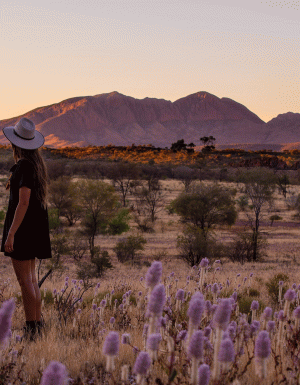
Whether you’re a nature lover looking to step into an Albert Namatjira watercolour with its unmistakeable red dirt and undulations of the West MacDonnell Ranges/Tjoritja or a culture fiend who can’t get enough of city galleries and beanie festivals, the Red Centre has something for you.

Ready to have your socks blown off? Here are the key art destinations to visit in the Red Centre.

The best way to explore the trail

First, get yourself to Alice Springs (Mparntwe) or Uluṟu, both easily reachable by plane from most capital cities in Australia.
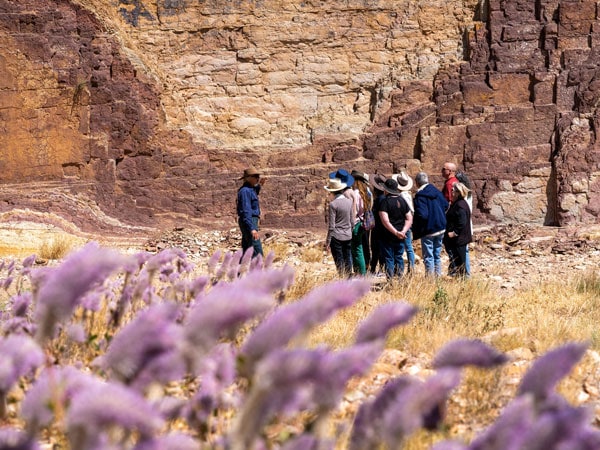
a group of travellers exploring Ochre Pits in the West MacDonnell Ranges
Explore the rugged beauty of the West MacDonnell Ranges. (Image: Tourism Australia)

Allow two to three days in the outback city, home to dozens of art galleries, before heading west through the West MacDonnell Ranges/Tjoritja to visit some of Australia’s most remote and remarkable art centres.
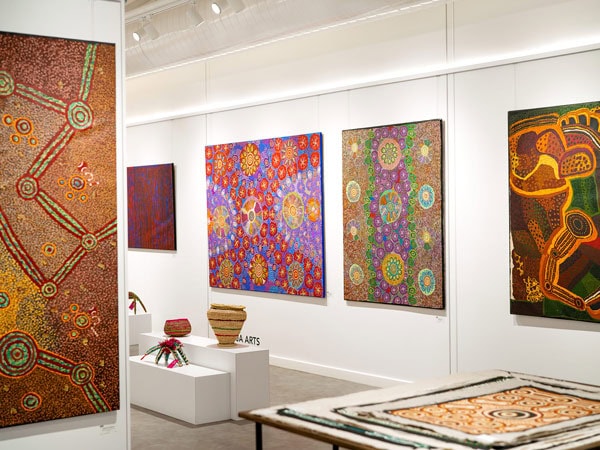
artworks by Anangu artists on display at the Gallery of Central Australia
See extraordinary Aṉangu Art at The Gallery of Central Australia. (Image: Tourism Australia)

Highlights include galleries at Hermannsburg (Ntaria), Haasts Bluff (Ikuntji) and Papunya and don’t miss squeezing in a stop at the Ochre Pits, about 110km west of Alice Springs, where the Western Aranda people have gathered vivid yellow, red, purple and white ochre for painting and body decoration for thousands of years.
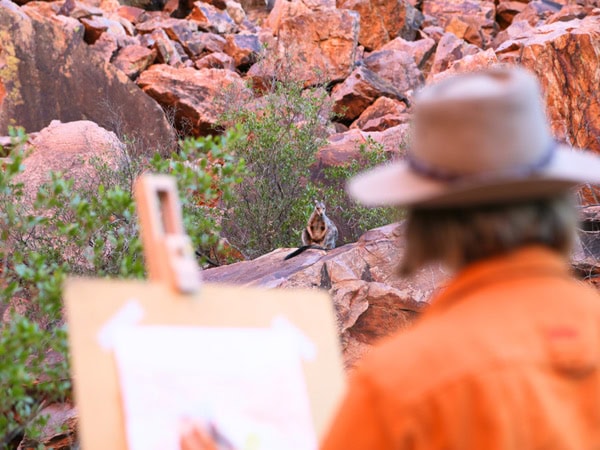
painting a wallaby with Art Tours of Australia, Red Centre
Show your appreciation for the ancient landscape through art. (Image: Art Tours of Australia)

Prefer to take a deep art dive on an organised tour? Artist and guide Anna Dakin of Art Tours of Australia takes guests on jaunts through the Red Centre to either make art or, if you prefer, to buy art. Her 5-day Art and Culture Trip begins in Alice Springs and takes in Uluṟu, where guests participate in an Aṉangu-led dot painting class, before travelling into the West MacDonnell Ranges/Tjoritja.
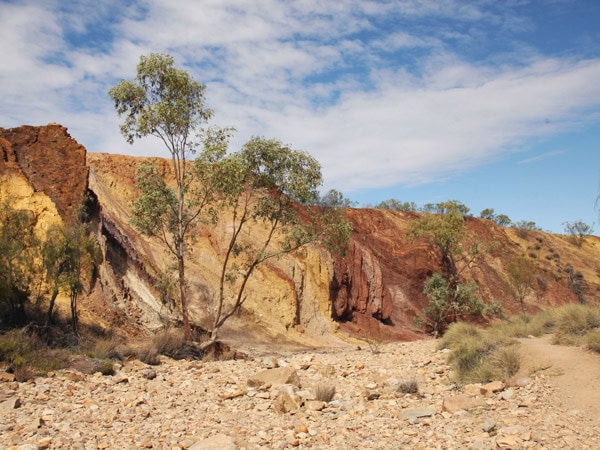
Ochre Pits - Larapinta Trail by World Expeditions, West MacDonnell Ranges, NT
The Ochre Pits are a highlight of the epic Larapinta trail. (Image: World Expeditions/Great Walks of Australia)

Alice Springs

Home to the Arrernte people, Alice Springs is a treasure chest of Aboriginal art from across Central Australia, offering a lively mix of one-of-a-kind galleries, quirky shops and hidden studios.
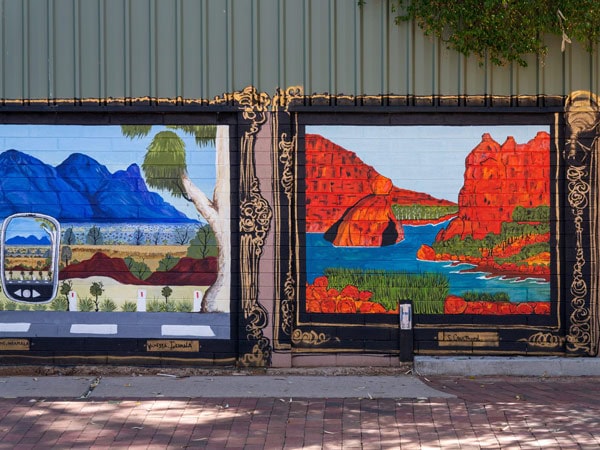
Namatjira watercolour paintings at Iltja Ntjarra Many Hands Art Centre
See Namatjira paintings at Iltja Ntjarra Many Hands Art Centre. (Image: Tourism Australia)

A great spot to kick off your artistic adventure in Alice Springs is the Araluen Arts Centre, home to many famous paintings by Albert Namatjira, including Haasts Bluff Country and Heavitree Gap.
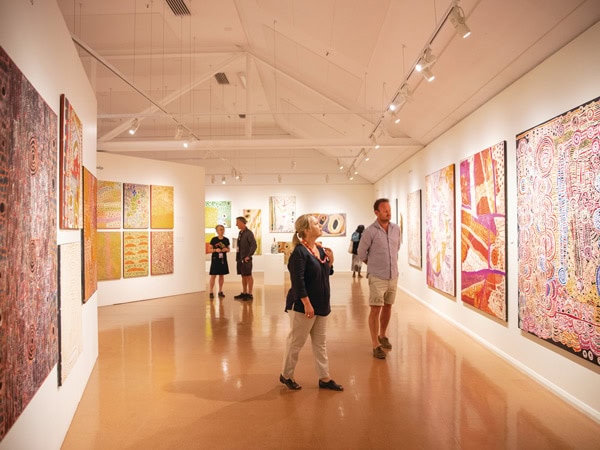
visitors exploring inside the Araluen Arts Centre
Araluen Arts Centre features the works of the great Albert Namatjira. (Image: Tourism NT)

Where else can you see a Namatjira watercolour and then within minutes be amongst the mountainous landscape that inspired him?
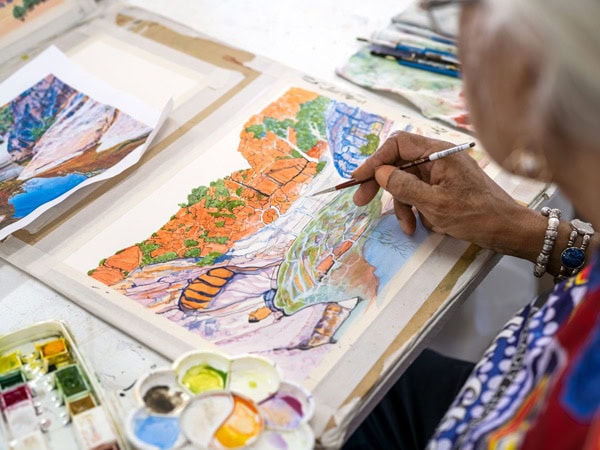
watercolour painting at Iltja Ntjarra Many Hands Art Centre
Namatjira uses watercolour to depict the beauty of Country. (Image: Tourism Australia)

Not far from here, on the edge of the CBD, you’ll find the Iltja Ntjarra Many Hands Art Centre – an essential stop for continuing your journey into Namatjira’s world. This vibrant gallery and working studio is home to the Namatjira artists who carry forward the landscapes made famous by their family member. It’s the perfect place to not only see their stunning creations but also to watch artists at work and have a yarn about their craft.
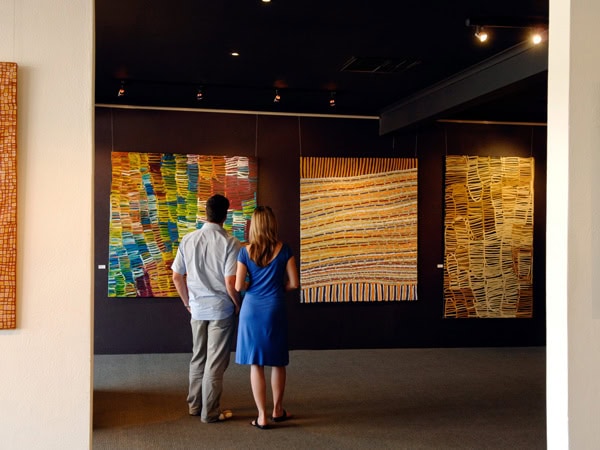
a couple admiring the artworks at Mbantua Gallery
Admire the Aboriginal art in Mbantua Gallery. (Image: Tourism Australia/Tourism NT)

From here, saunter to Todd Mall, where you’ll discover a collection of lively art galleries, cooperatives and shops. Pop into Papunya Tula Gallery, Yubu Napa Art Gallery and Mbantua Gallery to see works by some of Australia’s most celebrated Aboriginal artists.
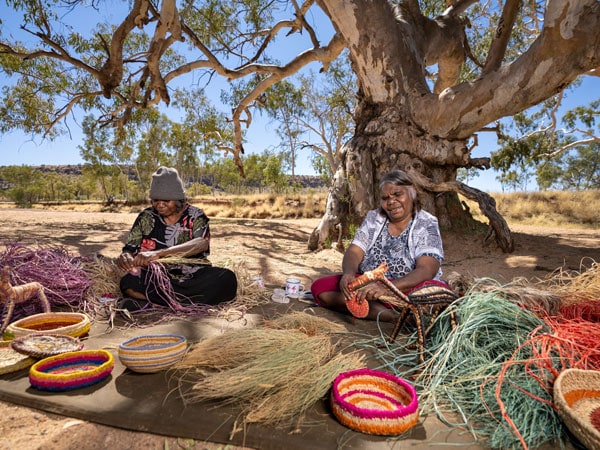
women weaving baskets, Tjanpi Desert Weavers
Tjanpi Desert Weavers provides job opportunities for women. (Image: Tourism Australia)

For fans of fibre art, don’t miss Tjanpi Desert Weavers, a unique gallery showcasing intricately woven baskets, earrings and sculptured animals, all crafted by women from the Central and Western desert regions.
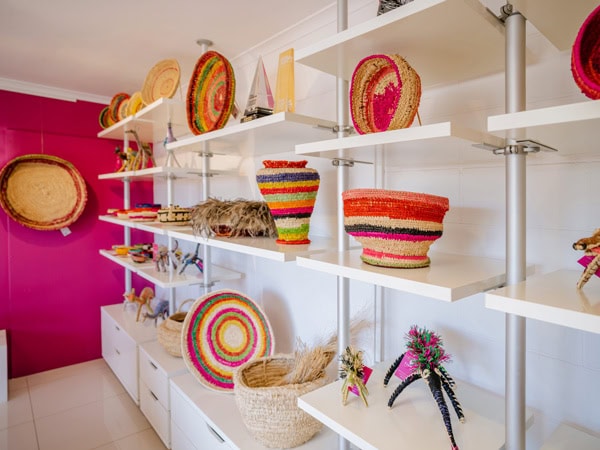
woven baskets on display at Tjanpi Desert Weavers
These baskets are intricately woven by women on Country. (Image: Tourism Australia)

Need tips, more detail or itinerary ideas tailored to you? Ask AT.

AI Prompt

East MacDonnell Ranges

If you’re looking to take your art adventure outdoors, then it’s time to head into nature and discover the ancient rock art that dots the landscape.

There’s no better place to start than the East MacDonnell Ranges, just a short drive from Alice Springs. Start your adventure at Yeperenye/Emily Gap, a picturesque spot in the East MacDonnell Ranges. This site is not only visually stunning, with its striking red rock formations and shady gums, but it’s also home to rock art that depicts the caterpillar dreaming.

Hermannsburg

Hermannsburg is one of the Red Centre’s must-see gems, and it’s easy to understand why – it’s like stepping back in time. This well-preserved former Lutheran mission, founded in 1877, gives you a real sense of history. Just a scenic 130km drive west of Alice Springs, it’s also the birthplace of Arrernte artist Albert Namatjira, who passed away in 1959.

The Hermannsburg Historic Precinct, listed by the National Trust, is a charming cluster of whitewashed, German-style buildings. Here, you’ll find a dining room and bakery that’s now home to a gallery and gift shop.

If you’re planning to visit the Hermannsburg Potters, make sure to call ahead and book your spot before hitting the road. You won’t want to make the trek out there only to find you’ve missed out on seeing these incredible artists in action. The colourful terracotta pots burst with life, each one telling a unique story about the artists’ culture and their connection to Country.
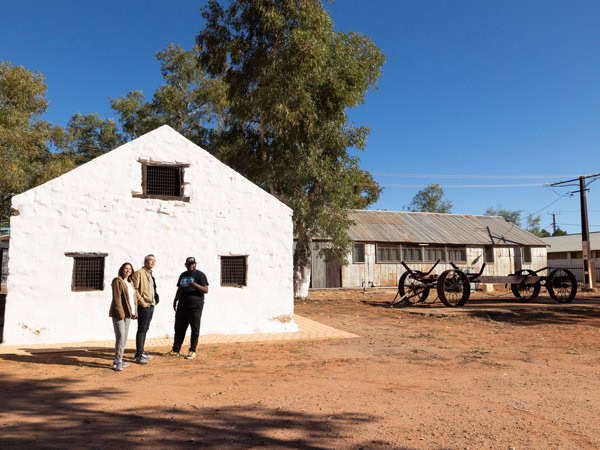
a couple exploring the Hermannsburg Historic Precinct with a local guide
Hermannsburg is the birthplace of the Hermannsburg School of watercolour painting, pioneered by Albert Namatjira. (Image: Tourism NT/Charlie Bliss)

Haasts Bluff

Art lovers, keep your engines running. If contemporary Aboriginal art is your thing, then you won’t want to miss the 230km drive west of Alice Springs to Haasts Bluff. At Ikuntji Artists, you’ll find a dazzling mix of bold paintings, vibrant textiles and eye-catching accessories – all crafted by talented Aboriginal artists.
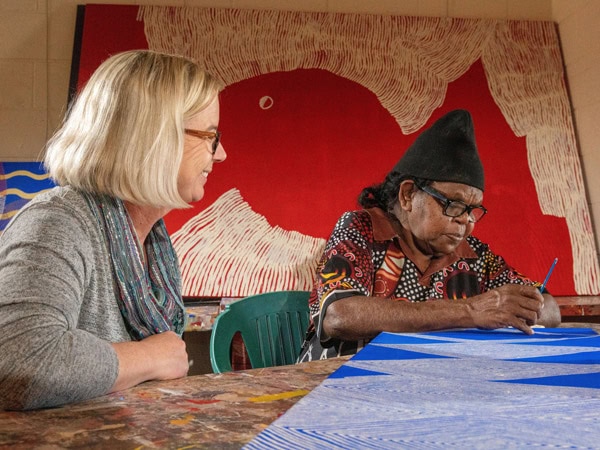
a woman watching an Aboriginal Artist working on a painting at Ikuntji Artists, Haasts Bluff
Ikuntji Artists is pioneered by women in the Western Desert Art Movement. (Image: Tourism NT/Christopher Tangey/Ikuntji Artists)

This not-for-profit Aboriginal-owned centre has a fascinating history, starting back in the 1980s when a group of women began painting in the local aged care facility. Since then, it’s blossomed into a hub of creativity, and today, it’s a must-see destination for anyone wanting to experience the heartbeat of the region’s contemporary art scene.
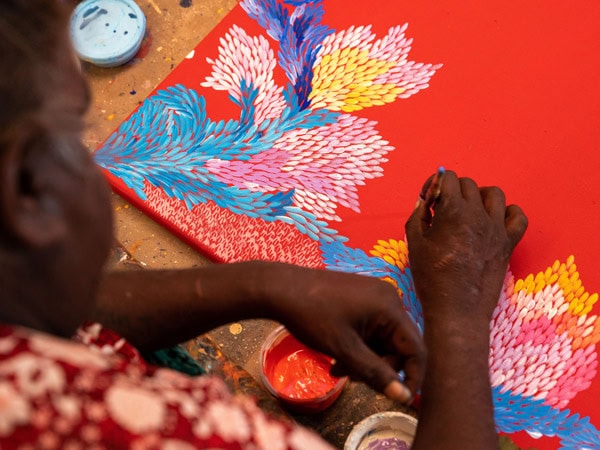
a woman making Aboriginal Art at Ikuntji Artists, Haasts Bluff
he distinctive style of Ikuntji Artists brings the spirit of Haasts Bluff to life. (Image: Tourism NT/Christopher Tangey/Ikuntji Artists)

Papunya

Around 250km west of Alice Springs, Papunya is the place that packs a punch in the world of Aboriginal art – it’s the birthplace of the iconic Western Desert dot-painting movement. Today, this artistic legacy lives on through Papunya Tjupi Artists, where over 100 local artists bring their powerful visions to life.

Known for their striking line work and innovative approaches to telling ancient stories, the artists of Papunya Tjupi continue to push boundaries while honouring tradition. If you’re a fan of bold, meaningful art, this is the place to experience it first-hand.

Weekly travel news, experiences
insider tips, offers, and more.

Uluṟu

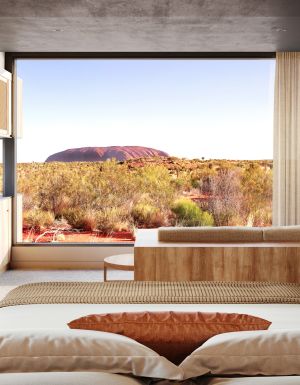
For an unforgettable art experience, head south from Alice Springs to the iconic Uluṟu, about 450km away, where the desert landscape meets the rich cultural traditions of the Aṉangu people.
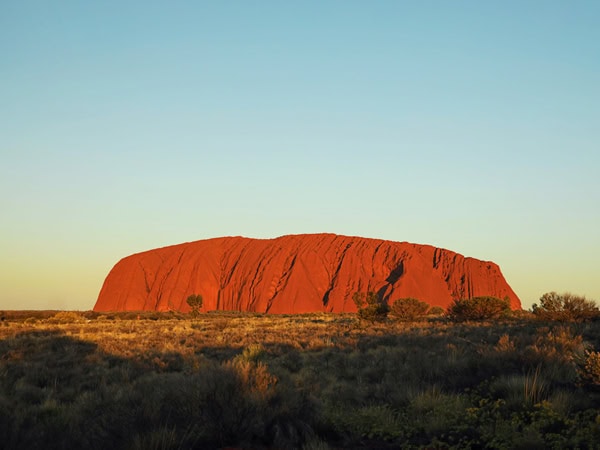
the Ayers rock/Uluru sandstone formation
Uluṟu is a breathtaking symbol of Australia’s heart. (Image: Tourism Australia)

Just a short drive from the rock itself, you’ll find Maruku Arts, a fantastic not-for-profit cooperative run by Anangu artists from over 20 remote communities across the Central and Western deserts.
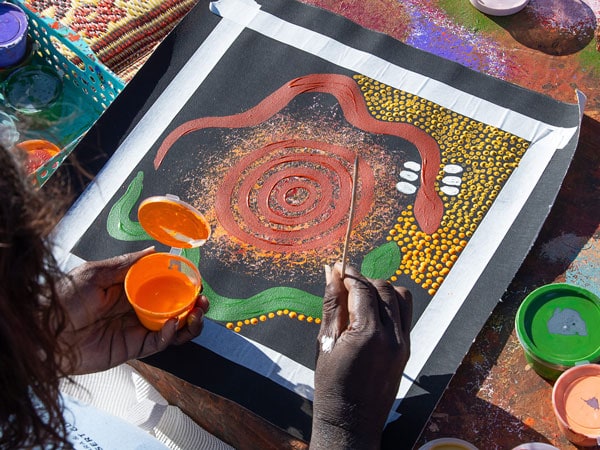
a Maruku Art Dots Painting in Uluru
GMaruku Arts showcases the vibrant stories of the Anangu people. (Image: Tourism Australia)

At Maruku, you can dive deep into Aboriginal art and culture – whether it’s through exploring stunning dot paintings or learning about ancient techniques. Even better, you can get hands-on and take part in a dot-painting workshop, where you’ll create your own piece to take home.
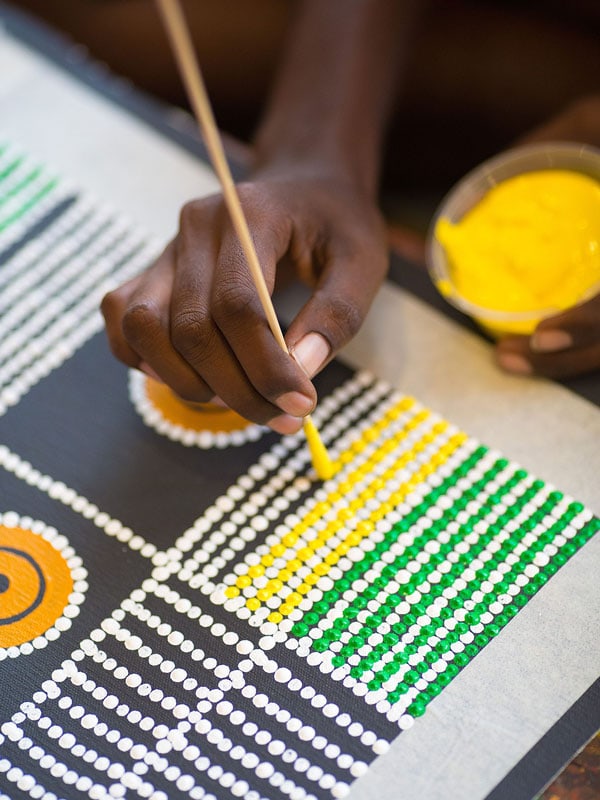
a hand doing a Maruku Art Dots Painting in Uluru
Marvel at how meticulously each dot painting is made. (Image: Tourism Australia/NTCB)

Uluṟu’s striking red rock face is world-renowned, but it’s also a fantastic place to see rock art. Around 80 sites reveal the Anangu people’s Tjukurpa (creation stories) and cultural knowledge, passed down through generations.
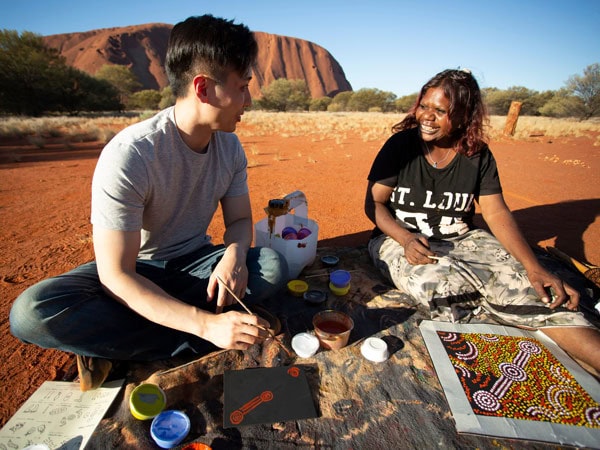
Maruku Art Dots Painting workshop at Ayers Rock Resort
Join the Maruku Art Dots Painting workshop with a local Aṉangu artist. (Image: Tourism Australia)

To see these remarkable artworks up close, the best way is on a guided tour along the Mala Walk to Kantju Gorge or the Kuniya Walk to Mutitjulu Waterhole.
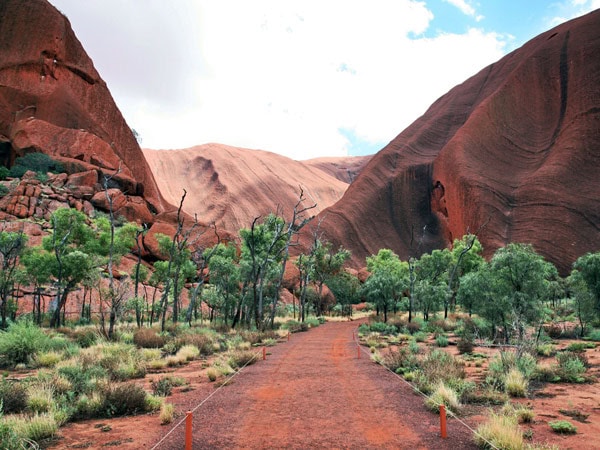
the Kuniya Walk, Uluru Kata Tjuta, NT
Take the legendary Kuniya Walk to the Mutitjulu waterhole. (Image: Tourism Australia)

Discover incredible things to do at Uluṟu (that aren’t climbing).

Want to see more stories from Australian Traveller in your Google search results?

  1. Click here to set Australian Traveller as a preferred source.
  2. Tick the box next to "Australian Traveller". That's it.
Leah McLennan
Leah McLennan is a freelance writer based in Darwin. She was a journalist in Sydney for over a decade and counts her time as travel editor for Australian Associated Press as one of the highlights of her career. From exploring remote campsites in the Top End with her family, to seeking out new art galleries in faraway cities, she’ll grab an adventurous or arty travel experience within her reach.
View profile and articles
hero media

8 reasons why the low season is the best time to explore the Northern Territory

Credit: Tourism and Events NT

September to April in the Northern Territory rewards those who seek adventure.

Sure, the Northern Territory shines during the high season, but did you know it transforms into lush magnificence in the summer low season? From September to April, hundreds of waterfalls roar into action, vegetation flourishes and natural pools swell, all thanks to spectacular storms. This is when some of the country’s best arts and cultural events hit the calendar, too.

Travelling at this time of year means you’ll also be rewarded with off-peak travel pricing on accommodation, tours and experiences, and can even enjoy many of the top sites all to yourself.

1. Kings Canyon is transformed

A woman reaching out to touch a natural waterhole at Kings Canyon during the best time to explore the NT.
See Kings Canyon at its most spectacular. (Credit: Tourism and Events NT)

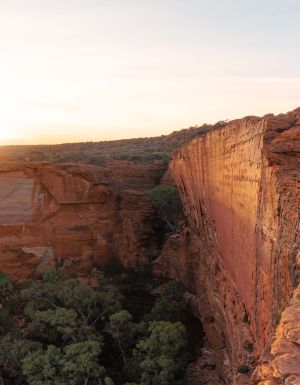
Kings Canyon’s towering sandstone domes and crevasses are a sight to behold year-round, but during the low season you can witness a rare phenomenon. This ancient outback wonder’s arid landscape bursts to life when it rains, temporarily transforming it with waterfalls that thunder down the cliffs. At the base of the canyon is the verdant Garden of Eden and its permanent watering hole.

2. John Hayes Rockhole is a natural wonder

Two women hiking to John Hayes Rockhole, one of the unforgettable experiences during the best time to explore the NT.
Hike to a desert oasis. (Credit: Tourism and Events NT)

Hidden in the Trephina Gorge Nature Park in the East MacDonnell Ranges, John Hayes Rockhole is an oasis waiting to be discovered. Visit the narrow canyon during the high season, and you may see only a sandy creekbed, but after rain in the low season the pool is full of cool water. It’s accessible via a 4WD-only track off the Ross Highway, or you can set out early and join the nine-kilometre Trephina Ridgetop Walk. The reward for undertaking the hike is worth every step, and there’s a dedicated, tent-only campground for those who’d like to soak up the serenity overnight.

3. The Red Centre Light Trail shines bright

A woman admiring The Light Towers, one of the must-see attractions during the best time to explore the NT.
Watch the Outback light up after sunset. (Credit: Tourism and Events NT)

The Red Centre’s rich cultural heritage and lack of light pollution make it the ideal setting for immersive light shows, and you can experience the most iconic ones on an epic six-day road trip in April. Witness the Parrtjima cultural festival in Mparntwe (Alice Springs) before heading to Kings Canyon for Bruce Munro’s Light-Towers, where 69 glowing towers shine to a celestial soundscape. At Uluṟu, Munro’s Field of Light blankets the red soil with glowing frosted-glass stems, and the Wintijiri Wiru drone show lights up the sky in front of the sacred cultural site. Along the way you’ll witness the changing landscapes of the desert from the West MacDonnell Ranges to the Valley of the Winds.

4. The Parrtjima festival lights up the Red Centre

Festival lights illuminating the Northern Territory, showing why the best time to explore the NT is during festival season.
Witness the magic of Parrtjima. (Credit: Tourism and Events NT)

For 10 days every April, the Red Centre turns into a dazzling display of colour for the Parrtjima festival. Held at Alice Springs Desert Park, the unmissable celebration shines a spotlight on the world’s oldest living culture using modern technology. Artworks by local Aboriginal artists are transformed into large-scale illuminated installations with accompanying soundscapes, offering a unique opportunity to see the spectacular sunburnt landscapes, night skies and 300-million-year-old West MacDonnell Ranges in a new light. The jam-packed line-up of art and cultural events also includes workshops, markets, short films, talks and live music.

5. Cruising along Nitmiluk Gorge is breathtaking

Aerial view of Nitmiluk Gorge, showcasing its dramatic cliffs and waterways.
Sail between towering sandstone cliffs. (Credit: Tourism and Events NT/Nic Morley)

Drifting down the emerald waters of Nitmiluk (Katherine) Gorge between towering red sandstone cliffs carved over millions of years, all while waterfalls stream down around you, is an experience like none other. Nitmiluk Katherine’s two-hour NitNit Dreaming Two Gorge Tour sails through gorges past ancient rock art while a local guide imparts knowledge about the Jawoyn culture and significance of the landscape.

6. You can explore local culture on the Tiwi Islands

A quick boat ride from Darwin lies the peculiarly pink shores of Melville Island, Tiwi Islands. Populated by the hilariously cheeky Indigenous Tiwis, stepping onto the Islands is like stepping back in time. Sweeping rusty dirt roads meander through the eucalypt forest and are interspersed only by small communities and freshwater springs.
Immerse yourself in Tiwi culture. (Credit: Tourism and Events NT/Elise Cook)

Take an 80-kilometre ferry ride from Darwin to arrive at the Tiwi Islands, an archipelago of 11 picturesque islands and a haven for art lovers and anglers. On the Tiwi By Design walking tour you’ll be guided to the Tiwi Design Art Centre, one of Australia’s oldest art centres, to observe local artists in action and join a screen printing workshop.

If you’re more partial to sinking a line, book a stay at Tiwi Island Retreat in April. It’s one of the best months to fish for barramundi, and their world-class fishing adventures are your best chance at reeling in a prized catch.

7. Scenic flights over Kakadu’s waterfalls are jaw-dropping

Jim Jim Falls from above during a wet season helicopter tour. Covering nearly 20,000 square kilometres, Kakadu National Park is teeming with wildlife, home to important Aboriginal rock art sites, and takes in diverse and exotic landscape.
Soar above Jim Jim Falls. (Credit: Tourism and Events NT/Jarrad Seng)

Seeing Kakadu National Park’s gushing waterfalls and dramatic escarpments from above offers a dose of unparalleled beauty – and it’s all best witnessed in the low season.

Taking flight from Darwin, Kakadu Air Services offers an unforgettable experience, with doorless helicopters revealing unobstructed views of the 1.8-billion-year-old landscape. Soar above the untouched savannah that turns into a tropical green paradise, marvel at the thunderous Jim Jim Falls and Twin Falls, and whiz through ancient sandstone canyons. If you’re lucky, the scenery will look all the more dramatic with rolling tropical storm clouds in the distance.

8. Litchfield National Park is an amazing place to cool off

Litchfield National Park
Dive into natural swimming holes. (Image: Tourism NT/Joshua Griffen)

Litchfield National Park is peppered with stunning natural swimming pools for you to beat the heat in. Take a refreshing dip in pristine, crocodile-free spots such as Buley Rockhole, a series of spring-fed cascading pools, and the nearby Florence Falls, which is enveloped by monsoon rainforest and features a crystal-clear plunge pool fed by a 15-metre-high waterfall. Be sure to check the Northern Territory Parks & Reserves website for closures before you go.

Start planning your low season adventure of a lifetime at northernterritory.com.