Trekking Hanging Rock with a llama

hero media
Jocelyn Pride discovers that trekking the Macedon Ranges’ mystical Hanging Rock with a llama is good for your soul. No, really…

“Hmmm, hmmm, hmmm," hums Jaro in a melodic B-flat, I’ve-got-something-important-to-say-sort-of-way.


Huge brown eyes with movie star lashes look straight into mine and his banana-shaped fluffy ears twitch back and forth as I make soft cooing sounds.


It’s love at first sight. A perfect way to start a 24-hour relationship… with a llama.


Domesticated by the Incas thousands of years ago, llamas are one of the oldest animals on the planet. Known as the dolphins of the land, these camelids are whip smart, full of personality and easy to train, as Mark Brindley of Hanging Rock Llama Treks discovered. By saving a llama’s life, he changed his.


“When my partner brought home a day-old orphaned cria (baby llama) with a hole in its heart from her veterinarian clinic, I was hooked," says Mark, a retired aircraft engineer turned llama farmer. “Although Yoda only lived six months, she opened me to a new world."


Mark now has 15 llamas and recently started offering guided llama trekking within the Victorian Macedon Ranges region.


Jaro stands patiently as I learn the art of llama handling.


“Before you ask, spit happens," says Mark with a playful chuckle. “But don’t worry, it’s rare and only a llama to llama thing."


The thought of being in the middle of a llama drama and sprayed with green slime is a tad off-putting, however Jaro and his mates already have the herd hierarchy worked out.


“Just make sure you give them their own space."


After weighing each saddle-bag loaded with our camping gear, food and wine, clothing, and llama essentials like a pooper scooper, tether ropes and ‘llama lollies’ (pellets), we head to Hanging Rock Reserve.


Leading a llama is like taking an oversized well-trained dog for a walk, except I soon find they only have two speeds – stop and llama pace. Each step Jaro takes is slow, deliberate and strong.


It’s easy to see why these sure-footed, well-natured animals are revered as pack animals. Even weighing in at 160 kilograms they’re kind on the environment.


“A llama leaves less of a footprint than our hiking boots," says Mark.


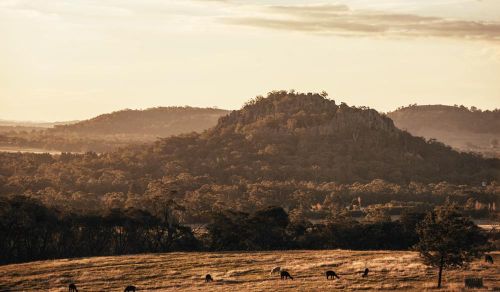
We meander the labyrinth of undulating trails lined with peppermint and manna gums around Australia’s ‘second’ rock formed six million years ago when lava oozed through a vent in the Earth’s surface.


Immortalised in literature, Hanging Rock is as evocative today as it was in Joan Lindsay’s novel and Peter Weir’s film Picnic at Hanging Rock, the haunting tale of the disappearance of a group of school girls here on Valentine’s Day in 1900.


(MORE… Picnic at Hanging Rock – fact of fiction?)


Jaro occasionally cuddles into my neck and sniffs my pockets for ‘llama lollies’. Chris, my travel companion is envious. She doesn’t bond as quickly with Warrego, the tallest and most aloof of the trio. “Llamas can be more like cats than dogs," says Mark.


For afternoon tea we lazily snack on chocolate brownies and banana cake, sipping tea while the llamas chomp on grass and snatch mouthfuls of pine needles.


As camping isn’t permitted in the reserve, we load the llamas onto a horse float and drive half-an-hour to a ‘pet friendly’ camping ground in the tiny village of Blackwood on the edge of Lerderderg State Park.


With great hilarity and wide-eyed llamas watching on, we manage to pitch the tents before darkness shrouds us.


Dinner is a fine camp fire affair – nibbles with a local pinot gris, lamb curry (Mark’s secret recipe) with all the trimmings, followed by sticky date tart.


As we snuggle into the sleeping bags, our four-legged friends kush down (sit) as sentinels behind the tents. Their hums and snuffles are like a lullaby and I’m asleep within seconds.


Our six-kilometre hike the following morning is a challenge. Narrow tracks criss-cross the old gold mining trails. This is new territory for Jaro but nothing fazes him. He carefully picks our path, up and down the rocky hills – confident, steady, grounded. He has my complete trust.


Instead of my usual hurried pace, I’m totally in the moment. I feel the breeze touch my face, listen to the swish of the leaves and each note of a kookaburra’s laughter.


Jaro’s humming becomes my ‘om’. It sure beats a colouring book.


Need tips, more detail or itinerary ideas tailored to you? Ask AT.

AI Prompt

The details: Hanging Rock Llama Treks, Victoria

Getting there: Hanging Rock is a 60-minute drive north-west of Melbourne.


Playing there: Mark offers a number of llama experiences ranging from kids’ parties on his farm to day hikes along a rail trail with a pub lunch to overnight camping treks. The price for the overnight experience is $130 per person including camping gear, food, wine and lollies for the llamas. hangingrockllama.com.au


Staying there: If you don’t fancy sleeping in a tent, ‘The Caboose’ at Hanging Rock Reserve is a beautifully restored railway carriage (sleeps two). Contact Garry and Kate Marks on 0418394984.


MORE… Finished exploring Victoria by hoof and ready to take to the air? Vintage flight – hot air ballooning Yarra Valley style

Want to see more stories from Australian Traveller in your Google search results?

  1. Click here to set Australian Traveller as a preferred source.
  2. Tick the box next to "Australian Traveller". That's it.
hero media

Unforgettable First Peoples tours and experiences in Victoria

    Angela Saurine Angela Saurine
    From ancient aquaculture systems to sacred rock art shelters, Victoria’s First Peoples cultural experiences offer a powerful connection to one of the world’s oldest living cultures – where every site, story and smoking ceremony invites a deeper understanding of the land beneath your feet. 

    Victoria’s sweeping landscapes hold stories far older than any road map can trace – stories etched into stone, sung through generations and woven into every bend of river and rise of hill. From the lava flows of Budj Bim to the ancient middens of Moyjil/Point Ritchie and the volcanic crater of Tower Hill, the state is home to some of the most significant First Peoples cultural sites in Australia. These places, along with other immersive experiences, offer not only a window into a 60,000-year legacy, but a profound way of understanding Country itself. As more travellers seek connection over checklists, guided tours by Traditional Owners offer respectful, unforgettable insights into a living culture that continues to shape the land and the people who walk it. 

    Budj Bim cultural landscape  

    Budj Bim Cultural Landscape
    Budj Bim Cultural Landscape is on Gunditjmara Country. (Image: Visit Victoria)

    Venture beyond the surf and sand of the Great Ocean Road to discover a deeper story etched into the volcanic landscape. At Budj Bim, ancient aquaculture channels built by the Gunditjmara people to trap, store and harvest kooyang (short-finned eel) reveal one of the world’s oldest living cultures. While you’re in the area, head over to the state-of-the-art Tae Rak Aquaculture Centre, where you can observe the eels in a special tank, wander the shores of Tae Rak (Lake Condah), and enjoy a bite at the Bush Tucker Cafe. Also nearby is Tower Hill, a dormant volcano reborn as a wildlife reserve, offering trails through bushland teeming with emus and koalas. 

    eel tank
    The kooyang (eel) tank at Tae Rak. (Image: Visit Victoria)

    Dumawul Kooyoora Walking Tour 

    Dumawul walkingtour
    Guests are guided through Kooyoora State Park on the Dumawul walking tour. (Image: Visit Victoria)

    Step into a timeless landscape with Dumawul’s guided tour through Kooyoora State Park, around an hour’s drive west of Bendigo in north-central Victoria. Led by Djaara guides, this immersive half-day journey breathes life into Country, weaving together stories, bush tucker and ancient rock art. Known to the Dja Dja Wurrung people as Guyura – the ‘mountain of light’ – this dramatic granite range is rich with cultural and spiritual significance.  The adventure begins with a meet-up at the Bridgewater Hotel on the banks of the Loddon River, before guests are welcomed onto Country with a traditional Smoking Ceremony – a powerful ritual that honours ancestors and cleanses those who walk the land. From there, it’s a gentle wander through rugged outcrops and open bushland, with sweeping vistas unfolding at every turn. Along the way, guides share their knowledge of how the Dja Dja Wurrung peoples have cared for and adapted with this land for generations, offering a rare and moving window into an ancient way of life that continues to thrive today.  

    Kooyoora walking tour
    Knowledge of the Dja Dja Wurrung is shared on the trail. (Image: Visit Victoria)

    Kingfisher Cruises  

    Kingfisher Cruises
    Cruising the Murray with Kingfisher Cruises. (Image: Visit Victoria)

    Glide quietly through the Barmah-Millewa forest – the nation’s largest river red gum ecosystem – on a scenic journey along the Murray River and into the Barmah Lakes with Kingfisher Cruises. Led by passionate guides who share stories of the cultural significance of this ancient landscape, these cruises reveal the stories, totems and traditional knowledge of the Yorta Yorta people. As you navigate narrow waterways and spot native birds, you’ll gain a richer understanding of how First Peoples have lived in harmony with this floodplain for tens of thousands of years. It’s a gentle, immersive experience that leaves a lasting impression – one where every bend in the river carries echoes of culture, connection and Country.  

    wawa biik 

     Taungurung leaders
    Exploring Nagambie with Taungurung leaders. (Image: Visit Victoria)

    Translating to ‘hello, Country’ in the language of the First Nations People and Custodians of the rivers and mountains of Taungurung Country in Central Victoria, wawa biik guides a range of authentic and deeply immersive experiences. Leaving from either Nagambie or Euroa, the tours are woven with ancient stories of the Taungurung, telling how a sustained connection and responsibility ensures the continued health of biik – benefitting the people, animals and plants that live in and around the Goulburn River. During the wawa Nagambie experience, guests participate in a Welcome Smoking Ceremony, and enjoy lunch and conversation with two Taungurung leaders as they cruise through the wetlands of tabilk-tabilk (place of many waterholes). The 4.5-hour tour begins at Tahbilk Winery, which is set in the wetlands of Nagambie on Taungurung Country and collaborates with Taungurung Elders to share knowledge of biik. 

    Bataluk Cultural Trail  

    Bataluk Trail
    Cape Conran on the Bataluk Trail. (Image: Visit Victoria)

    The Bataluk Cultural Trail winds through East Gippsland like a thread stitching past to present, tracing the deep connection between the Gunaikurnai people and their land. Starting at the Knob Reserve in Stratford, visitors walk among scarred trees and ancient stone tools once used for survival and ceremony. At the Den of Nargun near Mitchell River, the earth holds stories of women’s sacred spaces, cloaked in myth and legend. Further along, Legend Rock at Metung tells of greed and consequence, its surface etched with ancient lore. At Cape Conran, shell middens lie scattered like breadcrumbs of history – 10,000 years of gatherings, stories and saltwater songs still echoing in the wind.  

    Healesville Sanctuary  

    echidna at Healesville Sanctuary
    Get up close with a resident echidna at Healesville Sanctuary. (Image: Visit Victoria)

    Set on the historic grounds of Coranderrk Aboriginal Station, Healesville Sanctuary honours the Wurundjeri people of the Kulin Nation through immersive storytelling and connection to Country. Along Wurundjeri Walk, visitors are invited to reflect on the land’s rich First Peoples history, with native plants revealing their traditional uses. Wurundjeri Elder and educator Murrundindi shares culture in-person with the Wominjeka Aboriginal Cultural Experience every Sunday, and most days during Victorian school holidays. Murrundindi’s smoking ceremonies, storytelling and bush tucker knowledge reveal the sacred relationship between people, animals and the environment. Bird-lovers can’t miss the incredible Spirits of the Sky show featuring native birds daily at 12pm and 3pm. 

    The Grampians 

    Rock art at Bunjil Shelter in The Grampians
    Rock art at Bunjil Shelter in The Grampians. (Image: Visit Victoria)

    Known as Gariwerd to Traditional Owners, the Grampians is a place of immense cultural and spiritual significance. This rugged landscape holds more than 80 per cent of Victoria’s known First Peoples rock art, offering a powerful window into the region’s deep heritage. Visitors can respectfully explore five remarkable rock art sites: Billimina and Ngamadjidj in the Wartook Valley, Manja Shelter near Hamilton, Gulgurn Manja shelter near Laharum, and the Bunjil Shelter near Stawell, where the creator spirit is depicted. Each site tells a unique story of connection to Country, shared through ancient handprints, dancing figures and Dreaming narratives etched into stone.  

    Trekking Hanging Rock at a llama's pace - Australian Traveller