10 most memorable things to do at Wilsons Promontory

hero media
More than 400,000 visitors each year can’t be wrong: Wilson’s Promontory National Park, on Victoria’s south-east coast, is something very special. Victoria’s oldest national park, encompassing 50,000 hectares of land the southernmost tip of mainland Australia, has pristine beaches, carefully preserved forests and a range of accommodation options.

If you’re lucky enough to secure yourself a stay at ‘the Prom’ (school holidays are balloted a year in advance…), Hannah Foster has you covered with the top ten things to do at this much-loved piece of hiking and holidaying heaven.

1. Walk to historic Sealers Cove

This 19-kilometre (return) walk takes you through mountains, temperate rainforest and ultimately to one of the Prom’s most beautiful, sheltered and secluded beaches. It’s a huge improvement on what Sealer’s Cove was used for a hundred years ago, when it was the site of significant sealing and whaling activity and later, timber logging. Note: Access to Sealers Cove is only possible via a 25 kilometre hike from Telegraph Saddle.
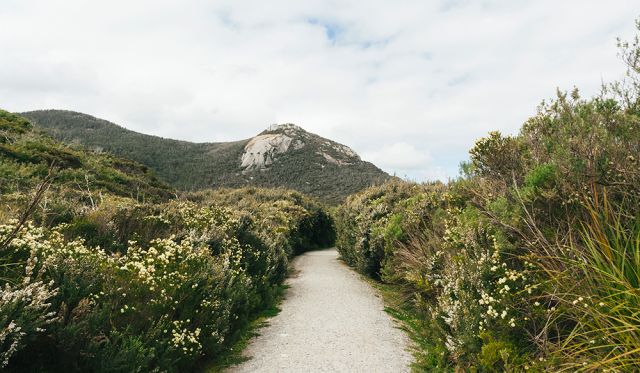
Hiking trail in Wilsons Promontory National Park, Victoria, Australia.

2. Overnight lighthouse stay

Wilsons Promontory Lightstation is super remote, accessible only by sea or a day-long hike from Tidal River or Telegraph Saddle car park. Hikers can stay overnight in one of three of the lighthouse’s cottages. For romantics, the Banks Cottage has a queen bed, private bathroom and uninterrupted views out over Bass Strait.

3. Glamping luxury at Tidal River

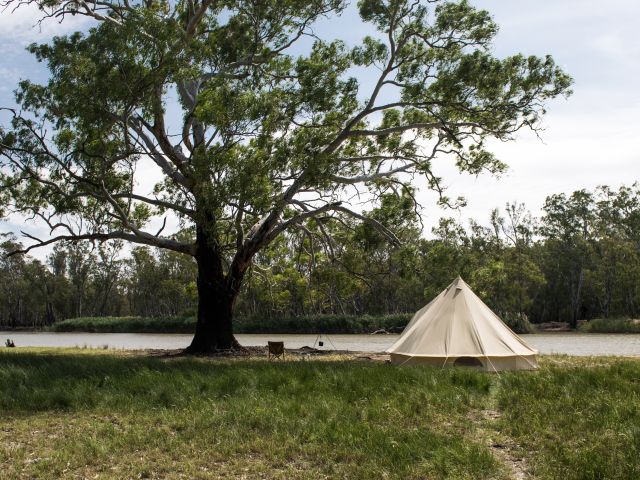
The Prom’s latest accommodation option, these safari-style large permanent tents are situated in a quiet part of Tidal River and are the ultimate in glamping, with timber floors, a queen bed and a communal kitchen for Wilderness Retreat guests.

4. See black swans and the world’s southern-most mangroves

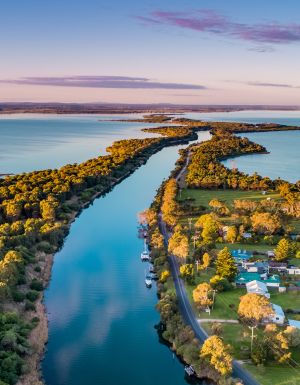
The northern part of the Prom doesn’t get nearly as many visitors, but Miller’s Landing, near the park entrance, is an easy walk with the chance to see flora and fauna you wouldn’t normally associate with the Prom, including large flocks of black swans.

5. Refuge Cove

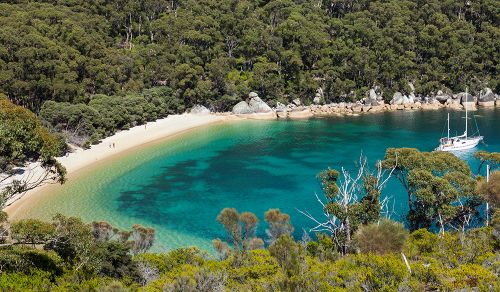
An abundance of wildlife calls Refuge Cove its home, with waters in the region that supports dolphins, sharks, seals and migrating whales as well as a rich diversity of bird life, including albatross, shearwater, fairy prions, little penguins and white-bellied sea eagles.  We are lucky that departures are daily and you will also enjoy a lunch on board of Wildlife Coast Cruises .
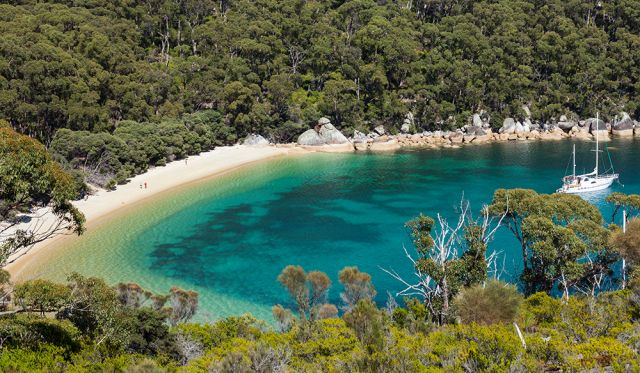
Refuge Cove from above, Wilson Promontory National Park

6. Eat hot chips on Norman Bay beach

Why? Because it’s hot chips. On the beach. And because Norman Bay is a wide, white, postcard-ready beach with decent surf at one end and a kid-friendly tidal river at the other.

7. Wildlife spotting, Loo Errn Boardwalk track

Spotting native animals out in the wild never gets tiring. Around the Loo Errn you’ll most likely see wombats, but also look out for various types of wallabies, echidnas, native swap rats, several types of tiny marsupials and native birds. Pro tip: No matter how cute, never interfere with the wildlife or try to feed them your food, it’s dangerous for you and for them.

8. Watch the sun set from the top of Mt Oberon

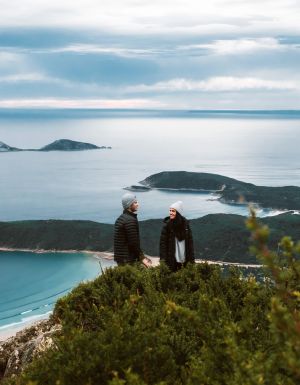
The hike up this mountain is worth it for the view at any time of day, but seeing the sun set over the ocean, casting pink to golden light across Tidal River below, is something very special.
Pro tip: Once the sun goes down it gets very dark very quickly, so take a good torch with you for the walk back down the mountain.
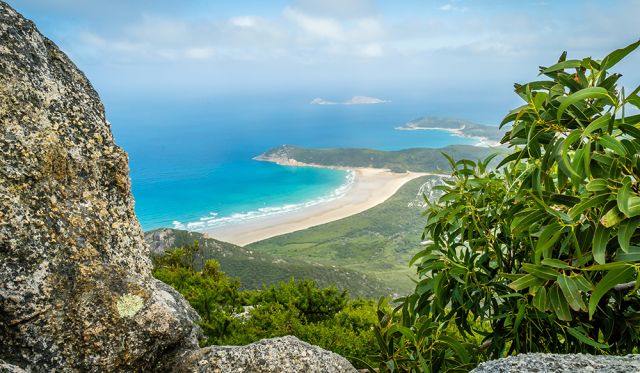
Wilsons promontory national park view from Mount Oberon

9. Attend a ranger talk at the Visitor Centre

Parks Victoria offers a great schedule of academic speakers and kids activities that you can attend while at the Prom. With a long and complex history and amazing biodiversity, there’s a lot to learn. Plus, it’s a good alternative to your tent on a rainy day!

10. Take a cruise around the Prom’s coastline

Much of the water around the Prom is a marine national park, with seabird colonies, fur seals, leatherback turtles and visiting whales. Full day cruises around the Prom’s coastline are a way to see this unique destination from a different perspective.


Planning a big trip? Check out our handy destination guide full of tips on where to eat, stay and play in Gippsland…

 

This luxe trawler tour is redefining Victoria’s seafood experience

Victoria’s ‘mussel capital’ is the source of exceptional shellfish used by top chefs far and wide. Step aboard a beautifully refurbished trawler to see how these plump and juicy bivalves are sustainably cultivated.

A curtain is slowly winched from the placid, teal waters just off Portarlington , like a floating garland beside our boat. The ropes heave with blue mussels, the star attraction of our tour. But as we reach to pluck our own, it’s quickly clear they’re not alone; a mass of weird and wonderful creatures has colonised the ropes, turning them into a living tapestry. ‘Fairy’ oysters, jelly-like sea squirts, and tiny, wriggling skeleton shrimp all inhabit this underwater ecosystem.

We prize our bivalve bounty from the ropes, and minutes later the mussels arrive split on a platter. The plump orange morsels are served raw, ready to be spritzed with wedges of lemon and a lick of chilli as we gaze out over the bay. They’re briny, tender and faintly sweet. “This wasn’t originally part of the tour,” explains Connie Trathen, who doubles as the boat’s cook, deckhand and guide. “But a chef [who came onboard] wanted to taste the mussels raw first, and it’s now become one of the key features.”

A humble trawler turned Hamptons-style dreamboat

inspecting bivalve bounty from the ropes
Inspecting the bounty. (Image: Visit Victoria/Hannyn Shiggins)

It’s a crisp, calm winter’s day, and the sun is pouring down upon Valerie, a restored Huon pine workhorse that was first launched in January 1980. In a previous life she trawled the turbulent Bass Strait. These days she takes jaunts into Port Phillip Bay under the helm of Lance Wiffen, a fourth-generation Bellarine farmer, and the owner of Portarlington Mussel Tours . While Lance has been involved in the fishing industry for 30-plus years, the company’s tour boat only debuted in 2023.

holding Portarlington mussels
See how these plump and juicy bivalves are sustainably cultivated.

It took more than three years to transform the former shark trawler into a dreamy, Hamptons-esque vessel, with little expense spared. Think muted green suede banquettes, white-washed walls, Breton-striped bench cushions, hardwood tables, bouquets of homegrown dahlias, and woollen blankets sourced from Waverley Mills, Australia’s oldest working textile mill. It’s intimate, too, welcoming 12 guests at most. And yet there’s nothing pretentious about the experience – just warm, down-to-earth Aussie hospitality.

As we cruise out, we crack open a bottle of local bubbles and nibble on the most beautifully curated cheese platter, adorned with seashells and grey saltbush picked from the water’s edge that very morning. Australasian gannets soar overhead, and I’m told it’s not uncommon for guests to spot the odd seal, pod of dolphins, or even the occasional little penguin.

The sustainable secret behind Victoria’s best mussels

blue mussels off Portarlington
Blue mussels sourced just off Portarlington.

Connie and Lance both extol the virtues of mussels. They’re delicious. A lean source of protein and packed with omega-3 fatty acids, vitamin B12, iron, selenium, and zinc. They’re cooked in a flash (Connie steams our fresh harvest with cider and onion jam). And they’re also widely regarded as one of the most sustainable foods in the world.

Portarlington mussels with lemon and chilli
Mussels served with lemon and chilli.

“Aquaculture is [often] seen as destructive, so a lot of our guests are really surprised about how environmentally friendly and sustainable our industry is,” Lance says. “[Our mussels] would filter 1.4 billion litres of water a day,” he adds, explaining how mussels remove excess nitrogen and phosphorus from the water. “And through biomineralisation, we lock carbon into mussel shells.”

a hand holding a Portarlington mussel
Mussels are a sustainable food.

Despite their glowing list of accolades, these molluscs have long been seen as the oysters’ poorer cousins. “It was a really slow start,” explains Lance, who says that in the early days of his career, “you could not sell mussels in Victoria”.

But word has slowly caught on. Chefs as globally acclaimed as Attica’s Ben Shewry and even René Redzepi of Noma, Denmark, have travelled to these very waters just to try the shellfish at the source, sharing only the highest praise, and using Lance’s mussels in their restaurants.

guests sampling Portarlington mussels onboard
Sampling the goods onboard. (Image: Visit Victoria/Hannyn Shiggins)

According to Lance there’s one obvious reason why the cool depths of Portarlington outshine other locations for mussel farming. “The water quality is second to none,” he says, noting how other regions are frequently rocked by harvest closures due to poor water quality. “We grow, without a doubt, some of the best shellfish in the world.” And with Lance’s bold claims backed up by some of the industry’s greatest names, perhaps it won’t be much longer until more Aussies uncover the appeal of Portarlington’s mussels.