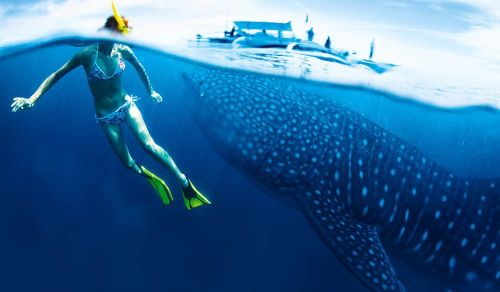
A close encounter with Ningaloo‘s whale sharks

hero media
If swimming with whale sharks isn’t on your outback bucket list, well then you’re missing out, says Daniel Scott.

Just being here on this sparkling winter morning would be enough, cruising from Tandabiddy boat ramp through a break in one of the largest fringing reefs in the world. And Ningaloo Reef is right here in Australia, running for 300 kilometres along the continent’s north-western tip and enshrined on the World Heritage List since 2011 for its outstanding natural beauty and biological diversity.


After diving and snorkelling on its coral forests for the past three – unforgettable – days with Sail Ningaloo , I cannot imagine there being a healthier reef system anywhere on our planet. Nor one that draws such abundant and varied marine life. It’s impossible to count the number of tropical fish I’ve seen while snorkelling, decorated in luminous, electric colours that would outshine any neon-lit Tokyo street. While diving, I’ve loped along with a 90-year old loggerhead turtle, tried to keep up with cruising reef sharks and made awkward attempts to fly in formation alongside manta rays with five-metre wingspans.


But today, along with about 20 other passengers, I am about to realise a long-held dream: to swim with the biggest fish in the sea. Whale sharks: animals that can grow to 12 metres in length and weigh 21 tonnes and are yet among the most difficult of creatures to find on the planet. It’s another of Ningaloo Reef’s miracles that whale sharks are drawn, in significant numbers, to its plankton-enriched waters, between April and July every year.


Yesterday, on a scenic flight, I saw four of these behemoths in the deeper, darker Indian Ocean outside the reef, their spotted patterns clearly visible from 300 metres above. Now, my pilot Tiffany is up in the sky again, acting as a spotter for our boat, Kings Ningaloo Reef Tour’s The Magellan.


As we are briefed by our young whale shark guides, the sense of anticipation builds.


“Once we’ve located a whale shark," my guide Nadine tells our group of eight snorkellers, “the skipper will get the boat ahead of it. Then I will jump in, find it underwater and hold my arm up to indicate which way it is travelling. Then…"


“Whale shark!"


Before she has time to finish, the cry has gone up and The Magellan is powering toward a nearby sighting.


“Get in one by one," says Nadine shuffling to the back of the boat in her fins, “and fan out on either side in two groups of four. And please remember to stay three metres away from the…"


Nadine is in and swimming like an Olympian in the open ocean. I’ve got the sinking feeling and thumping pulse I always get when my sense of adventure is about to propel me into a situation my comfort-loving self would never consider.


Nadine has stopped and pumped her arm above the swell.


“Go, go, go!"


I take a deep half-breath, step onto the tailboard and stride off the boat. There’s bubbles and white water everywhere.


Strewth, I think, when the commotion clears, this water must be 80 metres deep. Before I can dwell on that, I catch a flash of Nadine’s yellow fins and push off towards her. Then I see it, an immense grey blur off to Nadine’s right. A second later it is a huge flat head proceeded by an outsized mouth, with natural lips that would put collagen out of business, heading straight toward me.


Getting run-down by a sub-aquatic double-decker bus wasn’t in my script. I gulp a snorkel full of ocean and fin backwards, sideways, anyways I can to get out of its road. It’s still coming toward me, the feeding whale shark’s mouth formed into an ‘O’, like one of those cool kids at school that blew perfect smoke rings.

Finally, I’m clear. I breathe easier and take in those markings that I’d seen from the air. Hundreds of off-white dots adorn its head and run in symmetrical patterns down its body. As it flashes past, I see the well-defined ridges of its back leading down to its vertical tail fin.


It takes 15 seconds for my first whale shark, an adolescent male that’s a mere four-and-a-half metres long and has the speed and grace of a marine cheetah, to be gone. As I flounder after it, it pulls away with a dismissive flap of its tail, leaving eight snorkellers gurgling like excited babies into their snorkels.


With careful manoeuvring, The Magellan drops us twice more into the path of this speedy shark. Later, we make the more relaxing acquaintance of a bigger, slower-moving female. But it is those first moments, described by shark expert Valerie Taylor as being like watching “a tanker emerging from the fog" that will remain etched in my brain as the greatest wildlife encounter of my life.

The details

Getting there


• Fly from Perth to Exmouth (Learmonth Airport) and head north to Exmouth (20 minutes) or south to Coral Bay (30 minutes). Both Coral Bay and Exmouth offer whale shark tours. You are more likely to swim with whale sharks at Exmouth (but only just – sightings at Coral Bay still happen at least 80 per cent of the time). Coral Bay is better known for its manta ray swims.

Staying there


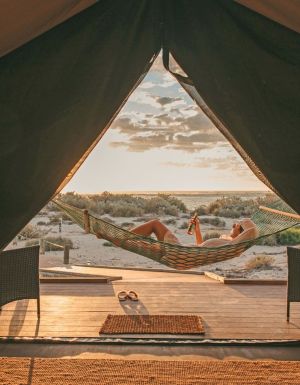
• If you’re a luxury lodge fiend, glamping property Sal Salis in the Cape Range National Park is the only place to stay. Often there is a three-night package including a whale shark experience, for around $2660 per person, twin share.


• We stayed onboard Sail Ningaloo ; they operate three, five and nine-day Ningaloo Reef Tours between March and December. Prices begin from $1700 for a three-night tour in a deluxe cabin including all meals and non-alcoholic drinks, transfers from Coral Bay and equipment. However, you won’t see whale sharks with Sail Ningaloo – that’s a day experience offered through other operators (see ‘Playing There’).

Playing there


• We swam with Kings Ningaloo Reef Tours , but there are several operators to choose from: seven at Exmouth and one at Coral Bay. Prices range from $385–$400 per person. Most offer a return ticket for the next day if the whale sharks don’t show up.


MORE: Swim with a real shark – ‘The Great White Truth About Cage Diving With Sharks

hero media

6 reasons the best way to experience the Kimberley is by cruise

This remote corner of Australia is one of the world’s last frontiers. This is how to see it properly.

Vast, rugged and deeply spiritual, the Kimberley coast in Australia’s North West feels a world away from everyday Australia – and there are countless ways to explore it. But if you want to reach ancient rock art, hidden gorges and lonely waterfalls, it has to be by boat. Whether you’re aboard a nimble expedition vessel or a luxury yacht with all the trimmings, exploring by the water brings exclusive experiences, shows unique views and makes travel easier than any other mode. And that’s just the beginning of Australia’s North West cruises.

The True North Adventure Cruise in between sandstone cliffs.
Adventure starts where the road ends.

1. Discover Broome, and beyond

Explore your launchpad before you set sail: Broome. Here camels and their riders stride along the 22 kilometres of powdery Cable Beach at sunset. That’s just the start.

At Gantheaume Point, red pindan cliffs plunge into the turquoise sea, whose low tide uncovers fossilised dinosaur footprints. Broome’s pearling history runs deep. Japanese, Chinese, Malay and Aboriginal divers once worked these waters, and their legacy lives on in boutiques where South Sea pearls still shine.

If the moon’s right, you may catch the Staircase to the Moon over Roebuck Bay. Or simply kick back with a cold beverage and a film under the stars at Sun Pictures , screening since 1916.

Ride a camel along Cable Beach as the sun sinks into the Indian Ocean, casting golden light across the sand and sea.
Ride a camel along Cable Beach. (Image: Nick Dunn)

2. Unmatched access to The Kimberley

Once you’re onboard, expect a backstage pass to some of the most isolated places on Earth. No roads. No ports. No phone reception.

At Horizontal Falls/ Garaanngaddim, 10-metre tides surge through twin gorges like a natural waterpark ride that’ll make your palms sweat. Then there’s Montgomery Reef/ Yowjab: a giant living platform of coral and seagrass, where the sea pulls back to reveal waterfalls, sea turtles and ospreys.

Up north, King George Falls/ Oomari rage 80 metres down red cliffs. Zodiac boats often nudge in closer so you can feel the spray on your sun-warmed cheeks. You might even fly in to reach Mitchell Falls/ Punamii-unpuu, a four-tiered cascade where you can swim in freshwater pools above the drop.

Come spring, some itineraries veer west to Rowley Shoals: an atoll chain of white sand and reef walls. Then it’s up the winding Prince Regent River to King Cascade/ Maamboolbadda, tumbling over rock terraces, and into a Zodiac to view the Gwion Gwion rock art, whose slender, ochre-painted figures are older than the pyramids.

A cruise drifts beneath King George Falls, where sheer sandstone cliffs frame the thunderous plunge into turquoise waters.
Get closer to the Kimberley than ever before.

3. Taste the Kimberley with onboard hospitality

You might spend your days clambering over slippery rocks or charging past waterfalls. But when you’re back on the water, it’s a different story. Meals are chef-prepared and regionally inspired: grilled barramundi, pearl meat sashimi, mango tarts, and bush tomato chutney. One night it’s barefoot beach barbecues with your shipmates; the next, alfresco dining on the ship.

Small expedition ships each have their own personality, but many carry just 12 to 36 guests, making being out on the water a whole other experience. You might sink into a spa on the foredeck or sip coffee in a lounge while watching crocodiles cruise by. It’s choose-your-own-relaxation, Kimberley style.

4. Expert-led excursions through the Kimberley

These voyages are led by people who know the Kimberley like the back of their sunburnt hand. Attenborough-esque naturalists might gently tap your shoulder to point out rare birds or tell the story beneath a slab of rock. Historians can explain exactly how that rusted World War II relic came to rest here.

If your ship has a helipad, you might chopper straight to a waterfall-fed swimming hole. If not, you’ll still be hopping ashore for that wet landing at a secret creek.

Then come the evenings: songlines shared by Traditional Owners under the stars, or astronomy sessions that link what’s overhead with what’s underfoot and what’s within.

A small group glides through Kimberley’s rugged coastline by boat, passing ancient cliffs.
Explore with naturalists and historians by your side.

5. Relax in luxurious lodgings

Just because you’re off-grid doesn’t mean you have to rough it. These Kimberley vessels are small in size, but mighty in luxury. True North’s ships come with their own helicopters and a no-sea-days policy, so you’re always in the thick of it. Try the luxurious offerings from Ocean Dream Charters for exploration in style. Kimberley Quest offers a fast boat for easy, off-ship adventures. On the larger end of the scale, Coral Expeditions has open-deck bars and curated wine cellars. And then there’s Ponant’s luxury yachts sleek and incredibly stylish French sailing yachts.

A helicopter soars above the sea, with a sleek cruise ship gliding in the distance.
See the Kimberley from sky to shore.

6. The adventure continues with pre- and post-cruise experiences

You’ve already come this far – so, why not go further? Broome makes it easy to ease in before you board, or wind down when your voyage ends, and there is no reason to stop there.

Head an hour and a half south to Eco Beach to stay off-grid and off the clock. Join a Yawuru guide for a mangrove walk or ocean forage. Dive even deeper into Broome’s pearling past at Willie Creek or Cygnet Bay, where divers and craftspeople still pull the seawater-slicked gems from the deep.

If you’re still craving adventure, it’s time to go further. Soar over the Buccaneer Archipelago, or detour inland with a 4WD trip along the Gibb River Road. Book a scenic flight over the Bungle Bungles. Or – because you never know when you’ll be back – do all three.

aerial of people walking on eco beach in the kimberley western australia
Stay off grid at Eco Beach. (Image: Tourism WA)

Find out more about your trip to Australia’s North West at australiasnorthwest.com .