hero media

Where to see the best bioluminescence in Australia

A dazzling underwater world reveals itself after dark – and we know where to find it.

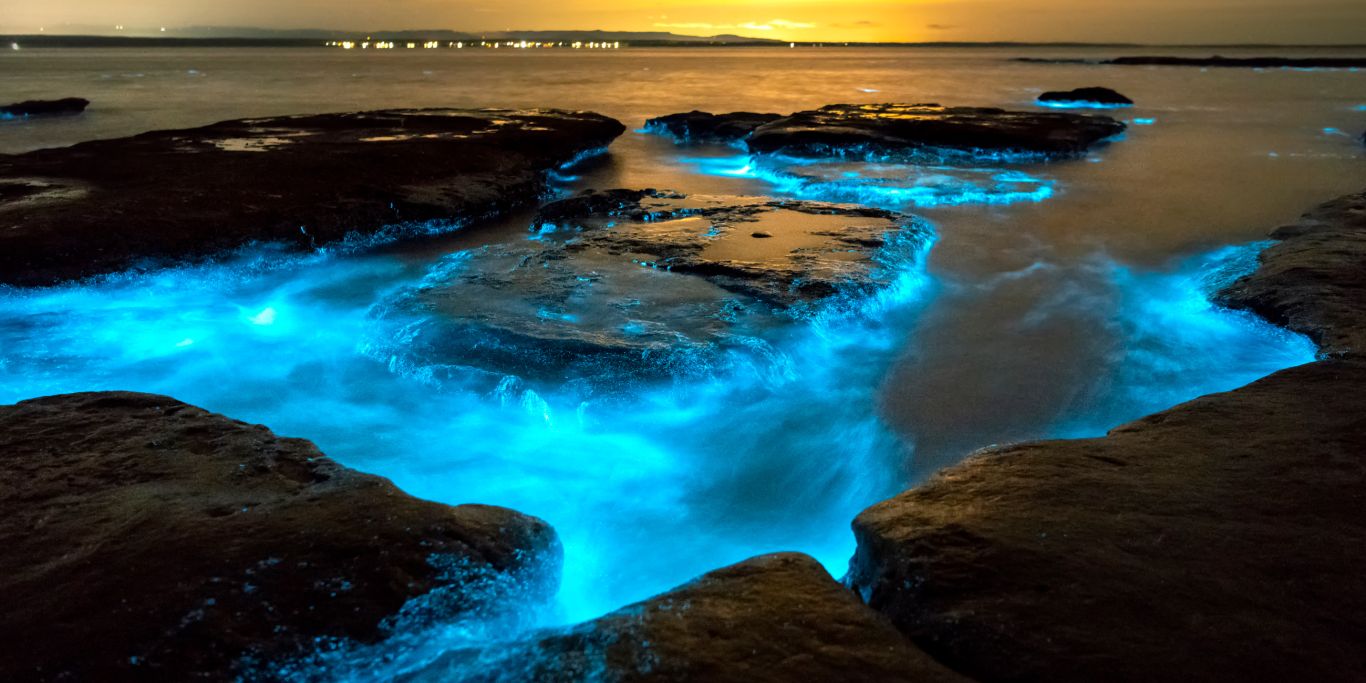
There are chemical reactions that bake your bread, rust your bike, and turn your water from still to sparkling. But perhaps one of the most magical chemical reactions on Planet Earth is that which lights up living things from the inside out: bioluminescence.

What is bioluminescence caused by?
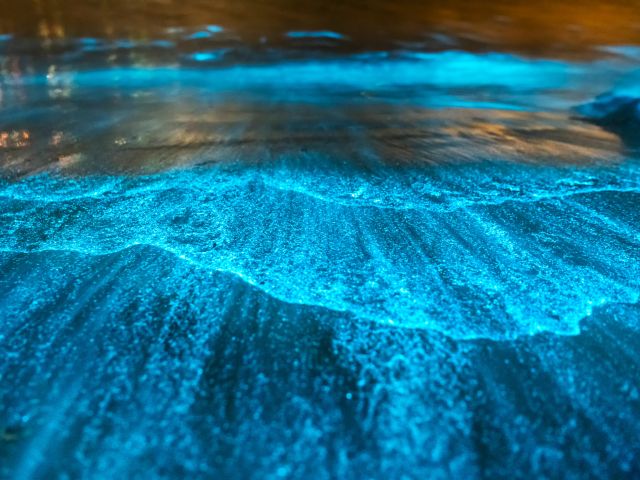
a bright and brilliant blue ocean at night
A chemical reaction in the water causes an ethereal glow. (Image: Getty/RugliG)

Bioluminescence is a primarily marine phenomenon, occurring in certain types of fish, plankton, jellyfish and other deep-sea invertebrates. It can take place on land, but this is much rarer, with fireflies, foxfire mushrooms and glow worms being amongst the most famous examples. In order to be bioluminescent, all these species share an important chemical duo: the molecule luciferin and the enzyme luciferase. When luciferin reacts with oxygen, catalysed by the luciferase as a spark might ignite a match, the reaction releases energy in the form of cold light from inside the organism. The colour of this light depends on the arrangement of luciferin molecules, although the colour you can most expect to see is a bright, brilliant blue.

Where in Australia can you see bioluminescence?
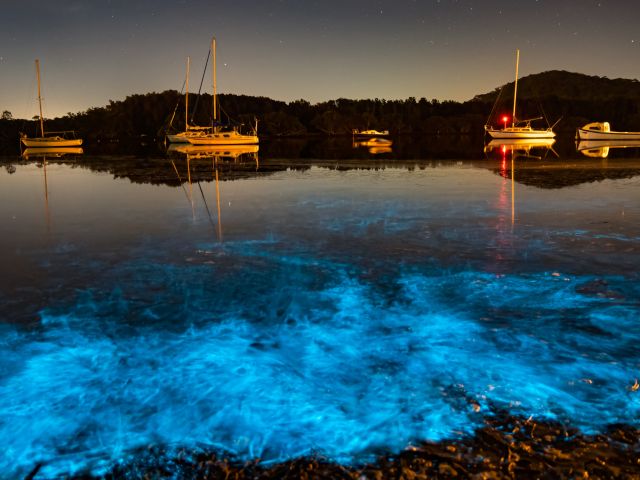
ocean water glows at night
Find dazzling waters in Tasmania, Victoria and New South Wales. (Image: Getty/Merrillie)

Thanks to nutrient-rich currents and greedy plankton, this sparkly show tends to hug the country’s south-eastern states, making Tasmania, Victoria and New South Wales the leading hotspots for seeing bioluminescence in Australia. Sightings in South Australia and Western Australia aren’t impossible (Port Lincoln on the Eyre Peninsula and Marina Mindarie near Perth have had documented flares), but it’s far, far rarer. Meanwhile, instead of glowing waves, the Northern Territory and Queensland are two of your best bets for spotting fireflies. Taking previous displays and recent sightings of bioluminescence into account, here’s a run-down of where to try first…

Tasmania

Noctiluca scintillans – an algae species that shows up red in daylight but transforms into a glittering blue after dark – seem especially fond of Australia’s island state. Best of all, you really don’t have to go far from Hobart to catch a glimpse. Seven Mile Beach, Montagu Bay, Howrah Beach and Ralphs Bay have all lit up on calm summer nights. Meanwhile, just off the eastern coast of Bruny Island, Storm Bay has even had recent sightings of the dazzling moon jellyfish. On the state’s eastern edge, brilliant pictures of both the red and blue blooms have been taken around Eaglehawk Neck, Pirates Bay and Port Arthur. If you’d rather be taken to the action, Tassie local and bioluminescent expert Dr Lisa Gershwin – who holds a literal PHD in ‘Jellyfish’ – runs a guided Glow Tour from Hobart , with dates throughout the year.

Victoria

A four-hour drive from Melbourne, the Gippsland Lakes region is a reliable spot for our electric-blue Noctiluca scintillans, particularly around the Lakes National Park. That said, inner-city spots like St Kilda and Port Melbourne have been seeing increasing flares of bioluminescence in Port Phillip Bay, making the glow surprisingly accessible without leaving the city. See also: the Mornington Peninsula, spots along the Surf Coast (particularly around Lorne and Wye River) and the Otways, whose dark, damp forests make them prime catch for glow worms, too.

New South Wales

New South Wales is home to perhaps Australia’s most famous bioluminescence hotspot: Jervis Bay, an almost three-hour drive south from Sydney. A perfect cocktail of shallow waters, sheltered beaches, minimal light pollution and an abundance of microscopic algae makes it a bio-spotter’s best chance at seeing the phenomenon up close. From Jervis Bay, the Noctiluca scintillans can appear all along the coast as far north as Lake Macquarie, propelling spots around Palm Beach and Wollongong into the spotlight. Closer to Sydney, Manly Beach and Shelley Beach are becoming increasingly blue come nightfall.

And if you want to get really serious, there’s a Bioluminescence Australia Facebook group you can join for live updates of activity around the country.

What time of year can I see bioluminescence in Australia?
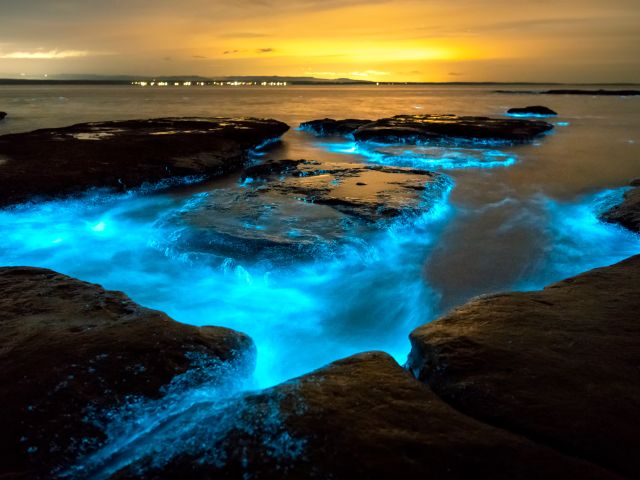
bright blue waters caused by bioluminescence
Bioluminescence is more active after the rain. (Image: Getty/RugliG)

While the phenomena can strike at any time of year, warm water makes for the best bioluminescent bedfellow, since heat stimulates the growth, reproduction and activity of our glow-in-the-dark microorganisms. In Australia, this means the late summer months heading into autumn (February to April) generally produce more frequent sightings. For ultimate sparkle-spotting conditions, bioluminescence is more active after a period of rainfall (rain washes nutrients from the land into the water, helping to trigger algae blooms), and is best viewed on a moonless light, with minimal light pollution.

Is it safe to touch bioluminescent water?
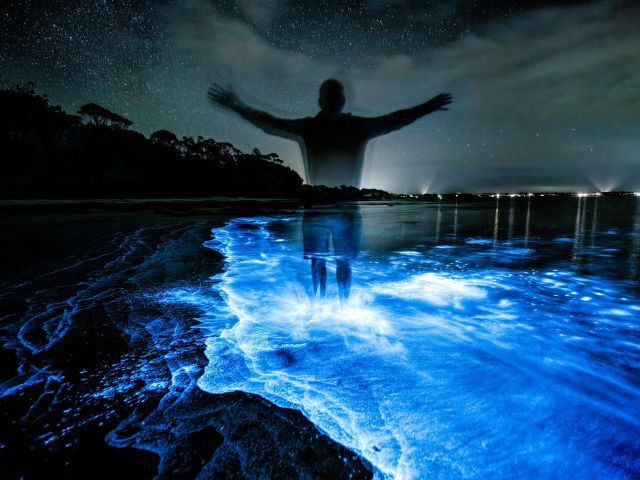
ocean water glows bright blue with a human silhouette in the background
Touching or disturbing the water too much can stress the light-emitting organisms. (Image: Trevor Mckinnon/Unsplash)

On the whole, it’s not recommended – bioluminescent organisms and the ecosystems they inhabit tend to be extremely delicate and vulnerable. Plus, by touching bioluminescent organisms in order to encourage the light, you are by default having to stress and disturb them – akin to poking a lion to make it roar. Some species are even toxic, and can cause skin irritation. Having said this, many glow-in-the-dark tours around the world do permit gentle touching, so long as no sunscreen, lotions or perfume is worn. Many will see you glide through bioluminescent waters on kayaks. The best advice? Exercise your own judgement and practice responsible tourism.

Hannah Ralph
Hannah Ralph is an award-winning travel editor turned freelance writer. She’s currently chasing stories across Australia, until reality (and her inexplicable fondness for chilly British weather) demands a return to the UK, where her globe-trotting career began more than a decade ago. Following a formative start as Features Assistant at The Sunday Times Travel Magazine, Hannah went on to hone her aviation chops for several years on the British Airways editorial team, serving as Editor and Deputy Editor on numerous titles, including the flagship in-flight mag, High Life. She later returned to The Times and Sunday Times as an in-house Travel Writer. Now freelance, Hannah finds herself a roaming reporter with bylines for Mr & Mrs Smith, The Telegraph, Business Traveller UK, National Geographic Traveller, Eurostar’s Metropolitan magazine, and more. Her mission? To track down all of Australia’s greatest, most unforgettable stays – and live what might just be the most glamorous gap year yet.
See all articles
hero media

Your Mandurah guide: art, dining & dolphins await in WA’s coastal gem

Discover the perfect road trip stopover between Perth and wine country.

Western Australia punches above its weight when it comes to coastal hot spots, but no other town or city has seen a tourism boom quite like Mandurah. Named Australia’s Top Tourism Town in 2023 , it’s the relaxed, beachside break you’ve been searching for. And it’s perfectly placed, sitting between Margaret River and Perth, as it’s just a 55-minute drive from Perth’s CBD. Which is why we’ve put together your ultimate Mandurah guide.

Aerial view of Mandurah.
Plan your perfect coastal escape to Australia’s Top Tourism Town of 2023.

The best things to do in Mandurah

Wetlands and rivers, ocean and inlet; Mandurah’s laid-back lifestyle centres around the aquatic. Its waterways cover twice the ground of Sydney Harbour – measuring some 134 square kilometres in total – and form a unique environment for oceanic and estuarine flora and fauna to thrive.

In the city’s estuary lives perhaps the region’s most famed inhabitants – a resident pod of 100 bottlenose dolphins – and the inlet’s silty bottom is home to the prized blue manna crab. Spot the former breaching and playing on an hour-long dolphin cruise through the channels, or try your hand at catching the latter by wading through the estuary’s shallows with a scoop net in hand.

While swimming at the circular Kwillena Gabi Pool, chance encounters with the local wildlife aren’t uncommon. The sheltered estuarine pool takes its name from the traditional custodians of the land, the Bindjareb people, and directly translates to ‘dolphin waters’. Jutting out of the eastern foreshore, it’s enclosed by a ring of net-free floating pontoons, which allow the dolphins to swim freely through the attraction.

If that’s a little too close for comfort, book a kayak tour with Down Under Discoveries . The dolphins have been known to cruise beside the paddle-powered crafts, which are a fun, family-friendly way to explore the city’s inner waterways.

Dolphins swimming in Mandurah.
Watch dolphins glide by as you explore Mandurah.

You don’t have to be on the water to appreciate the coastal city’s aquatic beauty, with 600 kilometres of cycleways and scenic walking trails traversing Mandurah’s estuary, inlet and coast.

Follow the 30-kilometre coastal trail and you’ll come face to face with one of Thomas Dambo’s headline-making ‘Giants of Mandurah  sculptures, Santi Ikto, along the way. There are five sculptures around Mandurah in total, hidden among gum-filled reserves or sitting sentry over the water.

Head to the Mandurah Visitor Centre to pick up a map to pinpoint their exact location and download the traveller’s companion to learn more about the sights along the way. Or join a three-hour e-bike tour from The Bike Kiosk and you’ll stop by two of the giants – Santi Ikto and Yaburgurt Winjan Cirkelstone – as you sightsee central Mandurah.

 The towering Santi Ikto, one of Thomas Dambo’s iconic Giants of Mandurah.
Meet Santi Ikto, one of the legendary Giants of Mandurah.

Where to eat in Mandurah

Mandurah’s culinary scene reflects its laid-back lifestyle, with large, honest meals and locally brewed beer. After visiting Lake Clifton’s 2000-year-old thrombolites, head to the peppermint and gum-shaded beer garden at Thorny Devil Brewery . Tuck into a platter of house-smoked meats and an ale pulled fresh from the tanks. Closer to town and right on the waterfront is Boundary Island Brewery ; here, woodfired pizza, pub-style seafood dishes and easy-drinking brews are centre stage.

On a Murray River Lunch Cruise , the focus is as much on the environment around you as the food you’re filling up on. Help yourself to the colourful salads and freshly cooked meats on the buffet as you meander up the winding, jarrah tree-lined waterway, stopping at the heritage Cooper’s Mill for a quick walking tour along the way.

Keep your eyes trained on the Creery Wetlands as you pass – you’ll spot much of the region’s migratory birdlife, and, as always, might see the playful bottlenose dolphins in the inlet.

The most memorable meals aren’t necessarily always the fanciest, and lunch aboard a self-skippered Mandurah BBQ Boat is a testament to that. All food and beverage prep is left up to you as you cruise through the canals, sausages and steaks sizzling away on the central hot plate.

If seafood is more your kind of fare, board the Wild Seafood Experience , where dolphin cruise meets long table lunch. Eight courses of crab, crayfish and scallops await.

A table filled with plates of crab, crayfish, and scallops.
Dine on the water with eight courses of ocean-fresh fare.

Where to stay in Mandurah

With so many waterways comes abundant waterside stays. Like the self-contained Seashells Mandurah on the shores of Comet Bay. The calm, oceanic outlook from the one-, two- and three-bedroom apartments and villas is as close to Maldivian as Mandurah gets. Families especially enjoy the property, bouncing between the protected cove and the beachfront pool for endless hours of fun.

Seashells Mandurah; on the shores of Comet Bay.
Stay right by the sea.

The Sebel Mandurah , just a hop, skip and jump from the Mandurah Ocean Marina, has a different outlook entirely, overlooking the estuary and lively foreshore on the other side. It’s also within walking distance of the Mandurah Performing Arts Centre , cinema and a swathe of waterfront bars and eateries.

But you can’t get any closer to the water than on a vessel from Mandurah Houseboats . You don’t need a skipper’s ticket to hire one, nor do you need comprehensive boating experience; just a full driver’s license and your undivided attention during the pre-departure tuition will do. Then you’re free to take to the estuaries and tributaries for a few nights of peaceful rest, surrounded by the very element that makes Mandurah so special.

A houseboat cruising in Mandurah along the river
Captain a houseboat to explore Mandurah at your own pace.

Plan your next WA getaway in Mandurah.