7 vibrant markets in Darwin to visit

hero media
Opals to flowers, food stalls, zebra rock: Darwin’s markets run the gamut for souvenirs and a culinary education on the tropical city’s multifaceted culture.

Visiting Darwin’s markets has become the cornerstone of the locals’ weekend routine. But whether you’re a Territorian, a visitor or a vendor, everyone can easily find something to love about Darwin’s vibrant, community-focused ventures.

From breakfast banh mi to crocodile belts, here is your comprehensive guide to Darwin’s best markets and stalls.

1. Mindil Beach Sunset Market

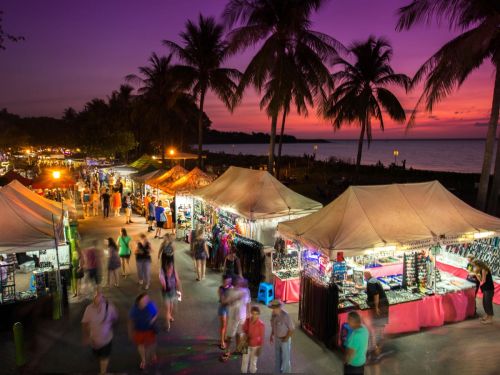
Taking pride of place, Darwin’s largest market runs along the foreshore of Mindil Beach, famous for its sunsets over the Timor Sea. Visitors enjoy browsing over 200 stalls, live performances and scrumptious food trucks.
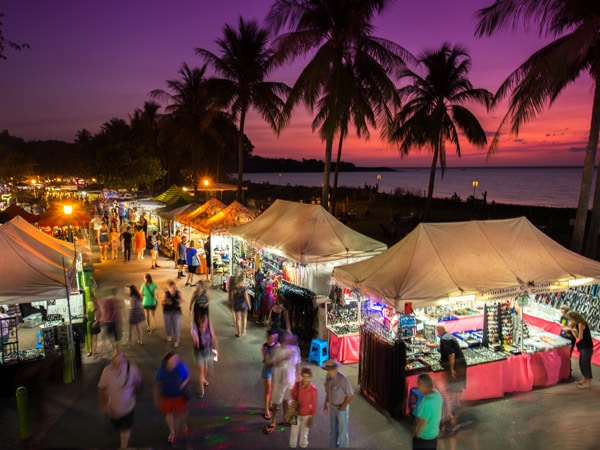
an aerial view of Mindil Beach Sunset Market
The sky turns purple at dusk at Mindil Beach Sunset Market. (Image: Mindil Beach Markets/Charlie Bliss)

Hungry hordes graze their way along the food stalls, which serve up tastes from Turkey to Timor. From made-to-order yellowfin tuna nachos to the sugary goodness of Spanish churros topped with Belgium chocolate, there are hundreds of picnic-friendly dishes, including crocodile, kangaroo and buffalo gourmet burgers from the quirky Roadkill Café.
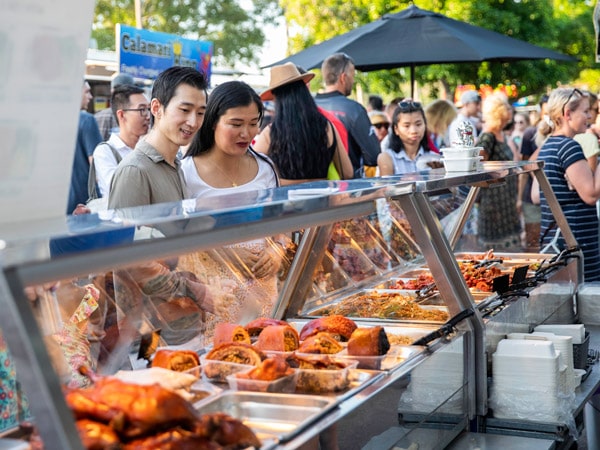
a couple picking food at Mindil Beach Sunset Market
Taste your way around the food stalls. (Image: Tourism NT/Helen Orr)

Souvenir lovers, rejoice. Fill your suitcase with Indigenous art, local photography, antique batik pieces, Slappa’s Thongs, Bogan Biltong (made by Mr and Mrs Bogan) and don’t forget – a crocodile back scratcher from Mick’s Whips.
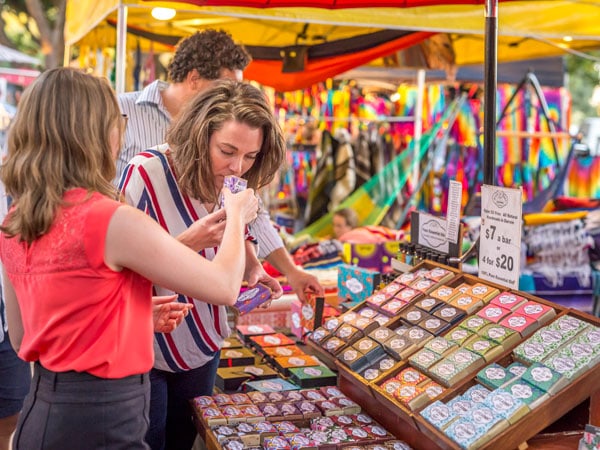
a person smelling soap at a stall in Mindil Beach Sunset Market
Find scented soaps and other artisan items. (Image: Tourism NT/Nick Pincott)

After the VIP market experience at the Mindil Beach Sunset Market? The Sunset Lounge (reserve a table and seat online before you visit) is the perfect place for sipping wine, a local mango smoothie and nibbling snacks.

welcome VIPs signage at Mindil Beach Sunset Market
Book your seat in the VIP Sunset Lounge. (Image: Tourism NT/Nick Pincott)

When: Thursdays and Sundays, May to October
Hours: 4pm – 9pm
Address: Mindil Beach, off Gilruth Avenue

2. Parap Village Markets

The smaller but equally vibrant markets in the hip hood of Parap are a locals’ favourite for a progressive brunch. A Malaysian laksa noodle soup, with its creamy coconut broth, a roti wrap and an icy fresh-fruit shake are non-negotiable. But don’t stop there; there’s also Cambodian prawn pancakes, Indonesian satays, Lebanese snacks and authentic Thai sweets to try.
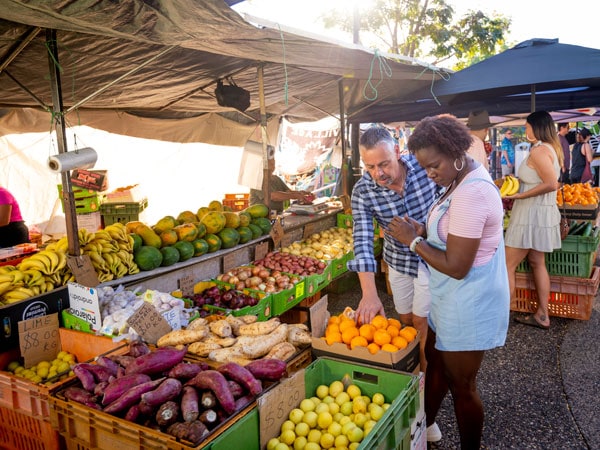
a couple checking out the fresh produce on display at a stall in Parap Village Markets
Pick fresh fruits at Parap Village Markets. (Image: Tourism NT)

One of Parap’s most famous food stalls is Mary’s legendary laksa (just look for the queue) – with its fragrant, noodle-stuffed broth, quality seafood and fiery sambal – it certainly deserves the devotion it inspires.
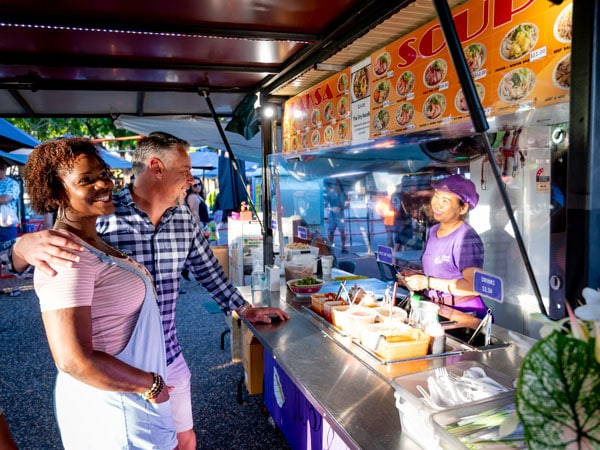
a couple buying Laksa soup at Parap Village Markets
Try out Mary’s legendary laksa. (Image: Tourism NT)

From books to jewellery and door stoppers to tarot card readings, you can buy just about everything you’d expect at these lively markets. Whether you want to gawk at the rows of colourful tropical fruits or snag some affordable textiles, this market is good for anyone who wants a truly local Darwin experience.
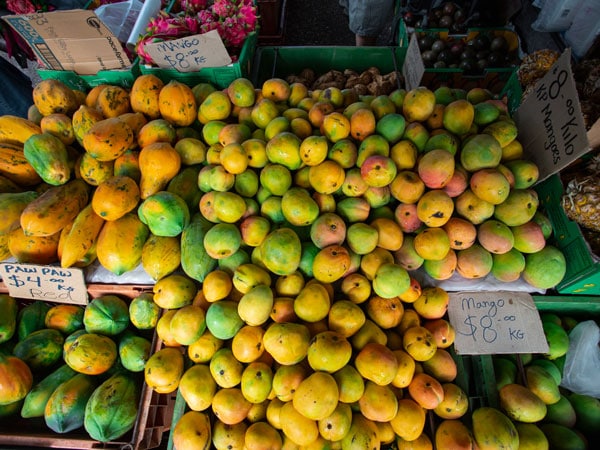
mangoes on display at Parap Village Markets
Freshly picked mangoes are available at Parap Village Markets. (Image: Tourism Australia/Nicholas Kavo)

“The market is a weekend institution," says Sousou Elayoubi, while serving up kofta, hummus and falafel at her Lebanese food stall. “It has a relaxed vibe and is a great place to catch up with friends."
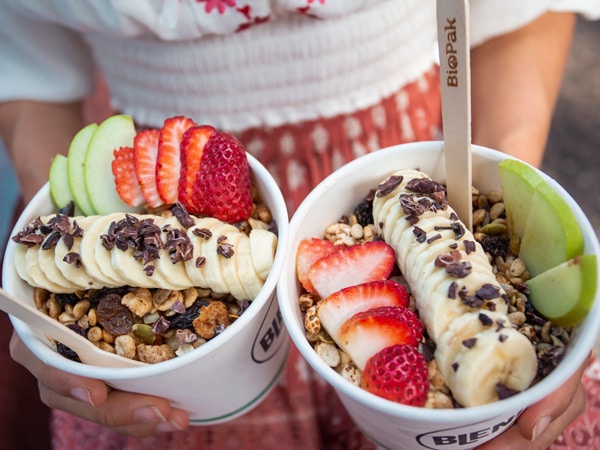
a person holding two cups of desserts at Parap Village Markets
The markets are a foodie delight. (Image: Tourism Australia/Nicholas Kavo)

If you’re seeking a break from the heat, jump into the air-con nearby at these standout venues: Parap Fine Foods, Parap Bakery, The Cyclone Café, Laneway Speciality Coffee and Mad About Coffee.

Walk off your caffeine buzz with a wander through the Parap galleries, including the Northern Centre for Contemporary Art, Outstation Gallery and Laundry Gallery.

a couple shopping clothes at Parap Village Markets
Browse fashionable items through the stalls. (Image: Tourism NT)

When: Saturdays (rain or shine)
Hours: 8am to 2pm
Address: Parap Shopping Village, Parap

Need tips, more detail or itinerary ideas tailored to you? Ask AT.

AI Prompt

3. Rapid Creek Markets

For mountains of bright tropical fruits, piles of Asian greens and eskies filled with homemade tofu and fish, head to Darwin’s oldest market, Rapid Creek Markets.
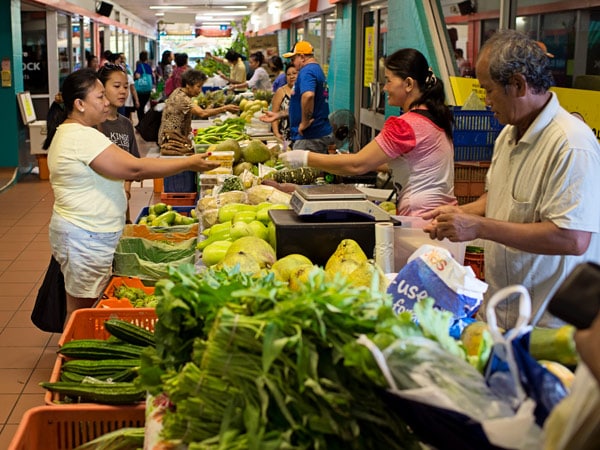
buying green vegetables at Rapid Creek Markets
Fill your basket with Asian greens at Rapid Creek Markets. (Image: Tourism NT/Shaana McNaught)

It might be set in a suburban shopping centre about 10 kilometres from Darwin CBD, but no serious foodie will want to miss this bustling Asian market, with its maze of indoor and outdoor stalls teeming with fresh-picked vegetables and fruit sold by Filipino, Tamil, Thai, Vietnamese and Chinese growers.
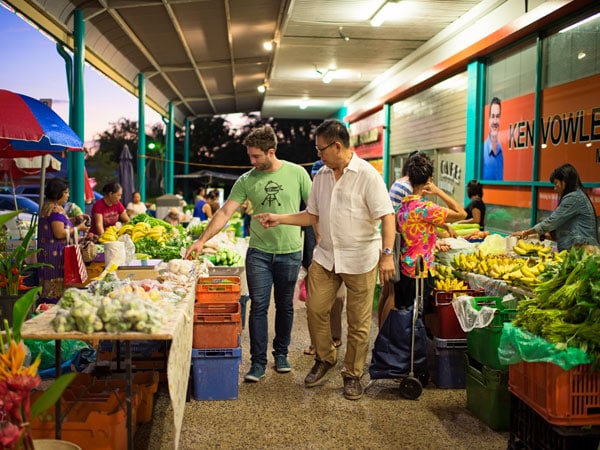
two people browsing through stalls selling fresh produce at Rapid Creek Markets
Different varieties of fresh produce are lined up along Rapid Creek Markets. (Image: Tourism NT/Shaana McNaught)

Arrive early to beat the crowds (and the heat) to hoe into delights such as spicy jackfruit curry and roti wraps, banana fritters hot from the fryer and bright green pandan cakes.
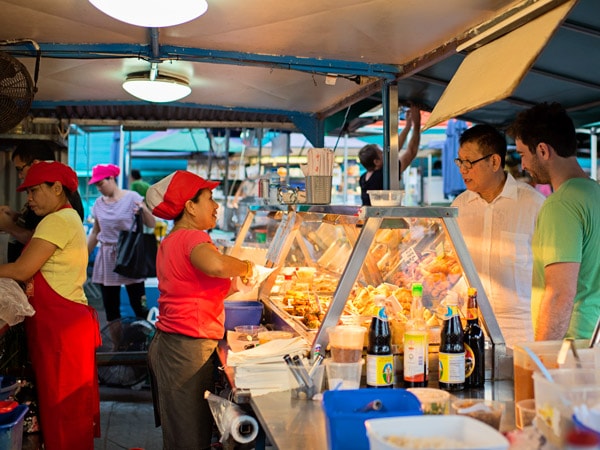
people buying at a food stall in Rapid Creek Markets
Drop by the food stalls to try Asian snack delights. (Image: Tourism NT/Shaana McNaught)

When: Saturday and Sunday
Hours: 7am to 2pm
Address: Trower Road, Rapid Creek

4. Nightcliff Markets

The super-local, family-friendly Nightcliffe Markets is a popular brunch spot where locals kick back to live music, sip smoothies, munch on crepes, enjoy a Thai massage and have their tarot read over a coffee or three.

Highlights of this Darwin market include the perfect pork banh mi (also available with tofu), Nutella and banana creations from Ken’s Crepes, and mixed berry donuts from the revered Ray’s Café and Patisserie.

To take home there’s hand-made jewellery, second-hand books, pot plants and clothing made using screen and lino printed fabrics. Kids (and parents) will embrace the children’s playground and shaded seating.
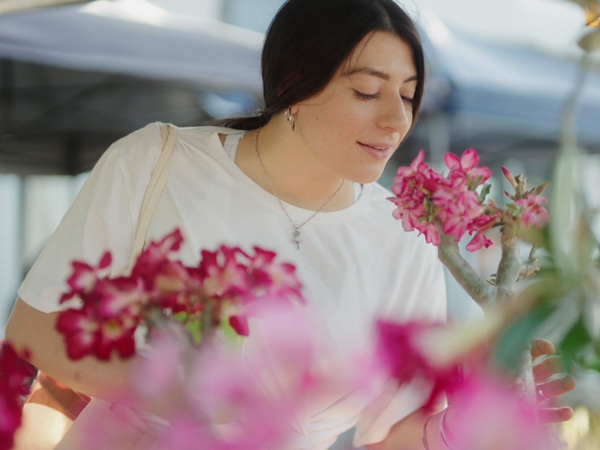
a woman smelling flowers at Nightcliff Markets
Pick fresh blooms at Nightcliff Markets. (Image: Tourism NT/Kane Chenoweth)

When: Sundays
Hours: 8am to 2pm
Address: Progress Drive, Nightcliff

Weekly travel news, experiences
insider tips, offers, and more.

5. Fred’s Pass Rural Market

Locals head to Fred’s Pass, about 30 kilometres from Darwin’s CBD, to pick up second-hand books, have a massage and to relax at the tables with nibbles while listening to local musicians. For the kids, there’s a jumping castle and toy stalls. With ample parking for caravans, campervans and trailers, this is a good option for adventurers enjoying a road trip to Darwin.
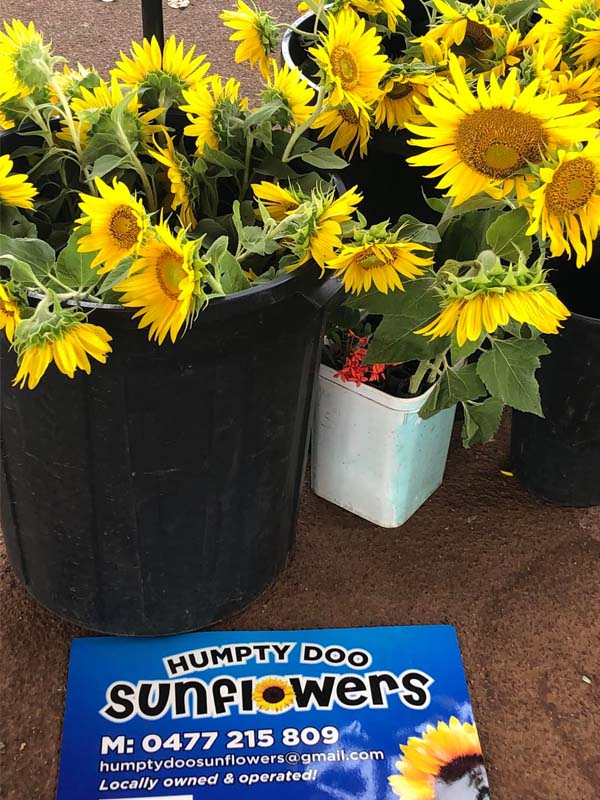
Fred's Pass
Brighten your space with something from Fred’s Pass Markets. (Image: Freds Pass Rural Markets Facebook)

When: Saturdays
Hours: 8am to 1pm
Address: Fred’s Pass Reserve, Bees Creek Road

6. Palmerston and Rural Markets

Every Friday night, Palmerston’s CBD comes alive with local entertainment and an array of 60 stalls selling dishes from Thailand, Vietnam, Laos, Indonesia and Greece. At the Palmerston and Rural Markets there’s also locally grown tropical fruit and veggies, handmade jewellery, pot plants and massages.
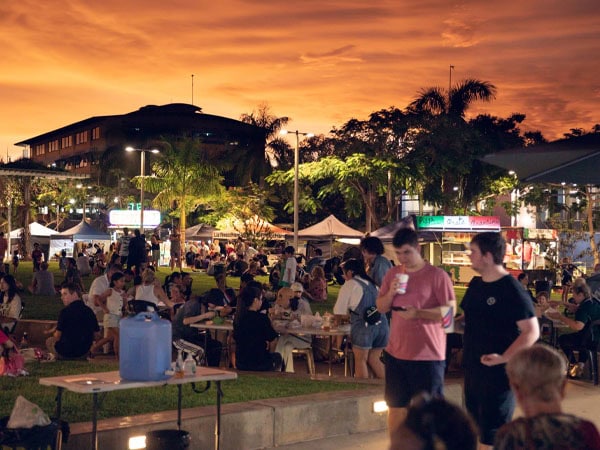
Head to Palmerston markets for food, fun and community vibes. (Image: Palmerston Markets Facebook)

When: Fridays (April to October)
Hours: 5pm to 9pm
Address: Goyder Square, Palmerston

7. Berry Springs Markets

Join the locals for brekky at Berry Springs Community Markets, which has stalls laden with fresh fruit and veggies, second-hand goods and arts and crafts. For the kids there are often running races, a tug-a-war competition and arts and crafts activities.

When: Last Sunday of each month, March to December
Hours: 8am to midday
Address: Cox Peninsula Road, Berry Springs

Want to see more stories from Australian Traveller in your Google search results?

  1. Click here to set Australian Traveller as a preferred source.
  2. Tick the box next to "Australian Traveller". That's it.
Leah McLennan
Leah McLennan is a freelance writer based in Darwin. She was a journalist in Sydney for over a decade and counts her time as travel editor for Australian Associated Press as one of the highlights of her career. From exploring remote campsites in the Top End with her family, to seeking out new art galleries in faraway cities, she’ll grab an adventurous or arty travel experience within her reach.
View profile and articles
hero media

Discovering East Arnhem: Australia’s most unique and rewarding corner

    Joanne Millares Joanne Millares

    Hard to reach and harder to forget, East Arnhem offers something rare in modern travel: the chance to slow down and experience Country on its own terms.

    The sky feels bigger in East Arnhem. It stretches wide and uninterrupted above rouged earth, stringybark woodland and beaches so empty they seem to belong to another era. The coastline curves for kilometres without a footprint and the horizon runs on forever.

    For comedian Lou Wall, the scale of the place was the first thing that hit them.

    “The sheer openness,” they say. “The sky feels infinite and the land stretches out endlessly. It’s pretty breathtaking visually.”

    But the physical landscape is only part of the story. The real reward isn’t only the scenery but the shift in perspective the journey brings. Visitors stop trying to tick off the destination and a real engagement takes over.

    “It made me never want to travel again,” Wall jokes. “In that I never wanted to leave East Arnhem.”

    Getting there

    Aerial shot of East Arnhem’s coastline as cars trace the curve of the shore.
    Sail along the remote coastline on an expedition cruise.

    Reaching East Arnhem is part of the adventure. Travellers typically fly into Gove Airport near Nhulunbuy via Darwin or Cairns, or arrive by expedition cruise along the remote coastline. Others make the journey overland along rutted dirt roads that cut through East Arnhem’s small pockets of monsoon forest.

    However you arrive, there’s a distinct feeling of crossing into somewhere different. Permits are required to visit the region, reflecting the fact that this is Yolŋu land where communities and traditional owners maintain deep cultural connections to Country.

    The extra planning becomes part of the experience. By the time visitors arrive, they understand they’re entering a place not just of respect, but also patience and curiosity.

    At one with nature

    East Arnhem’s  landscapes leave a strong imprint. For Wall, one place in particular still lingers in their memory: Ngalarrkpuy, also known as Lonely Beach, near Bawaka Homeland.

    “I genuinely felt like I was living inside an Instagram filter,” they say. “One of the most stunning feats of nature I’ve ever seen. The water was so clear I swear I could see even the fish smiling.”

    Across the region, natural experiences unfold at a slower pace. Fishing, beachcombing and island hopping reveal the rhythm of the coastline. The tides shape daily life and the vastness of the landscape makes even simple moments feel downright cinematic.

    For visitors with limited time, Wall says the Bawaka Homeland experience is unmissable.

    “I just left and I’m already planning when I can get back there.”

    The sense of remoteness is part of the appeal. In a country where many beaches are crowded and well-trodden, East Arnhem’s coastline still feels wonderfully wild.

    Immersing in local culture

    A visitor spends a meaningful moment alongside Yolŋu guides, gaining insight into their deep cultural knowledge and connection to the land.
    Experience authentic moments with the locals.

    Culture is woven through every experience in East Arnhem. Visitors have the opportunity to spend time on Country with Yolŋu guides and knowledge holders who share stories and traditions that have been passed down for generations.

    For Wall, one of the most powerful moments came during a conversation with a Yolŋu elder.

    “I got to meet a traditional elder, Mayalil, in Nhulunbuy,” they say. “Listening to her talk about her home made the land feel alive in ways I couldn’t have imagined.”

    The region is also home to internationally recognised Aboriginal art centres where artists shape works deeply connected to land and family knowledge.

    Music carries the same cultural energy. East Arnhem has produced globally recognised artists such as King Stingray and Baker Boy, blending Yolŋu language, storytelling and contemporary sound.

    Wall experienced this musical spirit first-hand.

    “A jam session around the fire was it for me,” they say. “Letting the deep joy and history of their music wash over me…  and meeting a few of the King Stingray musicians was unreal.”

    These moments of human connection often become the most memorable part of a visit.

    Spotting local wildlife

    An aerial view of the beach shows tiny figures lined up across the white sand, moving as if in a rhythmic dance.
    Step into a world where nature reigns.

    The wildlife of East Arnhem adds another layer to the experience. The region is home to an extraordinary range of animals, from waterbirds and turtles to dugongs, dolphins and the formidable saltwater crocodile.

    Wall admits they didn’t actually spot a croc during their visit.

    “Devastatingly, I didn’t see one,” they laugh. “But with all the stories from the locals I definitely gained a healthy respect for caution.”

    Some of the most memorable wildlife encounters can be surprisingly small., At Banubanu Beach Retreat on Bremer Island, Wall remembers walking along the beach one morning and watching it come alive.

    “As you walk through the sand you see hundreds of crabs scurrying into their holes as you pass by,” they say. “Such a small thing, but it was completely magical.”

    Moments like this reveal the quieter rhythms of East Arnhem, where even the smallest creatures seem to play a part in the landscape.

    Visitors who make the journey soon learn the most important travel tip of all.

    “Go in open-minded with a sense of curiosity,” Wall says. “Be prepared to ditch your plans. The land and the locals will guide you on an adventure no spreadsheets could ever compete with.”

    And most importantly, they add, don’t rush.

    “The land and people deserve your time and attention. You’ll be all the better for slowing down.”

    For more information on visiting East Arnhem, head to eastarnhem.com.au.