hero media

I visited the Red Centre in low season – here’s why you should too

Image: Tourism NT/@domandjesso

From icons seen in a new light to moments few experience, the Red Centre rewards travellers who visit when most don’t. Consider this your guide to the Red Centre in low season.
the Kings Canyon/Watarrka plateau from above
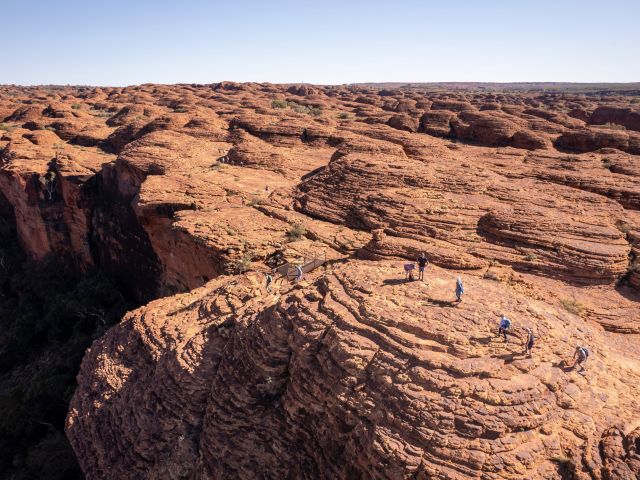
Hiking across the Kings Canyon/Watarrka plateau. (Image: Tourism NT/Mark Fitzpatrick)

Looking down on our small group of walkers from all sides are the cliff faces we just scrambled over. They form cake-like layers of deep, earthy reds and surprisingly vibrant greens, with a few splashes of black and white where the elements have had their way.

One holds a more resounding presence than the rest as we stand at the bottom of this natural amphitheatre. Another hiker has dubbed it ‘the sphinx’ and I can’t think of a better description for its rocky form. It appears to swivel its head, watching us as we continue our rocky trail along the Mpaara Loop within Finke Gorge National Park – stopping occasionally to admire colourful wildflowers and dancing birdlife. Later, we discover we didn’t imagine its presence. Traditional Owner Conrad Ratara confirms over dinner that it’s part of an important story. But he can’t tell us any more than that.

Eco-camping in Finke Gorge National Park
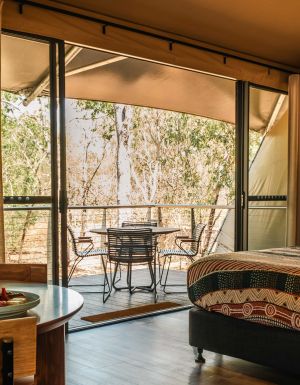
a safari-style eco tent at Yalka Ratara Eco Camp
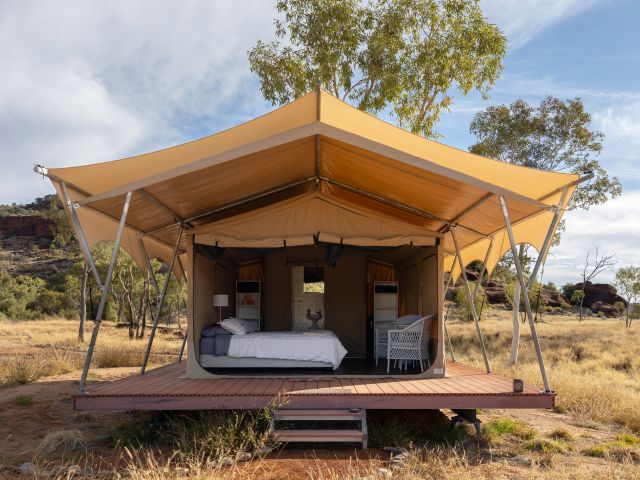
A safari-style eco tent at Yalka Ratara Eco Camp. (Image: Sarbo Studio)

We’re staying the night at Conrad’s glamping site, Yalka Ratara Eco Camp. He’s opened it exclusively to Intrepid Travel and guests on the six-day Red Centre & Uluṟu Tour . In return, Intrepid has helped him turn this long-time dream into a reality. “I had my dream for more than 30 years," Conrad tells us that evening. “I’m proud and happy to be standing with all you people."

The camp sits within Finke Gorge National Park, on the oldest river system in the world and near Palm Valley. Eight eco-designed tents have been set up around camp, all with front-row seats to the landscape around us. The riverbed is currently dry as a bone, despite recent rain in the region. Soft buttery sand gives way to smooth light-coloured rocks, which give way to scraggly spinifex grass.
a large goanna in Red Centre
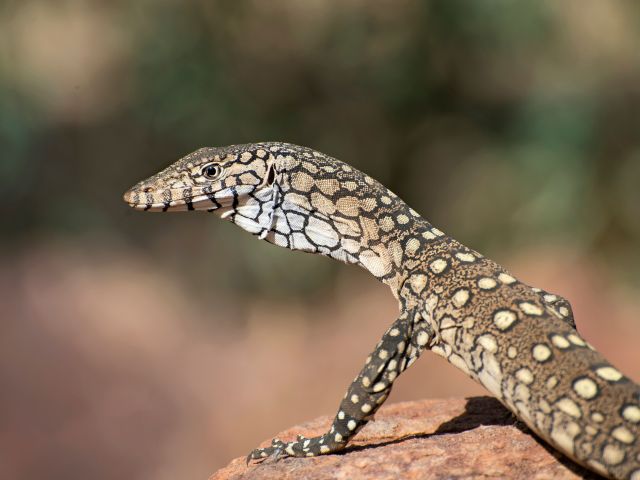
A large goanna monitors the landscape. (Image: Tourism NT/Shaana McNaught)

Ghost gums care not for where the river may choose to flow and dot themselves along the entire way. Locals make themselves known in quiet moments – like the perentie goanna that wanders slowly in front of my tent.

Hiking the Red Centre in low season
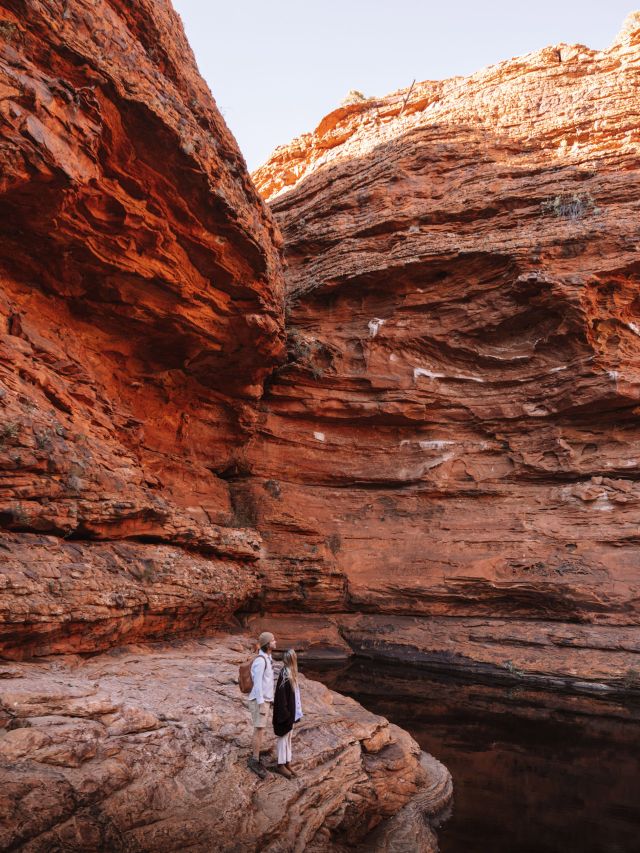
a couple at Kings Canyon
A quiet moment of stillness, looking up in awe at the walls of Kings Canyon. (Image: Tourism NT/@75vibes_)

We’re travelling in November at the start of the Red Centre’s low season, which extends through the summer months. While weather that oscillates from dramatic storms to blistering heat keeps most tourists away, there’s a special magic to this time that so few get to witness. We experience that magic in full flow at Kings Canyon/Watarrka. “Look out there," says John Stafford, our tour guide. He is pointing to the dark grey clouds rolling towards us as we stand at the base of the infamous Heartbreak Hill – a name given to the steep climb at the beginning of the Kings Canyon Rim Walk. They seem to be swallowing up the blue sky at a pace, making their way towards us.

We make it to the top before the rain breaks. Up here, it almost feels like we’ve left Australia behind and hit the craggy rock walls of Sedona, USA. Yet the almost hut-like domes of rock are so uniquely Australian. The storied beauty of this walk has not been overstated. The deep reds of the rim juxtapose with the greens and whites of the cycads, gum and witchetty trees, and bush tomatoes in the canyon below. The keen eyes of our guide spot a little rock wallaby gazing in our direction with disinterest.
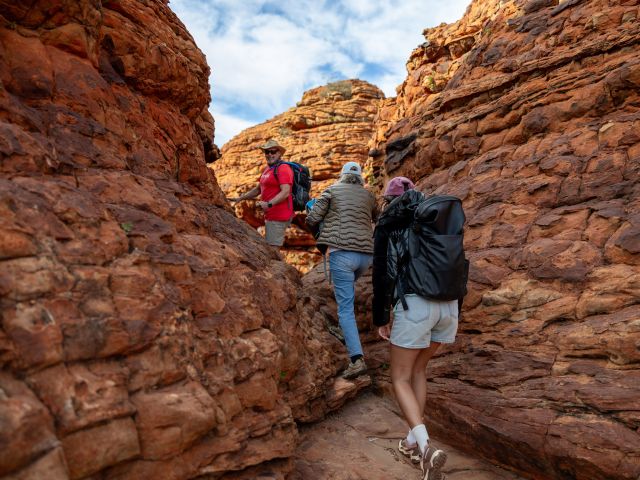
hikers walking through Priscilla’s Gap
Squeezing through ‘Priscilla’s Gap’. (Image: Sarbo Studio)

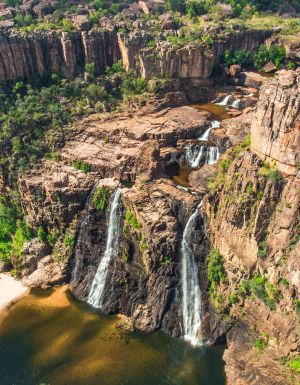
We just make it through Priscilla’s Gap (a section of the trail made famous in the 1994 film The Adventures of Priscilla, Queen of the Desert) when the heavens open again. Within minutes, what had been parched earth flows with temporary rivers that pour into the canyon below as a series of waterfalls. It turns the striking landscape into one of ethereal beauty – almost like a mermaid might pop out of the filling pools at any moment. Pools like the iconic Garden of Eden, always beautiful, are now full to the brim thanks to a thundering waterfall. It’s a natural phenomenon so rare that most hikers don’t ever set eyes on it. “I’ve been [leading tours here] for 28 years," says John, in awe, “and I’ve never seen this."

As strange as it may sound, being soaked to the bone, crossing flowing waterways that hadn’t been there moments before and seeing this desert beauty in its low-season form was an experience that would have been worth the trip on its own.

Exploring Indigenous stories and ancient landscapes
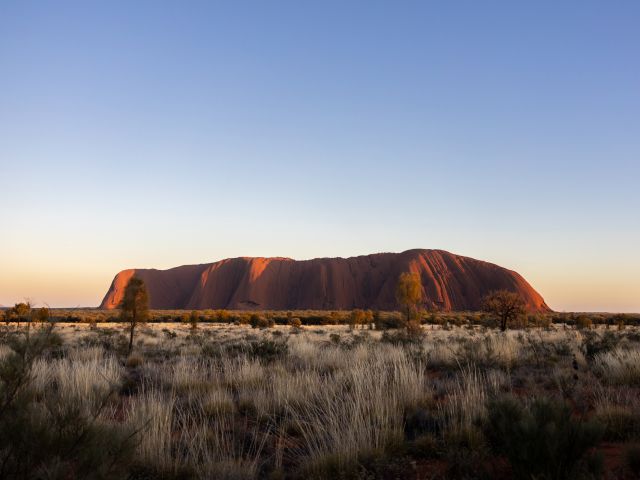
Uluru at dusk
See Uluru at dusk when every curve, crease and ancient contour catches the light. (Image: Sarbo Studio)

Kings Canyon is not the only icon we get to visit on this journey through the Red Centre, where history is quite literally written into the earth.

That history can be seen in the Jukurrpa stories shared by our Aṉangu guides, Sascha and her uncle Phillip, along the Kuniya Walk from one edge of Uluru into the Muṯitjulu Waterhole tucked into its jellybean-like folds. We see Uluṟu in every light, from the soft colours of sunrise to the vibrant glow of sunset. I’m not sure Uluṟu will ever be empty of tourists, or minga (ants), as Sascha calls them. But this time of year does thin out the crowds.
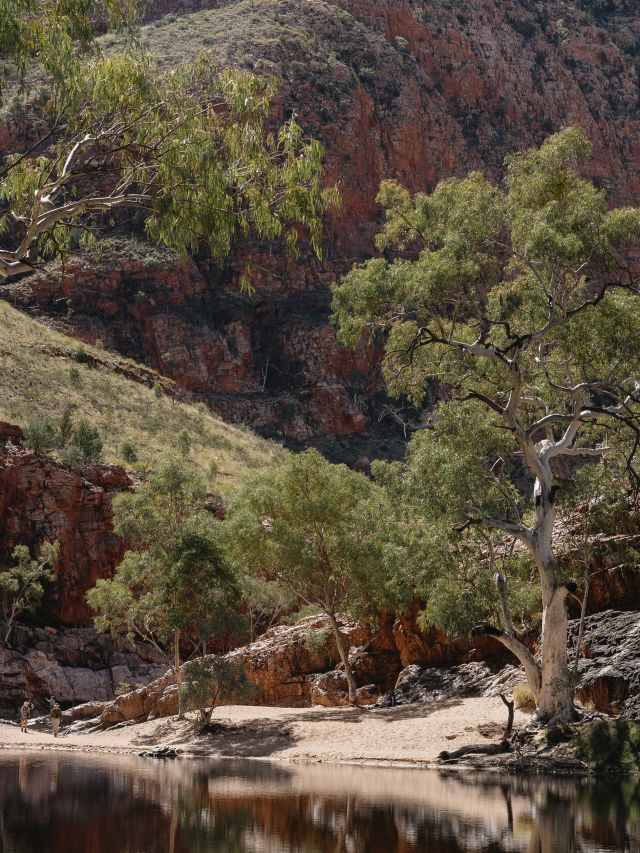
a swimming hole at Ormiston Gorge
A cool, glassy pool at the base of Ormiston Gorge offers relief from the heat. (Image: Sarbo Studio)

History can also be seen in the landscape’s scars from unearthly events. Like the 20-kilometre-wide crater of Gosse Bluff/Tnorala, left by the impact of a comet striking Earth around 150 million years ago. Or the jagged layers of sediment, pushed up from underground by tectonic plate activity and left reaching out of the earth to create the MacDonnell Ranges, which we wind our way through to reach the culturally significant Simpsons Gap/Rungutjirpa. And Ormiston Gorge, a picture-perfect swimming hole that we almost have to ourselves.

Stargazing in Alice Springs
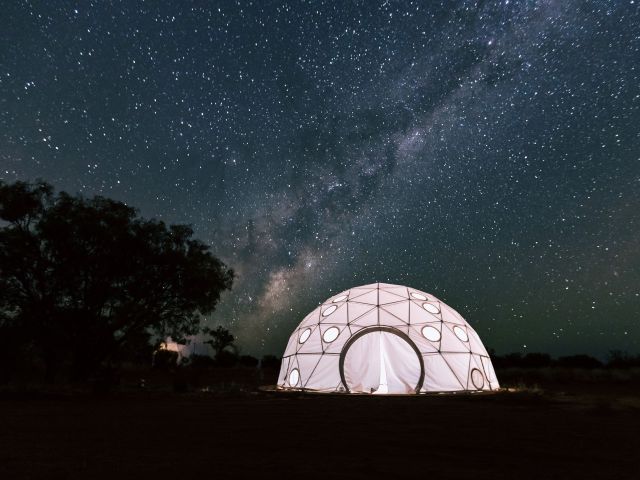
the Earth Sanctuary World Nature Centre
Enjoy dinner and a show under a dark desert sky at Earth Sanctuary. (Image: Tourism NT/Plenty of Dust)

History is written in the skies above, something we get a first glance at during a stargazing experience at the Earth Sanctuary World Nature Centre in Alice Springs/Mparntwe on our final night. Looking up at this dark sky, sparkling with stars uninterrupted by human lights, it feels just as vast as the land we’ve been road tripping over.

Up there, the more scientists learn, it seems, the more there is still to learn. Down here, in the heart of this vast country, the same holds true: the more of it I witness, the more there is still to discover. Come rain or shine.

A traveller’s checklist
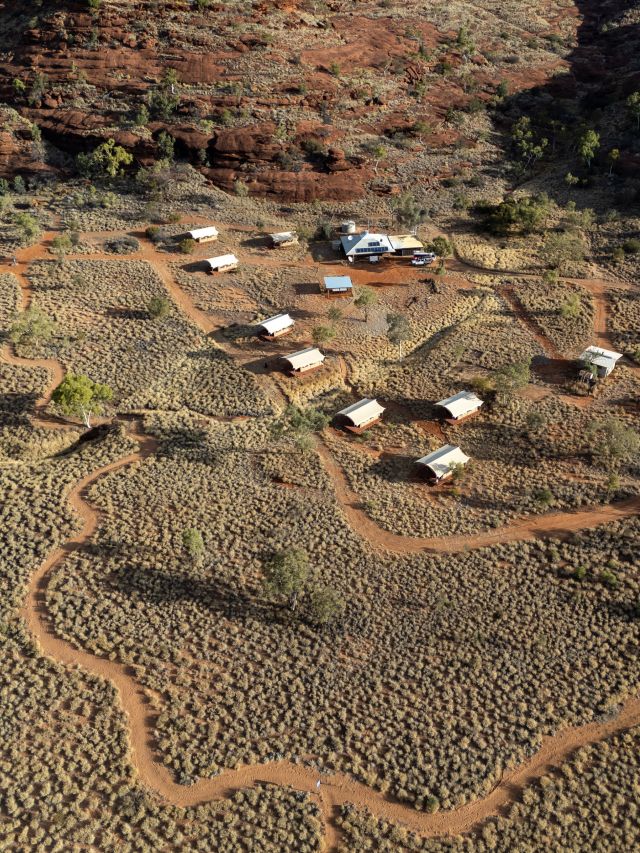
Yalka Ratara Eco Camp from above
Yalka Ratara Eco Camp sits softly on the earth. (Image: Sarbo Studio)

Getting there

Most major Australian cities have direct flights to Ayers Rock Airport, with free shuttle buses to accommodation. Alternatively, fly to Alice Springs/Mparntwe, then drive for about 4.5 hours.

Playing there
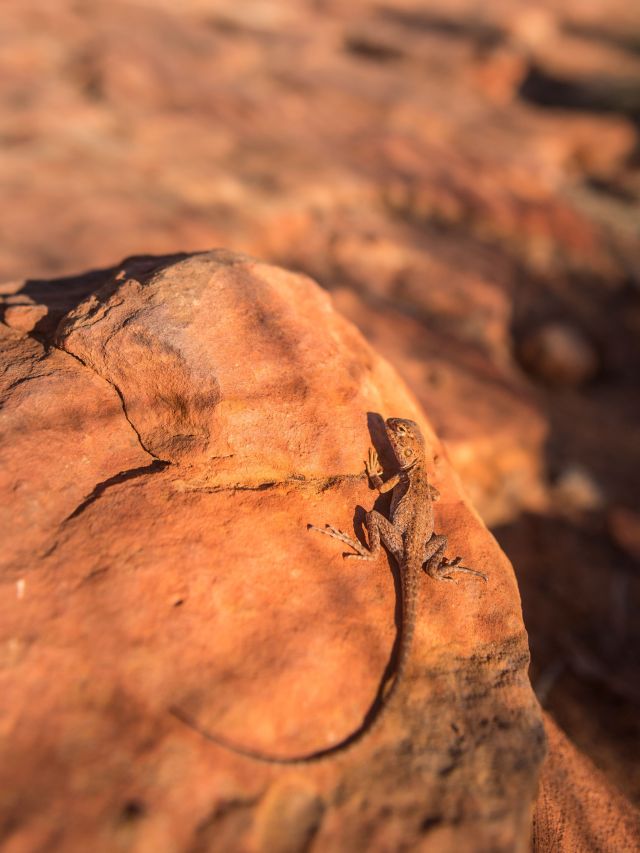
a lizard at Kings Canyon
A ring-tailed dragon. (Image: Tourism NT/Matt Glastonbury)

Intrepid Travel’s six-day Red Centre & Uluṟu Explorer runs year-round. Prices start from $2583 per person, with all accommodation, transport and some meals and activities included.

Low season is an incredible time to visit the Red Centre. Burnt landscapes are transformed by thundering waterfalls – a sight very few get to see – and there are fewer crowds than in the peak season. Walking trails are typically open, as are iconic experiences such as Bruce Munro’s Field of Light (an optional extra if you travel with Intrepid).

Kassia Byrnes
Kassia Byrnes is the Native Content Editor for Australian Traveller and International Traveller. She's come a long way since writing in her diary about family trips to Grandma's. After graduating a BA of Communication from University of Technology Sydney, she has been writing about her travels (and more) professionally for over 10 years for titles like AWOL, News.com.au, Pedestrian.TV, Body + Soul and Punkee. She's addicted to travel but has a terrible sense of direction, so you can usually find her getting lost somewhere new around the world. Luckily, she loves to explore and have new adventures – whether that’s exploring the backstreets, bungee jumping off a bridge or hiking for days. You can follow her adventures on Instagram @probably_kassia.
See all articles
hero media

8 Red Centre locations to explore after seeing the new movie, Kangaroo

    Lucy CousinsBy Lucy Cousins
    Spend a few days visiting the real-life Central Australian locations that inspired the new film everyone is talking about, and discover why Alice Springs is such an important part of Australian culture.

    In the credits of the new Australian film Kangaroo , the first name under ‘cast’ should read ‘The Northern Territory ’. Not only is Alice Springs (and the surrounding landscape) integral to the movie itself, but the spiritual heart of Australia and its local Indigenous owners also inform the look and feel of every frame, explains Producer Trisha Morton-Thomas of Brindle Films, who also plays Charlie’s grandmother Gwennie.

    “By setting Kangaroo in Alice Springs (Mparntwe), the film embraces how visible Aboriginal people are here, and the living Aboriginal culture that is woven through this community,” she explains.

    still from kangarro film
    See Kangaroo, then visit the real-life filming locations.

    And while shooting in such a sacred part of the Northern Territory required extra planning, it was something the cast and crew were highly invested in.

    “There are incredibly significant sacred sites and places of deep cultural stories in the area, that at times are very gender-specific, which we’ve kept out of the production,” she explains. “Even if overhead drone footage captures a sacred site that isn’t meant to be seen by other people outside of that clan, we’ve made sure to omit it from the film.”

    If Kangaroo piqued your interest in a Central Australian holiday, we don’t blame you. Read on to discover eight places featured in the movie that you can visit in real life – and get planning. Don’t forget to pack sunscreen and a hat.

    1. Alice Springs/ Mparntwe

    artist at Many Hands Art Centre
    Visit the galleries of Alice Springs, like Many Hands Art Centre. (Image: Tourism NT/ Helen Orr/ Many Hands Art Centre)

    The red and dusty streets of the film’s fictional town of Silvergum were filmed on the outskirts of Alice Springs. And, while the art gallery featured in the film is fictional, Alice Springs is a hub of creativity. See the work of local artists at the Araluen Art Centre , Yubu Napa Art Gallery , Iltja Ntjarra (Many Hands) Art Centre and the famous Tjanpi Desert Weavers .

    2. The Kangaroo Sanctuary & Kangaroo Rescue Centre

    The Kangaroo Sanctuary Alice Springs, the inspiration for the Kangaroo move
    Visit the movie’s inspiration at Kangaroo Sanctuary. (Image: Tourism NT/ Kangaroo Sanctuary)

    Kangaroo was inspired by the journey of Chris ‘Brolga’ Barns, who founded the now world-renowned Kangaroo Sanctuary based in Alice Springs. For lead actor, Aussie Ryan Corr, the animals were central to the movie, alongside the landscapes.

    “The animals in this story were a real calling point for me,” he explains. “What this story tries to tell us about the connection between humans and animals is beautiful.”

    To gain a real insight into the fauna and flora of the Red Centre, you can visit the Kangaroo Sanctuary on a sunset tour, where you might even get the chance to hold a baby kangaroo.

    3. Ormiston Gorge

    woman walking along the edge of Ormiston Gorge near alice springs
    Take a dip in Ormiston Gorge. (Image: Tourism NT/ @domandjesso)

    The film captures the raw beauty of the West MacDonnell Ranges, known in the Arrernte language as Tjoritja. This national park is rich in Indigenous culture and stark geological wonders.

    Only a 15-minute drive from Alice Springs, Tjoritja offers visitors the chance to camp, hike and swim among ancient landscapes (most attractions are less than a three-hour drive away).

    Ormiston Gorge , a cooling oasis in among the red desert sands, is one of the most popular destinations, no doubt because of the permanent swimming hole and towering red cliffs. From here, visitors can also embark on the beautiful Ormiston Pound Walk and the shorter – more accessible – Ghost Gum Walk. Bring your bathers – it’s safe for swimming.

    4. Standley Chasm

    woman walking through Standley Chasm near alice springs
    Wander through Standley Chasm. (Image: Tourism NT)

    The 1.2-kilometre walk to nearby Standley Chasm will be a highlight for any visitor as the imposing 40 metre-high chasm walls project strength and ancient wisdom.

    Visit at midday to experience the path illumined by the midday sun. Not only will you fill your camera roll with vibrant red images of the gorge and its intoxicating shadows, but you can also camp nearby in a powered or unpowered site so you can watch the brilliance of the desert stars fill the night sky after dusk.

    5. Simpsons Gap

    three people walking on path through simpsons gap near alice springs
    Walk the trails of Simpson’s Gap. (Image: Tourism NT/ Helen Orr)

    Closer to Alice Springs, the photogenic Simpsons Gap is the perfect place to spot the endangered Black-footed Rock wallaby near the permanent watering hole. While swimming isn’t permitted, soaking up the sun and views certainly is.

    Explore the area’s numerous walking trails, appreciate the soaring cliffs on either side of the ‘gap’ and pick out the shooting locations of Kangaroo in the area.

    6. Ellery Creek Big Hole

    aerial of Ellery Creek Big Hole near alice springs
    Dive into Ellery Creek Big Hole. (Image: Tourism NT/ Tourism Australia)

    When it comes to classic Northern Territory landscapes, you can’t go past Ellery Creek Big Hole/ Udepata : tall gum trees sidling up to a refreshing watering hole (fed by the West MacDonnell Ranges and surrounded by rugged red cliffs.

    Swim in the cooling waters, hike the cliff tops, watch for birds and even stargaze as you camp here overnight. It’s locations like this that attracted the film’s director Kate Woods to the project.

    “It humbles you to be in this environment: it’s so beautiful, so old and so vast,” she explains. “I was thrilled to get a chance to … shoot such a beautiful story in the incredible landscape of the Northern Territory.”

    7. Larapinta Drive

    aerial of Larapinta Drive into alice springs
    Drive along Larapinta Drive. (Image: Tourism NT)

    There is no better way to get a feel for how the characters arrived at the fictional Central Australian town of Silvergum than to travel along the iconic state road, Larapinta Drive.

    Connecting Alice Springs to the mighty King’s Canyon in the west, via the historic community of Hermannsburg, this road takes in the West MacDonnell National Park, Alice Springs Desert Park and artist Albert Namatjira’s house, among other attractions. Take your time, bring a camera and prepare for numerous stops along the way.

    8. Todd River

    competitors in Henley on Todd Regatta, alice springs
    Join in the fun of the quirky Henley on Todd Regatta. (Image: Tourism NT/ TImparja Creative)

    Meandering through Alice Springs like a lazy Western Brown snake, the Todd River is a central part of Alice Springs culture. Known as an ‘intermittent river’, the Todd can go from a dry dusty riverbed to a flowing waterscape in less than 15 minutes after heavy rainfall.

    When it’s dry, the famous Henley on Todd Regatta fills the sandy riverbed with handmade ‘boats’ carried by sailors. This is the world’s only dry river boating event, and it’s referenced in the ‘Silvergum Boat Race’ in the movie. Inspired by the real-life event, the characters built quirky “Flintstones-style boats” and competed in teams.

    See Kangaroo in cinemas now, and start planning your NT getaway at northernterritory.com.