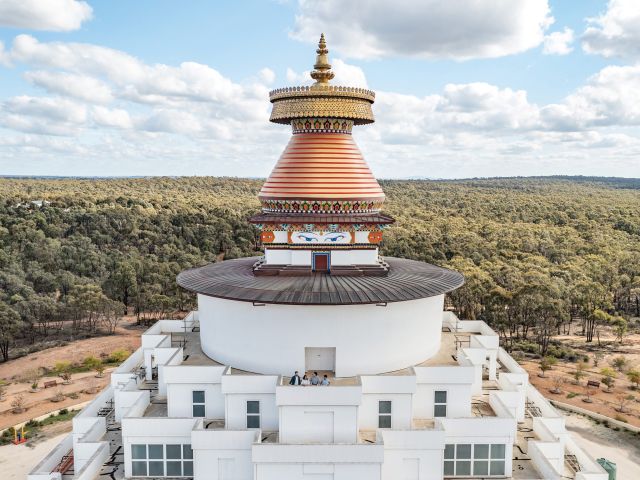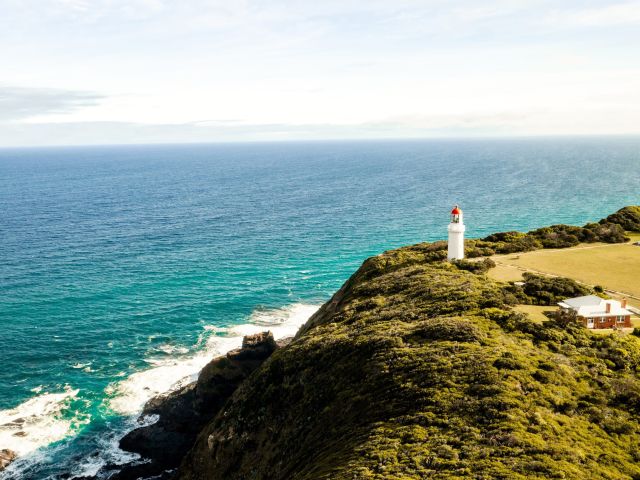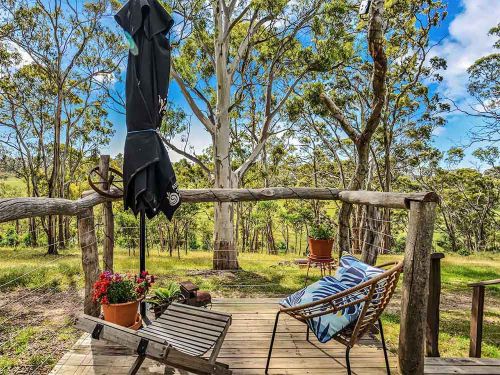
Whether you’re looking for affordable accommodation or high-end luxury, here’s where to stay in Adelaide.
If you’re heading to Adelaide for work or pleasure, or planning a staycation, there is nothing like staying somewhere where you will find everything you need on your doorstep. From boutique heritage boltholes to newly refurbished hotels, from campsites and caravan parks to luxury accommodation and chic Airbnbs on the city’s fringes, here is a look at eight of the best places to stay in Adelaide.
Sequoia Luxury Lodge
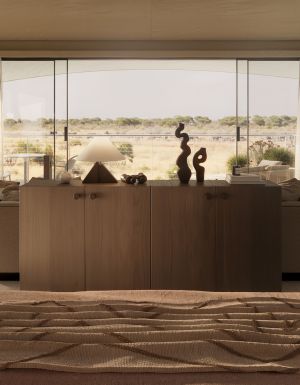
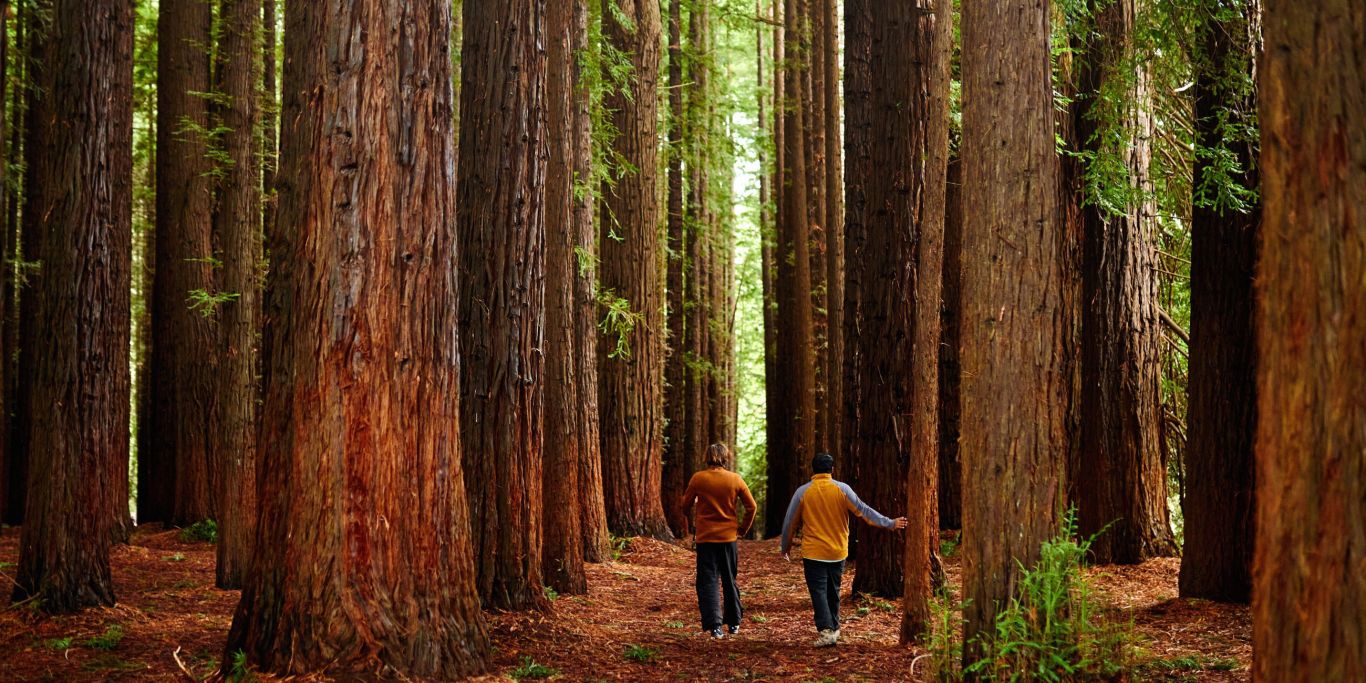
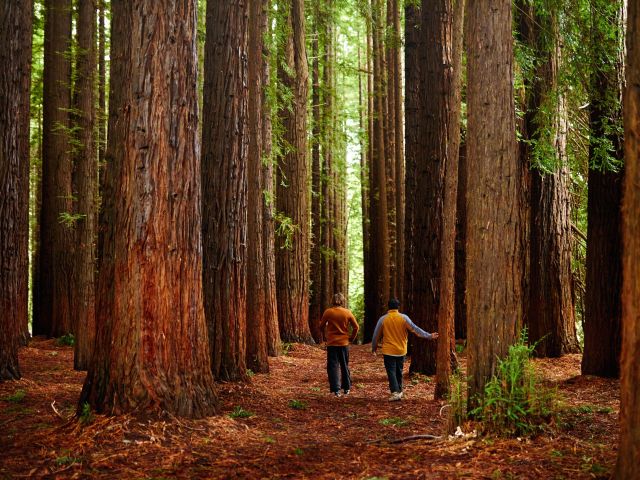
Sequoia Luxury Lodge is nestled in the Adelaide Hills and it’s as exquisite as a glass of the Mount Lofty House Summit sparkling wine produced exclusively for guests from the grapes grown on the grounds where the vineyard sits. The $18 million luxury lodge comprises 14 luxury sustainably designed suites, an infinity pool and a day spa. Guests at Sequoia also have access to the three-hatted Hardy’s Veranda Restaurant at nearby Mount Lofty House, which is also located on the 12-hectare estate.
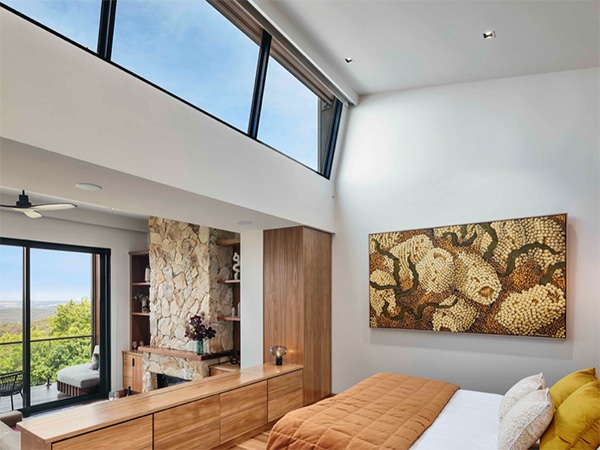
The doors to Sequoia have quietly opened in the Adelaide Hills.
Mayfair Hotel
One for Adelaide architecture fans, the Mayfair Hotel is set inside the old Colonial Mutual Building, which was transformed into a stylish five-star place to stay in 2015. Located on busy King William Street, the city’s main drag, the Mayfair offers 10 different styles of rooms with all the trappings you’d expect of a high-end hotel: espresso machines, Appelles amenities, fluffy bathrobes and slippers and a complimentary mini-bar. Take in the breathtaking views from the hotel’s Hennessy Rooftop Bar, named after the building’s architects: Hennessy, Hennessy & Co. and dine at the stylish The Den downstairs.
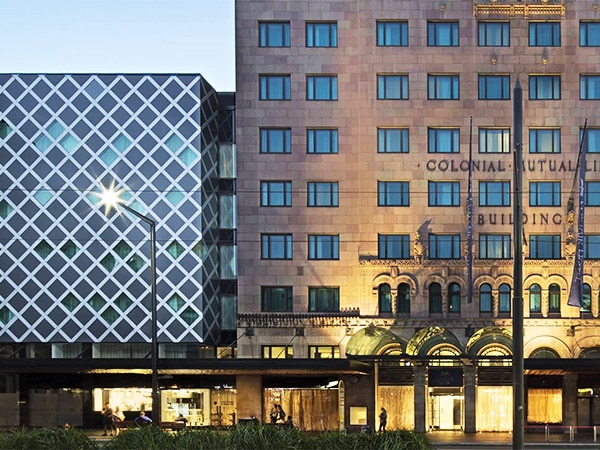
Heritage meets contemporary charm at The Mayfair.
The Playford
The Playford is located opposite the Adelaide Convention Centre and minutes from Adelaide’s major retail and restaurant zone, making it a popular choice for business travellers. From its gold-leaf walls to its sweeping grand staircase and bold curves, the MGallery by Sofitel hotel – once home to Adelaide newspaper, The News – has a warm Art Nouveau ambience. All up, the hotel in the heart of Adelaide’s cultural precinct offers 182 beautifully appointed guest rooms.
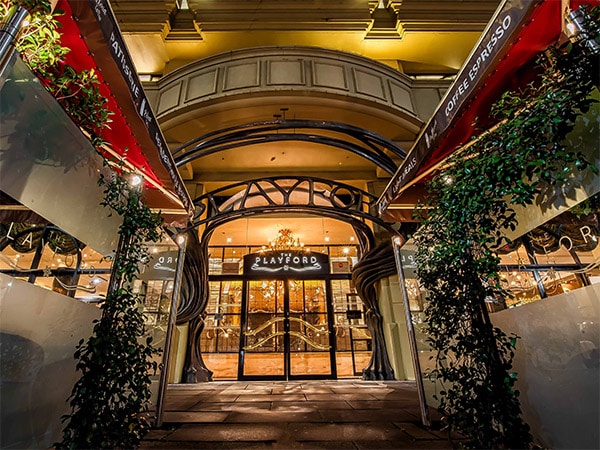
The Art Nouveau ambience.
Adabco Boutique Hotel
Adabco Boutique Hotel was originally opened as Our Boys’ Institution in 1897, an accommodation provider that preceded the YMCA. Housed in a charming, heritage-listed building, there is a distinct playful style on show in the boutique hotel with hand-painted artworks and a palette of warm gold and claret reds tempered with original features that will transport you back to the original 19th-century Venetian Gothic-style building. The hotel, located on a leafy street in Adelaide’s east, features spacious rooms, a communal kitchen and a relaxing lounge and dining area just a 10-minute walk to the city centre.
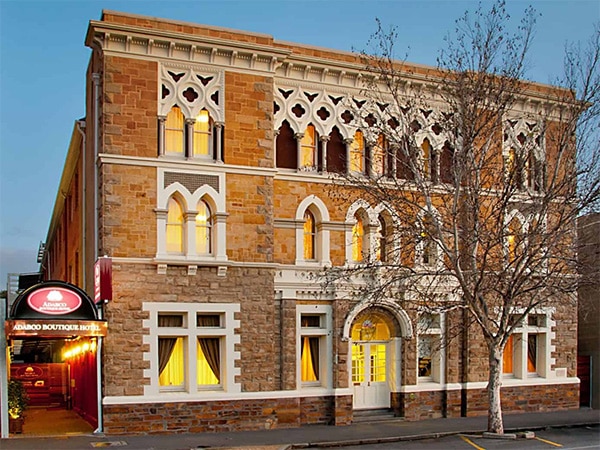
Adabco is housed in a charming, heritage-listed building.
Holiday Inn Express
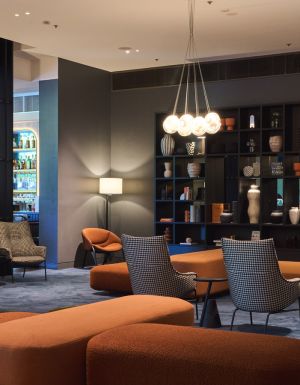
The Holiday Inn Express Adelaide City Centre is located in the north-west quarter of Adelaide’s CBD and although it looks rather austere from the outside, the nine-level, 245-room hotel is all warmth and colour and fun inside with colourful rugs, bold artworks and impressive murals livening things up. The new hotel provides easy access to Adelaide Oval, Adelaide Convention Centre and Rundle Mall and offers guests a free Express Start Breakfast or Grab & Go option.
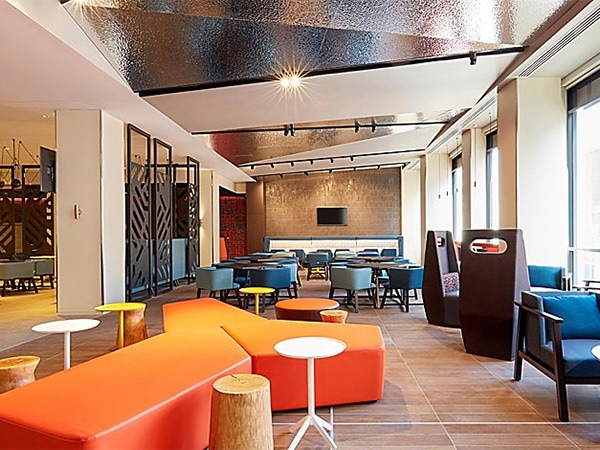
Warmth, colour and fun inside.
Fire Station Inn
As far as fire engine-obsessed kids are concerned, there’s no other accommodation in Adelaide that holds a candle to the Fire Station Inn. There’s nothing flash or subtle about the North Adelaide property, but that’s the whole point. The 4.5-star inn sleeps a maximum of four in a suite splashed with colour from a bright-red 1942 International Fire Truck, which takes pride of place in the Fire Engine Spa Suite. Housed in Adelaide’s first Fire Station (built circa 1866), the suite also includes fireman lights, a red fireman’s pole and memorabilia.
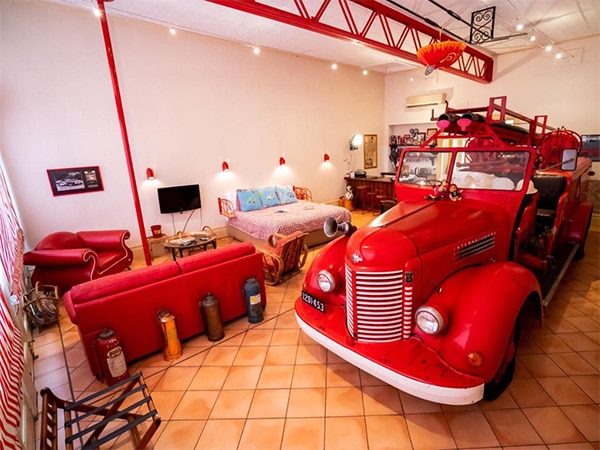
Housed in Adelaide’s first Fire Station (built circa 1866).
Discovery Holiday Parks Adelaide Beachfront
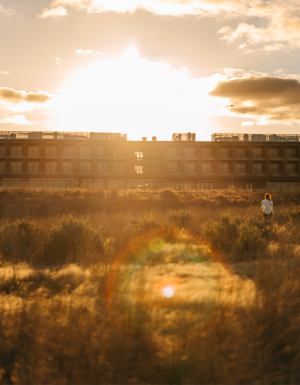
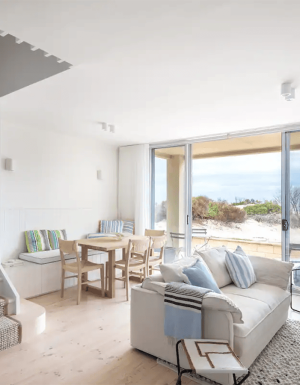
With West Lakes and Glenelg beaches nearby, there’s plenty to do at the Adelaide Beachfront holiday and caravan park . In addition to luxuries such as an en suite, hot showers and laundry facilities, a stay here also offers access to nearby West Lakes, Henley Beach and Glenelg, which are well worth including on your Adelaide itinerary. Suitable for tents, campervans, and caravans, the pet-friendly campground has a swimming pool, bouncing pool, activity room and kiosk.
Location, location, location.
Planning a trip to Adelaide? Read more tips and itineraries in our Adelaide travel guide.
Carla Grossetti avoided accruing a HECS debt by accepting a cadetship with News Corp. at the age of 18. After completing her cadetship at The Cairns Post Carla moved south to accept a position at The Canberra Times before heading off on a jaunt around Canada, the US, Mexico and Central America. During her career as a journalist, Carla has successfully combined her two loves – of writing and travel – and has more than two decades experience switch-footing between digital and print media. Carla’s CV also includes stints at delicious., The Sydney Morning Herald, and The Australian, where she specialises in food and travel. Carla also based herself in the UK where she worked at Conde Nast Traveller, and The Sunday Times’ Travel section before accepting a fulltime role as part of the pioneering digital team at The Guardian UK. Carla and has been freelancing for Australian Traveller for more than a decade, where she works as both a writer and a sub editor.
The Grampians just might be the ultimate antidote for the metropolis, writes one returning Aussie ready to disconnect from the modern world and reconnect to the Great outdoors.
There are no kangaroos back in Chicago: they’re all here in the Grampians/Gariwerd . In the heart of the Grampians National Park’s main gateway town, Halls Gap, pods of eastern greys are eating grass beside my parked rental car beneath the stars. Next morning, when I see the backyard of my rented villa on the edge of town for the first time, there are kangaroos feeding beside a slow-moving creek, lined with river red gums.
Five hundred metres up the road, 50 or so of them are eating by the side of the road in a paddock. I pull over to watch and spot three emus. Yellow-tailed black cockatoos fly overhead towards the tall green mountains just beyond town.
‘Kee-ow, keee-oww’… their calls fuse with the maniacal cackle of a kookaburra (or 10). Gawd, how I’ve missed the sound of them. Far above, a wedge-tailed eagle watches, and there you go: the ‘great birds of Australia’ trifecta, all half a kay from the town limits.
Exchanging city chaos for country calm
The park is renowned for its significant diversity of native fauna species. (Image: Visit Victoria/Robert Blackburn)
I’ve come to the Grampians to disconnect, but the bush offers a connection of its own. This isn’t just any bush, mind you. The Grampians National Park is iconic for many reasons, mostly for its striking sandstone mountains – five ridges run north to south, with abrupt, orange slopes which tumble right into Halls Gap – and for the fact there’s 20,000 years of traditional rock art. Across these mountains there are more than 200 recorded sites to see, created by the Djab Wurrung, Jardwadjali and Gunditjmara peoples. It’s just like our outback… but three hours from Melbourne.
I’ve come here for a chance at renewal after the chaos of my life in America’s third-largest city, Chicago, where I live for now, at the whim of a relative’s cancer journey. Flying into Melbourne’s airport, it only takes an hour’s drive to feel far away from any concept of suburbia. When I arrive in Halls Gap two hours later, the restaurant I’m eating at clears out entirely by 7:45pm; Chicago already feels a lifetime ago.
The trails and treasures of the Grampians
Grampians National Park /Gariwerd covers almost 2000 square kilometres. (Image: Ben Savage)
Though the national park covers almost 2000 square kilometres, its best-known landmarks are remarkably easy to access. From my carpark here, among the cockatoos and kangaroos on the fringe of Halls Gap, it only takes 60 seconds’ driving time before I’m winding my way up a steep road through rainforest, deep into the mountains.
Then it’s five minutes more to a carpark that serves as a trailhead for a hike to one of the park’s best vantage points, The Pinnacles . I walk for an hour or so, reacquainting myself with the smells and the sounds of the Aussie bush, before I reach it: a sheer cliff’s edge lookout 500 metres up above Halls Gap.
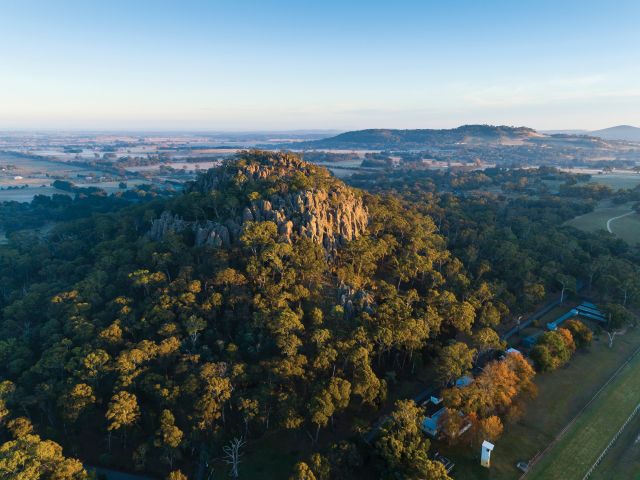
Overlooking the vast Grampians landscape from Hollow Mountain. (Image: Robert Blackburn)
There are hikes and there are lookouts and waterfalls all across this part of the park near town. Some are a short stroll from a carpark; others involve long, arduous hikes through forest. The longest is the Grampians Peaks Trail , Victoria’s newest and longest iconic walk, which runs 160 kilometres – the entire length of Grampians National Park.
Local activities operator Absolute Outdoors shows me glimpses of the trail. The company’s owner, Adrian Manikas, says it’s the best walk he’s done in Australia. He says he’s worked in national parks across the world, but this was the one he wanted to bring his children up in.
“There’s something about the Grampians,” he says, as he leads me up a path to where there’s wooden platforms for tents, beside a hut looking straight out across western Victoria from a kilometre up in the sky (these are part of the guided hiking options for the trail). “There are things out here that you won’t see anywhere else in Australia.” Last summer, 80 per cent of the park was damaged by bushfire, but Manikas shows me its regrowth, and tells me of the manic effort put in by volunteers from town – with firefighters from all over Australia – to help save Halls Gap.
Spot wildflowers. (Image: Visit Victoria)
We drive back down to Halls Gap at dusk to abseil down a mountain under the stars, a few minutes’ walk off the main road into town. We have headlamps, but a full moon is enough to light my way down. It takes blind faith to walk backwards down a mountain into a black void, though the upside is I can’t see the extent of my descent.
Grampians National Park at sunset. (Image: Wine Australian)
The stargazing is ruined by the moon, of course, but you should see how its glow lights up the orange of the sandstone, like in a theme park. When I’m done, I stand on a rocky plateau drinking hot chocolate and listening to the Aussie animals who prefer nighttime. I can see the streets of Halls Gap off in the distance on this Friday night. The restaurants may stay open until 8pm tonight.
What else is on offer in The Grampians?
Travelling along the Wimmera River in Dimboola. (Image: Chris McConville)
You’ll find all sorts of adventures out here – from rock climbing to canoeing to hiking – but there’s more to the Grampians than a couple of thousand square kilometres of trees and mountains. Halls Gap may be known to most people, but what of Pomonal, and Dimboola, and Horsham? Here in the shadow of those big sandstone mountains there are towns and communities most of us don’t know to visit.
And who knew that the Grampians is home to Victoria’s most underrated wine region ? My disconnection this morning comes not in a forest, but in the tasting rooms and winery restaurants of the district. Like Pomonal Estate, barely 10 minutes’ drive east of Halls Gap, where UK-born chef Dean Sibthorp prepares a locally caught barramundi with lentil, pumpkin and finger lime in a restaurant beside the vines at the base of the Grampians. Husband-and-wife team Pep and Adam Atchison tell me stories as they pour their prize wines (shiraz is the hero in these parts).
Dine in a restaurant beside vines at Pomonal Estate. (Image: Tourism Australia)
Three minutes’ drive back down the road, long-time mates Hadyn Black and Darcy Naunton run an eclectic cellar door out of a corrugated iron shed, near downtown Pomonal. The Christmas before last, half the houses in Pomonal burnt down in a bushfire, but these locals are a resilient lot.
The fires also didn’t stop the construction of the first art centre in Australia dedicated to environmental art in a nature-based precinct a little further down the road (that’s Wama – the National Centre for Environmental Arts), which opened in July. And some of the world’s oldest and rarest grape vines have survived 160 years at Best’s Wines, outside the heritage town of Great Western. There’s plantings here from the year 1868, and there’s wines stored in century-old barrels within 150-year-old tunnels beneath the tasting room. On the other side of town, Seppelt Wines’ roots go back to 1865. They’re both only a 30-minute drive from Halls Gap.
Great Western is a charming heritage town. (Image: Griffin Simm)
There’s more to explore yet; I drive through tiny historic towns that barely make the map. Still part of the Grampians, they’re as pretty as the mountains behind them: full of late 19th-century/early 20th-century post offices, government offices and bank buildings, converted now to all manner of bric-a-brac stores and cafes.
The Imaginarium is one, in quirky Dimboola, where I sleep in the manager’s residence of an old National Australia Bank after a gourmet dinner at the local golf club, run by noted chef and teacher, Cat Clarke – a pioneer of modern Indigenous Australian cooking. Just south, I spend an entire afternoon at a winery, Norton Estate Wines, set on rolling calico-coloured hills that make me think of Tuscany, chit-chatting with owners Chris and Sam Spence.
Being here takes me back two decades, when I lived here for a time. It had all seemed as foreign as if I’d driven to another planet back then (from Sydney/Warrane), but there seemed something inherently and immediately good about this place, like I’d lived here before.
And it’s the Australian small-town familiarity of the Grampians that offers me connection back to my own country. Even in the better-known Halls Gap, Liz from Kerrie’s Creations knows I like my lattes with soy milk and one sugar. And while I never do get the name of the lady at the local Ampol station, I sure know a lot about her life.
Kookaburras are one of some 230 bird species. (Image: Darren Donlen)
You can be a local here in a day; how good is that? In Chicago, I don’t even know who my neighbour is. Though each day at dusk – when the kangaroos gather outside my villa, and the kookaburras and the black cockatoos shout out loud before settling in to sleep – I prefer the quieter connection I get out there in the bush, beneath these orange mountains.
A traveller’s checklist
Staying there
Sleep beside the wildlife on the edge of Halls Gap at Serenity .