Explore Victoria’s little-known Silo Art Trail

hero media
Get ready to marvel at the large-scale murals along the Silo Art Trail in Victoria.

Stretching over 200 kilometres, Victoria’s Silo Art Trail is Australia’s largest outdoor gallery (and one of 100 Amazing Road Trips).

Conceived after the success of the first silo artwork in Brim in 2016, the trail recognises and celebrates the Wimmera Mallee region through a series of large-scale mural portraits that have given new life to the 80–90-year-old grain silos.

The project saw a team of renowned artists from Australia and across the world visit the region, meet the locals and transform each grain silo into an epic work of art; each one telling a unique story about the host town.

DAY ONE: Melbourne to Rupanyup

Rupanyup

Located about three hours from Melbourne, Rupanyup is the ideal first stop for your Silo Art Trail road trip.

Rupanyup’s silo art is the work of Russian mural artist, Julia Volchkova, who turned her attention to the town’s youth and their great love of team sport. Capturing the spirit of community and providing an accurate insight into rural youth culture, the work features the faces of Rupanyup residents and local sporting team members, Ebony Baker and Jordan Weidemann, who are dressed in their sports attire (netball and AFL, respectively).
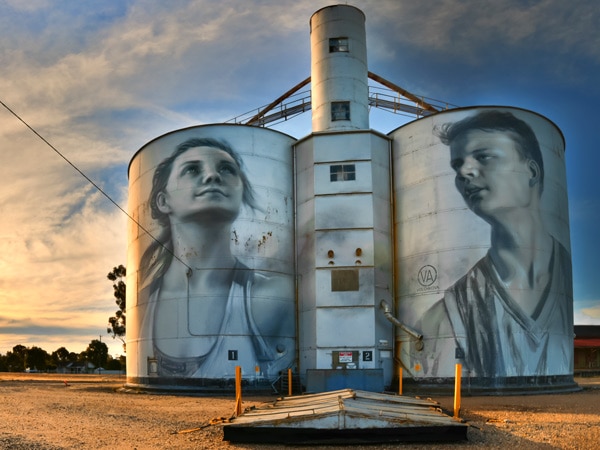
Rupanyup silo art by Julia Volchkova of Ebony Baker and Jordan Weidemann. (Image: Visit Victoria/Anne Morely)
Julia Volchkova depicted Rupanyup locals Ebony Baker and Jordan Weidemann on the silos. (Image: Visit Victoria/Anne Morely)


Must-see

Georgia Goodie artwork, Rupanyup

As a side project of the Silo Art Trail, Melbourne street artist Georgia Goodie painted two murals in Rupanyup, each one depicting firefighters. The first mural is at a house that was damaged by fire in September 2016, while the other adorns the town’s old shire office building.
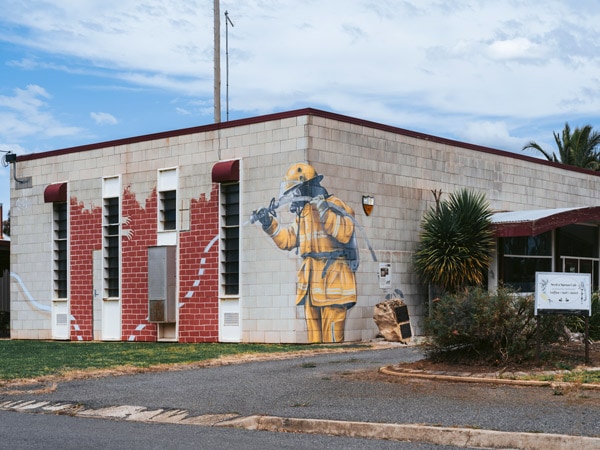
A mural of a firefighter on the Rupanyup old shire office building by Melbourne street artist Georgia Goodie. (Image: Visit Victoria/Anne Morely)
Head to the Rupanyup old shire office building to see Melbourne street artist Georgia Goodie’s firefighter murals. (Image: Visit Victoria/Anne Morely)

Stay

The Shack is a rustic and homely rural retreat. The two-bedroom cottage offers panoramic views of farm paddocks, dams, gum trees and the Grampians, the perfect place to rest after a day of exploring.

DAY TWO: Rupanyup to Sheep Hills, Goroke, Kaniva and Brim

Sheep Hills

Melbourne-based artist, Adnate found inspiration for his mural on the Sheep Hills silos in 2016 when he developed a friendship with the Barengi Gadjin Land Council in north-west Victoria.

Adnate depicted Wergaia Elder, Uncle Ron Marks, and Wotjobaluk Elder, Aunty Regina Hood, alongside two young children, Savannah Marks and Curtly McDonald to celebrate the richness of the area’s Indigenous culture.

The night sky represents elements of local dreaming and the overall image signifies the important exchange of wisdom, knowledge and customs from Elders to the next generation.

Spending four weeks with the community in late 2016 to conceive and complete the mural, Adnate sought to shine a spotlight on the area’s young Indigenous people and highlight the strong ancestral connection they share with their Elders.
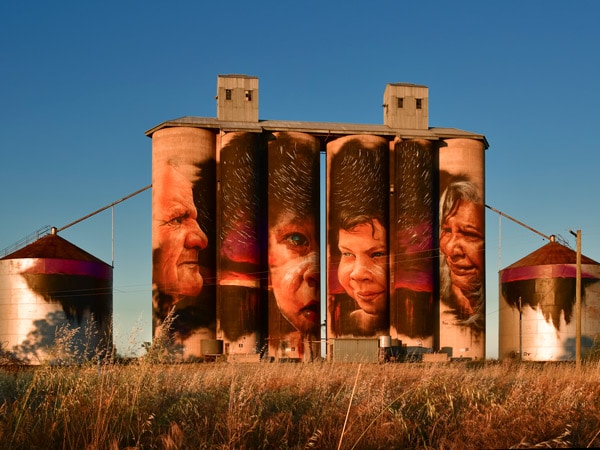
Silo Art at Sheep Hills by Adnate depicts Wergaia Elder, Uncle Ron Marks, Wotjobaluk Elder, Aunty Regina Hood, with children, Savannah Marks and Curtly McDonald. (Image: Visit Victoria/Anne Morely)
Adnate shines light on the strong ancestral connection young Indigenous people share with their Elders. (Image: Visit Victoria/Anne Morely)

Goroke

Artist Geoffrey Carran was heavily inspired by the birdlife in West Wimmera Shire when creating the Goroke silo art.  The word Goroke is the local Aboriginal word for magpie, so the native bird was a natural choice. Geoffrey then expanded the idea to include other native birds, including a kookaburra and galah.
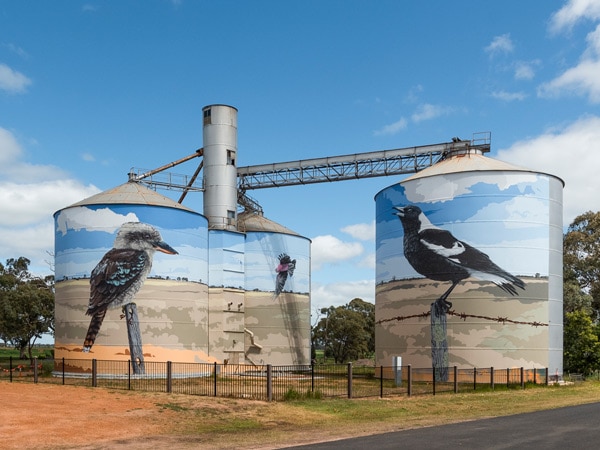
Geoffrey Carran silo art in Goroke of a magpie and kookaburra. (Image: Visit Victoria/Anne Morely)
The word Goroke is the local Aboriginal word for magpie. (Image: Visit Victoria/Anne Morely)

Kaniva

The artwork was painted by David Lee Pereira and pays tribute to the nearby Little Desert and its diverse flora and fauna. It is home to more than 600 species of native plants, 220 species of birds and 60 native mammals and reptiles.

The design features the Australian Hobby bird, which is smaller than other falcons, and is one of six Australian members of the family ‘Falconidae’. To the left of the bird is the plains sun orchid, with the salmon/pink sun orchid on the right.
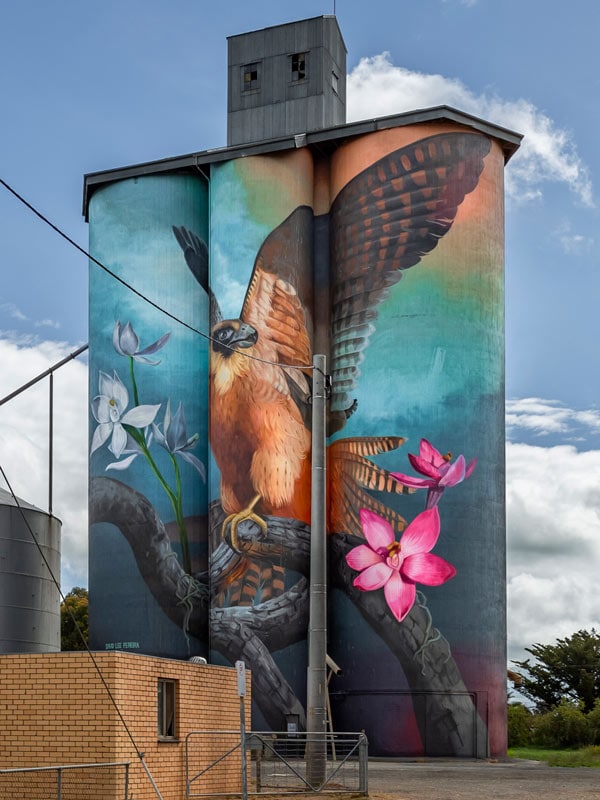
The Australian Hobby bird, and a plains sun orchid painted by David Lee Pereira on the Kaniva silos. (Image: Visit Victoria/Anne Morely)
The Australian Hobby bird is smaller than other falcons. (Image: Visit Victoria/Anne Morely)

Brim

Guido van Helten’s iconic Brim mural was the first silo artwork to appear in Victoria, and after gaining widespread local and international attention, its success shone a spotlight on the Wimmera Mallee region and inspired the establishment of the Silo Art Trail.

Completed in early 2016 van Helten’s mural depicts a multi-generational quartet of female and male farmers. Rendered across the four silos, van Helten’s subjects bear expressions that exemplify the strength and resilience of the local farming community.

The figures are both central and peripheral, present and absent, and the work explores shifting notions of community identity at a time when rural populations face both immense economic pressure and the tangible consequences of climate change.
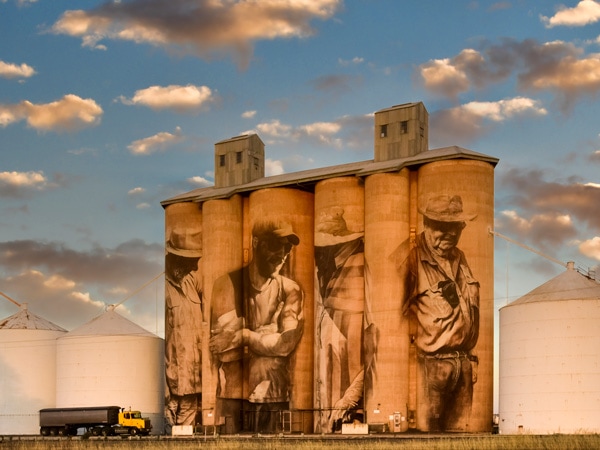
Guido van Helten's silo art in Brim depicts a multi-generational quartet of female and male farmers across four silos. (Image: Visit Victoria/Anne Morely)
Guido van Helten’s Brim mural was the first silo artwork to appear in Victoria. (Image: Visit Victoria/Anne Morely)

Must-see

Nine kilometres north of Brim on the Henty Highway is the Netting Fence, constructed in 1885 to stop rabbits invading the Mallee from the south and to keep the dingos to the north. The fence is also the division between the Wimmera and the Mallee regions.

Stay

Brim has a stunning free campsite, which can be powered (or not!) called Reddas Park Camping Area .

DAY THREE: Brim to Rosebery, Albacutya and Patchewollock

Rosebery

Before commencing work in Rosebery, Melbourne artist, Kaff-eine spent time in the Mallee assisting fellow artist Rone on his Lascelles silo project. Kaff-eine’s artwork depicts themes that she says embody the region’s past, present and future.

The silo on the left captures the grit, tenacity and character of the region’s young female farmers, who regularly face drought, fires and other hardships living and working in the Mallee.

The silo on the right portrays a quiet moment between man and horse, who are relaxed and facing downward, indicating their mutual trust, love and genuine connection.
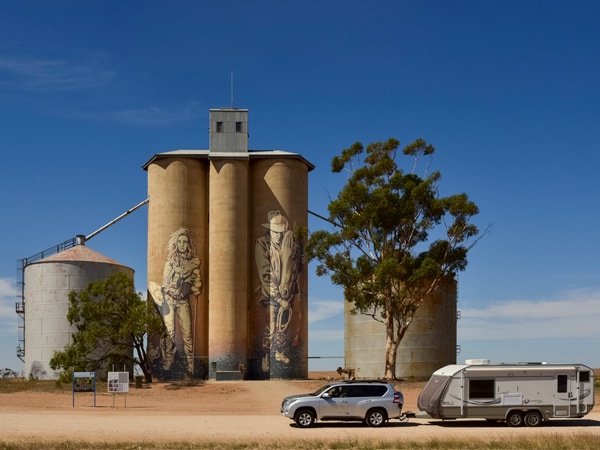
Kaff-eine's Rosebery silo on the left shows a young female farmer, and the silo on the right portrays a quiet moment between man and horse. (Image: Visit Victoria/Anne Morely)
Kaff-eine’s artwork depicts themes that embody the region’s past, present and future. (Image: Visit Victoria/Anne Morely)

Albacutya

Ten kilometres north of Rainbow lies the quirky, colourful and more modern take on Silo Art at Albacutya Silo.

Melbourne artist Kitt Bennett was inspired to, “create an artwork that tells a story of growing up in the country as a youth. I have fond memories of exploring the bush and looking for yabbies under rocks in creeks with my parents. Reflecting on this weird and wonderful time as an adult is something that brings me a lot of happiness."
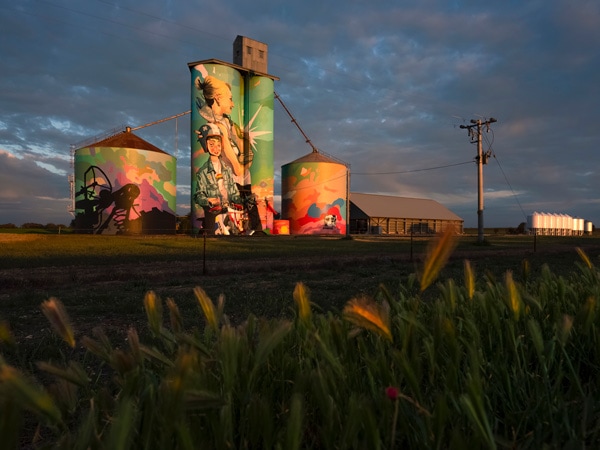
The Albacutya Silo by Kitt Bennett shows bright colours telling the story of growing up in the country. (Image: Visit Victoria/Anne Morely)
The Albacutya Silo by Kitt Bennett is a more modern take on silo art. (Image: Visit Victoria/Anne Morely)

Patchewollock

To prepare for his Patchewollock mural, Brisbane artist, Fintan Magee booked a room at the local pub to immerse himself in the community and get to know its people. When he met local sheep and grain farmer, Nick “Noodle" Hulland, Magee knew he had found his muse.

The rugged, lanky local exemplified the no-nonsense, hardworking spirit of the region. Perhaps more importantly though, Noodle had just the right height and leanness to neatly fit onto the narrow, 35-metre-high canvas of the twin silos. Hulland’s solemn expression, sun-bleached hair and squinting gaze speak to the harshness of the environment and the challenges of life in the Wimmera Mallee.
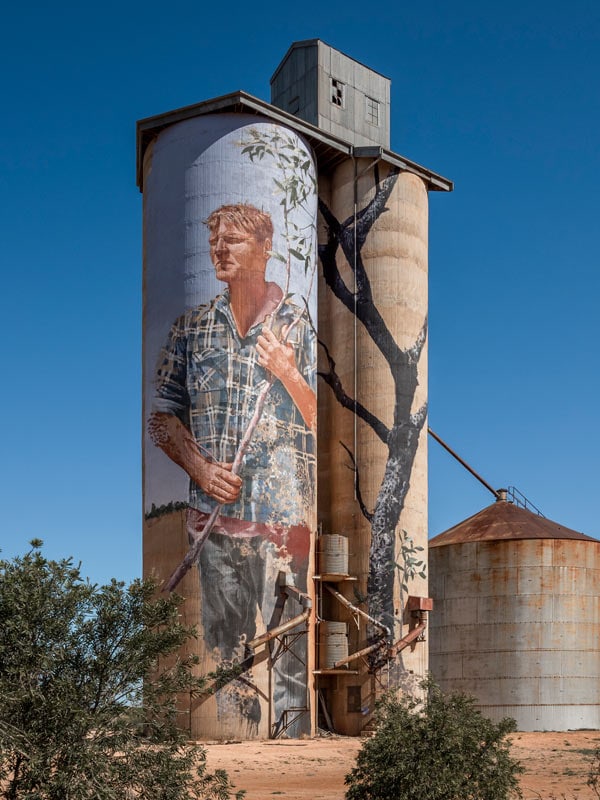
Fintan Magee painted Nick “Noodle
Brisbane artist, Fintan Magee met his silo art subject at the local pub. (Image: Visit Victoria/Anne Morely)

Must-see

Lake Albacutya

Lake Albacutya is one of a series of terminal lakes on the Wimmera River, which form the largest land-locked drainage system in Victoria.

The Big Mallee Fowl

The Big Mallee Fowl, constructed almost entirely from painted corrugated iron, is one of the most obscure of Australia’s Big Things. Make sure you stop by when you’re in Patchewollock!
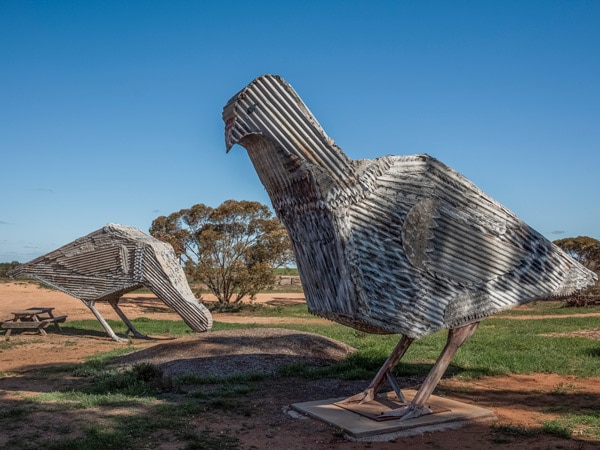
The Big Mallee Fowl in Patchewollock. (Image: Visit Victoria/Anne Morely)
The Big Mallee Fowl is a lesser-known “Big Thing" in Australia. (Image: Visit Victoria/Anne Morely)

Stay

Just 20 minutes out of Patchewollock is Pine Plains Lodge. With glorious sunrises, lingering sunsets, clear night skies and stars so close you can almost touch them, it is the perfect place to cosy up next to the fire after a big day sightseeing.

DAY FOUR: Patchewollock to Lascelles and Sea Lake

Lascelles

In order to capture the true essence of Lascelles, Melbourne-based artist, Rone knew that he had to learn about the town from those who were deeply connected to it. He depicts local farming couple Geoff and Merrilyn Horman, part of a family that has lived and farmed in the area for four generations.

Rone says that he wanted the mural to portray his subjects as wise and knowing, nurturing the town’s future with their vast farming experience and longstanding connection to the area.
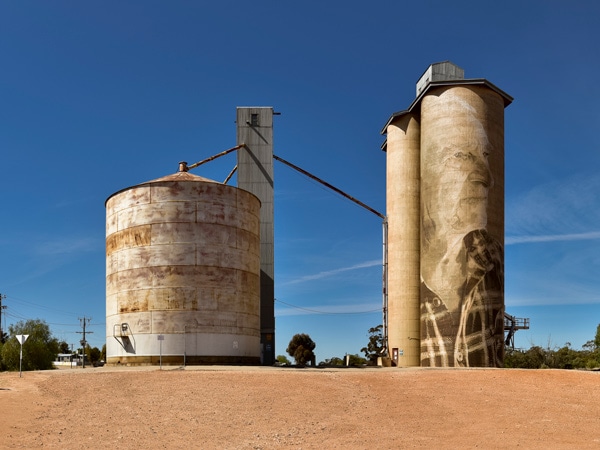
Lascelles silo art by Rone depicts local farming couple Geoff and Merrilyn Horman. (Image: Visit Victoria/Anne Morely)
The mural portrays Geoff and Merrilyn Horman as wise and knowing. (Image: Visit Victoria/Anne Morely)

Sea Lake

Joel Fergie and Travis Vinson painted the silo artwork at Sea Lake as a celebration of the still and silence found in outback Victoria, and the associated feelings of wholeness and freedom. The young girl, swinging from a Mallee Eucalyptus, looks over Lake Tyrrell and reflects on her Indigenous heritage.

The Indigenous name ‘Tyrille’ means ‘space opening to the sky’ as the colours of dusk and dawn are reflected in the shallow saline bowl. The Boorong People were known to have more knowledge of astronomy than any other tribe, and their stories are rich in culture and connection to the lake. The artwork aims to connect and bring the viewer closer to some of the relatively ordinary and overlooked elements of the outback landscape and allows viewers to see these elements from a new perspective.
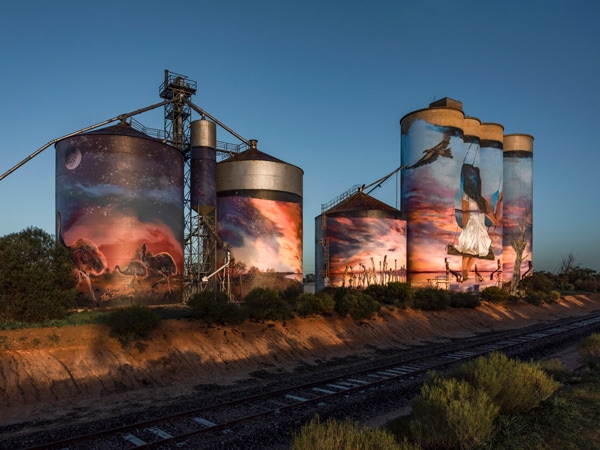
Joel Fergie and Travis Vinson painted the silo artwork at Sea Lake of a young girl, swinging from a Mallee Eucalyptus, looking over Lake Tyrrell and reflecting on her Indigenous heritage. (Image: Visit Victoria/Anne Morely)
The Boorong People were known to have more knowledge of astronomy than any other tribe, and their stories are rich in culture and connection to Lake Tyrrell. (Image: Visit Victoria/Anne Morely)

Must-see

Lake Tyrrell

A visit to Lake Tyrrell, Victoria’s largest salt lake, is a must while in Sea Lake. You’ll get a once in a lifetime insta pic, plus the 120,000-year-old lake is regarded as one of the best places in Australia for stargazing, with the dark and endless skies providing the perfect environment.
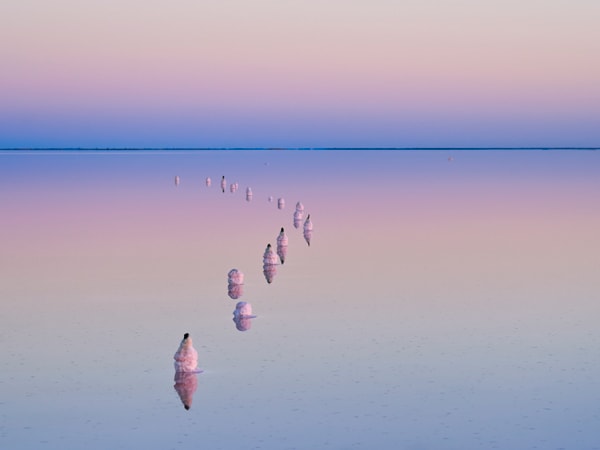
Pinks and purples reflect off Lake Tyrrell is Victoria's largest salt lake. (Image: Visit Victoria/Anne Morely)
Lake Tyrrell is the ultimate stargazing spot. (Image: Visit Victoria/Anne Morely)


Stay

Sea Lake has a range of different stays to suit your needs, whether camping is your vibe or you’d prefer to relax in a hotel.

DAY FIVE: Sea Lake to Melbourne via Nullawil

Nullawil

Artist Sam Bates (Smug) painted the Nullawil silo of a kelpie sheepdog and a farmer on the concrete canvas. The soft-coated black and tan Kelpie was depicted with a sheen on his coat, a shiny black nose, a spark in his brown toned eyes and fine grey whiskers above his semi drooped mouth.

As a “nod" to the history of Nullawil the registration disc has a “galah" and “stick" engraved on it. The name of the town is derived from two Aboriginal words, “Nulla" which means killing stick, and “Wil" derived from the term “willock" meaning Galah.

After visiting Nullawil, it’s back home to Melbourne!
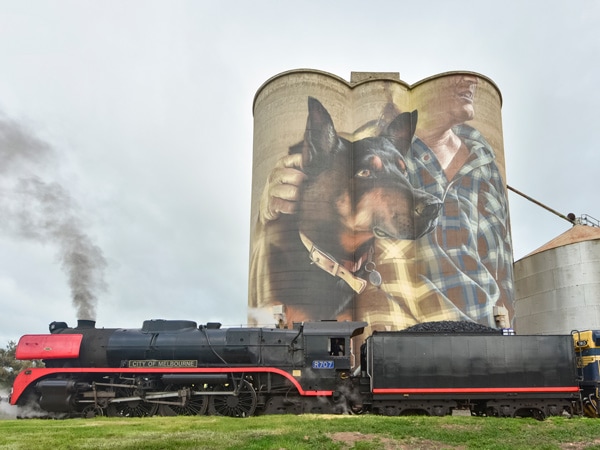
Artist Sam Bates (Smug) painted the Nullawil silo of a kelpie sheepdog and a farmer on the concrete canvas. (Image: Visit Victoria/Anne Morely)
The name of the town is derived from two Aboriginal words, “Nulla" which means killing stick, and “Wil" derived from the term “willock" meaning Galah. (Image: Visit Victoria/Anne Morely)
Emily Murphy
Emily Murphy is Australian Traveller's Email & Social Editor, and in her time at the company she has been instrumental in shaping its social media and email presence, and crafting compelling narratives that inspire others to explore Australia's vast landscapes. Her previous role was a journalist at Prime Creative Media and before that she was freelancing in publishing, content creation and digital marketing. When she's not creating scroll-stopping travel content, Em is a devoted 'bun mum' and enjoys spending her spare time by the sea, reading, binge-watching a good TV show and exploring Sydney's vibrant dining scene. Next on her Aussie travel wish list? Tasmania and The Kimberley.
See all articles

How to spend a tasty long weekend in Geelong and the Bellarine

    Lucy CousinsBy Lucy Cousins
    hero media
    From rust-coloured foliage and foodie experiences to stunning sunsets, this part of Victoria is best explored as the mild days of winter arrive.

    As the heat of the summer sun subsides and the milder days roll in, the stunning landscapes of Geelong and the Bellarine add pops of colour. The slight chill in the air will stir your taste buds and invite you to explore the peninsula’s foodie hotspots, while the vivid sunsets and cooler evenings will draw you to cosy fireside chats and evening adventures to watch the stars appear one at a time.

    Just over an hour from busy Flinders Street, or a short 25-minute drive from Avalon Airport, Geelong is Melbourne’s cooler, more laid-back cousin with a sparkling marina, stunning surf beaches, impressive museums and a lively foodie scene.

    federal mill geelong in autumn
    Winter is the perfect time to see local sights.

    It’s also the perfect starting point from which to explore the Bellarine Peninsula. Packed full of jaw-dropping scenery, inviting townships and over 40 cellar doors serving up local cool-weather wines, winter here is distinctly beautiful with its change of colours, temperatures and produce.

    Whether you drive or catch the short but incredibly scenic ferry from the Mornington Peninsula, it’s no surprise this region offers up one of Australia’s best long weekend destinations. Here’s how to soak it all up.

    Day 1: Explore Geelong with the locals

    Morning

    Start the day by grabbing breakfast and strong coffee from Pavilion Geelong (try the braised mushrooms on toast) while watching the gentle waves lapping the edge of Corio Bay. After brekkie, join the locals walking along the scenic Art Deco waterfront to explore the historic piers, beautiful beaches and gleaming white yachts in the marina.

    Pavilion Geelong in winter
    Start the day at Pavilion Geelong.

    Afternoon

    After a morning in the sun, venture to the recently refurbished Federal Mill precinct , a grand old woollen mill built in 1915. Explore the industrial history of this area, as well as the gourmet produce on offer, before pulling up a table at the popular Paddock Bakery . Famous for their wood-fired sourdough and tasty pastries, this cafe serves up tasty dishes like their Crème Brûlée doughnuts. Chase your lunch down with an afternoon of gin tasting at Anther Distillery .

    Paddock Bakery Crème Brûlée doughnut
    Try the Paddock Bakery Crème Brûlée doughnuts.

    Night

    For an evening of frivolity and decadence, head back to Geelong for dinner and a show at the newly reopened Geelong Arts Centre . Later, enjoy a mini Negroni with a scoop of Black Pearl Oscietra Gold caviar at the sleek Non Disclosure Bar .

    Day 2: A foodie-centric day in Moorabool Valley

    Morning

    Wake up with the soft winter sun and cooler temperatures, then travel to the lush farmlands and stunning landscapes of Moorabool Valley, the home of Meredith Farm Store . Choose a seat outside in the leafy courtyard and enjoy a tasting platter of fresh produce among the flowers.

    Afternoon

    To explore the area, visit the cellar door at the Moorabool Valley Wine Collective , which encompasses three award-winning winemakers, before stopping by Austin’s Wines for lunch. Not only can you taste over 10 local wines at the dedicated tastings bar, but you can also curate your own cheese platter to eat outside on their shaded deck.

    two people trying the wine at Austin's wines
    Stop by Austin’s Wines for lunch.

    Night

    Continue on your foodie quest with dinner in Newtown at the Asian fusion Two Noble restaurant, or, inside the same venue at Sawyers Arms Tavern, dive into the European flavours of Eileen’s Charcoal Grill on your way back to Geelong.

    table spread at two noble restaurant
    The chef’s hatted Two Noble restaurant is waiting.

    Day 3: Adventures in The Bellarine

    Morning

    For a light breakfast, head 20 minutes out of town to the rustic Ket Baker , an artisan bakery known for their 100% sourdough croissants. Grab a hot cuppa under the gum trees and enjoy the morning chill in the air. Then spend the morning on the foodie-focused Bellarine Taste Trail , visiting local producers like  Bellarine Smokehouse Flying Brick Cider House  and FarmDog Brewing .

    croissants at ket baker
    Enjoy a light breakfast at Ket Baker.

    Lunch

    There’s no better way to enjoy lunch than to make it from scratch. With Harvest Experience’s Pasta & Pinot cooking class, you’ll have a genuine farm-to-plate experience as you learn to make fettuccini and filled ravioli from scratch. Once cooked, sit down, relax and enjoy your hard work with a glass of Bellarine Peninsula pinot noir.

    Afternoon and night

    Burn off your lunch with an afternoon trip to the bayside town of Portarlington , where Australian blue mussels are harvested offshore. Stop by the quirky Ducks Nuts and peruse the trinkets and treasures before making your way to the restored Portarlington Grand Hotel . Built in 1888, this beautiful building now houses four distinct dining experiences, including the new open-air spaces of The Atrium and Lawn, where you can enjoy a local gin as the sun sets over the bay.

    waiter holding mussels at Portarlington Grand Hotel
    Be sure to try Portarlington mussels.

    Start planning your ultimate Geelong & The Bellarine adventure at visitgeelongbellarine.com.au.