What it’s like to be a hot air balloon pilot during a global pandemic

hero media
For a snapshot in time, we asked eight people around the country to reflect on Australia Now. Here, Georgia Croft, a pilot for Global Ballooning Australia based in Victoria, shares her thoughts on what the global pandemic has taught her.

Keep reading our Australia Now series here.


When lockdowns grounded Global Ballooning Australia’s Melbourne and Yarra Valley flights, Georgia Croft saw an opportunity to establish a brand-new location for the company.


Today, one of only five female hot-air balloon pilots in Australia, the 24-year-old flies high above the scenic landscape and rolling hills of Mansfield and Mt Buller in Victoria’s High Country.

A day in the life of a hot air balloon pilot

The day starts early – up to two hours before sunrise. Ungodly hours that only hot-air balloonists and bakers keep, says Georgia. The flip side is that post-flight day napping is entirely acceptable within their community.
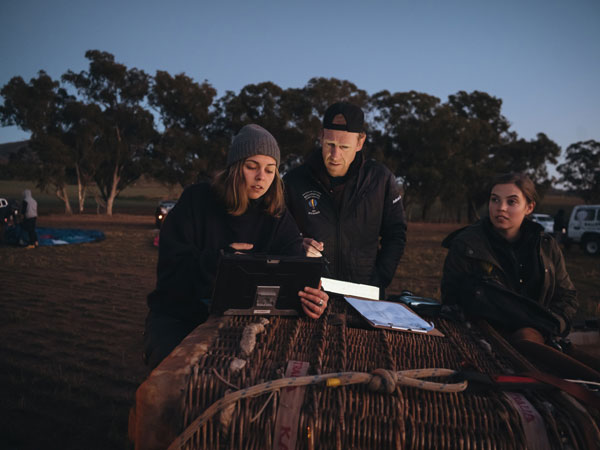
Hot air balloon pilot Georgia Croft getting ready to take off
Hot air balloon pilots are very early risers.

No day is typical with hot-air ballooning. “Every single day brings its own conditions and a whole new experience," says Georgia. “Even this morning – and I’ve been flying up here for three months – we got a wind direction that allowed us to fly over Lake Eildon and look at the valley from a completely different perspective. And last week we accidentally got bogged in a paddock and had to call the landowner to get in with his tractor to come and help us out. It’s a beautiful balance of being a professional and doing what we know and love, but also working things out as we go."

Why it’s great to pilot hot air balloons, according to Georgia

Georgia’s love for hot-air ballooning is manifold. From the fact it is the world’s oldest form of aviation and something of a lost art, to witnessing the awe of passengers, who are often first-timers, as they take in such inspiring sights as the sun rising over a snow-capped Mt Buller.
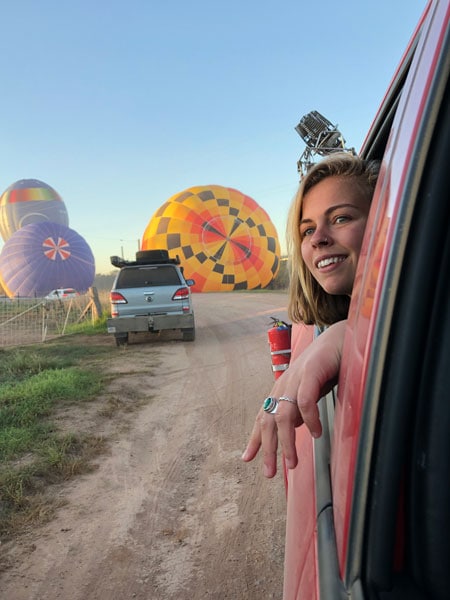
Hot air balloon pilot Georgia Croft
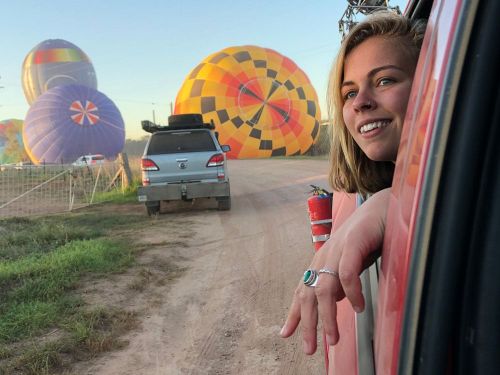
Hot air balloon pilot Georgia Croft, all set to take to the skies over Canowindra.

And she loves being part of the industry itself: the places it takes her and connections forged around Australia and beyond. “There are all these tiny little communities within this culture that have such a beautiful knowledge of their land and their environment, and also their [wider] community because of how engaged you have to be in that network in order to successfully do a hot-air balloon flight." Employing the seriously high level of skill and knowledge it takes to pilot a hot-air balloon, from meteorology to navigation, it offers a unique way to explore the country. “You’re assessing the wind and the topography and you’re looking at all these really niche factors that you would have no reason to pay attention to otherwise," she says.


It makes for a unique perspective on Australia, and not only literally. The job requires engagement with local landowners to get permission to launch and land: often popping into their backyard and saying, ‘Hey, do you mind if we land here?’ “And then 20 minutes later you’re in this random dude’s house and he’s walking you through his property and serving you a cup of tea," laughs Georgia. “I am constantly blown away by how giving people are of their time and their place, and their knowledge of the place. When you turn up and show an interest in that way, your possibilities are endless. And, through those interactions, you learn so much more about the land and the way that it works."
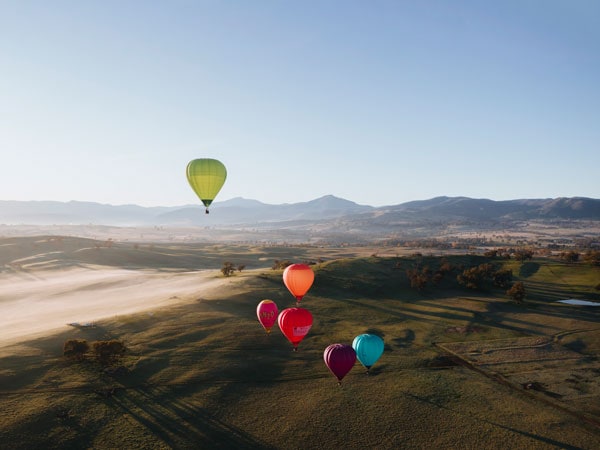
Hot air balloons over Mt Buffalo National Park
Hot air balloons over Mt Buffalo National Park. (Image: Visit Victoria)

What the global pandemic has taught her

And there’s a lot more Australia can reveal to us yet, Georgia reflects. “This period of hardship, which everyone has gone through individually, has made me sit back and really appreciate this country and how much we have to learn from it and grow within it as well. But more so than that, it’s made me realise how privileged I am to be here and to live here. It gives me this solid optimism going forward, because it opens us up to have more intimate and more in-depth experiences rather than constantly looking elsewhere. It’s through this we could really learn to cherish where we belong and where we are. And that makes me really excited."

hero media

A must-visit list of Victoria’s most iconic spots

From natural wonders to historical sites, we’ve rounded up Victoria’s most epic icons that deserve a place on your itinerary.

Grampians (Gariwerd) National Park

Mount William peak in Grampians (Gariwerd) National Park
Mount William is the highest peak in the Grampians (Gariwerd) National Park. (Image: Matt Donovan)

From towering mountains to crystal cascades and ancient rock art sites, the Grampians (Gariwerd) National Park is a playground for both outdoor adventurers and nature lovers. Don’t miss the views from the highest peak Mount William or the iconic Pinnacle.

Murray River

A paddle steamer down the Murray in Echuca
The wonders of the Murray are best experienced on board a paddle steamer. (Image: Visit Victoria)

A natural icon of majestic proportions, the Murray River flows for a staggering 2700 kilometres, making it one of the world’s longest navigable rivers. Meandering through Victoria before flowing out to sea at Goolwa in South Australia, the river is home to diverse wildlife, picturesque towns and secluded creeks and beaches.

Twelve Apostles, Port Campbell

the Twelve Apostles, Great Ocean Road
The Twelve Apostles are a star attraction on the Great Ocean Road. (Image: Tourism Australia/Two Palms/Harry Pope)

These limestone sea stacks are arguably Victoria’s most famous icon . After an $8-million upgrade to its lookout, The Blowhole near Loch Ard Gorge/Poombeeyt Kontapool (meaning breath of the whale) has recently reopened. A brand-new Twelve Apostles Visitor Experience Centre, complete with rooftop lookout, will open in 2026.

You Yangs, Geelong

kangaroos in You Yangs
Kangaroos enjoy dusk in the You Yangs. (Image: Tourism Australia)

Rising 300-plus metres from the flat volcanic plains between Melbourne/Naarm and Geelong, the You Yangs are massive granite boulders named for the local Wadawurrung word ‘Youang’, meaning ‘big hills’. Hiking, biking, rock climbing and horse-riding are popular within this regional park.

Redwood Forest, Yarra Valley

Redwood Forest, Yarra Valley
Yarra Valley’s soaring Redwood Forest. (Image: Tourism Australia)

Near the town of Warburton, an extraordinary forest of some 1500 Californian Redwoods stands among native orchids, eucalypt trees and rich birdlife. Planted in the 1930s, these 55-metre-plus trees can live for 2000 years and will grow to be some of the world’s tallest.

Wilsons Promontory, Gippsland

the Wilsons Promontory
Wilsons Promontory is home to the incredible Skull Rock formation. (Image: Tourism Australia)

The Prom, as it’s known locally, is the southernmost tip of mainland Australia. This 50,000-hectare reserve comprises granite mountains and forest, fringed by sandy beaches and surrounded by a marine park rich in marine biodiversity. It’s also home to the incredible and imposing Skull Rock formation.

Hanging Rock Reserve, Macedon Ranges

the Hanging Rock Reserve, Macedon Ranges
Enigmatic Hanging Rock. (Image: Visit Victoria/ Rob Blackburn)

This six-million-year-old volcanic rock  was thrown into the national spotlight thanks to the 1967 novel and consequent 1975 film based on the fictional disappearance of schoolgirls in 1901. Mystery aside, visitors can walk the steep 105-metre summit, fish for trout and go twitching.

Sovereign Hill, Ballarat

exploring Sovereign Hill
Step back in time at Sovereign Hill. (Image: Tourism Australia)

Cry ‘eureka!’ at Sovereign Hill , a living museum to the prosperous Gold Rush era of the 1850s, during which Ballarat produced the most gold in the world. Visitors to this much-loved attraction can walk historic  streets, enter a gold mine and try panning for the good stuff, too.

The Great Stupa, Bendigo

Great Stupa, Bendigo
The Great Stupa in Bendigo. (Image: Tourism Australia)

Who’d have thought the largest Buddhist temple in the Western world would be tucked away in Bendigo’s bushland? Welcoming visitors to explore, this sacred Buddhist pagoda is an epicentre for Tibetan culture, architecture, art and interfaith harmony.

Cape Schanck Lighthouse, Mornington Peninsula

the Cape Schanck Lighthouse from above
Heritage-listed Cape Schanck Lighthouse. (Image: Tourism Australia/Two Palms/Harry Pope)

Ensuring the safe passage of ships in the notoriously treacherous Bass Strait since 1859, this heritage-listed lighthouse overlooks dramatic volcanic coast and wild beaches. The surrounding reserve is home to a plethora of wildlife including little penguins, seals and echidnas.