Vertically Challenged

hero media
The spirit of Kokoda – courage, endurance, mateship and sacrifice – reverberates through the forests of the Gold Coast hinterland each year during the gruelling Kokoda Challenge. Stu Lloyd explores the unique headspace you need to be in to take on one of Australia’s toughest endurance events.

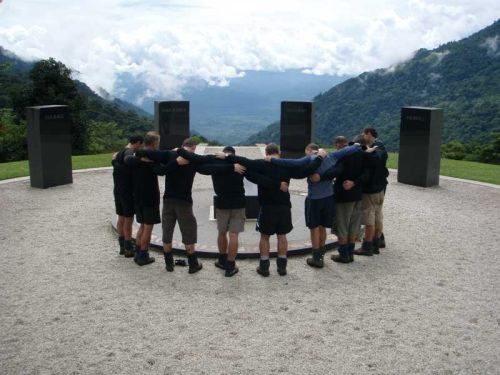
At Isurava, overlooking the dramatically misty Yodda Valley along the Kokoda Trail, stand four black granite pillars engraved with the words: Courage. Endurance. Mateship. Sacrifice. They are a reminder of the qualities that enabled our Diggers to turn around the rampant and numerically superior Japanese in WWII, and gave birth to the legend of Kokoda.


But this story is not about Kokoda. It’s about the spirit of Kokoda: for “Kokoda" has become synonymous with a certain fighting spirit against overwhelming odds. Ticker.


Some 2000km south of that “bastard of a place", at Nerang in the Gold Coast hinterland, 1200 masochistic contestants dig deep each July to participate in the Kokoda Challenge. The course skirting Lake Hinze is 96km (the same distance as Kokoda to Ower’s Corner) and the time limit given for teams to complete it is 39 hours – in remembrance of the 39th Militia, the first of the Aussie troops to reach Kokoda.


The event came about as a result of the Hon Charlie Lynn, MLC, speaking of the battle of the Kokoda Trail at an RSL conference. The not-for-profit Kokoda Challenge Association was formed by Doug Henderson in January 2005 to promote the Kokoda Spirit and benefit Aussie youth at some sort of crossroads in their life. Last year’s event raised nearly half a million dollars.


The inaugural outing in 2005 saw 76 teams of four front up. One of the organisers, and participants, was John Nalder, whose father fought on the trail that John, as a trek leader for Adventure Kokoda, has now hiked more than 30 times. The GC course replicates the Kokoda Trail from south to north quite uncannily, being an ever-rising series of peaks, with the highest point about two thirds in before plunging down to the finish. The checkpoints are named for villages along the Kokoda Trail. Charlie Lynn, whose father also fought on Kokoda, followed his dad into the army. “I spent a fair bit of time training in the hinterland around Canungra," Lynn says. “While the terrain can be as tough as Kokoda, it’s not as rugged or unrelenting."


“Sixty per cent of it is mental," says Nalder of the GC Challenge. “If your head’s not there when the going gets tough, you’ll struggle. At 3am when the cold wind is blowing, you’re right up against it." Lows of around three degrees when the Last Post sounds at the race start are not unknown. “That comes back to why you’re there . . . remembering what the young men went through back in 1942 helps provide perspective and drive."


And it’s exactly that spirit which now attracts 300 teams from all over Australia, and even Papua New Guinea, each year. Some are super-athletes, porters, students, descendents of Diggers, serving soldiers, and family groups in it to fundraise for a good cause.


In 2007 Kokoda Trekking put several teams in, one of which was KTL Elite. It comprised the four fastest men to ever cover the Kokoda Trail: Brendan Buka (an astounding 16hrs 34mins), Wayne Urina, Horace Yuaga – all PNG porters – and “honorary wontok" Damon Goerke, the fastest white man to cross the Trail. You’d think they were a shoe-in to win. But no. “Competing in a team-based event is a lot different to running it individually," explains Goerke. “Over the 96km everyone goes through a bad stage at some point, and it takes experience to manage yourselves to stay consistent. You have to make sure everyone’s eating and drinking and not pushing themselves too hard, which may hurt them later." Support crews at checkpoints ply their teams with a fuel-rich nutritional nightmare of chocolate, donuts, chips, pies and Coke. Then . . . drama! “Horace cramped at 5km," recalls Kokoda Trekking proprietor Gail Thomas. “Brendan and Wayne were getting pissed off with him for dragging the team. They spent most of the time waiting at the checkpoints." The super-team finished in fourth place.


Typically, endurance-running legend Don Wallace’s Nike Hammer team takes line honours in around 12 hours. But for every Don Wallace there are many ordinary punters straggling in under the deadline. Like 42-year-old Peter Shellam and his workmates, who slogged it out for 28 hours. Why? “For the fitness and the challenge of pushing your body and mind beyond the norm," says Shellam. “Few, if any, had walked that distance in one go so there was trepidation about whether or not we’d make it." For many, the most gruelling part is the steep climb to Syd Duncan Park. Shellam found the steep sections around the Environmental Centre in pitch black the toughest. “Every step required extra concentration and effort from tired and aching muscles." He also found the final section very difficult: “Every kilometre feels like it’s two."


The bonding and camaraderie is what sticks. “It doesn’t matter what team you belong to," says Shellam. “Everyone is friendly, jovial, supportive." Then there was the famous incident when the 41 Artillery Battalion’s brigadier marched 6km into the jungle hefting a slab of beer on his shoulder for his boys, only to be told they couldn’t possibly dream of drinking a beer.


The event attracts celebrities such as Olympians Duncan Armstrong and Nickey Carroll. Carroll, a marathon runner, said it’s “a challenge adventure racers dream of, where pain meets ecstasy and mind over matter is everything." Strange dreams! But it was rugby league legend Mal Meninga who provided one of the Challenge’s most inspirational moments. “Seeing Mal finish, he’s a big guy and I’d hate to have to lug that frame up and down all those hills," says Goerke. For his part, Meninga claimed it was “the toughest mental challenge I have ever endured."


At the finish line, Kokoda veterans greet the racers in a poignant tear-jerking finale, and the four pillars of Isurava resound through the Queensland bush. Maybe now they’re ready to tackle the real thing? “Kokoda is the world’s toughest history class," cautions Charlie Lynn.

The Spirit of Kokoda

Of the thousands of unsung struggles of the Diggers on Kokoda, two stand out as truly heroic: Private Bruce Kingsbury and Corporal John Metson. The scene at Isurava in August 1942 was bleak as 6000 Japanese soldiers stormed towards Port Moresby – next stop Australia? With the beleaguered 39th Militia in danger of being overrun, Kingsbury – a 24-year-old from the 2/14th – rushed forward bare-chested, firing his bren gun from the hip, clearing a path through the enemy for the platoon to withdraw, inspiring his men to recapture the precarious position. From behind a massive rock he swept enemy positions, accounting for dozens of Japanese before a sniper ended his heroic stand. The citation for his Victoria Cross reads: Private Kingsbury displayed a complete disregard for his own safety.


In that same action, Metson was shot through the ankle. Unable to walk, he and dozens of seriously wounded were stretchered back along the Trail. Metson insisted he didn’t want to be a burden, so decided to crawl instead, his hands and knees bandaged for protection. He tended to other worse cases, adding good cheer where he could, although he and the men were wounded, dehydrated and starving after three weeks on the move. At Sangai village, it was decided to leave all stretcher cases behind while help was sought from Moresby. This position was soon overrun by the Japanese, who murdered all, including Metson, in cold blood. He received the British Empire Medal. And that, dear readers, is the spirit of Kokoda.


For more information on the GC Kokoda Challenge, and the Kokoda Challenge Youth Program, visit www.kokodachallenge.com

hero media

Heathcote has evolved into the ultimate eco-escape for foodies

From cabins to canvas, craft distillers to destination dining, Heathcote locals reveal their eco-savvy passions in ways that resonate with those seeking to travel lightly. 

Heathcote , on traditional Taungurung Country in Central Victoria, is synonymous with its garnet-hued shiraz, but wine isn’t the only string to its bow. The town itself is sprinkled with heritage buildings from the gold rush era, and beyond that a growing collection of sustainable gastronomy and eco-friendly escapes. Nearby Bendigo, one of only 65 cities in the world recognised as a UNESCO Creative City and Region of Gastronomy, plates up an astonishing calibre of produce, wine and food for its size. Increasingly the entire region is taking up the challenge, though Heathcote in particular shines with its focus on sustainability. 

Pink Cliffs GeologicalReserve
The dramatic landscape of Heathcote’s Pink Cliffs Geological Reserve. (Image: Visit Victoria/Emily Goodfrey)

The eco-stays bringing sustainability to Heathcote 

Yellow BoxWood’s safari-style tents
Yellow Box Wood’s safari-style tents are nestled on 40 hectares of bushland. (Image: Emily Goodfrey)

Andee and Lisa Davidson spent years working in southern Africa before settling in Heathcote. “We had a vision of how this could be,” explains Andee. “We wanted a retreat, but one that was off-grid and environmentally sustainable.” Now, at Yellow Box Wood , two luxury safari-style tents are at the heart of 40 hectares of rolling hills and native bush, with kangaroos, wallabies, echidnas, goanna and birdlife aplenty. It’s all solar-powered, wood for the fire is mainly fallen timber, and water is collected on the carport roof.  No lack of creature comforts though – en suite with rain shower, espresso coffee maker, comfy seating, wood-burning fire all set to go. There’s also a solar-heated, mineral salt pool in a bush setting, walking tracks, and even a mini bush golf course.  On my visit, I put the vision to the test. Cocooned in the plush four-poster bed I can glimpse the stars, while the heater casts a golden glow on the canvas. In the morning, I wake to a blush-pink sunrise, kangaroos feeding and a soundtrack of magpies.

Mt Ida Eco Cabin
Mt Ida Eco Cabin is rustic and simple but oozes comfort. (Image: Graham Hosking)

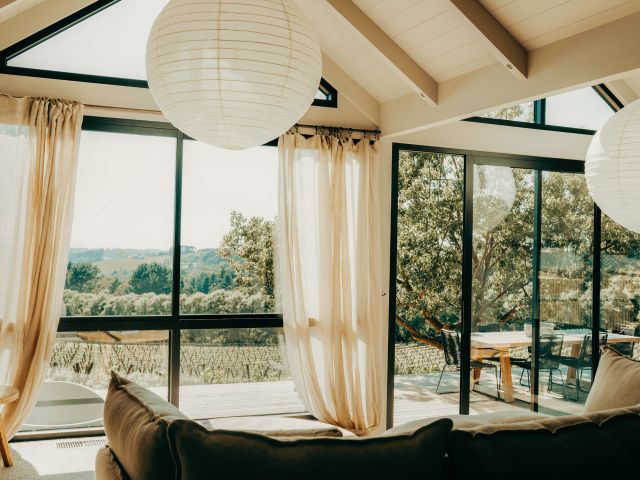
If a tent is not your style, Stephen and Cally Trompp’s carbon-neutral Mt Ida Eco Cabin might entice with its generous deck and farmland views.   Inside the cabin, corrugated iron walls as rusty as a shearing shed, gleaming (recycled) floorboards, timber truss ceiling (crafted by Stephen), wood-fired heater and an old-school turntable with a pile of vinyls to spin. It’s fun, and a little boho. “Everything is recycled. The cabin takes maximum advantage of the sun in winter. It’s all solar-powered. Don’t panic, though,” says Stephen, “you can still charge your phone and get 4G reception!” Settle into an Adirondack chair on the deck or pedal off on a mountain bike to suss out the wineries.  

A taste of Spain in Central Victoria 

Three Dams Estate
Three Dams Estate make Spanish-style wine.

Another person with a vision is Evan Pritchard at his Three Dams Estate where the wines reflect his deep love of Spain and of Spanish-style grapes, such as tempranillo. Afternoons in the ‘wine shed’ or cantina are matched with music (flamenco is a favourite), Spanish bites from tapas to paella (with Evan on the pans!) and views to Mount Alexander. Sustainability is also a passion. “You don’t need to buy anything. We decided to be off-grid from the start, but it is a lifestyle change,” he says. “You need to think about it and be careful.” Everything here is recycled, reassembled, refurbished. Evan has an electric car (with solar-powered charger), solar-power for the winery, and even a jaunty little electric tractor/forklift. “I love the idea of all the things you can do using the sun.” Sipping a crisp rosado (a Spanish rosé) with Evan in the sunshine, I couldn’t agree more. 

The vineyard redefining sustainable winemaking 

Silver Spoon winery
The Silverspoon Estate winery is completely off-grid. (Image: Graham Hosking)

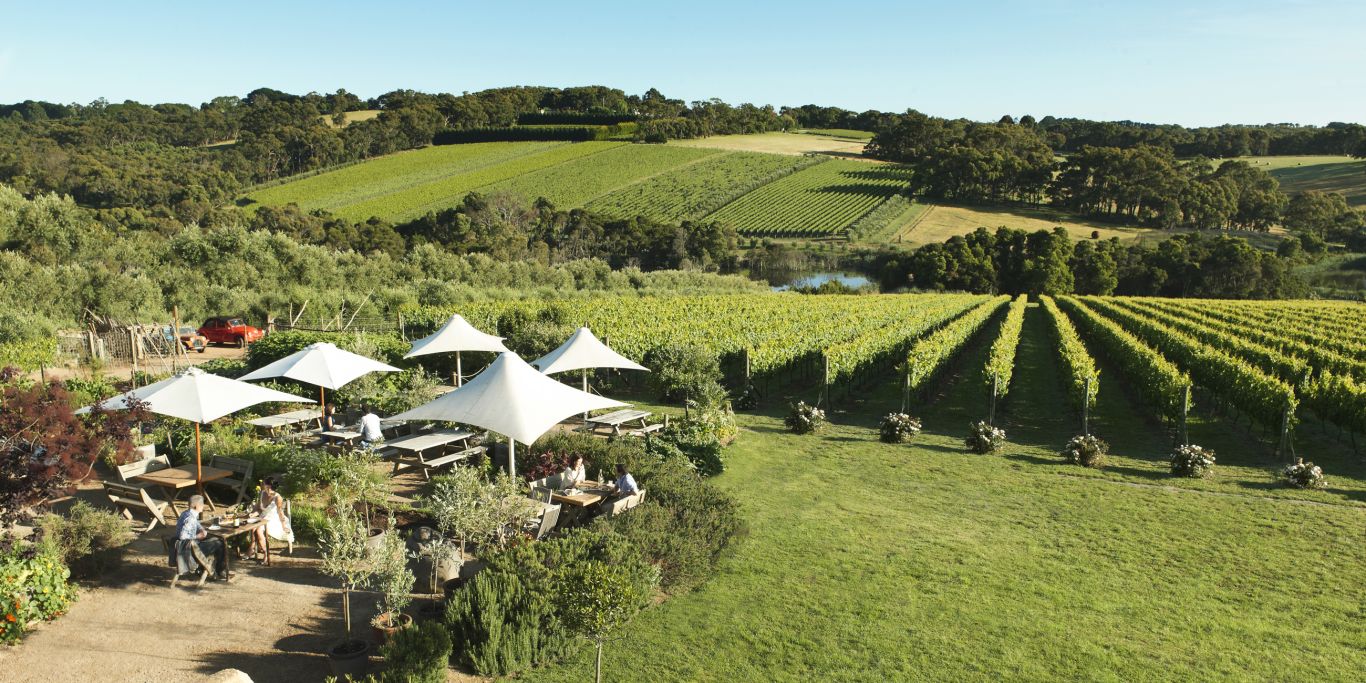
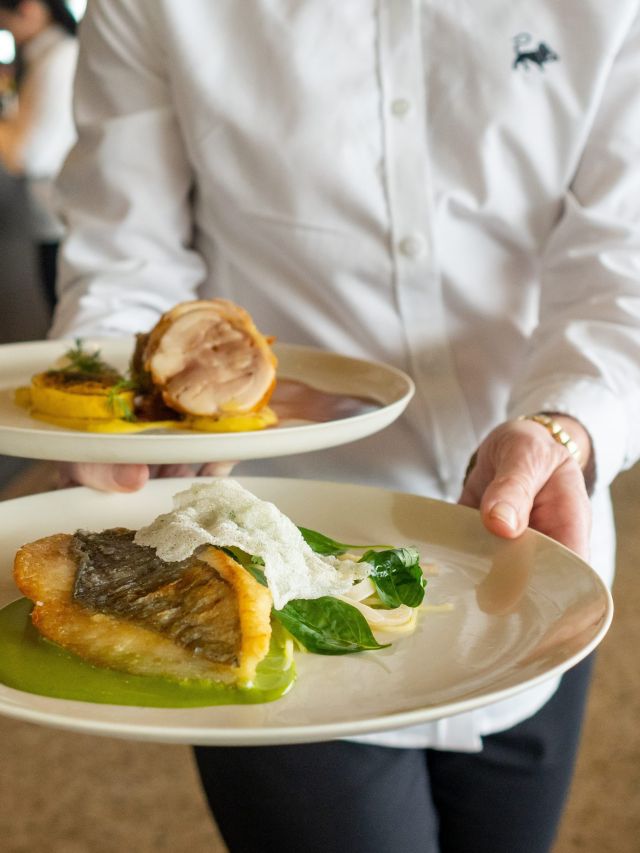
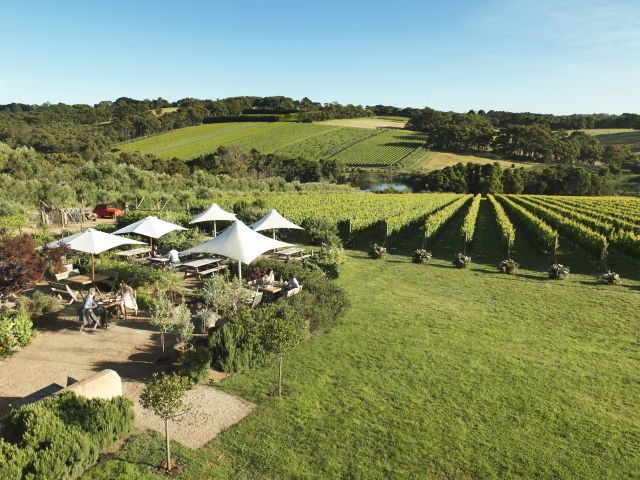
On the other side of Heathcote, Silver Spoon Estate demonstrates sustainability on a more extensive scale. Tracie and Peter Young’s winery, cellar door, award-winning restaurant and their own house are all solar-powered and off the grid. Sustainability is intrinsic to everything they do.  The property sprawls across 100 hectares, with 20 hectares under vine – shiraz, viognier, grenache, tempranillo. As the climate has changed, so too has the approach. These are dry-grown vineyards. “We prune for drought. That means lower yields but more intense flavours,” says Peter.  The fine-dining restaurant offers sweeping views, a wood-burning fire and a deck for languid lunches. Head chef Ben Hong sources regional, sustainable ingredients and weaves estate wines into the menu – think crispy wild mushroom arancini, viognier-infused chicken breast.   

Silver Spoon’s award-winning restaurant
Silver Spoon’s award-winning restaurant.

Heathcote’s other hidden gems 

Heathcote Wine Hub
Heathcote Wine Hub is housed in a 1855-built timber church.

Not all local wineries have a cellar door, but I find local treasures at the Heathcote Wine Hub , a petite 1855 timber church in the main street, lovingly returned to life by Karen Robertson and Carey Moncrieff.  “Carey is a scrounger,” says Karen. “He doesn’t throw a single thing away.” He does, however, craft things into something quite special. Heritage floors, light-filtering lancet windows and shelves of regional wines create the perfect ambience for wine tasting. Or order a glass and linger over a cheese platter.  

Heathcote is not all wine, of course. Nathan Wheat and partner Vanessa Curtis run Envy Distilling with a committed sustainable ethic – and a serious love of gin. Their small-batch distillery produces grape-based gin, and soon brandy. Distilled water is reused in an ingenious cooling system. All waste is treated on site. They buy excess wine from winemakers to distil and buy recycled barrels. “Distilling with the sun,” as Nathan says. Each Envy gin has its own story. Spicy, award-winning The Dry, is designed to capture the region’s dry, rugged nature. Pull up a stool at the bar (reclaimed timbers and tiles, of course), order a Gin Flight, or kick back with a cocktail and let Nathan share his eco journey.   

Envy gins
Sample gins at small-batch distillery Envy.

A traveller’s checklist 

Getting there

It’s less than two hours’ drive from Melbourne. The scenic route we take goes past Sunbury, then along a splendid country road through Romsey and the magic, boulder-strewn landscape of Lancefield. Watch for kangaroos on the road! 

Staying there

Go off-grid in style at Yellow Box Wood for glamping or try Mt Ida Eco Cabin for a couple’s weekend hideaway. 

Eating there

French dishes at Chauncy
Award-winning French restaurant Chauncy.

At award-winning Chauncy , French chef Louis Naepels and sommelier wife Tess Murray have created a tiny, elegant pocket of rural France. Meticulously restored 1850s sandstone building, sun-drenched dining room, impeccable service, a menu suffused with local flavours and thoughtful wine pairings.  

Fodder is both cafe and social hub. Chef Mo Pun and sister Lalita serve classic Aussie breakfast-to-lunch fare, though their Nepalese heritage sneaks through. 

Playing there

Sanguine Estate
Sip on wines among the vines at Sanguine Estate. (Image: Visit Victoria/Emily Godfrey)

Sanguine Estate ’s cellar door and terrace overlook bucolic vineyards. Its award-winning, dry-grown wines include the distinctive D’Orsa Blanc dessert wine, reflecting the family’s Swiss-Italian heritage. Order a charcuterie board and stay a while. Keep it carbon neutral by cycling some (or all) of the 50-kilometre O’Keefe Rail Trail to Bendigo.  

At Bridgeward Grove , learn about the property’s Old Mission Grove heritage olive trees, do a sommelier olive oil tasting, and stock up on sustainably grown olives and oil. Explore the unique landscape, wildflowers and wildlife of pink cliffs geological reserve.