hero media

The 8 best places to see jacarandas around Australia

From Sydney to the Scenic Rim, the purple haze of jacaranda trees is synonymous with Australian spring.

Every spring, Australian social media accounts become flooded with purple as people line up in front of vibrant jacaranda trees in full bloom. Despite being imported, over the last 100 years or so, they’ve become a symbol of Australian spring, and their popularity only seems to increase yearly. Heck, they even have a 90-year-long annual festival in their honour. Read on for the best places around Australia to see jacarandas and join in the purple craze.

History
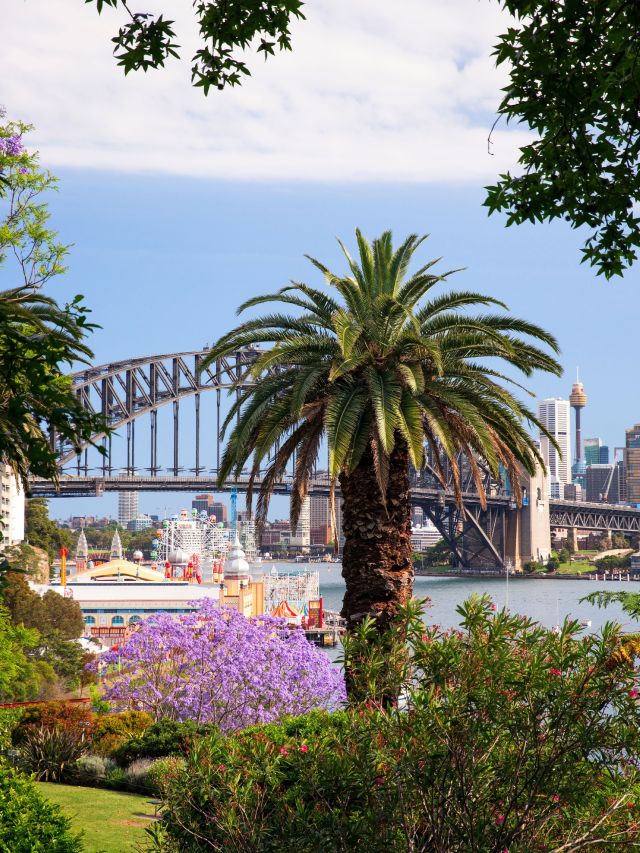
view of Lavender Bay with jacarandas in the spring
Sydney is taken over by purple in spring. (Image: Destination NSW)

Endemic to South America, the first jacaranda specimens were sent to British shores by Botanist Alan Cunningham from Rio de Janeiro. They were planted in Kew Gardens in 1818, and one theory of how they got into Australia is that they were brought from these very gardens during colonisation. But it’s also possible Cunningham himself brought them here during his later postings.

So, who got the first jacaranda tree in Australia? Brisbane claims the titles with its earliest tree being planted in 1864, but records show that the Sydney Botanic Garden jacaranda is dated to about 1850. Not to mention, jacarandas were listed for sale around Sydney in 1861. Sorry, Brisbane.

1. Grafton, NSW
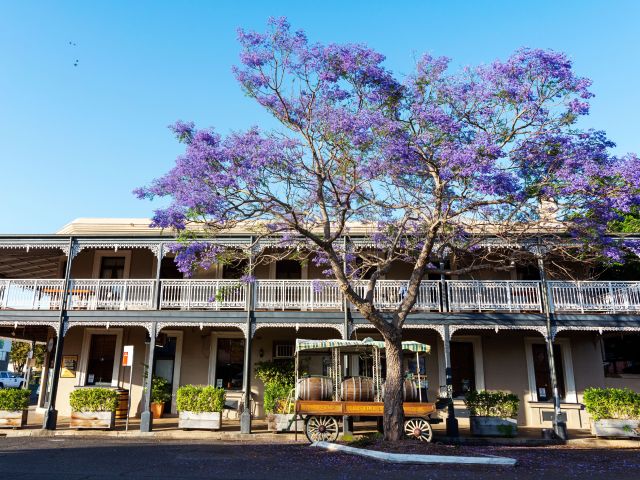
Jacarandas Grafton Roches Family Hotel
Grafton is arguably Australia’s most famous destination for jacaranda trees. (Image: My Clarence Valley)

It would be remiss not to start with Grafton, arguably Australia’s most famous destination for jacaranda trees and home to the Jacaranda Festival, which turns 90 this year (making it the country’s longest-running floral festival). Join in long lunch events, stay after dark to see the purple trees in lights, learn from the three Traditional Custodians of the Clarence Valley and bring the kids for plenty of family-friendly events.

2. Sydney, NSW
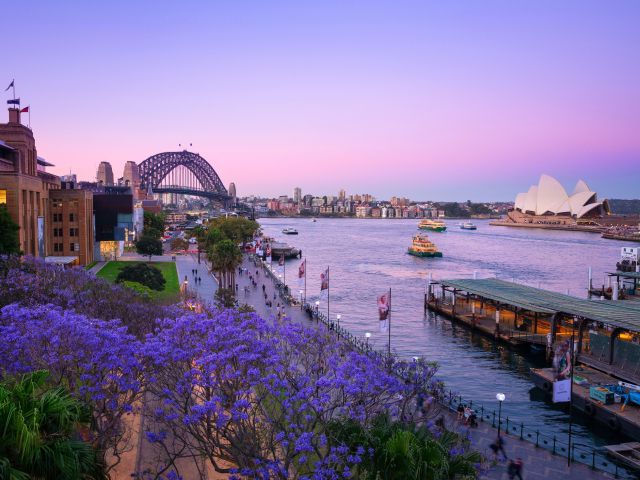
view of Circular Quay from The Rocks with jacarandas in the spring
Sydney is awash with purple as it dusts off the chill of winter. (Image: Destination NSW)

It’s hard to avoid jacaranda trees in Sydney, the city is awash with purple as it dusts off the chill of winter. Inner-city areas like Circular Quay and The Rocks, Paddington and Kirribilli are all very popular photo spots and tend to provide beautiful Harbour Bridge and city or sandstone backdrops for the trees. Lavender Bay, Hunters Hill and the lower North Shore also put on a show, though they’re harder to get around if you’re relying on public transport. The University of Sydney has a beautiful campus already, and it becomes dotted with purple each year.

The Inner West joins in the show, especially around Camperdown, Newtown and Glebe. Out west, Parramatta isn’t to be outdone, especially around the popular River Walk. A little further afield of the city, Argyle Street in Camden is popular for jacaranda photos, as is Macarthur.

3. Brisbane, Qld
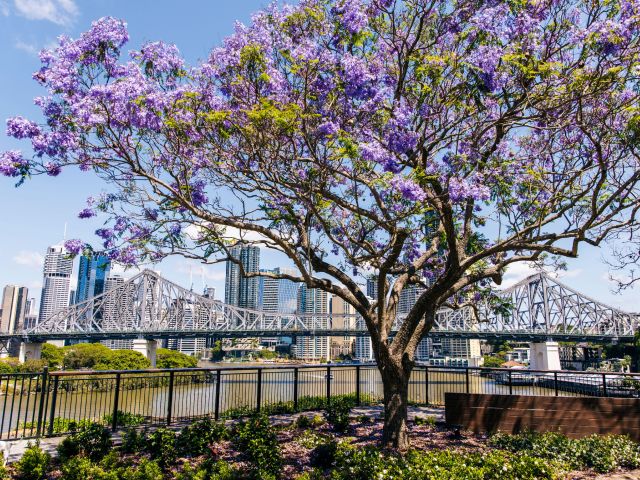
Jacaranda at Brisbane's Wilsons Lookout
Jacarandas can be spotted all around Brisbane. (Image: Tourism and Events Queensland)

Queensland’s capital has proven itself to be just as jacaranda happy as its southern counterpart. The first stop for those hoping to see jacarandas must be Brisbane City Botanic Gardens. In fact, this is where the state’s first Jacaranda tree was planted, in 1864 (as we know, Queensland does claim this is the first in Australia, but it seems unlikely). It was blown down by weather events, but these days, plenty bloom in its place.

Also around the city, the University of Queensland campus, Princess Street in the CBD, Goodna and New Farm all fill with a purple haze. While the Dockside walk at Kangaroo Point is the perfect way to enjoy these trees, Yeronga even has an aptly named Jacaranda Park.

If you have the time (and you should make time), Leis Park in Lawnton is an hour out of the CBD and doesn’t play with its jacaranda display, while sipping local wine and looking out at a purple Mt Tamborine is pretty spectacular.

4. Melbourne, Vic
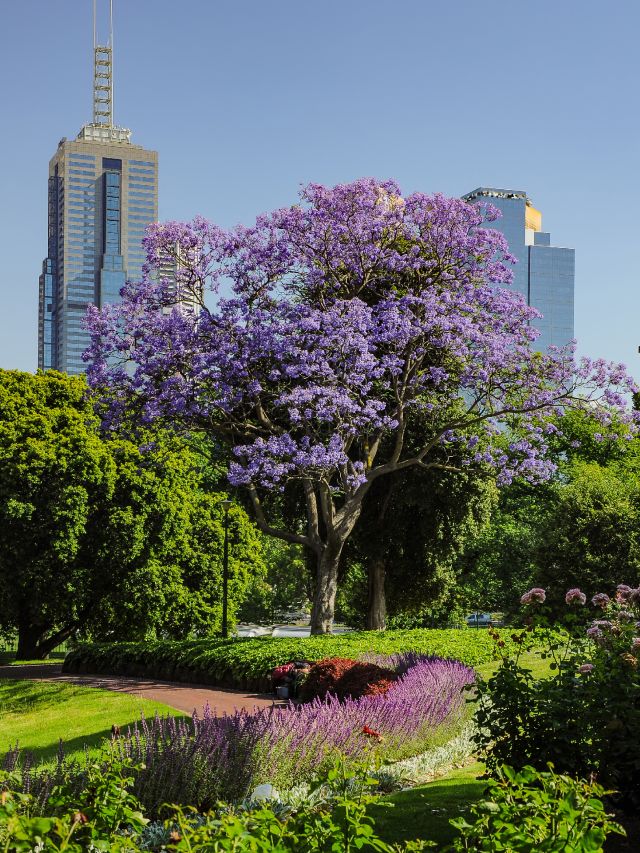
Jacaranda tree in Park in Melbourne
See jacarandas dot Melbourne Royal Botanic Gardens in spring. (Image: Getty Images / Zoya Avenirovna)

Melbourne may already draw crowds keen to sip its world-renowned coffee while they gaze at its plentiful and colourful street art. But come spring, there’s one more, purple, reason to visit. Head to the Royal Botanical Gardens to wander through a range of stunning florals, see jacarandas against the historic sandstone Parliament House and the University of Melbourne buildings, or drive a little further out of the CBD to see the impressive display in Fitzroy North’s Edinburgh Gardens.

5. Perth, WA
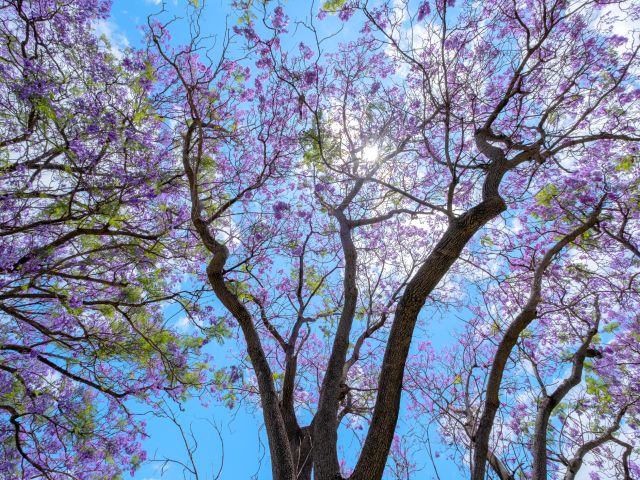
Beautiful Jacaranda trees are reaching out to sky on a sunny blue sky day, Perth, Australia
Perth is not to be left out in the jacaranda season. (Image: Getty Images / Hideaki Edo)

Home to another jacaranda festival, Perth is not to be left out in the jacaranda season. Head to Applecross for the annual Rotary Jacaranda Festival to find stalls and live entertainment to celebrate these beauties, as well as all things community. Elsewhere around the capital, Highgate, Inglewood and Marlborough Street in East Perth all present photo opportunities. While Old Jacaranda Way in Subiaco is famous for these trees, it was even named after them.

6. Adelaide, SA
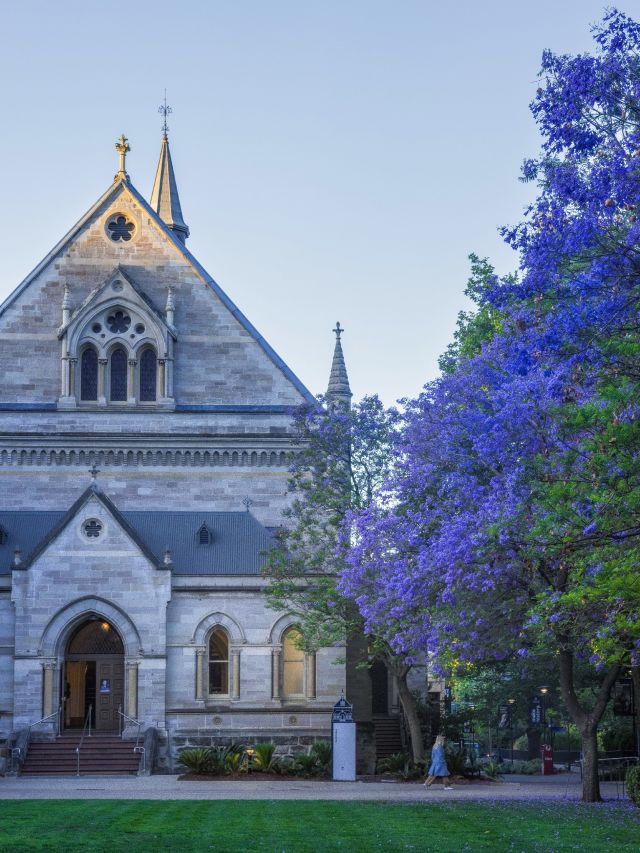
Jacarandas in Adelaide North Terrace
Seek out jacarandas in Adelaide. (Image: Michael Waterhouse Photography)

Perhaps not as filled with these purple trees as other capital cities, you’ll still find a decent smattering of purple all around the Adelaide CBD, as we as throughout the suburbs of Goodwood, Blair Athol, Blackforest, Beulah Park, Clarence Gardens and Clarence Park.

7. Southeast Queensland
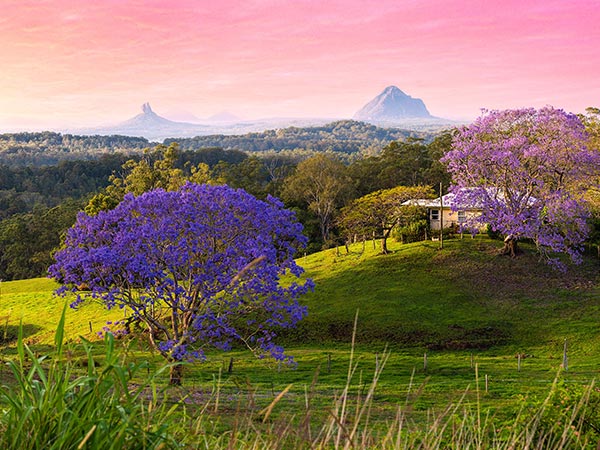
a jacaranda tree in bloom in front of glasshouse mountains queensland
View jacarandas and the usual stunning view from the Mary Cairncross Scenic Reserve lookout.

The Glasshouse Mountains in Sunshine Coast’s hinterlands, seen from the lookout by Mary Cairncross Scenic Reserve, are a stunning sight year-round, but over spring, when the foreground becomes dotted with purple jacaranda flowers, the colour palette becomes unbeatable. A quaint country town, Boonah, also has a reputation for its purple blooms (and its world heritage-listed surrounds), and the adorable Scenic Rim Farm Shop & Cafe sits in the shade of a giant jacaranda. Here, you can taste an ever-changing menu that champions local ingredients, and a particularly popular range of house-made cakes.

8. Herberton, Qld
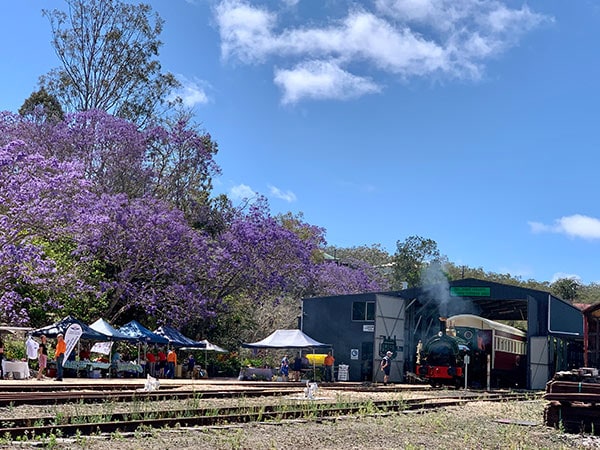
train and stalls at Herberton Jacaranda Festival in queensland
Head to Herberton in October for the Jacaranda Festival.

Further north, near Atherton and its famous Tablelands in Tropical North Queensland, Herberton also puts on a seasonal festival . During October, one weekend is filled with live music, entertainment, food trucks and even competitions, all in the name of jacaranda trees.

Kassia Byrnes
Kassia Byrnes is the Native Content Editor for Australian Traveller and International Traveller. She's come a long way since writing in her diary about family trips to Grandma's. After graduating a BA of Communication from University of Technology Sydney, she has been writing about her travels (and more) professionally for over 10 years for titles like AWOL, News.com.au, Pedestrian.TV, Body + Soul and Punkee. She's addicted to travel but has a terrible sense of direction, so you can usually find her getting lost somewhere new around the world. Luckily, she loves to explore and have new adventures – whether that’s exploring the backstreets, bungee jumping off a bridge or hiking for days. You can follow her adventures on Instagram @probably_kassia.
See all articles
hero media

7 Kimberley experiences that need to be on your bucket list

From thundering waterfalls to ancient Indigenous art, Kimberley’s raw beauty will take your breath away.

Wild, pristine, and shaped by nature, the Kimberley Coast is one of Australia’s most spectacular landscapes. A remote and rugged frontier that remains a bucket list destination for many travellers. Its most breathtaking attractions – including Montgomery Reef, King George Falls and Horizontal Falls – are accessible only by sea or air, making a guided expedition cruise aboard Silversea’s luxury expedition ship, Silver Cloud, the ideal way to explore it.

From its intricate intertidal zones to ancient rock art, extreme tides and rare wildlife found nowhere else in Australia – or the world – this journey offers an unparalleled exploration of one of Earth’s last true wildernesses.

Why Silversea?

Silversea offers a 10-day expedition departing Broome, or an extended 16-day expedition voyage from Indonesia, including landings on the hidden gems of Palopo Sulawesi and Komodo. Accompanied by expert guides and specialists in marine biology, history and geology, guests gain a deeper understanding of the Kimberley’s dramatic landscapes, rich cultural heritage and extraordinary biodiversity.

Silversea offers one of the experiential travel industry’s leading crew-to-guest ratios. Along with all-suite accommodation (80 per cent with private verandah), 24-hour butler service, a swimming pool and four dining options. Silver Cloud also has an experienced crew of multilingual expedition guides and specialists in marine biology, history and geology to enhance your Kimberley Experience.

silversea cruise ship pool deck
Take a dip in the pool deck.

1. Koolama Bay

​​Before visitors see King George Falls, they hear them – a growing rumble in the distance, steady and foreboding as the Zodiac glides through the gorge, the sound echoing off sheer rock formations. At 80 meters tall, the twin cascades carve through the red cliffs, churning the waters below in a spectacular finale – but Koolama Bay holds secrets beyond its striking scenery.

Named after a ship that beached here following an aerial attack by Japanese bombers in World War II, the bay may seem desolate, yet it teems with life. With Silversea’s expert guides on their 10-day Kimberley itinerary, guests gain a sharper eye for its hidden wonders – rock wallabies darting across the cliffs, crocodiles lurking among dense green mangroves, and high above, the silhouette of a bird of prey circling the sky.

King George Falls at koolama bay excursion on Silversea Kimberley Cruise
Take a shore excursion to see King George Falls.

2. Freshwater Cove / Wijingarra Butt Butt

Connect with Country on a wet landing at Freshwater Cove, also known as Wijingarra Butt Butt. Considered one of the most special experiences on both the 16-day and 10-day Kimberley cruises, Silversea guests are welcomed by the traditional Indigenous custodians of the land, painted with traditional ochre, and invited to take part in a smoking ceremony.

Located on the mainland near Montgomery Reef, Wijingarra Butt Butt holds deep cultural significance to the local Indigenous community. Here, rock formations along the shore represent spiritual ancestors, and guests are guided to a nearby rock overhang filled with ancient art, where traditional owners share the stories and meaning behind these sacred paintings.

welcome to country on freshwater cove during silversea kimberley cruise
Take part in a smoking ceremony. (Image: Tim Faircloth)

3. Vansittart Bay (Jar Island)

Modern history, ancient culture and mystery converge in Vansittart Bay, which is also known as Jar Island. Here, the first thing to catch the eye is the dented, silver fuselage of a World War II-era C-53 plane – a striking relic of the past. Yet, the true cultural treasures lie just a short hike away where two distinct styles of Indigenous rock art – Gwion Gwion and Wandjina – can be found.

The Wandjina figures, deeply connected to Indigenous traditions, stand in stark contrast to the enigmatic Gwion Gwion (Bradshaw) paintings, which date back more than 12,000 years. Significantly different in form and style, the two different styles create a striking juxtaposition, offering a rare glimpse into the region’s rich and complex past.

aerial view of Vansittart Bay, See it in you Silversea Kimberley Cruise.
Explore ancient Gwion Gwion rock art at Vansittart Bay. (Image: Janelle Lugge)

4. Horizontal Falls

Part illusion, part natural phenomenon, the Kimberley’s much-lauded Horizontal Falls aren’t a waterfall, but a tidal and geographic spectacle that visitors have to see to comprehend. Known as Garaanngaddim, the phenomenon occurs when seawater rushes through two narrow gaps- one just twenty metres wide, and the other seven metres in width, between the escarpments of Talbot Bay.

With each tidal shift,  the force of the water creates whirlpools, furious currents and the illusion of a horizontal cascade as thousands of gallons of water are pushed and pulled in through the gap every six hours with relentless movement, making this one of the Kimberley ’s most mesmerising natural wonders.

Horizontal Falls are described as "One of the greatest wonders of the natural world". They are formed from a break in-between the McLarty Ranges reaching up to 25m in width. The natural phenomenon is created as seawater builds up faster on one side of the gaps than the other, creating a waterfall up to 5m high on a King tide.
Watch whirlpools and furious currents collide. (Image: Janelle Lugge)

5. Montgomery Reef

As the tide turns in Montgomery Reef, magic happens. With the Kimberley’s legendary tides varying up to ten metres, at low tide the submerged reef almost appears to rise from the depths: exposing up to four metres of the sandstone reef.

The impact is otherworldly: as the water drains, waterfalls cascade on either side of the channel,  turtles left exposed scramble and dive, and fish leap in search of sanctuary in shallow pools. Meanwhile, the dinner bell rings for the migratory seabirds dugongs, reef sharks and dolphins that scavenge and feast in the area.

Using zodiacs, guests cruise through one of the world’s most significant inshore reef systems navigated by experienced guides, exploring the most intricate and fascinating parts of a 300-square-kilometre-wide biodiversity hotspot.

aerial view of boat going along Montgomery Reef
Witness seabirds, dolphins and reef sharks on the hunt.

6. Mitchell Falls by Helicopter

Experiencing the Kimberley by sea allows you to feel the power of the tides, but travelling by helicopter reveals the sandstone tapestry of the Kimberley, a landscape geologists believe is over 1.8 billion years old.

One of Silversea’s most popular optional excursions , guests who opt to fly into the interior from the onboard helipad soar up above the rust-coloured landscape of the Mitchell plateau, taking in one of Australia’s most scenic waterfalls: Mitchell Falls, a series of four emerald-coloured pools gently cascades into each other, before plunging down to the river below.

Seeing the landscape from above reveals a landscape weaved and shaped by the power of the freshwater wet season, juxtaposed to the constant lapping of the relentless and powerful tide on the coast.

aerial view of mitchell falls on silversea helicopter excursion
See emerald pools cascade into the river below. (Image: Tim Faircloth)

7. Indigenous Art Caves, Wandjina Art

The Kimberley Region of Western Australia is home to some of the most striking and significant

Indigenous rock art in Australia. Dotted throughout the landscape are caves, cliffs and rock overhangs depicting the striking, ethereal image of Wandjina, the rainmaker spirit and creation being central to many of the Dreamtime stories in this region.

Some of the paintings are regularly repainted by traditional custodians, while others are believed to be over 4,000 years old. Each artwork serves as both a cultural record and a living connection to the past, offering a rare opportunity to engage with the enduring traditions of the Kimberley’s Indigenous communities.

Freshwater Cover Rock Art the kimberleys
Walk among cultural records preserved in stone. (Image: Tim Faircloth)

See the best of this incredible part of the world on a Silversea Kimberley cruise. Book your 10- or extended 16-day expedition voyage at silversea.com