Everything you need to know about Australia’s Big Banana

hero media
You could say it is almost a rite of passage for Aussie families on their annual road trip to make a pitstop at the Big Banana in Coffs Harbour on their way up or down the east coast of Australia, but why do we love the oversized fruit so much?

In 1995, the Big Banana – arguably our most renowned Big Thing – was voted the most bizarre and grotesque tourist attraction in the world by 200 globetrotting young Australians, edging out the Big Pineapple at Nambour and the Giant Penis seat in Amsterdam’s Sex Museum. It might not be everyone’s idea of a tourist attraction, but there is more to the Big Banana than meets the eye.

The size of the Big Banana

Builder Alan Harvey began work on the 13m long, 5m high, 2.4m wide banana in September 1964 and had it finished in just three months, allowing the impressive-looking timber-framed, lurid yellow ferroconcrete structure to open just in time for Christmas.

Many people think the Big Banana has shrunk, secretly replaced by a smaller version a few years ago. “We did move the banana a few metres forward and a metre or so higher in 1995 to give it better visibility from the Pacific Highway, but it definitely hasn’t shrunk," says Rubie (the previous owner). “It’s just that people who come back to visit have grown up."

What to do at the Big Banana

No mere monstrous foodstuff, today the Big Banana is an educational resource and home to a myriad of banana-based recreational and cuisine delights that attract well over one million visitors each year.

Shop banana products and souvenirs

You can buy a bewildering bevy of banana products including fresh bananas, dried bananas, chipped bananas, banana jams, banana chutneys and banana pickles, choc-coated frozen bananas, banana splits, banana cake, banana muffins and banana smoothies.

You can go on a real banana bender in the souvenir shop, which boasts hundreds of balmy banana products, from the practical to the bizarre to the tasteless. Our favourites are the four different varieties of fridge magnets and the Big Banana water pistol.

Big Banana Souvenirs
You can pick up a souvenir to commemorate your visit to the Big Banana.

Cool off at the Water Park

The Water Park boasts 7 slides, including open-body slides, two-person tube slides and a 45-degree Kamikaze slide for thrill seekers. For the younger crowd, they have two inflatable slides and a kids’ water play area with a tower, 3 additional kids’ slides, interactive water jets, toys and a tipping bucket. A family ticket for two adults and two kids is $66.

Go on the rides at the Big Banana Fun Park

The Big Banana’s indoor Giant Slide is the biggest slide of its kind in Australia, with 6 lanes, each 83 metres long and standing at 17.5 metres tall, this is not for the faint-hearted. The competitive among us can race their loved ones down the slide with an interactive scoring system to report back who was the quickest. Prices start at $7 for two slides.

The 4D Ride Simulator gives visitors the choice between four films, including Moon Thunder, Dino Safari 2, Canyon Coaster and Wild West Mine Ride. Prices start at $8 for a single ride.

The Toboggan Ride runs wraps around the park for over half a kilometre, with views of the Pacific Ocean visible as you hug the turns and navigate your way around the track to the finish line. Prices start at $7.

You can also take a spin on the Ice Skating Rink, play a game of mini golf and fight it out in a round of Laser Tag.

Kids on Toboggan ride at the Big Banana
The toboggan is one of many rides at the Big Banana.

History of the Big Banana

American entomologist John Landi loved Australia so much while on a six-month research trip in 1962 that he and his wife, Betty, decided to emigrate and purchased a five-hectare banana plantation at Macauley’s Headland, just north of Coffs Harbour.

Inspired by a large pineapple he had seen on top of the Dole Cannery in Hawaii, Landi figured a similarly bewitching banana would help promote sales at his roadside fruit stall. The local chapter of the Banana Growers Federation thought it was such a good idea they agreed to meet half the construction costs and the Big Banana opened in December 1964.

In 1968 Landi sold his share of the business to his partner John Enevoldson, who kept it until 1988, when it was purchased by local entrepreneur Bob Johnson. Johnson acquired adjoining properties and undertook a $30 million redevelopment of the complex, turning it into a showcase for horticultural education. However, it all went pear-shaped, and Kevin Rubie and his wife Marie bought the complex from administrators in 1993. The couple went on to develop the Big Banana into more of a fun park by adding in the Wiegand Family Toboggan Ride in 1996 and the Ice Skating Rink in 1999.

The Rubie family and the development company Village Building Co. became joint venture partners in 2005. The partnership resulted in the addition of The World of Bananas Theatre and Tour experience, the Laser Tag arena, a three-hole Mini Golf Course and the biggest Water Park between Sydney and the Gold Coast. As of December 2016, Village Building Co. became the sole owner of the Big Banana Fun Park after purchasing the remaining share of the business from Kevin and Marie Rubie.

Big Banana
The Big Banana was constructed in the 1960s.

The Big Banana details

How to get there: The Big Banana is a five and a half hour’s drive from Sydney via the M1 and Pacific Highway, four and a half hours drive from Brisbane. You can fly from Sydney and Brisbane with Qantas, Tiger Air or Virgin.

Address: Pacific Highway, 3  kilometres north of Coffs Harbour, NSW

Contact: Phone: (02) 6652 4355

 This is an edited extract from Big Things: Australia’s Amazing Roadside Attractions by David Clark published by Penguin Books, rrp $24.95.

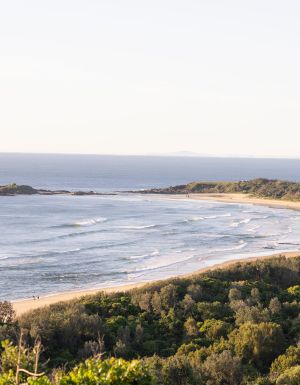
Are you planning a road trip along Australia’s northeastern coast this year? Make sure you read our guide to where to eat, sleep and stay on the NSW North Coast.
hero media

8 ways to discover a new side of Port Stephens

Aussies might think they know what Port Stephens is all about – but it’s time to take another look.

You might’ve driven through this NSW coast town. Maybe even stopped for fish and chips or a quick dip. But spend a long weekend in the new Port Stephens , and you’ll seriously regret not doing it sooner. We’re talking treks across beaches, reef dives and up-close time with rescued koalas.

All in all? It only takes a day before you see Port Stephens in a whole new light, and not much longer until it’s locked in as your favourite family destination.

1. Stockton Sand Dunes

Port Stephens incredible Stockton Sand Dunes are the largest moving sand mass in the Southern Hemisphere. They shift like an endless magic trick across the Worimi Conservation Lands , a 4200-hectare coastal co-managed by the Traditional Owners.

Tear over them in a 4WD. Rev through valleys soft as melting ice cream on a quad. Carve down 30-metre slopes on a sandboard. However you choose to cross them, you’re guaranteed a seriously wild ride.

Four rugged 4WDs kick up trails of golden dust as they charge across the sweeping desert landscape.
Chase thrills across shifting sands. (Image: Destination NSW)

2. Scale Tomaree Head Summit Walk

A short climb through bushland opens up to the coastal drama of Tomaree Head . Spot Zenith, Wreck and Box Beaches. See the Fingal Island lighthouse and offshore rookeries where Australia’s rarest seabird, the Gould’s petrel, nests.

History buffs can’t miss the WWII gun emplacements. And if you’re hiking between May and November, bring binoculars. Travelling whales might just be breaching below.

Friends enjoying a scenic walk along the Tomaree Head Summit Walk in Tomaree National Park, Port Stephens.
Climb Tomaree Head for jaw-dropping coastal views. (Image: Destination NSW)

3. Watch out for whales

You’ve seen the spouts of migrating humpbacks and southern right whales from shore. Set sail from Nelson Bay to see them up close. Cruise straight into the action, with tail-slaps, barrel rolls and all.

And they’ve got competition from the local show-offs. Port Stephens bottlenose dolphins leap and play. Some tours even spot pudgy fur seals, spending lazy days soaking up the sun on Cabbage Tree Island.

A whale’s tail on the sea’s surface.
Watch for ocean tails. (Image: Destination NSW)

4. Port Stephens Koala Sanctuary

Pop into the Port Stephens Koala Sanctuary  to learn about the rescued koalas who climb, nap, snack and heal in this natural patch of bushland. Wander the immersive Sanctuary Story Walk to discover more about their habits, then head to the SKYwalk – a treetop platform constructed for spotting these eucalyptus-loving locals. Peek into the hospital’s viewing window, where sick or injured koalas may be resting in their recovery enclosures.

Not enough time around these adorable marsupials? Stay overnight in silk-lined glamping tents.

Koala sleeping in a tree at Port Stephens Koala Sanctuary, One Mile
See koalas in their natural habitat. (Image: Destination NSW)

5. Diving Port Stephens

Port Stephens has some of NSW’s best dive spots. At Fly Point, float through sponge gardens and coral castles thick with nudibranchs (AKA sea slugs). Halifax Park has blue gropers and crimson-banded wrasse, while Shoal Bay’s seagrass meadows hide pipefish, cuttlefish and octopus.

Accessible only by boat, Broughton Island is home to a vast array of marine (and bird) life. Snorkel with blue devilfish and stingrays at sites like The Looking Glass and North Rock. More experienced divers can head out with one of the many PADI-certified operators.

At nearby Cabbage Tree Island, expect to see shaggy-faced wobbegongs cruising along.

A couple suited up and ready to dive into adventure.
Suit up and dive into Port Stephens’ vibrant marine life. (Image: Destination NSW)

6. Irukandji Shark and Ray Encounters

Not quite ready to dive in? Irukandji Shark and Ray Encounters is the perfect way to spot local marine life without getting too deep. But there’s no obnoxious glass tank tapping here. Instead, this interactive aquarium allows guests to wade into natural-style lagoons that mimic the real thing.

Gently pat Port Jackson and bamboo sharks, hand-feed rays, and feel their sandpapery skin with your fingertips. It is all under expert guidance. If you want to go deeper, pop on a wetsuit and swim alongside tawny nurse sharks, white-tipped reef sharks and zebra sharks in the lagoon.

Family enjoying an animal feeding experience at Irukandji Shark and Ray Encounters, Anna Bay.
Meet the ocean’s friendliest faces at Irukandji. (Image: Destination NSW)

7. Fish the estuaries

Fishing fanatics will fall for Port Stephens hook, line and sinker. Here, one of the largest estuary systems in the whole state sees tidal rivers and mangrove ecosystems. Waterfronts are thick with oysters, and residential fish that might include anything from bream, whiting and flathead, to blue swimmer crabs, kingfish and longtail tuna.

If you prefer to choose your own adventure and fish offshore, you can hire a boat from one of the marinas and set your own course.

three men fishing on a boat in port stephens
Join a tour or chart your own fishing trip. (Image: Destination NSW)

8. Taste new Port Stephens flavours

With plenty of activity to fill your days, refuelling on delectable cuisine becomes equally important. And Port Stephens answers the call.

Pop into Holbert’s Oyster Farm for fresh-farmed Port Stephens rock oysters and Pacific oysters, Australian king and tiger prawns, as well as a variety of tasty sauces to try them with.

Take a group to Atmos for an authentic Greek experience over large shared dishes and Greek-inspired cocktails. Or feast on sea-to-plate, modern Australian dishes at the pet-friendly Restaurant 2317.

A plate of fresh oysters.
Slurp your way through the region’s best oysters. (Image: Destination NSW)

Start planning your Port Stephens getaway at portstephens.org.au .