The fascinating sinkholes in Mount Gambier to visit

hero media
Fancy a swim in a dazzling cobalt waterway, or a stroll around a lush, emerald wonderland? The famous Mount Gambier sinkholes can set the mood for every kind of adventure.

Reykjavik, Naples, Cartago; when you’re yearning to explore a dramatic volcanic landscape, there’s only one destination where the sinkholes – a depression caused by the collapse of the surface layer – are a celebration (particularly in the warmer months): Mount Gambier  on South Australia’s spectacular Limestone Coast.

Proving that good things are worth the wait, geologists believe that Mount Gambier’s (justifiably) famous sinkholes are the result of rain on the region’s three fault lines breaking up the huge expanse of limestone, more than 25 million years old, spanning South Australia’s south-east. Water flowing through the limestone has formed 50 sinkholes, with at least 15 of them filled with water.

So, when is the best time to take advantage of Mount Gambier’s sinkholes? While Mount Gambier itself is a treat to visit year-round, aqua babies are best to plan a trip in the warmer months, between November and March, when the water is less biting and the colour morphs from a hue which can fall anywhere from steel grey or garden variety blue to vibrant cobalt. The good news? Whether you hire a car and drive to each spot (easily done since most of the major holes are located within a 20-minute drive of one another) or book a tour, there’s the perfect sinkhole experience for every kind of traveller, including these tourism-heavy hitters.

Kilsby Sinkhole
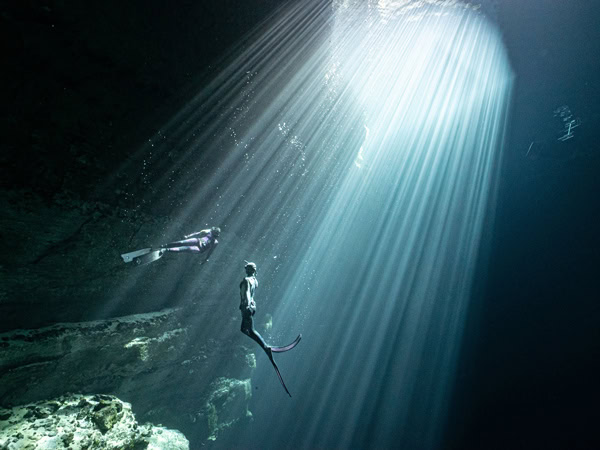
sunlight shines upon a diver underneath the Kilsby Sinkhole
Kilsby Sinkhole is a naturally occurring karst basin. (Image: Adam Stern)

Will it be snorkelling, scuba diving, free diving or a sinkhole tour of the training site for the South Australian Police? At Kilsby Sinkhole , located on a sheep farm among the rolling grasslands of Moorak just 14 kilometres south of Mount Gambier, you can choose all of the above.

Out here, where it’s not unusual for people to show up in mermaid outfits for the ultimate photoshoot, water clarity has drawn people to the site for decades, the giant chasm descending 65 metres and allowing up to 50 metres (most days) visibility for scuba drivers and freedivers, and pristine water clarity for those who prefer to frolic towards the surface. 50-minute guided tours cover the sinkhole’s fascinating history and geology – a real hit with the kids.
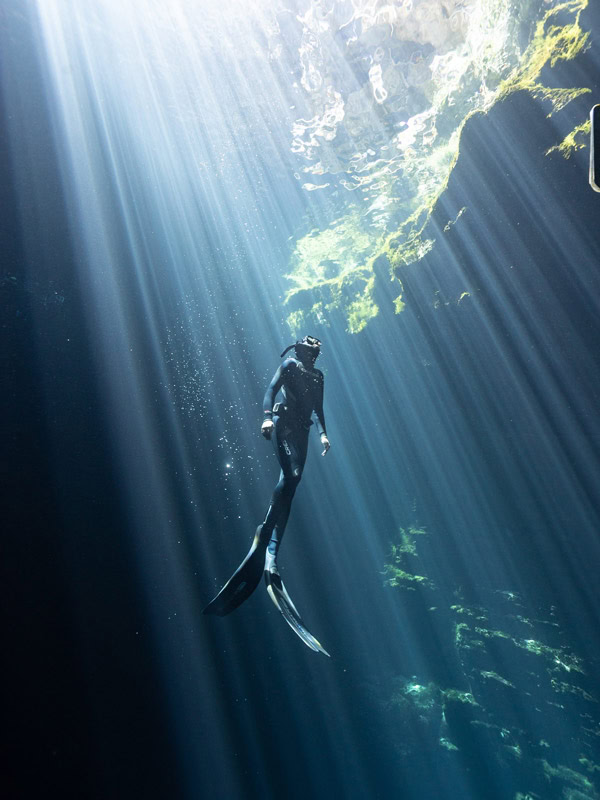
a diver facing the light as it passes through the water under Kilsby Sinkhole
It’s a stunning sight when the sun rises over Kilsby Sinkhole. (Image: Adam Stern)

Snorkelling tours run for two hours, complete with a safety briefing and under the supervision of a snorkel supervisor, while those interested in diving and freediving can book a licensed operator to help their dream come true.

Kilsby Sinkhole is a privately owned site, thus, all visits must be pre-booked online. The good news? They now offer a range of two-bedroom luxury villas at a surprisingly affordable price point, so you can take advantage of the sinkhole (and its surrounds) day after day.

Umpherston Sinkhole
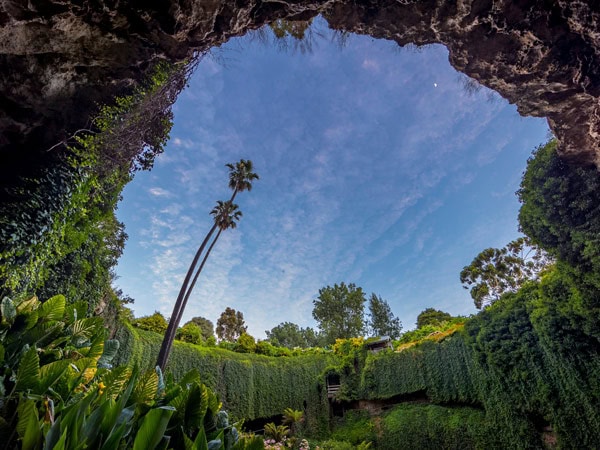
a large crater at Umpherston Sinkhole
Subaquatic flora grows abundantly in Umpherston Sinkhole. (Image: Offroad Images)

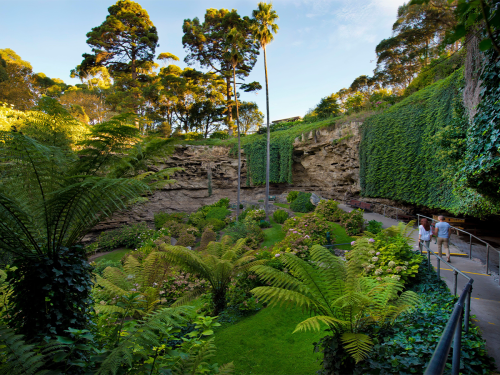
In the middle of Mount Gambier’s city streets, a lush, subterranean oasis blooms some 20 metres deep in a natural well providing cool respite for those who want to escape those blazing days, but don’t much fancy getting wet.

Named after its designer James Umpherston who designed this urban botanic garden in the late 1800s, Umpherston Sinkhole/Balumbul (one of the most photographed locations on the Limestone Coast) was once a cave formed through the dissolution of the limestone, becoming a sinkhole only after the top of its chamber collapsed and its topsoil provided the perfect environment on which flora to grow.
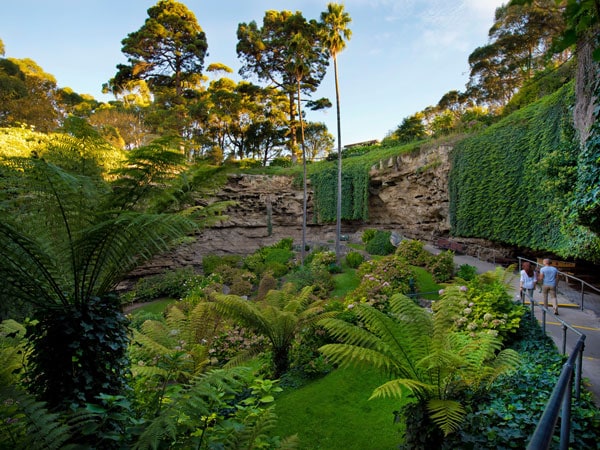
lush greenery at Umpherston Sinkhole
Stroll through the enchanting vines. (Image: South Australian Tourism Commission/Adam Bruzzone)

Now it’s best described as a gateway to a secret world filled with hanging vines and terraces, the depth and scale of which is best enjoyed from the viewing platforms before taking a walk down to the bottom to view the hydrangeas (but only after grabbing an ice cream or coffee from the onsite kiosk). Yep, at Umpherston Sinkhole, it’s all about walking and observing.

Beautiful any time of day, locals swear by a visit at dusk when the friendly locals, the Umpherston possums, come out to greet their visitors. Why not stick around and make use of the free barbecue area?

Little Blue Lake 
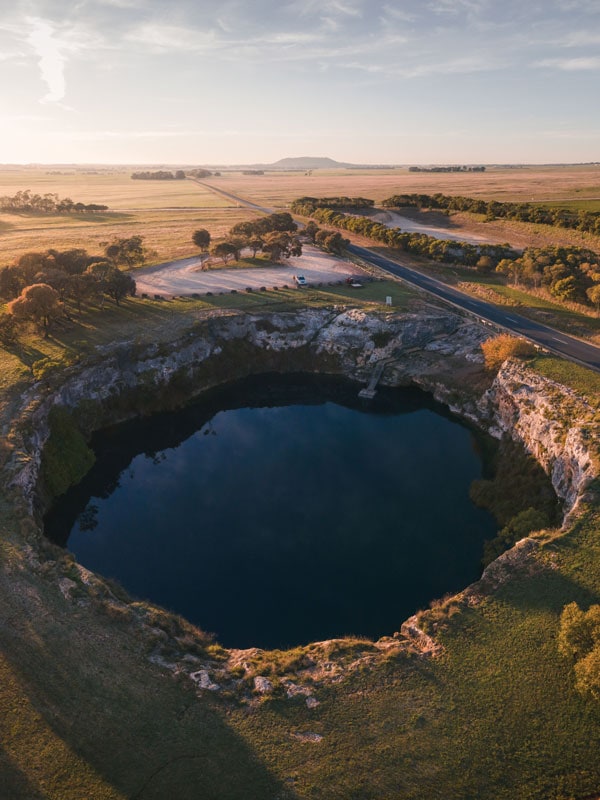
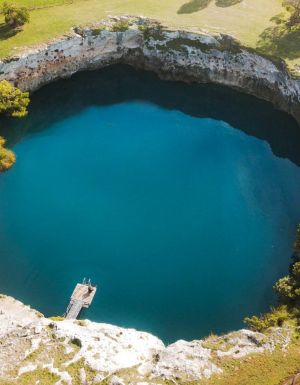
an aerial view of the Little Blue Lake sinkhole in Mount Gambier
Little Blue Lake is situated within a dormant volcanic crater. (Image: Thomas Cowey)

Disregard its name; Little Blue Lake is actually a sinkhole with a difference: the ability to change colour like a mood ring so that the steel grey it rocks throughout the winter months transforms into a vibrant cobalt blue come the summertime (November to March). It’s all thanks to a phenomenon caused by the formation of calcite crystals warmed by the rays of the sun.

Located in the Kanawinka volcanic area, wedged between the two (mercifully) dormant volcanoes of Mount Gambier and Mount Schank, follow the campervans making a line to Little Blue Lake, which is conveniently situated in a paddock by the highway.
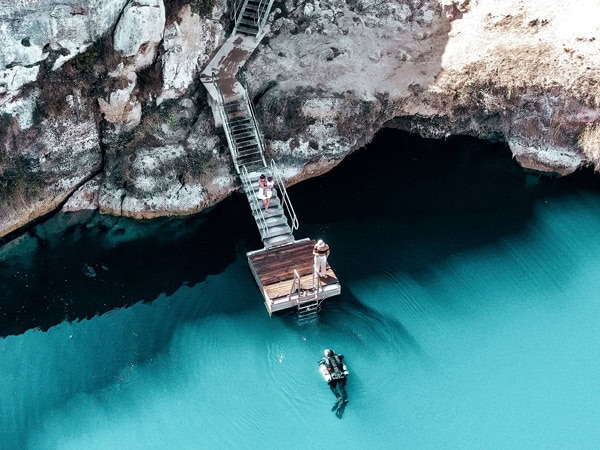
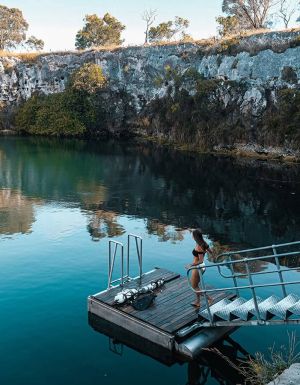
a diving platform above the milky turquoise waters of Little Blue Lake, Mount Gambier
Mount Gambier’s Blue Lake transforms into milky turquoise between November and March. (Image: Lucy Adamopoulos)

With a 47-metre depth, plus a diameter of 40 metres, the lake is what you might call bracing – a fact locals love and visitors quickly get used to as they enter the sinkhole via the stairs or ramp. Your best bet? Warm up beforehand or afterwards by lying out in the sun, or by enjoying a picnic (you’ll have to bring your own provisions). Just beware that there are no public amenities, so best to use the bathroom before you depart from your accommodation.

Got plenty of time in and around Mount Gambier up your sleeve and are keen to experience further sinkholes? Be sure to also put Ewens Ponds, Hell’s Hole and Caroline Sinkhole on your list.

Wanting to explore the rest of Mount Gambier? Follow our guide for awe-inspiring things to do in Mount Gambier.


Dilvin Yasa
Dilvin Yasa is a freelance journalist, author and TV presenter whose travels have taken her from the iceberg graveyards of Antarctica to the roaring rapids of Uganda. Always on the lookout for that next unforgettable meal, wildlife moment or 80s-themed nightclub, she is inexplicably drawn to polar destinations despite detesting the cold.
See all articles
hero media

7 Kimberley experiences that need to be on your bucket list

From thundering waterfalls to ancient Indigenous art, Kimberley’s raw beauty will take your breath away.

Wild, pristine, and shaped by nature, the Kimberley Coast is one of Australia’s most spectacular landscapes. A remote and rugged frontier that remains a bucket list destination for many travellers. Its most breathtaking attractions – including Montgomery Reef, King George Falls and Horizontal Falls – are accessible only by sea or air, making a guided expedition cruise aboard Silversea’s luxury expedition ship, Silver Cloud, the ideal way to explore it.

From its intricate intertidal zones to ancient rock art, extreme tides and rare wildlife found nowhere else in Australia – or the world – this journey offers an unparalleled exploration of one of Earth’s last true wildernesses.

Why Silversea?

Silversea offers a 10-day expedition departing Broome, or an extended 16-day expedition voyage from Indonesia, including landings on the hidden gems of Palopo Sulawesi and Komodo. Accompanied by expert guides and specialists in marine biology, history and geology, guests gain a deeper understanding of the Kimberley’s dramatic landscapes, rich cultural heritage and extraordinary biodiversity.

Silversea offers one of the experiential travel industry’s leading crew-to-guest ratios. Along with all-suite accommodation (80 per cent with private verandah), 24-hour butler service, a swimming pool and four dining options. Silver Cloud also has an experienced crew of multilingual expedition guides and specialists in marine biology, history and geology to enhance your Kimberley Experience.

silversea cruise ship pool deck
Take a dip in the pool deck.

1. Koolama Bay

​​Before visitors see King George Falls, they hear them – a growing rumble in the distance, steady and foreboding as the Zodiac glides through the gorge, the sound echoing off sheer rock formations. At 80 meters tall, the twin cascades carve through the red cliffs, churning the waters below in a spectacular finale – but Koolama Bay holds secrets beyond its striking scenery.

Named after a ship that beached here following an aerial attack by Japanese bombers in World War II, the bay may seem desolate, yet it teems with life. With Silversea’s expert guides on their 10-day Kimberley itinerary, guests gain a sharper eye for its hidden wonders – rock wallabies darting across the cliffs, crocodiles lurking among dense green mangroves, and high above, the silhouette of a bird of prey circling the sky.

King George Falls at koolama bay excursion on Silversea Kimberley Cruise
Take a shore excursion to see King George Falls.

2. Freshwater Cove / Wijingarra Butt Butt

Connect with Country on a wet landing at Freshwater Cove, also known as Wijingarra Butt Butt. Considered one of the most special experiences on both the 16-day and 10-day Kimberley cruises, Silversea guests are welcomed by the traditional Indigenous custodians of the land, painted with traditional ochre, and invited to take part in a smoking ceremony.

Located on the mainland near Montgomery Reef, Wijingarra Butt Butt holds deep cultural significance to the local Indigenous community. Here, rock formations along the shore represent spiritual ancestors, and guests are guided to a nearby rock overhang filled with ancient art, where traditional owners share the stories and meaning behind these sacred paintings.

welcome to country on freshwater cove during silversea kimberley cruise
Take part in a smoking ceremony. (Image: Tim Faircloth)

3. Vansittart Bay (Jar Island)

Modern history, ancient culture and mystery converge in Vansittart Bay, which is also known as Jar Island. Here, the first thing to catch the eye is the dented, silver fuselage of a World War II-era C-53 plane – a striking relic of the past. Yet, the true cultural treasures lie just a short hike away where two distinct styles of Indigenous rock art – Gwion Gwion and Wandjina – can be found.

The Wandjina figures, deeply connected to Indigenous traditions, stand in stark contrast to the enigmatic Gwion Gwion (Bradshaw) paintings, which date back more than 12,000 years. Significantly different in form and style, the two different styles create a striking juxtaposition, offering a rare glimpse into the region’s rich and complex past.

aerial view of Vansittart Bay, See it in you Silversea Kimberley Cruise.
Explore ancient Gwion Gwion rock art at Vansittart Bay. (Image: Janelle Lugge)

4. Horizontal Falls

Part illusion, part natural phenomenon, the Kimberley’s much-lauded Horizontal Falls aren’t a waterfall, but a tidal and geographic spectacle that visitors have to see to comprehend. Known as Garaanngaddim, the phenomenon occurs when seawater rushes through two narrow gaps- one just twenty metres wide, and the other seven metres in width, between the escarpments of Talbot Bay.

With each tidal shift,  the force of the water creates whirlpools, furious currents and the illusion of a horizontal cascade as thousands of gallons of water are pushed and pulled in through the gap every six hours with relentless movement, making this one of the Kimberley ’s most mesmerising natural wonders.

Horizontal Falls are described as "One of the greatest wonders of the natural world". They are formed from a break in-between the McLarty Ranges reaching up to 25m in width. The natural phenomenon is created as seawater builds up faster on one side of the gaps than the other, creating a waterfall up to 5m high on a King tide.
Watch whirlpools and furious currents collide. (Image: Janelle Lugge)

5. Montgomery Reef

As the tide turns in Montgomery Reef, magic happens. With the Kimberley’s legendary tides varying up to ten metres, at low tide the submerged reef almost appears to rise from the depths: exposing up to four metres of the sandstone reef.

The impact is otherworldly: as the water drains, waterfalls cascade on either side of the channel,  turtles left exposed scramble and dive, and fish leap in search of sanctuary in shallow pools. Meanwhile, the dinner bell rings for the migratory seabirds dugongs, reef sharks and dolphins that scavenge and feast in the area.

Using zodiacs, guests cruise through one of the world’s most significant inshore reef systems navigated by experienced guides, exploring the most intricate and fascinating parts of a 300-square-kilometre-wide biodiversity hotspot.

aerial view of boat going along Montgomery Reef
Witness seabirds, dolphins and reef sharks on the hunt.

6. Mitchell Falls by Helicopter

Experiencing the Kimberley by sea allows you to feel the power of the tides, but travelling by helicopter reveals the sandstone tapestry of the Kimberley, a landscape geologists believe is over 1.8 billion years old.

One of Silversea’s most popular optional excursions , guests who opt to fly into the interior from the onboard helipad soar up above the rust-coloured landscape of the Mitchell plateau, taking in one of Australia’s most scenic waterfalls: Mitchell Falls, a series of four emerald-coloured pools gently cascades into each other, before plunging down to the river below.

Seeing the landscape from above reveals a landscape weaved and shaped by the power of the freshwater wet season, juxtaposed to the constant lapping of the relentless and powerful tide on the coast.

aerial view of mitchell falls on silversea helicopter excursion
See emerald pools cascade into the river below. (Image: Tim Faircloth)

7. Indigenous Art Caves, Wandjina Art

The Kimberley Region of Western Australia is home to some of the most striking and significant

Indigenous rock art in Australia. Dotted throughout the landscape are caves, cliffs and rock overhangs depicting the striking, ethereal image of Wandjina, the rainmaker spirit and creation being central to many of the Dreamtime stories in this region.

Some of the paintings are regularly repainted by traditional custodians, while others are believed to be over 4,000 years old. Each artwork serves as both a cultural record and a living connection to the past, offering a rare opportunity to engage with the enduring traditions of the Kimberley’s Indigenous communities.

Freshwater Cover Rock Art the kimberleys
Walk among cultural records preserved in stone. (Image: Tim Faircloth)

See the best of this incredible part of the world on a Silversea Kimberley cruise. Book your 10- or extended 16-day expedition voyage at silversea.com