6 stunning waterfalls near Daylesford

hero media
Don’t just imagine the perfect outdoor adventure exploring waterfalls near Daylesford. Make it happen!

Daylesford and its vastly beautiful surrounds play host to some of the most spectacular waterfalls in country Victoria. The positively charged energy that permeates from Mother Nature’s mega water fountains is truly astounding. It’s safe to say that anyone who witnesses these waterfalls up close will feel it.

Note: Please check the Parks Victoria  website for safety updates and closures before you embark on visiting any of the below waterfalls.

1. Trentham Falls

Distance from Daylesford: 18-minute drive
Where:
Coliban River Scenic Reserve
Parking:
Yes
Difficulty:
Easy
Swimming:
No

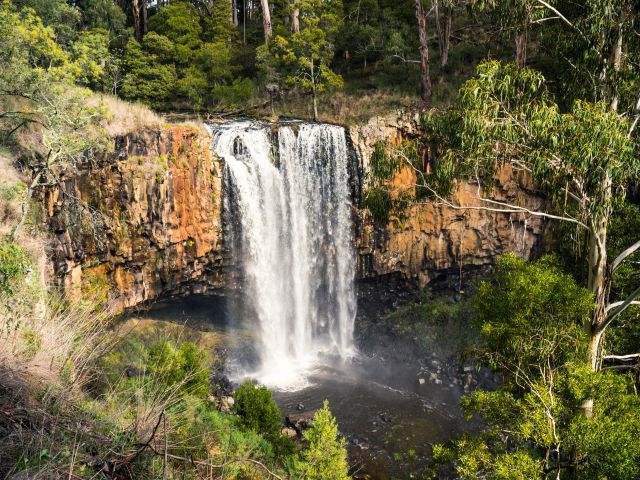
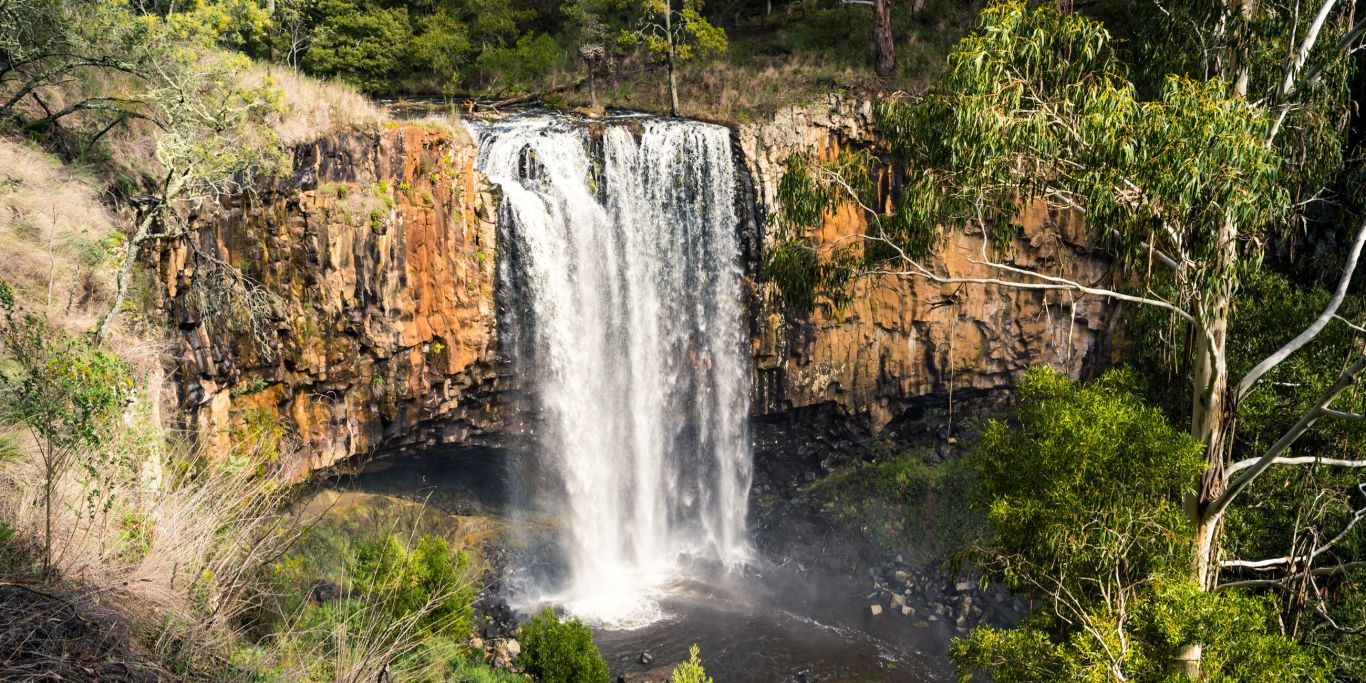
Trentham Falls is one of Victoria’s longest single-drop waterfalls! Towering 32 metres high, the water heaves over impressive basalt rock structures. Upon arrival (it’s just a short, easy walk from the car park to the viewing platform) you can straight-up expect a breathtaking experience.

Watching the rapid force of natural hydropower in action is phenomenal. Note: there’s no access to the top or bottom of the falls as the cliffs are unstable – it’s best to stay safe on the platform and designated walking track.

the Trentham Falls in Coliban River Scenic Reserve
Trentham Falls drops from a 32-metre-high basalt cliff.

Trentham Falls form part of an Aboriginal cultural landscape in the traditional Country of the Dja Dja Wurrung Peoples. Overall, it’s one of the most magical waterfalls near Daylesford! Put it on your must-see central Victorian natural attractions list ASAP.

2. Stanley Park Waterfall

Distance from Daylesford: 46-minute drive
Where: Mount Macedon
Parking: Yes
Difficulty: Easy to Moderate
Swimming: No

This is such a cool (literally and metaphorically) little waterfall in the Mount Macedon region. So, it’s best to visit in the middle of the day and catch the sun’s rays splitting over the falls. The vertical drop is approximately 5-10 metres long, depending on the power of the water pushing through from the Turtiable Creek source. We love the sheltered BBQs here for visitor use, plus the kid’s playground and dogs are welcome on a lead too. The most reliable time to see the falls in all their glory is during winter/spring but if there’s been recent rainfall you can get lucky in summer/autumn too.

3. Sailors Falls

Distance from Daylesford: 7-minute drive
Where: Sailors Falls
Parking: Yes
Difficulty: Easy to moderate
Swimming: Yes

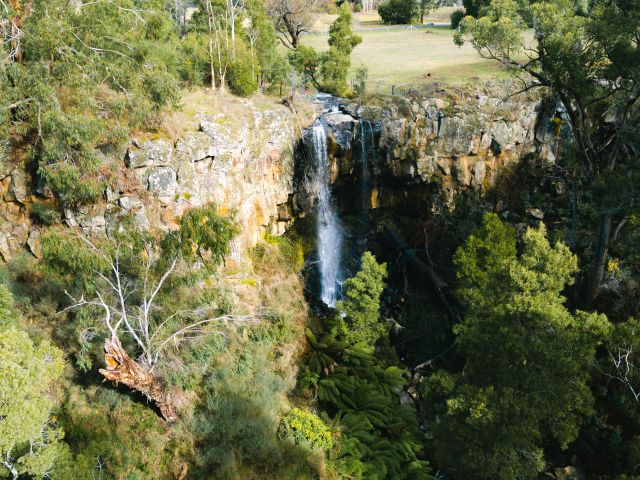
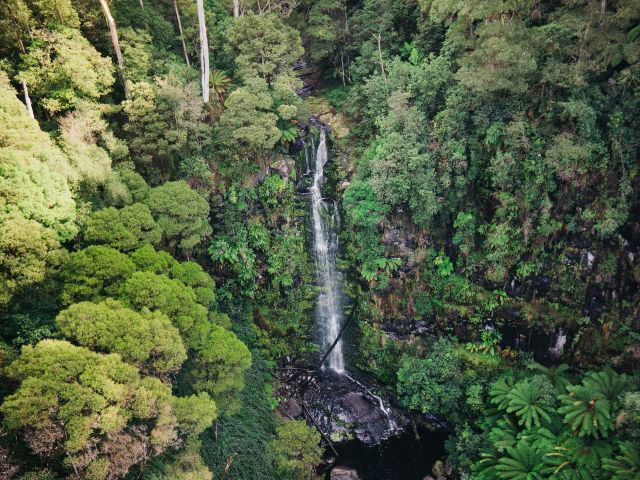
Waterfalls and mineral springs in one place, yes, please. It’s a super accessible, almost roadside spot too. All you must do is take a lovely stroll along the forest-lined walkway and be greeted by the amazing scenery at Sailors Falls.

an aerial view of Sailors Falls, Hepburn Springs, Daylesford
Sailors Falls drops into a lush, fern-lined gully.

There’s a 1.37-kilometre loop track that takes about 30 minutes to walk and offers up mesmerizing views if getting up close and personal with nature is your thing or simply relax at the lookout (which is wheelchair and pram friendly) adjacent to the picnic area. Feeling thirsty? There are two mineral spring taps about, one at the start in the car park area and another along the walking track.

two women admiring the Sailors Falls, Hepburn Springs, Daylesford
Gaze at the stunning Sailors Falls in Hepburn Springs, Daylesford.

History buffs take note, gold was first discovered in this area way back in 1851 and with that, an influx of fossickers and their families arrived. Sailors Falls became (and remains) a popular spot for picnics.

a stunning view of Sailors Falls, Hepburn Springs, Daylesford
Sailors Falls is located just south of Daylesford.

4. Loddon Falls

Distance from Daylesford: 14-minute drive
Where: Glenlyon
Parking: Yes. Accessible by all vehicles in dry weather and by 4WD only in the wet.
Difficulty: Moderate
Swimming: Experienced swimmers only

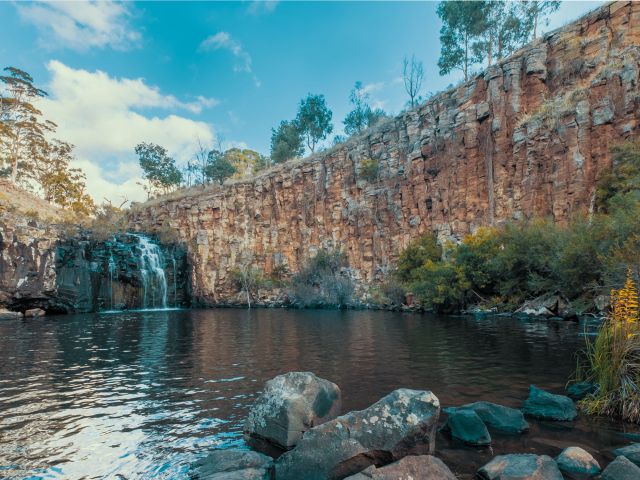
Located along the Loddon River in Glenlyon, these lesser-known waterfalls are well worth the short trip from Daylesford. The water here spills over imposing hexagonal basalt rock columns that jut up from the gorge (which does indeed make for a lovely swimming spot in the right conditions) about 30-40 metres below. Native flora and fauna are bountiful in these parts! It’s a quick walk from the car park to the gorge lookout. From there, there are two paths to take – the high track to the top spot or, the low-slung, rock-hugging walk to the bottom. Either vantage point makes for excellent photo opportunities.

a spectacular gorge at Loddon Falls, Glenlyon, Daylesford
Loddon Falls is a spectacular gorge tucked within rolling hills and dirt tracks. (Image: R Reeve)

5. Colbrook Reservoir

Distance from Daylesford: 32-minute drive
Where: Wombat State Forest, Colbrook
Parking: Yes, best accessed by 4WD
Difficulty: Moderate
Swimming: Yes

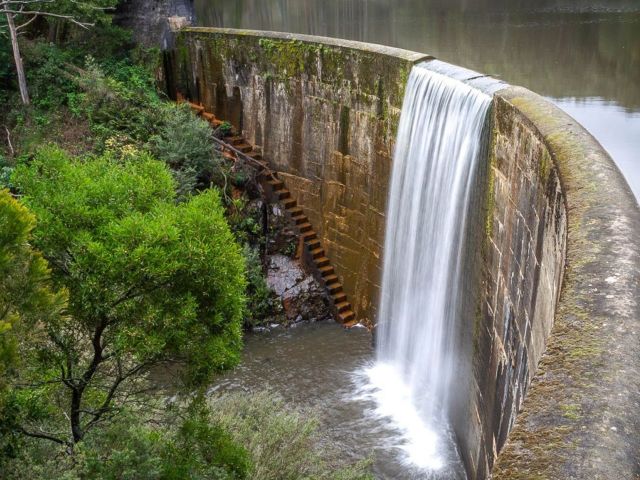
Colbrook Reservoir is an off-the-beat destination suited to adventure seekers keen to see a seasonal waterfall spilling over the massive reservoir dam wall. It’s a gem of a setting for bushwalking, swimming, fishing and snap-happy photographers. Free bush camping sites are available here but there are no facilities; bring in everything you need and take it when you leave (including any rubbish please).

6. The Blowhole

Distance from Daylesford: 9-minute drive
Where: Hepburn Regional Park
Parking: Yes 
Difficulty: Easy
Swimming: Yes, seasonal – dependent on gentle water flow. No diving. Experienced swimmers only.

Hepburn Springs outdoes itself here with the Blowhole’s immaculate display of sheer beauty. Fact: people are surprised to discover that this is a manmade waterfall/ swimming hole, created by gold miners in the late 19th century for fossicking purposes.

The Blowhole and Sailors Creek (the water source that feeds into it) is part of the 210-kilometre Goldfields Track, which runs from Mt Buniyong near Ballarat and passes through Creswick, Daylesford and Castlemaine to Bendigo. Sure, the Blowhole becomes quite a turbulent show after high rainfalls, and then, on the opposite end of the spectrum, it’s just as often an idyllically, pretty place to visit. Either way, we recommend packing a picnic and plotting your spot, for there’s plenty of space to spread out and relax.

Visiting Daylesford and its surrounds soon? Check out our Daylesford & Macedon Ranges guide for the top things to do, best restaurants and cosy accommodations in Daylesford.

Roxanne Andrews
Roxanne Andrews is a freelance travel writer and editor based in Yamba, Australia. Topics of expertise include; sports tourism, luxury travel, arts & culture, cuisine & dining, wellness, the adventure sector and all things marine. A professional scribe who occasionally goes gonzo to capture the moment.
See all articles

This luxe trawler tour is redefining Victoria’s seafood experience

Victoria’s ‘mussel capital’ is the source of exceptional shellfish used by top chefs far and wide. Step aboard a beautifully refurbished trawler to see how these plump and juicy bivalves are sustainably cultivated.

A curtain is slowly winched from the placid, teal waters just off Portarlington , like a floating garland beside our boat. The ropes heave with blue mussels, the star attraction of our tour. But as we reach to pluck our own, it’s quickly clear they’re not alone; a mass of weird and wonderful creatures has colonised the ropes, turning them into a living tapestry. ‘Fairy’ oysters, jelly-like sea squirts, and tiny, wriggling skeleton shrimp all inhabit this underwater ecosystem.

We prize our bivalve bounty from the ropes, and minutes later the mussels arrive split on a platter. The plump orange morsels are served raw, ready to be spritzed with wedges of lemon and a lick of chilli as we gaze out over the bay. They’re briny, tender and faintly sweet. “This wasn’t originally part of the tour,” explains Connie Trathen, who doubles as the boat’s cook, deckhand and guide. “But a chef [who came onboard] wanted to taste the mussels raw first, and it’s now become one of the key features.”

A humble trawler turned Hamptons-style dreamboat

inspecting bivalve bounty from the ropes
Inspecting the bounty. (Image: Visit Victoria/Hannyn Shiggins)

It’s a crisp, calm winter’s day, and the sun is pouring down upon Valerie, a restored Huon pine workhorse that was first launched in January 1980. In a previous life she trawled the turbulent Bass Strait. These days she takes jaunts into Port Phillip Bay under the helm of Lance Wiffen, a fourth-generation Bellarine farmer, and the owner of Portarlington Mussel Tours . While Lance has been involved in the fishing industry for 30-plus years, the company’s tour boat only debuted in 2023.

holding Portarlington mussels
See how these plump and juicy bivalves are sustainably cultivated.

It took more than three years to transform the former shark trawler into a dreamy, Hamptons-esque vessel, with little expense spared. Think muted green suede banquettes, white-washed walls, Breton-striped bench cushions, hardwood tables, bouquets of homegrown dahlias, and woollen blankets sourced from Waverley Mills, Australia’s oldest working textile mill. It’s intimate, too, welcoming 12 guests at most. And yet there’s nothing pretentious about the experience – just warm, down-to-earth Aussie hospitality.

As we cruise out, we crack open a bottle of local bubbles and nibble on the most beautifully curated cheese platter, adorned with seashells and grey saltbush picked from the water’s edge that very morning. Australasian gannets soar overhead, and I’m told it’s not uncommon for guests to spot the odd seal, pod of dolphins, or even the occasional little penguin.

The sustainable secret behind Victoria’s best mussels

blue mussels off Portarlington
Blue mussels sourced just off Portarlington.

Connie and Lance both extol the virtues of mussels. They’re delicious. A lean source of protein and packed with omega-3 fatty acids, vitamin B12, iron, selenium, and zinc. They’re cooked in a flash (Connie steams our fresh harvest with cider and onion jam). And they’re also widely regarded as one of the most sustainable foods in the world.

Portarlington mussels with lemon and chilli
Mussels served with lemon and chilli.

“Aquaculture is [often] seen as destructive, so a lot of our guests are really surprised about how environmentally friendly and sustainable our industry is,” Lance says. “[Our mussels] would filter 1.4 billion litres of water a day,” he adds, explaining how mussels remove excess nitrogen and phosphorus from the water. “And through biomineralisation, we lock carbon into mussel shells.”

a hand holding a Portarlington mussel
Mussels are a sustainable food.

Despite their glowing list of accolades, these molluscs have long been seen as the oysters’ poorer cousins. “It was a really slow start,” explains Lance, who says that in the early days of his career, “you could not sell mussels in Victoria”.

But word has slowly caught on. Chefs as globally acclaimed as Attica’s Ben Shewry and even René Redzepi of Noma, Denmark, have travelled to these very waters just to try the shellfish at the source, sharing only the highest praise, and using Lance’s mussels in their restaurants.

guests sampling Portarlington mussels onboard
Sampling the goods onboard. (Image: Visit Victoria/Hannyn Shiggins)

According to Lance there’s one obvious reason why the cool depths of Portarlington outshine other locations for mussel farming. “The water quality is second to none,” he says, noting how other regions are frequently rocked by harvest closures due to poor water quality. “We grow, without a doubt, some of the best shellfish in the world.” And with Lance’s bold claims backed up by some of the industry’s greatest names, perhaps it won’t be much longer until more Aussies uncover the appeal of Portarlington’s mussels.