Trekking Hanging Rock with a llama

hero media
Jocelyn Pride discovers that trekking the Macedon Ranges’ mystical Hanging Rock with a llama is good for your soul. No, really…

“Hmmm, hmmm, hmmm," hums Jaro in a melodic B-flat, I’ve-got-something-important-to-say-sort-of-way.


Huge brown eyes with movie star lashes look straight into mine and his banana-shaped fluffy ears twitch back and forth as I make soft cooing sounds.


It’s love at first sight. A perfect way to start a 24-hour relationship… with a llama.


Domesticated by the Incas thousands of years ago, llamas are one of the oldest animals on the planet. Known as the dolphins of the land, these camelids are whip smart, full of personality and easy to train, as Mark Brindley of Hanging Rock Llama Treks discovered. By saving a llama’s life, he changed his.


“When my partner brought home a day-old orphaned cria (baby llama) with a hole in its heart from her veterinarian clinic, I was hooked," says Mark, a retired aircraft engineer turned llama farmer. “Although Yoda only lived six months, she opened me to a new world."


Mark now has 15 llamas and recently started offering guided llama trekking within the Victorian Macedon Ranges region.


Jaro stands patiently as I learn the art of llama handling.


“Before you ask, spit happens," says Mark with a playful chuckle. “But don’t worry, it’s rare and only a llama to llama thing."


The thought of being in the middle of a llama drama and sprayed with green slime is a tad off-putting, however Jaro and his mates already have the herd hierarchy worked out.


“Just make sure you give them their own space."


After weighing each saddle-bag loaded with our camping gear, food and wine, clothing, and llama essentials like a pooper scooper, tether ropes and ‘llama lollies’ (pellets), we head to Hanging Rock Reserve.


Leading a llama is like taking an oversized well-trained dog for a walk, except I soon find they only have two speeds – stop and llama pace. Each step Jaro takes is slow, deliberate and strong.


It’s easy to see why these sure-footed, well-natured animals are revered as pack animals. Even weighing in at 160 kilograms they’re kind on the environment.


“A llama leaves less of a footprint than our hiking boots," says Mark.


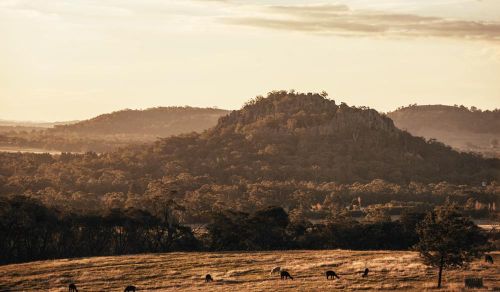
We meander the labyrinth of undulating trails lined with peppermint and manna gums around Australia’s ‘second’ rock formed six million years ago when lava oozed through a vent in the Earth’s surface.


Immortalised in literature, Hanging Rock is as evocative today as it was in Joan Lindsay’s novel and Peter Weir’s film Picnic at Hanging Rock, the haunting tale of the disappearance of a group of school girls here on Valentine’s Day in 1900.


(MORE… Picnic at Hanging Rock – fact of fiction?)


Jaro occasionally cuddles into my neck and sniffs my pockets for ‘llama lollies’. Chris, my travel companion is envious. She doesn’t bond as quickly with Warrego, the tallest and most aloof of the trio. “Llamas can be more like cats than dogs," says Mark.


For afternoon tea we lazily snack on chocolate brownies and banana cake, sipping tea while the llamas chomp on grass and snatch mouthfuls of pine needles.


As camping isn’t permitted in the reserve, we load the llamas onto a horse float and drive half-an-hour to a ‘pet friendly’ camping ground in the tiny village of Blackwood on the edge of Lerderderg State Park.


With great hilarity and wide-eyed llamas watching on, we manage to pitch the tents before darkness shrouds us.


Dinner is a fine camp fire affair – nibbles with a local pinot gris, lamb curry (Mark’s secret recipe) with all the trimmings, followed by sticky date tart.


As we snuggle into the sleeping bags, our four-legged friends kush down (sit) as sentinels behind the tents. Their hums and snuffles are like a lullaby and I’m asleep within seconds.


Our six-kilometre hike the following morning is a challenge. Narrow tracks criss-cross the old gold mining trails. This is new territory for Jaro but nothing fazes him. He carefully picks our path, up and down the rocky hills – confident, steady, grounded. He has my complete trust.


Instead of my usual hurried pace, I’m totally in the moment. I feel the breeze touch my face, listen to the swish of the leaves and each note of a kookaburra’s laughter.


Jaro’s humming becomes my ‘om’. It sure beats a colouring book.


The details: Hanging Rock Llama Treks, Victoria

Getting there: Hanging Rock is a 60-minute drive north-west of Melbourne.


Playing there: Mark offers a number of llama experiences ranging from kids’ parties on his farm to day hikes along a rail trail with a pub lunch to overnight camping treks. The price for the overnight experience is $130 per person including camping gear, food, wine and lollies for the llamas. hangingrockllama.com.au


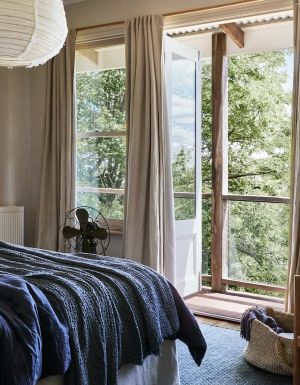
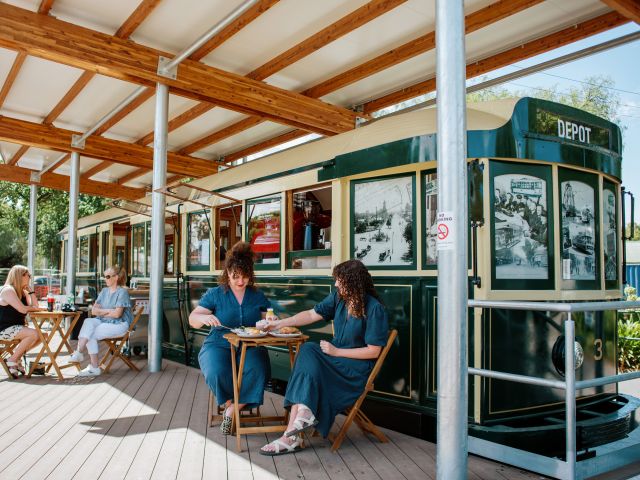
Staying there: If you don’t fancy sleeping in a tent, ‘The Caboose’ at Hanging Rock Reserve is a beautifully restored railway carriage (sleeps two). Contact Garry and Kate Marks on 0418394984.


MORE… Finished exploring Victoria by hoof and ready to take to the air? Vintage flight – hot air ballooning Yarra Valley style

hero media

8 incredible hikes just outside of Melbourne

Just over an hour from Melbourne, spectacular walking and hiking trails encompass ancient landscapes, forested ridgelines and volcanic peaks.

Just a short drive from the city, the urban sprawl gives way to rolling hills, mineral springs, and lush forests that will have you feeling like you’re in the bucolic countryside of France. Encompassing Daylesford , the Macedon Ranges, Castlemaine and the Central Goldfields, this pocket of Victoria is a region where nature, art, and wellness intertwine. Heritage towns hum with creativity, good food and wine, and welcoming locals. While Daylesford hikes, and those nearby, offer the chance to take a pause and reconnect with nature.

1. Hanging Rock Summit Walk

Hanging Rock Summit Walk
Take in views across the Macedon Ranges.

Etched into folklore, few places in Australia carry as much mystique as Hanging Rock. Rising dramatically from the plains near Woodend, this volcanic mamelon offers a beautiful nature walk. The walk begins at a gentle pace, weaving through shaded woodland before it gets a little steeper as the path starts to climb and twist to the summit. From here, you’ll have views that stretch across the Macedon Ranges. The walk is roughly 1.8 kilometres return, but the real reward lies in standing among the weathered boulders, feeling the age and energy of the earth beneath your feet.

2. Macedon Ranges Walking Trail

Macedon Ranges Walking Trail camel's hump lookout
Walk to Camel’s Hump. (Image: Clair Derwort)

The Macedon Ranges Walking Trail traverses around 19 kilometres of forest and mountain landscapes. The full trail is a six-hour circuit, with most of the walk being a grade three; however, you don’t have to tackle it all at once. There are shorter walks that will take you through the tall mountain ash forests, to tranquil picnic areas, and sweeping views from Camels Hump and the Memorial Cross. The best times of year to head out are autumn, when the mountain turns into a tapestry of crimson and gold, and spring, when wildflowers brighten the trail.

3. Mount Alexander Traverse

Mount Alexander Traverse
Take in the serenity.

Towering above the goldfields near Castlemaine, Mount Alexander is a granite giant that offers some great bushwalking trails. The Mount Alexander Traverse winds along the mountain’s rocky spine through dry eucalypt forest that opens up in sections to reveal beautiful panoramas across Loddon Valley and all the way to the distant Grampians. Once a site of ancient volcanic activity (and later a gathering place for the Dja Dja Wurrung people), the mountain’s granite tors are now quiet and create a beautiful, serene atmosphere for a moment of reflection while walking.

4. Murmuring Walk

Murmuring Walk daylesford hikes
Circle the picturesque Sanatorium Lake.

Located an easy drive from Daylesford, Murmuring Walk offers something a little different. Circling Sanatorium Lake, this free audio-guided walk aims to immerse you in the rhythms of Dja Dja Wurrung, Taungurung and Wurundjeri Woi Wurrung Country by blending the sounds of nature with a multi-layered soundtrack. There are two routes to explore while you listen: a shorter loop around the lake itself and a longer circuit that extends deeper into the woodland.

5. La Gerche Forest Walk

La Gerche Forest Walk
Walk into history on the La Gerche Forest trail.

Located in Creswick, the La Gerche Forest Walk honours the legacy of John La Gerche, a 19th-century forester who championed the regeneration of the then gold-rush-ravaged land. Today, over 100 years later, his replanting efforts have grown into a living cathedral of towering pines, oaks, and native gums. As you meander along the 2.2-kilometre circuit, you’ll find interpretive panels along the way that help tell the story of La Gerche’s vision, so you can learn as you wander.

6. Sailors Falls Loop

Sailors Falls Loop
See these spectacular falls. (Image: Visit Victoria)

Just outside Daylesford, Sailors Falls tumbles through a fern-lined gorge, fed by mineral springs. Thought to be named after the sailors who jumped ship to seek gold in the area during the 1850s gold rush, the loop walk begins at the car park and descends through a cool, shaded gully to the base of the falls. From here, you’ll make the climb back via the mineral springs. It’s a short but enchanting walk – about 1.5 kilometres in total, so make a day of it by packing a picnic to sit by the springs; you’ll feel worlds away from the city.

7. Paddys Ranges Loop Walk

Further north, the Paddys Ranges State Park loop reveals a different side of Victoria’s Heartland – dry forest, golden light and hints of a gold-rush past. This protected reserve is a stronghold of box-ironbark woodland, providing vital refuge for endangered species. In spring, the forest floor is awash with the colour of over 230 species of wildflowers, so a springtime walk is a must-do. As you walk the 4.5-kilometre loop trail, keep an eye out for remnants of old mine shafts and rusted relics from the prospectors who once sought their fortunes here.

8. Mount Franklin Summit Walk

Mount Franklin Summit Walk
Take in forests and waterfalls along the way to the top of Mount Franklin.

An extinct volcano turned picnic ground, Mount Franklin (known as Lalgambook to the Dja Dja Wurrung people) is one of the region’s quiet marvels. The summit walk follows a narrow, winding path through native forest to the crater’s rim, where you’ll get glimpses of farmland and forest below. It’s a moderate climb – just over an hour return, so it can easily be done if you’re camping in the surrounding reserve for a weekend nature retreat.

The trails of Victoria’s Heartland offer a chance to reconnect with the landscape, local history and yourself. Start planning your next adventure at daylesfordmacedonlife.com.au.