This luxe trawler tour is redefining Victoria’s seafood experience

Victoria’s ‘mussel capital’ is the source of exceptional shellfish used by top chefs far and wide. Step aboard a beautifully refurbished trawler to see how these plump and juicy bivalves are sustainably cultivated.

A curtain is slowly winched from the placid, teal waters just off Portarlington , like a floating garland beside our boat. The ropes heave with blue mussels, the star attraction of our tour. But as we reach to pluck our own, it’s quickly clear they’re not alone; a mass of weird and wonderful creatures has colonised the ropes, turning them into a living tapestry. ‘Fairy’ oysters, jelly-like sea squirts, and tiny, wriggling skeleton shrimp all inhabit this underwater ecosystem.

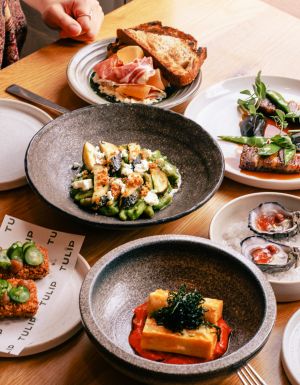
We prize our bivalve bounty from the ropes, and minutes later the mussels arrive split on a platter. The plump orange morsels are served raw, ready to be spritzed with wedges of lemon and a lick of chilli as we gaze out over the bay. They’re briny, tender and faintly sweet. “This wasn’t originally part of the tour," explains Connie Trathen, who doubles as the boat’s cook, deckhand and guide. “But a chef [who came onboard] wanted to taste the mussels raw first, and it’s now become one of the key features."

A humble trawler turned Hamptons-style dreamboat
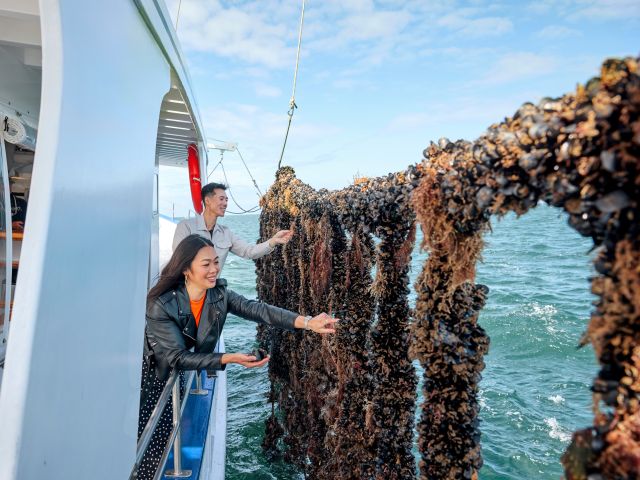
inspecting bivalve bounty from the ropes
Inspecting the bounty. (Image: Visit Victoria/Hannyn Shiggins)

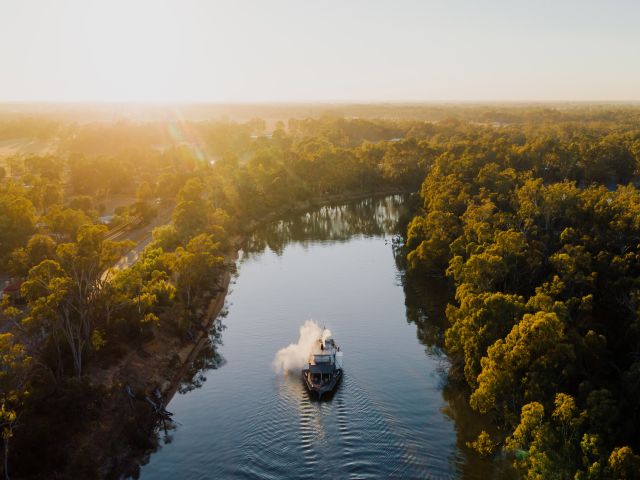
It’s a crisp, calm winter’s day, and the sun is pouring down upon Valerie, a restored Huon pine workhorse that was first launched in January 1980. In a previous life she trawled the turbulent Bass Strait. These days she takes jaunts into Port Phillip Bay under the helm of Lance Wiffen, a fourth-generation Bellarine farmer, and the owner of Portarlington Mussel Tours . While Lance has been involved in the fishing industry for 30-plus years, the company’s tour boat only debuted in 2023.
holding Portarlington mussels
See how these plump and juicy bivalves are sustainably cultivated.

It took more than three years to transform the former shark trawler into a dreamy, Hamptons-esque vessel, with little expense spared. Think muted green suede banquettes, white-washed walls, Breton-striped bench cushions, hardwood tables, bouquets of homegrown dahlias, and woollen blankets sourced from Waverley Mills, Australia’s oldest working textile mill. It’s intimate, too, welcoming 12 guests at most. And yet there’s nothing pretentious about the experience – just warm, down-to-earth Aussie hospitality.

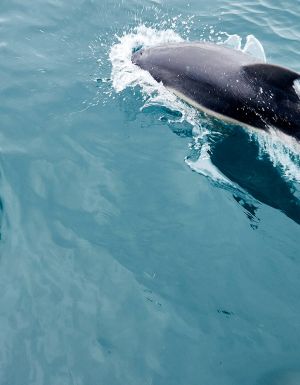
As we cruise out, we crack open a bottle of local bubbles and nibble on the most beautifully curated cheese platter, adorned with seashells and grey saltbush picked from the water’s edge that very morning. Australasian gannets soar overhead, and I’m told it’s not uncommon for guests to spot the odd seal, pod of dolphins, or even the occasional little penguin.

The sustainable secret behind Victoria’s best mussels
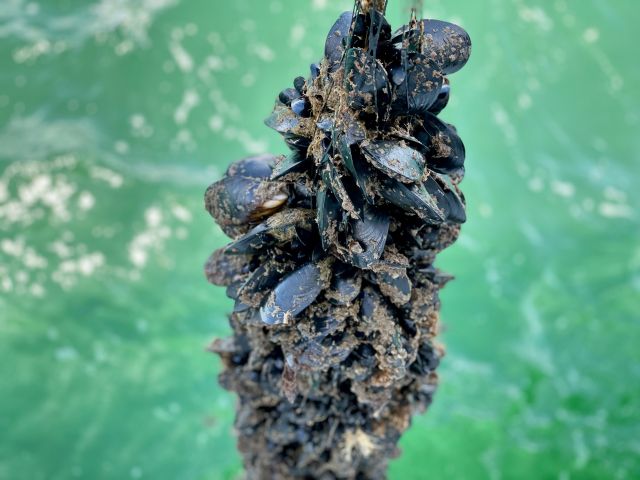
blue mussels off Portarlington
Blue mussels sourced just off Portarlington.

Connie and Lance both extol the virtues of mussels. They’re delicious. A lean source of protein and packed with omega-3 fatty acids, vitamin B12, iron, selenium, and zinc. They’re cooked in a flash (Connie steams our fresh harvest with cider and onion jam). And they’re also widely regarded as one of the most sustainable foods in the world.
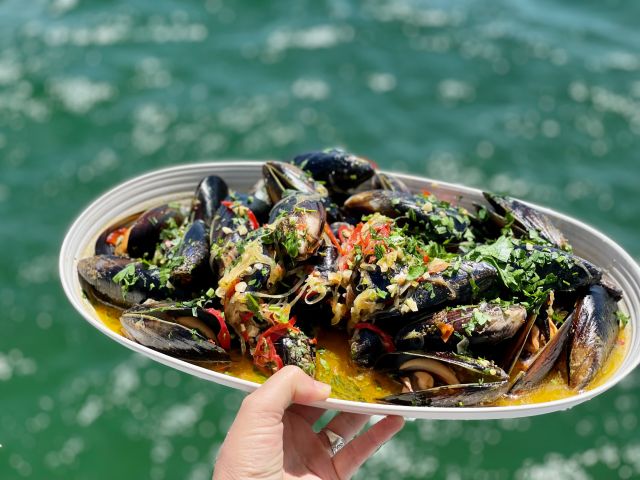
Portarlington mussels with lemon and chilli
Mussels served with lemon and chilli.

“Aquaculture is [often] seen as destructive, so a lot of our guests are really surprised about how environmentally friendly and sustainable our industry is," Lance says. “[Our mussels] would filter 1.4 billion litres of water a day," he adds, explaining how mussels remove excess nitrogen and phosphorus from the water. “And through biomineralisation, we lock carbon into mussel shells."
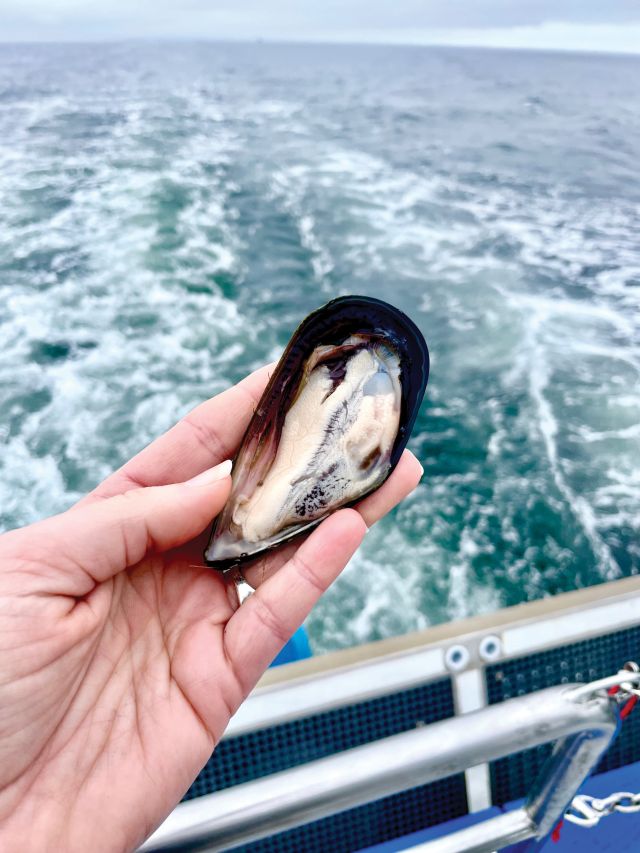
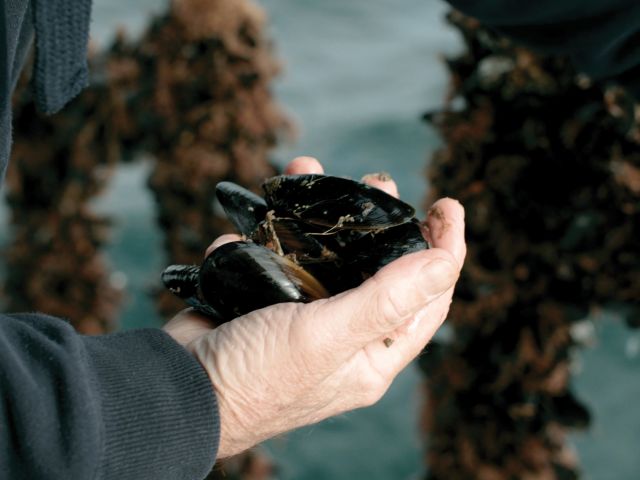
a hand holding a Portarlington mussel
Mussels are a sustainable food.

Despite their glowing list of accolades, these molluscs have long been seen as the oysters’ poorer cousins. “It was a really slow start," explains Lance, who says that in the early days of his career, “you could not sell mussels in Victoria".

But word has slowly caught on. Chefs as globally acclaimed as Attica’s Ben Shewry and even René Redzepi of Noma, Denmark, have travelled to these very waters just to try the shellfish at the source, sharing only the highest praise, and using Lance’s mussels in their restaurants.
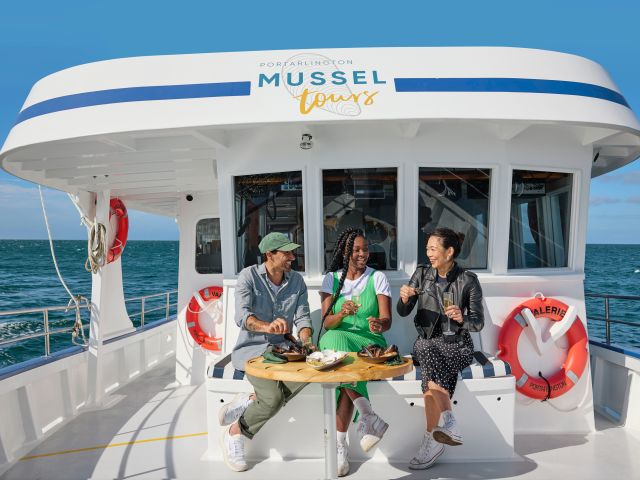
guests sampling Portarlington mussels onboard
Sampling the goods onboard. (Image: Visit Victoria/Hannyn Shiggins)

According to Lance there’s one obvious reason why the cool depths of Portarlington outshine other locations for mussel farming. “The water quality is second to none," he says, noting how other regions are frequently rocked by harvest closures due to poor water quality. “We grow, without a doubt, some of the best shellfish in the world." And with Lance’s bold claims backed up by some of the industry’s greatest names, perhaps it won’t be much longer until more Aussies uncover the appeal of Portarlington’s mussels.

Chloe Cann
Chloe Cann is an award-winning freelance travel and food writer, born in England, based in Melbourne and Roman by adoption. Since honing her skills at City St George's, University of London with a master's degree in journalism, she's been writing almost exclusively about travel for more than a decade, and has worked in-house at newspapers and travel magazines in London, Phnom Penh, Sydney and Melbourne. Through a mixture of work and pleasure, she's been fortunate enough to visit 80 countries to date, though there are many more that she is itching to reach. While the strength of a region's food scene tends to dictate the location of her next trip, she can be equally swayed by the promise of interesting landscapes and offbeat experiences. And with a small person now in tow, travel looks a little different these days, but it remains at the front of her mind.
See all articles

How a $1 deal saved Bendigo’s historic tramways

The passionate community that saved Bendigo Tramways has kept the story of this city alive for generations.

It was an absolute steal: a fleet of 23 trams for just $1. But such a fortunate purchase didn’t happen easily. It was 1972 when the Bendigo Trust handed over a single buck for the city’s historic collection of battery, steam and electric trams, which had transported locals since 1890.

inside the historic Bendigo Tram
Bendigo Tramways is a historic transport line turned tourist service. (Image: Bendigo Heritage)

The city’s tram network had been declared defunct since 1970 due to post-war shortages in materials to upkeep the trams and declining passenger numbers as motor vehicles were increasing. However, determined locals would not hear of their beloved trams being sold off around the world.

The Bendigo Trust was enlisted to preserve this heritage, by converting the trams into a tourist service. The Victorian government approved a trial, however news spread that the Australian Electric Tramways Museum in Adelaide had acquired one of the streetcars for its collection.

a tram heading to Quarry Hill in 1957
A tram on its way to Quarry Hill in 1957. (Image: Bendigo Heritage)

An impassioned group rallied together to make this physically impossible. Breaking into the tram sheds, they welded iron pipes to the rails, removed carbon brushes from the motors, and formed a blockade at the depot. The community response was extraordinary, and a $1 deal was sealed.

A new chapter for the city’s fleet

the old Tramways Depot and Workshop
The old Tramways Depot and Workshop is one of the stops on the hop-on, hop-off service. (Image: Tourism Australia)

Today, Bendigo Tramways welcomes some 40,000 passengers annually, operating as a hop-on, hop-off touring service aboard the restored trams. Fifteen of the now 45-strong fleet are dubbed ‘Talking Trams’ because of the taped commentary that is played along the route. The trams loop between Central Deborah Gold Mine and the Bendigo Joss House Temple, which has been a place of Chinese worship since 1871, via other sites including the old Tramways Depot and Workshop.

a Gold Mine Bendigo Tram
The fleet comprises 45 trams that have been restored. (Image: Visit Victoria/Robert Blackburn)

Keeping things interesting, throughout the year visitors can step aboard different themed trams. Tram No. 302 becomes the Yarn Bomb Tram, decorated both inside and out with colourful crochet by an anonymous group of locals.

During the festive season, Tram No. 15 operates as a tinsel-festooned Santa Tram, and the big man himself hides out somewhere along the route for excited children to find. And on selected dates, the adults-only Groove Tram runs nighttime tours of the city, accompanied by local musicians playing live tunes and a pop-up bar.

the historic post office turned visitor centre in Bendigo
Visitors can hop on and off to see the city’s sites such as the historic post office turned visitor centre. (Image: Tourism Australia)

As well as preserving the city’s history, however, the continuation of the tram service has kept the skills of tram building and craftsmanship alive in a practical sense. Bendigo’s Heritage Rail Workshop is world-renowned for restoring heritage trams and repurposing vehicles in creative ways.

Locally, for example, Tram No. 918 was transformed into the Dja Dja Wurrung Tram with original Aboriginal artworks by emerging artist Natasha Carter, with special commentary and music that shares the stories and traditions of Bendigo’s first people. You can’t put a price on preserving history. Nonetheless, it was a dollar very well spent.