Eco retreats, tiny houses and even underwater accommodation set light on the landscape provide unique opportunities to sleep soundly and immerse yourself in extraordinary environments.
Here are our favourite eco-friendly nature stays that made it into positions 49 to 58 of our coveted list of 100 unique stays. Head here to read the full list and start planning your next escape.
49. Naiko Retreat, Fleurieu Peninsula, SA
After a two-hour drive from Adelaide, Kangaroo Island’s sheer limestone cliffs and sparkling beaches beckon in the distance. Closer at hand, lush green meadows curve downwards in a parabola towards the sapphire blue water at the southern tip of the Fleurieu Peninsula. Designed by architect Max Pritchard (Southern Ocean Lodge) and with an all-encompassing commitment to sustainability, Naiko Retreat is hidden in the shadow of those slopes but, even from here, its appeal is obvious.
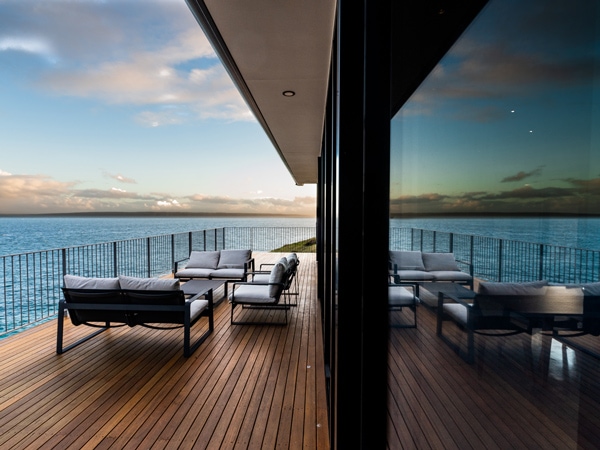
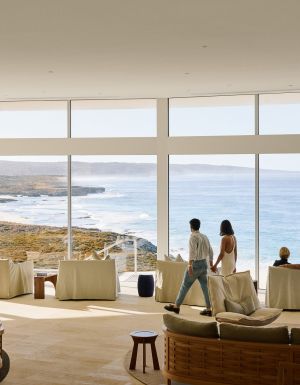
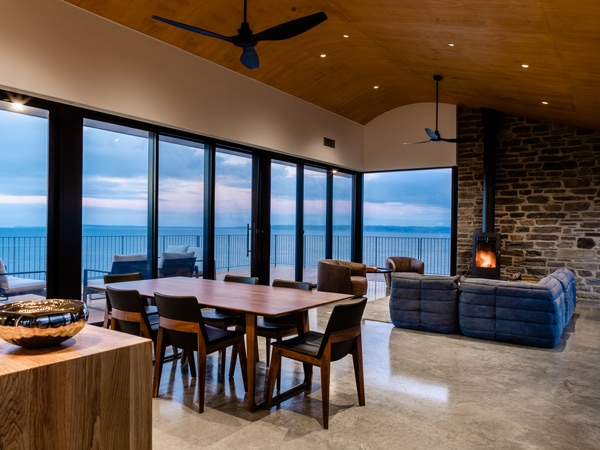
Gazing majestically out to sea, the three-bedroom house is fronted by floor-to-ceiling windows looking out over the Backstairs Passage and designed to resemble one of the waves tumbling into the private cove directly below. When I lie down in bed, the steep slope disappears and I feel as if I’m hovering directly over the water. In the other direction, a hiking path ascends a seemingly never-ending hill rent by steep gullies dotted with arum lilies. Dense stands of pink gum come alive with birdsong at my approach and an echidna curled up on the path is entirely oblivious to the glorious scenery around it. Mobs of roos keep a watchful eye on me and the skittishness of sheep grazing in the shadow of centuries-old yaccas indicates how rarely they encounter people – guests have the entire 800-hectare property to themselves.

My heart is racing from the walk, but I can feel my mind slowing down by the minute as a stiff sea breeze rushes over Naiko Retreat’s streamlined form and tousles my hair. Waves crash gently beneath the whistling wind and the solitude seems all-encompassing until I look up to see a wedge-tailed eagle circling overhead and remember that I’m far from alone in this rugged landscape that offers a welcome refuge for both wildlife and harried city dwellers. – Alexis Buxton-Collins
50. Change Overnight, Launceston, Tas
In a cosy loft room of a repurposed Launceston warehouse, I wake from one of the soundest sleeps I’ve had in a long time. Not just because the boutique hotel I am staying in is suitably flash, but because I know my stay has had a positive impact on the outside world. Change Overnight is one of only a few social enterprise hotels in Australia, with every stay supporting one of eight worthy causes.
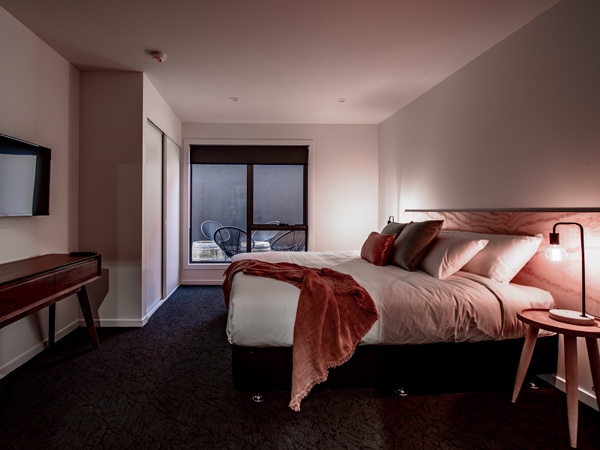
Opened in 2019, the property is the brainchild of Tasmanian entrepreneurs Tara Howell and Sam Haberle, who teamed up with likeminded locals Toby Wilkin and Marcel Anstie to form a social capitalist force to be reckoned with. The building’s exterior and entrance are understated. Inside, along a subdued hallway are lettered doors. I’m in F, a one-bedroom, two-storey apartment: when booking, I decided to benefit Be Hers, a not-for-profit organisation dedicated to ending human trafficking. Rooms are decorated with dynamic hand-painted murals and OZ Design furniture, with outdoor seating areas created using the building’s original exterior walls.
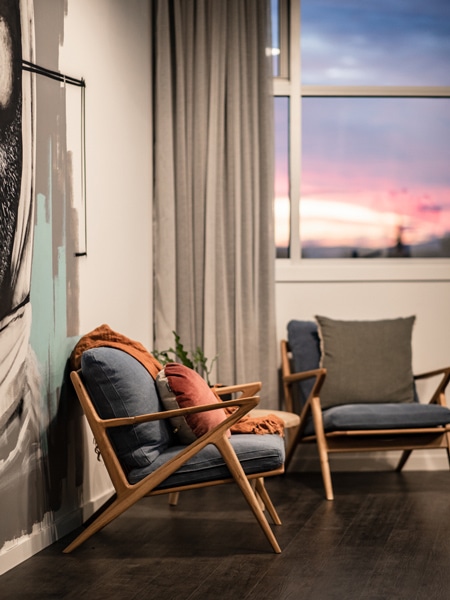
There’s also a three-bedroom penthouse where sun streams through a wall of windows into the comfy living room and “Thanks for being a life changer" is stencilled on a door. With self-check-in and keyless access, the property is effectively a hotel version of Airbnb, with apartments kitted out with kitchens, washing machines, free wi-fi and free undercover parking. Change’s eight causes – six chosen by the team and two voted on by the public – range from local to international. The Change team hopes their concept will catch on so that everyone, everywhere, gets a better night’s sleep. – Elspeth Callender
51. Eco Villas at Rawnsley Park Station, Flinders Ranges, SA
My favourite piece of the Eco Villas at Rawnsley Park Station took me by surprise. When I spotted the corrugated roof and verandah on two sides I was sure it would be sitting on the balcony watching the changing colours of the Elders Ranges and Wilpena Pound/Ikara as the sun set. A sight that ignites the same sense of wonder as the sunset on Uluru. It wasn’t.
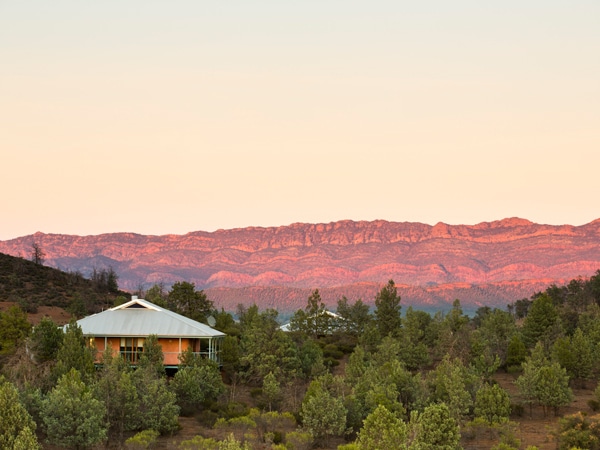
Inside the Eco Villa, the bright airy space is a welcome luxury in the startlingly beautiful yet harsh Flinders Ranges landscape. The energy-neutral structures are a building wonder of sustainability and eco creds. The walls are formed from rendered straw bales. The shade provided by the extensive verandah and the high ceiling with an exhaust in the apex keeps the interior cool and reduces the need for air conditioning. And, when switched on, the energy is provided by the large array of solar panels discreetly tucked away on a corner of the property.
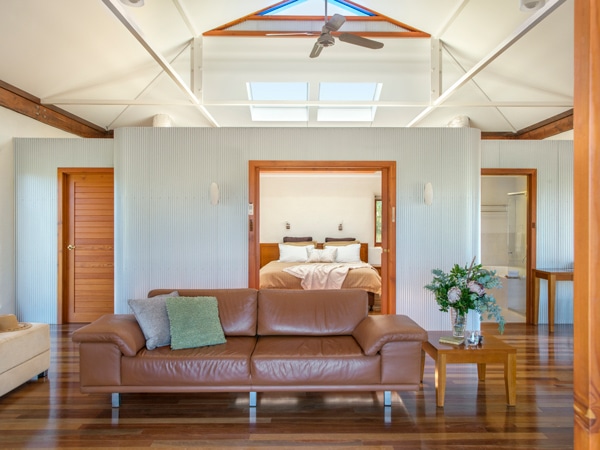
Making a welcome cup of afternoon tea after a long day’s walk and soaking in the tub within this sustainable gem of a villa could have been the moment… but it wasn’t. No, the magical experience of lying in bed and looking up into the sparkling night sky through thoughtfully placed sky lights was my favourite moment. It was camping under the stars if you can stretch ‘camp’ to a luxury one-bedroom villa. – Quentin Long
52. Swell Lodge, Christmas Island, off WA
Arriving at Swell Lodge was one of those true pinch-me moments in life. It was amplified by anticipation after what felt like an intrepid journey to get there: catching a flight from Sydney to Perth, making my way to the international terminal and hopping on a flight bound for Christmas Island before driving through an unfamiliar tropical landscape of jungle and crabs – so many crabs. Swell Lodge is hidden deep in the island’s national park (in fact, one third of the island is protected) and perched dramatically on the edge of one of the soaring sea cliffs that encircle it entirely save for a pearl-like string of bays and beaches.
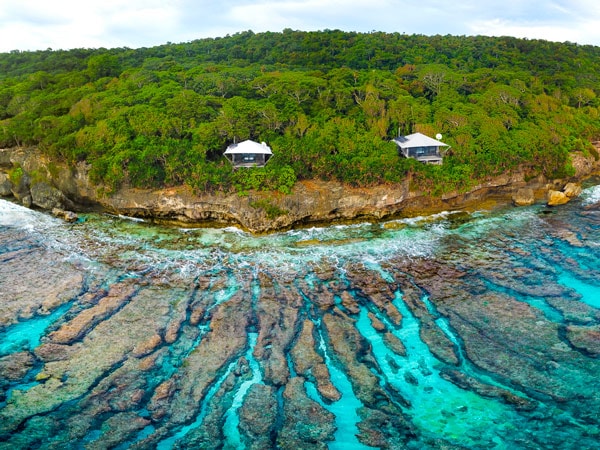
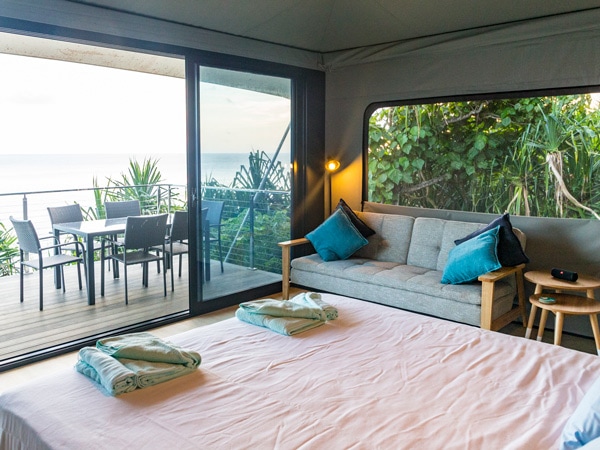
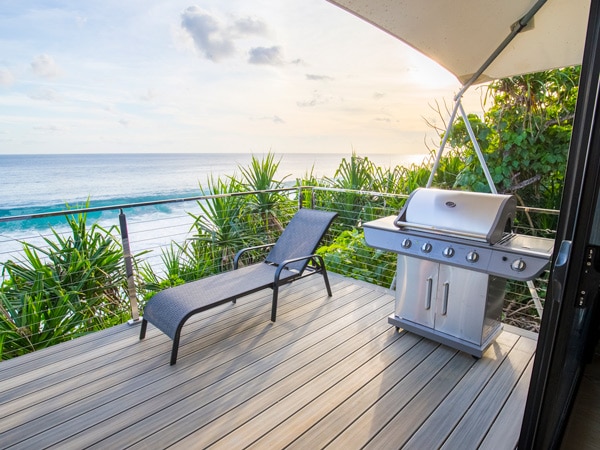
The pinch-me moment happened as I set foot on the huge deck that opens up to the seemingly infinite expanse of the Indian Ocean. There’s a reason it’s called Swell Lodge. Here, it’s just you, the roar of the ocean and the seabirds swooping overhead. I knew Swell Lodge was special at the time. Surely one of the world’s great eco lodges (between solar power, a carbon-neutral program that includes offsetting all emissions from its crab-safe lodge vehicle and much more besides, its eco credentials really do stack up), you don’t take places like this for granted. But reflecting on it now with a pandemic and overseas travel ban between us, my appreciation for it has only grown.
It’s no understatement to say that a trip to Christmas Island is the closest many of us will get to travelling internationally for a while. Because while you’re here you very much are overseas. An overseas Australian territory, Christmas Island is a pin-drop in the Indian Ocean that, at 2600 kilometres north-west of Perth, is closer to Asia than it is to the Australian mainland. It’s a tropical jungle wilderness where days are spent snorkelling in bath-like waters, finding secret swimming spots and walking through the rainforest undergrowth to hidden grottoes and waterfalls, before checking out temples and mosques and possibly Australia’s most unique golf course.
Evenings at Swell Lodge are spent eating dinner rustled up by your private chef using ingredients they might have foraged that day. The owners of the lodge have travelled the world on sailing expeditions and leading photography tours to its furthest-flung corners; they fell in love with Christmas Island and saw its potential as a luxury ecotourism island destination to rival Lord Howe and now they’re passionately sharing it with others. Since my visit, I’ve also spent considerable time extolling the virtues of Swell Lodge and the island itself. It has that kind of effect on you. – Imogen Eveson
53. Bamurru Plains, Kakadu, NT
It’s a race against the clock. We’re four-wheel-driving through a vast station on the fringes of Kakadu National Park originally owned by the man who inspired Indiana Jones. The odd water buffalo wallows by the wayside and I want to stop to take pictures but guide Sab Lord assures me there’ll be plenty more bovine photo ops where we’re going.
Arriving at Bamurru Plains just in time for sunset, we’re greeted warmly with a cool drink and eucalyptus-spiked face towel and ushered through the main lodge to the deck for the evening’s ritual. Sure enough, we settle in as herds of buffalo come in from the Mary River floodplains for the night. It’s a remarkable spectacle and a fitting introduction to a stay that’s all about immersion in nature.
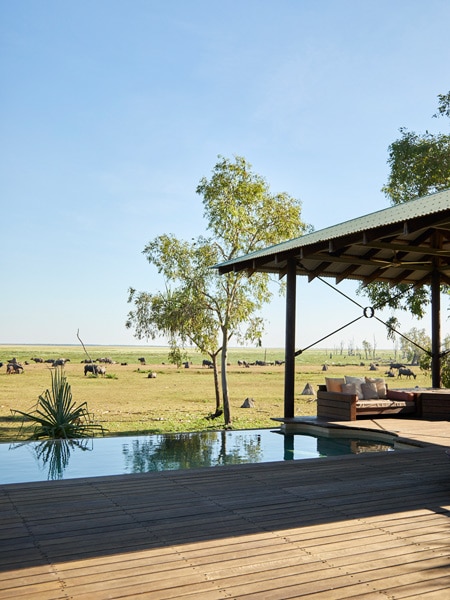
This Wild Bush Luxury property is built into savannah bush fringing the wetlands and, with its rustic-chic aesthetic, it espouses the kind of easygoing elegance that Australian lodges of this calibre do so well. Local-ingredient laced meals are relaxed and communal, shared with other lodge guests equally buoyed by the magic of the place; the exclusivity of the spot is divulged discreetly through touch points like the open bar. In fact, there’s a lightness of touch across everything here.
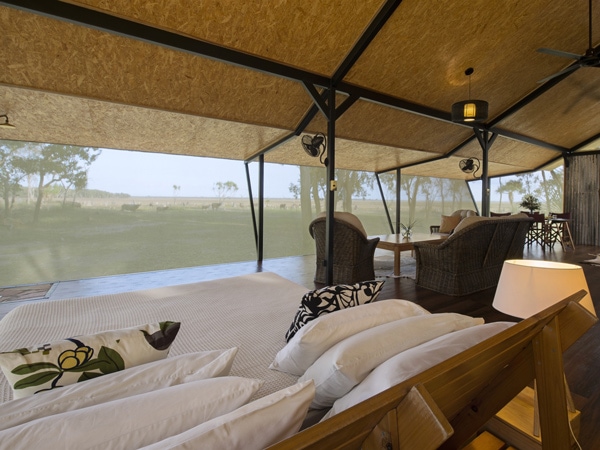
And, with a responsibility towards one of Australia’s richest and most important ecosystems, not least in its environmental footprint. Measures including the mesh walls on three sides of my safari bungalow (one of 10, elevated on poles above the floodplain and blended into the bush) that help circumvent the need for air conditioning and allow you to see out without disturbing the wildlife, also serve to create the thinnest of membranes between you and this extraordinary habitat of coastal floodplains, savannah woodland and paperbark swamps. The glow of dawn seeps in through the mesh and, from the comfort of a bed wrapped in sumptuous organic linens, I have a front-row seat to the animal world waking up. Capped off by the morning’s airboat careen through the wetlands themselves, among the spike rush with the white-necked herons, pygmy geese and cormorants, the crocs in the shallows and the buffalo bathing, it’s a singular experience that never fades in my memory. – Imogen Eveson
54. Surveyors, Munro and Retakunna, Tasman National Park, Tas
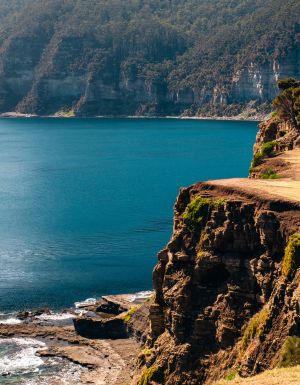
A host ranger greets us when we arrive at each of the three Parks and Wildlife hut sites as independent (non-camping) walkers on the Three Capes Track. All sites have three eight-bed dorms and six rooms with four bunks. And they’re cutting edge in terms of remote comfort and eco design. This 48-kilometre track to the southern hemisphere’s tallest sea cliffs is open year-round. When I walk it in mid-winter, pellet heaters burning processed waste material take the chill off inside. Though, better still, are the sun-catching verandahs for lounging and chatting.
There’s running water, cooking facilities, solar lighting, books, comfy seats and incredible views. Windows are angled to reduce bird strike. And the huts are constructed with fire-retardant material and raised off the ground, so we’d apparently be OK in a bushfire. – Elspeth Callender

55. Oceanview Eco Villas, Kangaroo Island, SA
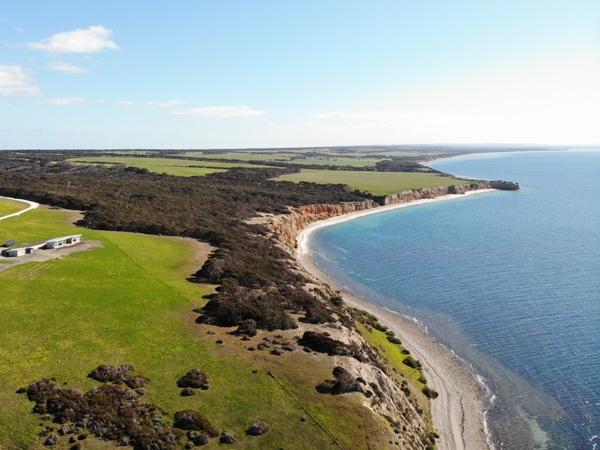
From a cursory glance, there’s nothing extraordinary about Oceanview. Sure, the two villas are beautiful, exuding luxury in their minimalism and materials. And certainly, a palpable sense of Zen pervades. Lashings of natural light pools within each room. A bathtub sits below huge bifolds that spotlight nothing but golden pasture, tall eucalypts and navy sea. And cleverly positioned letterbox windows frame the landscape as if it were a living, breathing watercolour.

But don’t be fooled by the simplicity of it all. Owners Tim and Tamsin Wendt have dedicated five years to planning this Kangaroo Island venture, and every last intricacy has been considered. From the taupe bedroom carpets fashioned from recycled fishing nets; to the rainwater that’s harvested on property; the solar panels that power this off-grid property; and the glass that’s been expressly designed for the Aussie climate and installed in each room, helping keep the two-bedroom, two-bathroom villas cool in summer and warm in winter. Even Oceanview’s construction materials were hyper-locally sourced, with all bar one per cent from South Australia.
The pride that Tim and Tam feel for the island, and their passion for the venture, is tangible and contagious. It rubs off as we sip aperitifs – Kangaroo Island Spirits’ gin and tonics, garnished with sprigs of coastal daisybush, an aromatic native botanical that Tam plucked fresh from the cliffs that morning. And it radiates as we chat over the hand-delivered three-course dinner – Tam pointing across the horizon to the Spencer Gulf to show where the plump prawns on our plate came from.
All these small touches make a stay at Oceanview feel like an overdue catch-up with generous and thoughtful long-lost family friends: the kind that insist upon waving you goodbye as you drive off into the distance. With an easy and genuine warmth, Tim and Tam embody the word ‘hospitality’. And beyond the all-consuming commitment to sustainability, and the vast natural beauty present in this rural parcel of land, that’s what makes it a standout in my 10-year career of hotel hopping – not just in Australia, but on the planet. – Chloe Cann
56. Reefsuites, Great Barrier Reef, Qld
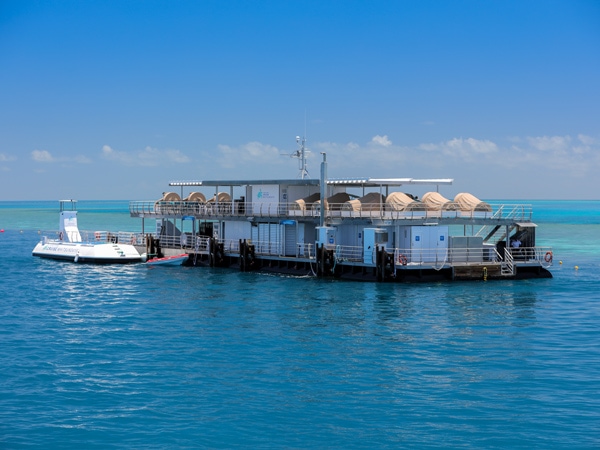
Reefsuites transcends being just unique. This eco-stringent underwater hotel floating on giant pontoons in the waters – and amid the kaleidoscopic marine landscape – of the UNESCO Heritage-listed Great Barrier Reef is an experience you can have nowhere else in the world, because nowhere else on the planet has the largest living organism and coral reef system right on its doorstep. The wonder of residing below the surface of the water, watching the comings and goings outside through huge picture windows, is beyond ethereal (you can also camp out on deck in a specially designed Reefbed pod). And when you do finally fall asleep, you can rest assured (literally) knowing that the structure and the practices implemented there are all designed to have minimal impact on the reef and its fantastical inhabitants.
57. CABN X, McLaren Vale, SA
Disembodied car headlights float through the cool night air like UFOs. They look like visitors from another world and from my vantage point in a commodious outdoor tub with room for two, they might as well be. Though it’s on the edge of McLaren Vale, CABN X feels surprisingly remote and with no wi-fi or TV the entertainment consists of making a bottle of sparkling wine disappear and listening to the sounds of the night.
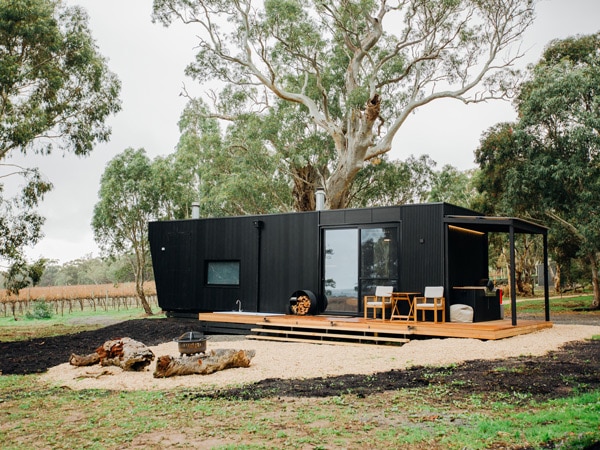
Down an intentionally unmarked dirt track, which is shaded by tightly interlocking trees, the sleek off-grid cabin is flanked by biodynamic vineyards on several sides. And although its sister cabin is only 50 metres away and I see no sign of the other occupants, I’m far from alone. In addition to the sheep grazing between the vines, a quartet of ancient red gums overlooking the cabins serve as apartment blocks for microbats, possums and countless birds. So I’m surprised when I’m able to sleep in the next morning, but as soon as I open the door that doubles as a floor-to-ceiling window I’m struck by the melodious warbling of magpies, cackling kookaburras and chirping rosellas that flit about in a blur of crimson and royal blue.
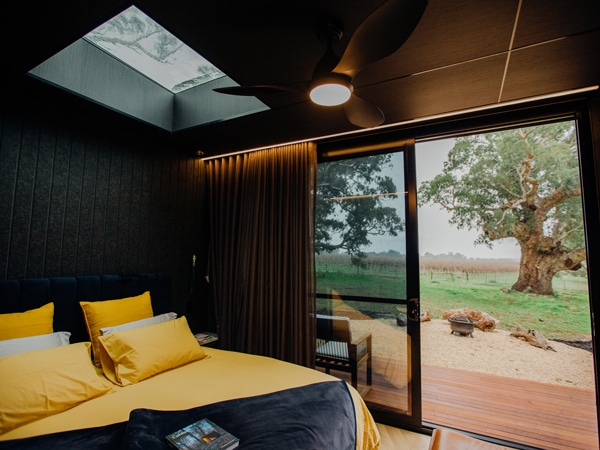
Proximity to nature is a chief part of the appeal of CABN’s Insta-friendly tiny houses, but their latest addition adds a little swag to the minimalist vibe. Despite the name, there’s nothing rustic about CABN X, which has a comfortable king bed with 1200 thread count sheets and a velvet bedhead, indoor and outdoor baths and a full kitchen. The furthest of the three rooms contains a wood-fired cedar sauna, and light streams in through a giant window that takes up the entire wall. Just like the outdoor tub, the sky window above the bed and even the bathroom windows that unfrost at the touch of a button, it’s designed to bring a touch of luxury to the off-grid cabin while still directing my attention to the surroundings that are the real highlight of a stay. With its focus on regenerative tourism, so too is knowing that CABN will donate a portion of each stay to its conservation fund as well as plant a native tree on guests’ behalf. – Alexis Buxton-Collins
58. Heyscape Tiny Cabins, WA
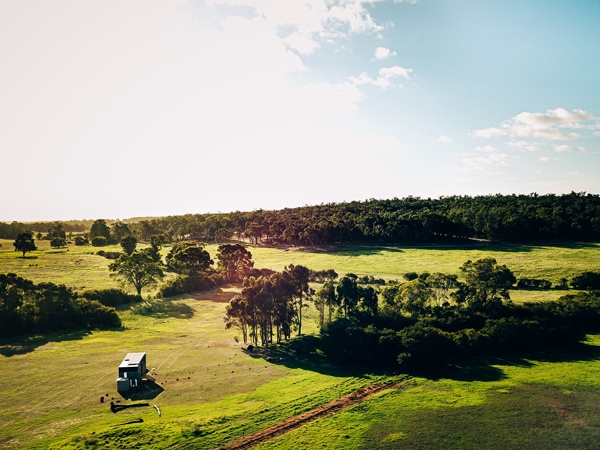
Good things come in small packages, right? The adage certainly rings true for the design-oriented boltholes on wheels that Heyscape Tiny Cabins have placed across rural Western Australia. Sporting lumberjack-vibe wood-panelled interiors, queen beds beside yawning windows and wood fires, the off-grid units are perfect for rebooting. One, named Flynn (after the founder of what is today the Royal Flying Doctor Service, John Flynn) sits surrounded by farmland and vineyards in Margaret River. Edith, after women’s rights activist Edith Cowan, who was also the first Australian female member of parliament, is a dairy paddock or two away. Others sit in quiet, natural environments north of Perth. – Fleur Bainger