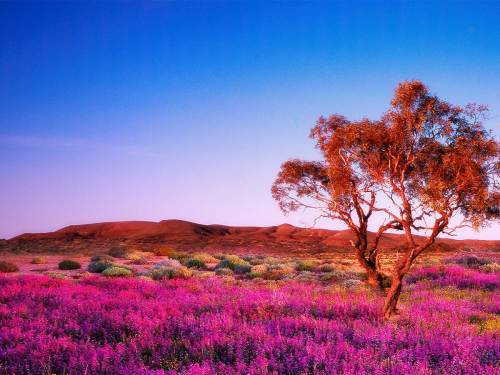
Where to see the best wildflowers in Australia this spring

hero media
It’s spring, so you know what that means… it’s wildflower season in Australia!

From the end of winter through to the beginning of the new year, down under blossoms with spectacular floral displays. Keen to see the country’s incredible biodiversity in full bloom? Below we’re sharing our guide on the best places to see wildflowers in Australia.

Wildflower Country, Western Australia

When it comes to wildflower displays, Western Australia is fortunate enough to have the most incredible, awe-inspiring one in the country.

Every state in Australia is blessed with floral flourishes from an array of native flora, but WA puts on one of the largest shows of wildflowers on Earth, with more than 12,000 species contributing to the wistfully ephemeral annual spectacle.
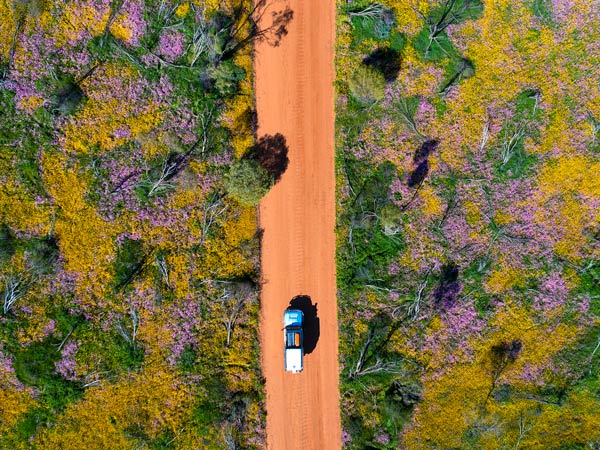
Wildflowers in Coalseam Conservation Park in WA.
WA puts on one of the largest shows of wildflowers on Earth. (Image: Tourism Western Australia)

Of these, an impressive 60 per cent are completely unique to the state and cannot be seen anywhere else on the planet.

When to see them: From August to October
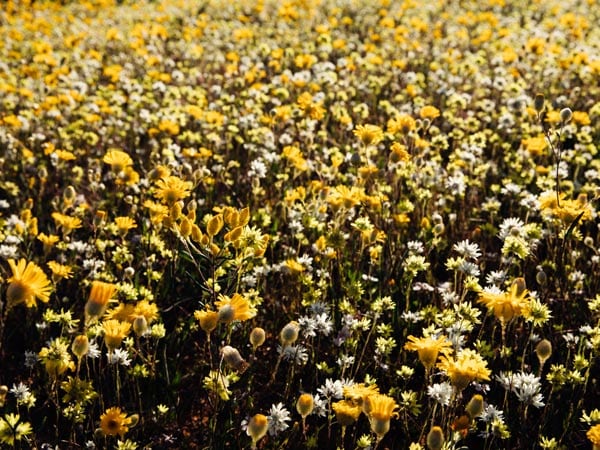
Yellow Wildflowers in canna in Western Australia
WA has more than 12,000 species of wildflowers. (Image: Tourism Western Australia)

Grampians National Park, Victoria

The Grampians (Gariwerd) has been described as the garden of Victoria as it houses more than one-third of Victoria’s flora. The state’s floral emblem, pink common heath, is found in abundance here.

The season of wildflowers, or Petyan, is one of the region’s six distinct weather periods outlined by the region’s traditional owners.

When to see them: From August to November
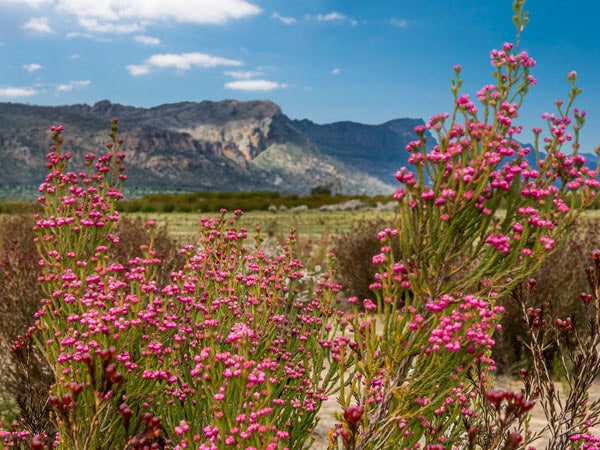
Pink wildflowers in Grampians National Park, Victoria, Australia
The Grampians houses more than one-third of Victoria’s flora.

Larapinta Trail, Northern Territory

The Larapinta Trail takes trekkers 223-kilometre over at least 12 days, through Central Australia’s West MacDonnell Ranges, home to nearly 600 species of rare flora.

Heading along this trail will give you an up-close-and-personal look at the beauty of the Northern Territory’s wildflowers. Delicate purples and bright yellow curry wattles are among splashes of colour often contrasting with the red desert along the route.

When to see them: May or from August to September
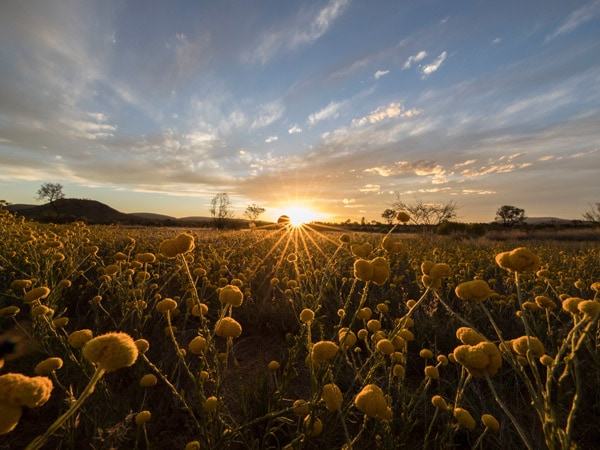
Wattles blooming along the Larapinta Trail in the Northern Territory
Bright yellow curry wattles are among splashes of colour often contrasting with the red desert along the Larapinta Trail. (Image: Tourism NT/Sean Scott)

Flinders Ranges and Outback, South Australia

Spring is a spectacular time in the Flinders Ranges, with so many wildflowers enhancing the amazing landscape. Thanks to the rain from winter, wildflowers and native plants envelop the landscape with bursts of colour.

Mount Remarkable National Park in Southern Flinders is only a few hours from Adelaide, and spots like Alligator Gorge will be full of wildflowers as spring progresses as well.

When to see them: From September to November
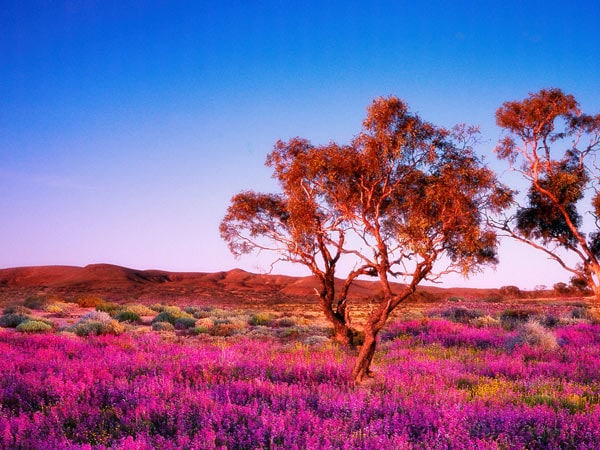
Purple and pink flowers on the Oodnadatta Track in the Flinders Ranges.
Wildflowers and native plants envelop the landscape with bursts of colour. (Image: Julie Fletcher)

Kosciuszko National Park, New South Wales

Kosciuszko National Park is roughly a 5.5-hour drive from Sydney or 2.5 hours from Canberra and is home to some of the best winter activities in the country in the Snowy Mountains. But, winter isn’t the only time to enjoy the beauty here.

In spring, pops of purple, yellow and pink cover the alpine fields. Hundreds of species grow here, including 21 that are unique to the area.

One of the nicest ways to see them is along the Kosciuszko Walk, which travels for 13 kilometres from Thredbo to the summit of Mount Kosciuszko. Or you can drive the Alpine Way from Canberra to Thredbo, then wind through prime wildflower territory on the Kosciuszko Summit Walk or cycle past high-altitude florals on the Thredbo Valley Track.

When to see them: From August to early October
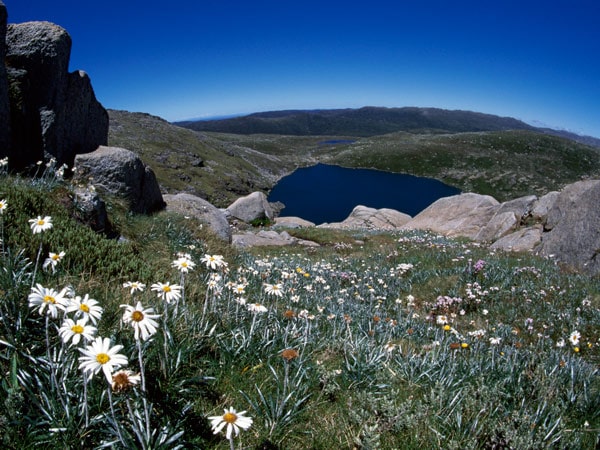
Wildflowers in Snowy Mountains National Park
In spring, pops of purple, yellow and pink cover the alpine fields. (Image: Tourism Australia)

Sunflower Farms, Queensland

Sunflowers grow in various spots around Queensland, and when they choose to bloom is largely up to the elements.

Your best chance of seeing them in full bloom is to head to the Toowoomba and Warwick regions. Some hot spots are Allora, Nobby, Clifton, Freestone and Felton. But hey, to be on the safe side, check in with the Toowoomba and Warwick tourism offices before you jump in the car.

When to see them: From January to March (weather dependent)
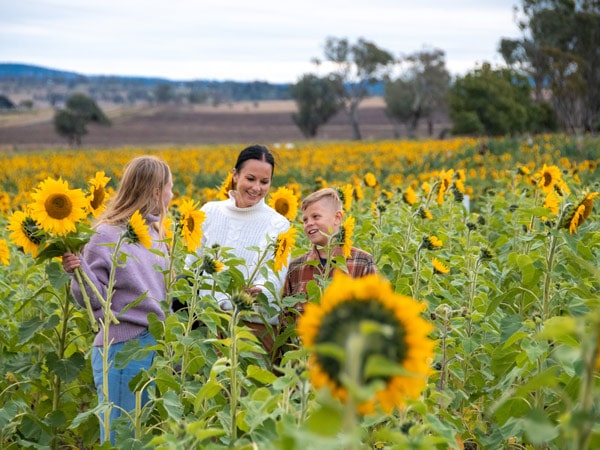
Family in sunflower field in Warraba in Queensland.
Get your sunflower fix in the Sunshine State. (Image: Tourism and Events Queensland)

This article was originally written by Emily Murphy with updates by Rachael Thompson.

Emily Murphy
Emily Murphy is Australian Traveller's Email & Social Editor, and in her time at the company she has been instrumental in shaping its social media and email presence, and crafting compelling narratives that inspire others to explore Australia's vast landscapes. Her previous role was a journalist at Prime Creative Media and before that she was freelancing in publishing, content creation and digital marketing. When she's not creating scroll-stopping travel content, Em is a devoted 'bun mum' and enjoys spending her spare time by the sea, reading, binge-watching a good TV show and exploring Sydney's vibrant dining scene. Next on her Aussie travel wish list? Tasmania and The Kimberley.
See all articles
hero media

A must-visit list of Victoria’s most iconic spots

From natural wonders to historical sites, we’ve rounded up Victoria’s most epic icons that deserve a place on your itinerary.

Grampians (Gariwerd) National Park

Mount William peak in Grampians (Gariwerd) National Park
Mount William is the highest peak in the Grampians (Gariwerd) National Park. (Image: Matt Donovan)

From towering mountains to crystal cascades and ancient rock art sites, the Grampians (Gariwerd) National Park is a playground for both outdoor adventurers and nature lovers. Don’t miss the views from the highest peak Mount William or the iconic Pinnacle.

Murray River

A paddle steamer down the Murray in Echuca
The wonders of the Murray are best experienced on board a paddle steamer. (Image: Visit Victoria)

A natural icon of majestic proportions, the Murray River flows for a staggering 2700 kilometres, making it one of the world’s longest navigable rivers. Meandering through Victoria before flowing out to sea at Goolwa in South Australia, the river is home to diverse wildlife, picturesque towns and secluded creeks and beaches.

Twelve Apostles, Port Campbell

the Twelve Apostles, Great Ocean Road
The Twelve Apostles are a star attraction on the Great Ocean Road. (Image: Tourism Australia/Two Palms/Harry Pope)

These limestone sea stacks are arguably Victoria’s most famous icon . After an $8-million upgrade to its lookout, The Blowhole near Loch Ard Gorge/Poombeeyt Kontapool (meaning breath of the whale) has recently reopened. A brand-new Twelve Apostles Visitor Experience Centre, complete with rooftop lookout, will open in 2026.

You Yangs, Geelong

kangaroos in You Yangs
Kangaroos enjoy dusk in the You Yangs. (Image: Tourism Australia)

Rising 300-plus metres from the flat volcanic plains between Melbourne/Naarm and Geelong, the You Yangs are massive granite boulders named for the local Wadawurrung word ‘Youang’, meaning ‘big hills’. Hiking, biking, rock climbing and horse-riding are popular within this regional park.

Redwood Forest, Yarra Valley

Redwood Forest, Yarra Valley
Yarra Valley’s soaring Redwood Forest. (Image: Tourism Australia)

Near the town of Warburton, an extraordinary forest of some 1500 Californian Redwoods stands among native orchids, eucalypt trees and rich birdlife. Planted in the 1930s, these 55-metre-plus trees can live for 2000 years and will grow to be some of the world’s tallest.

Wilsons Promontory, Gippsland

the Wilsons Promontory
Wilsons Promontory is home to the incredible Skull Rock formation. (Image: Tourism Australia)

The Prom, as it’s known locally, is the southernmost tip of mainland Australia. This 50,000-hectare reserve comprises granite mountains and forest, fringed by sandy beaches and surrounded by a marine park rich in marine biodiversity. It’s also home to the incredible and imposing Skull Rock formation.

Hanging Rock Reserve, Macedon Ranges

the Hanging Rock Reserve, Macedon Ranges
Enigmatic Hanging Rock. (Image: Visit Victoria/ Rob Blackburn)

This six-million-year-old volcanic rock  was thrown into the national spotlight thanks to the 1967 novel and consequent 1975 film based on the fictional disappearance of schoolgirls in 1901. Mystery aside, visitors can walk the steep 105-metre summit, fish for trout and go twitching.

Sovereign Hill, Ballarat

exploring Sovereign Hill
Step back in time at Sovereign Hill. (Image: Tourism Australia)

Cry ‘eureka!’ at Sovereign Hill , a living museum to the prosperous Gold Rush era of the 1850s, during which Ballarat produced the most gold in the world. Visitors to this much-loved attraction can walk historic  streets, enter a gold mine and try panning for the good stuff, too.

The Great Stupa, Bendigo

Great Stupa, Bendigo
The Great Stupa in Bendigo. (Image: Tourism Australia)

Who’d have thought the largest Buddhist temple in the Western world would be tucked away in Bendigo’s bushland? Welcoming visitors to explore, this sacred Buddhist pagoda is an epicentre for Tibetan culture, architecture, art and interfaith harmony.

Cape Schanck Lighthouse, Mornington Peninsula

the Cape Schanck Lighthouse from above
Heritage-listed Cape Schanck Lighthouse. (Image: Tourism Australia/Two Palms/Harry Pope)

Ensuring the safe passage of ships in the notoriously treacherous Bass Strait since 1859, this heritage-listed lighthouse overlooks dramatic volcanic coast and wild beaches. The surrounding reserve is home to a plethora of wildlife including little penguins, seals and echidnas.