10 best trails for hiking in Brisbane (no matter your skill level)

hero media
Get those legs moving all while exploring more of Queensland’s natural beauty.

Brisbane is full of incredible restaurants, a bustling cafe scene and ample things to do, but sometimes a break from the chaos of city life is needed and your body craves an escape to nature. And what better way to do that than hiking in and around Brisbane?

Well, put those walking shoes on because we’ve found all the best hikes near Brisbane for any skill level.

1. Summit Track, Mt Coot-tha
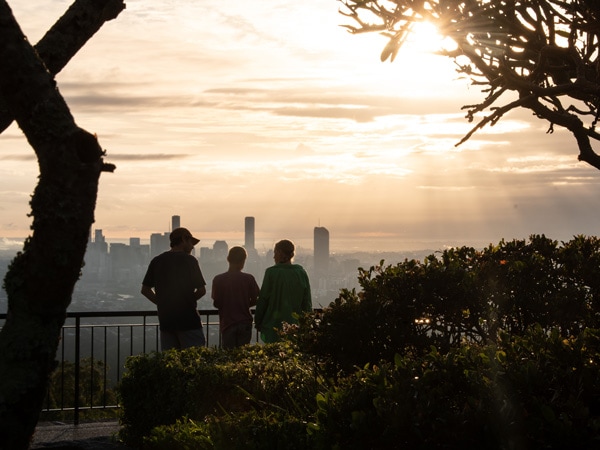
People standing at Mount Coot-tha Lookout at sunset hike in Brisbane
With views that go on for days, this walk is well worth it. (Image: Tourism and Events Queensland)

Friends, lovers, families, dogs – everyone in Brissie knows this iconic peak for its cracking views of the city.

Mt Coot-tha Lookout has sweeping views of Brisbane City, Moreton Bay, and around to the Tweed Volcano, Main Range and Mount Barney and Flinders Peak.

This track leads from the JC Slaughter Falls picnic area to the lookout and is just a 15-minute drive from the CBD.

Difficulty: Easy-moderate.
Terrain: Hilly.
Distance: 1.9 kilometres one way.
What to bring: Water, camera, sun protection.

2. North Gorge Walk, North Stradbroke Island
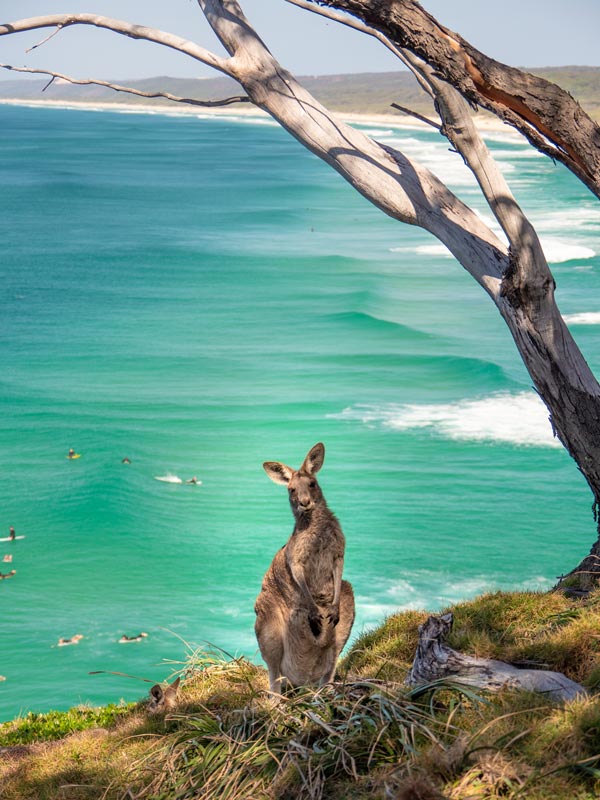
Kangaroo on North Gorge Walk
You’ll spot some wildlife on land. (Image: Tourism and Events Queensland)

One of the must-dos on North Stradbroke Island, the North Gorge Walk follows the headland of Point Lookout all while showing off breathtaking ocean views.

If you do it between June and November, you might even get to see migrating humpback whales, as the Gorge Walk is the best vantage point.

Difficulty: Easy-moderate.
Terrain
: Boardwalk.
Distance: 1.2 kilometres.
What to bring: Water, camera, sun protection.

3. Natural Bridge circuit, Springbrook National Park
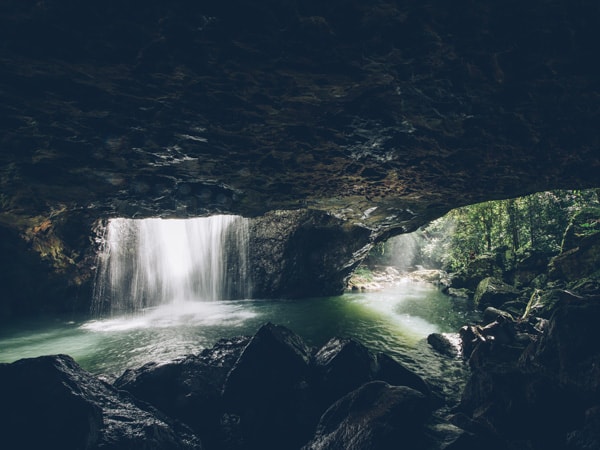
Waterfall coming from natural bridge above in Springbrook National Park
Glow worms and a waterfall? Yes, please. (Image: Tourism and Events Queensland)

The Natural Bridge circuit walk is a sealed circuit track that takes you through the forest, across Cave Creek and into the arched cave to witness the waterfall plunging from above.

Not only that, but at night you’ll be blessed with the tiny green lights of thousands of nocturnal glow worms! Glow worms are visible year-round; however, their display is significantly reduced during the winter months.

Be careful walking at night and make sure you bring sufficient lighting. There are also some restricted access areas to keep in mind when planning your hike.

Difficulty: Easy-moderate.
Terrain
: Asphalt track, but due to long sets of stairs, it is easier to walk this track in a clockwise direction.
Distance: One kilometre.
What to bring: Mosquito repellent, drinking water, torch.

Need tips, more detail or itinerary ideas tailored to you? Ask AT.

AI Prompt

4. Tamborine Mountain
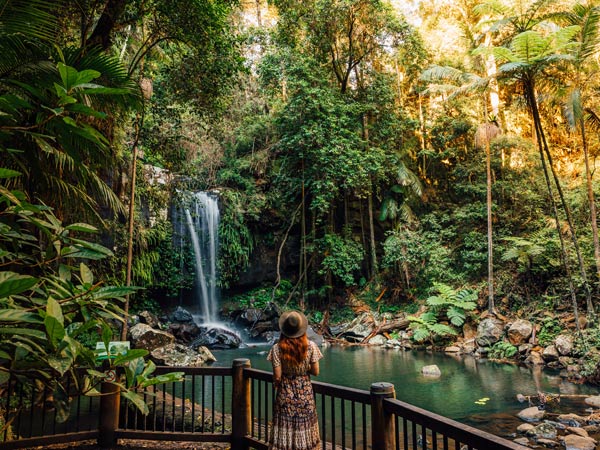
Woman standing in front of Curtis Falls
Stop at the beautiful Curtis Falls on your way. (Image: Tourism and Events Queensland)

Walking tracks are provided in six sections of Tamborine National Park. Most of them are short and relatively easy, although some have short, steep sections.

The hiking trails range from grade 1 to grade 4, so you can choose the track you want to take based on your fitness capabilities.

Difficulty: Easy-moderate.
Terrain
: Some steep sections.
Distance: Ranging from 400 metres to 4.8 kilometres.
What to bring: Water, sun protection.

5. Northbrook Gorges, D’Aguilar National Park
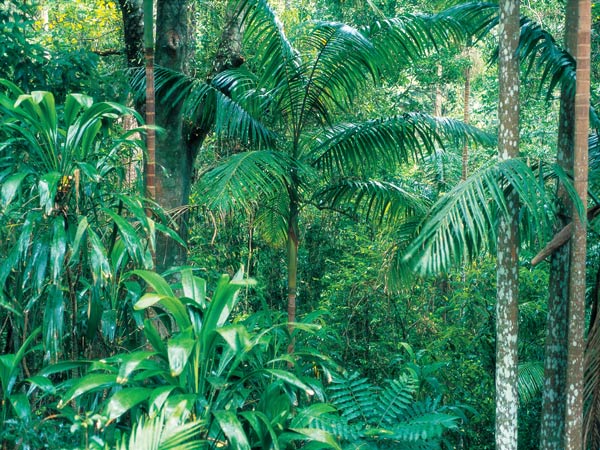
Ferns in Northbrook Gorges near Brisbane
This hike is suited for more experienced hikers. (Image: Tourism and Events Queensland)

Bring your swimmers for this next hike! You’ll have to swim through two freshwater gorges as part of this trail.

You’ll come across rock pools along the journey, with the longest measuring about 15 to 20 metres.

But the highlight of the Northbrook Gorges hike is the large, almost crystal clear, rock swimming pool, complete with a short waterfall, found in the second gorge.

The majority of the hike will take you over rocks, boulders, and rough and slippery terrain, making it best suited for fit and experienced hikers.

Difficulty: Moderate.
Terrain: Wet!
Distance: Six kilometres.
What to bring: Swimmers, drinking water, sun protection.

6. Kondalilla Falls circuit
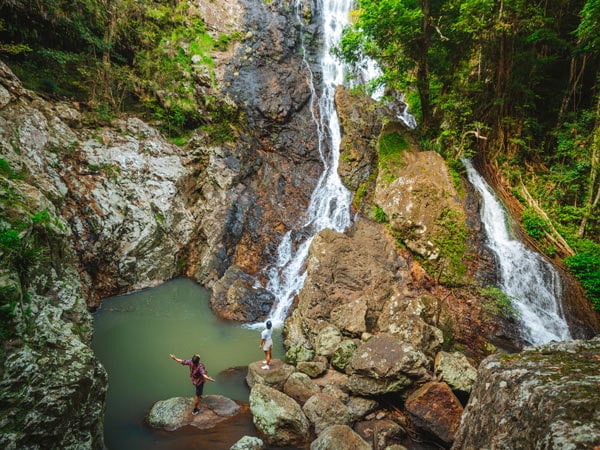
Bottom of Kondalilla Falls hike near Brisbane
Take a dip at Kondalilla Falls on your hike. (Image: Tourism and Events Queensland)

Located on the Sunshine Coast Hinterland, the Kondalilla Falls circuit is a stunning hike surrounded by lush rainforest.

You’ll follow the Picnic Creek circuit down the escarpment, go past rock pools and a lookout with views of Kondalilla Falls, all the way down to the base of the waterfall and continue back up the ridge.

But bear in mind there are over 300 stairs on the Kondalilla Falls circuit, so you need to be reasonably fit. Always come prepared, and allow enough time to finish your walk in daylight hours.

Difficulty: Moderate.
Terrain: Stairs.
Distance: 4.7 kilometres.
What to bring: Water, sun protection, camera, swimmers.

7. Araucaria track, D’Aguilar National Park
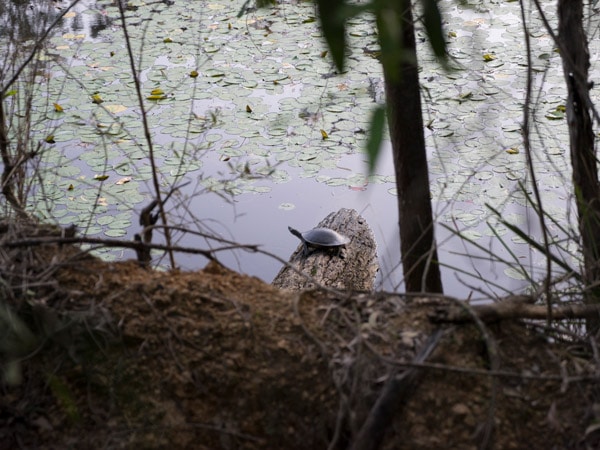
Turtle sitting on log at Araucaria track near Brisbane
Spot turtles, among other wildlife. (Image: Matthew Taylor/Tourism and Events Queensland)

The Araucaria track is a delightful trail that meanders through open eucalypt forest, winding along the forested shores of picturesque Enoggera Reservoir, before looping back around one of the reservoir’s peninsulas.

Head out early because the trail gets quite busy later in the day, and keep an eye out for brown snakes, and dress accordingly – long pants, good shoes, etc.

Difficulty: Moderate.
Terrain: Hilly.
Distance: Five kilometres.
What to bring: Swimmers, drinking water, sun protection, camera, binoculars.

Weekly travel news, experiences
insider tips, offers, and more.

8. Mount Ngungun, Glass House Mountains
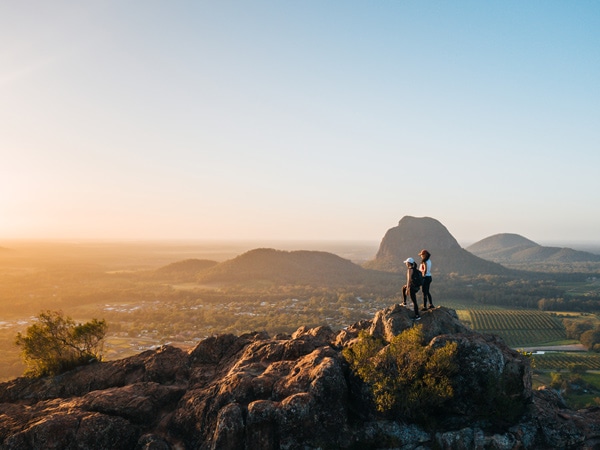
Standing at the top of Mount Ngungun at sunrise near Brisbane after hike
The views from the top of Mount Ngungun are well worth the tough hike. (Image: Tourism and Events Queensland)

If you prefer your hikes a little more rugged, up the ante at Mount Ngungun.

Located in the iconic Glass House Mountains, this short trail begins in an open forest and has some unbelievable views of Mount Tibrogargan, Mount Coonowrin and Mount Beerwah from the summit.

You should be moderately fit to do this grade 4 hike, and it passes close to cliff edges so be careful.

Difficulty: Moderate-hard.
Terrain: Steep.
Distance: 2.8 kilometres.
What to bring: Water, sun protection, supportive shoes.

9. Mount Maroon
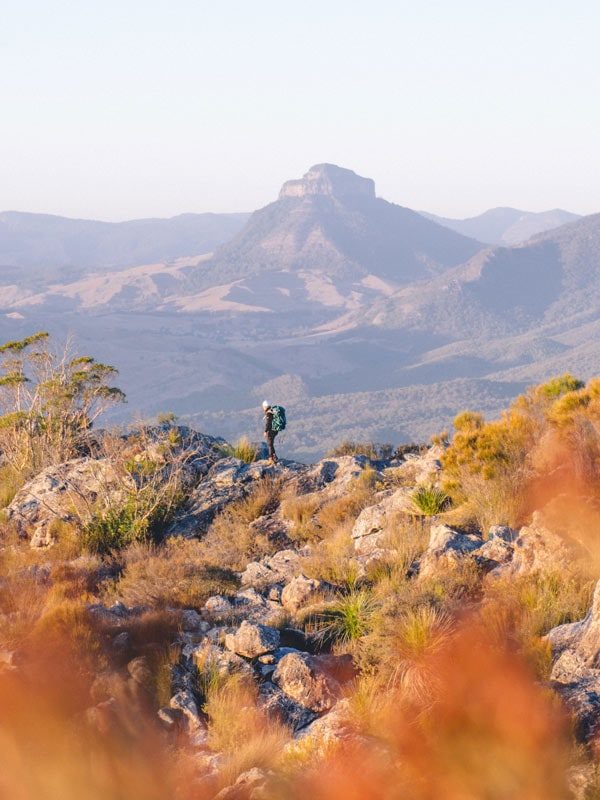
Man standing at the top of Mount Maroon after doing hike
You’ll be feeling Mount Maroon in your legs. (Image: Tourism and Events Queensland)

Mount Maroon is a great warm-up climb if you’ve ever wanted to tackle the neighbouring Mount Barney.

It’s steep from the get-go, and the hike will test those leg muscles on a number of occasions. But even though it’s an intense track, the views are well worth it. But only if you are an experienced hiker.

Offline navigation is strongly recommended for this one. And as always, let someone know where you are and when you plan to finish the hike.

Difficulty: Moderate-hard.
Terrain
: Steep.
Distance: Six kilometres.
What to bring: Lots of drinking water, sun protection and a personal locator beacon (PLB) is recommended.

10. Mount Barney

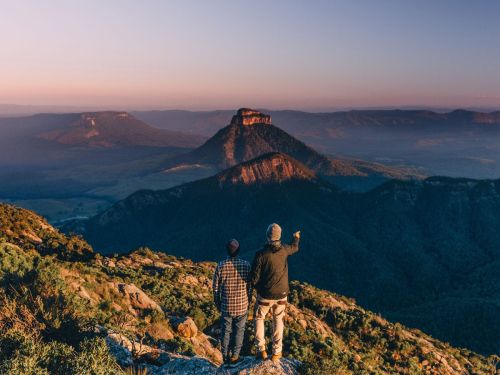
Two men at the top of Mount Barney after hike in Brisbane
Mount Barney is not for the faint-hearted. (Image: Tourism and Events Queensland)

The mother of all Brisbane hikes really takes it up a notch at Mount Barney – South East Queensland’s second-highest peak.

There are four walking tracks at Mount Barney, all classified as grade 4, but varying in length. Yellow Pinch, Lower Portals, Cronan Creek and Upper Portals.

Remember to stay safe at all times, only choose activities that suit the skills, experience and fitness of your group, never walk alone and make sure someone knows where you are, and what time you plan to finish hiking the trail.

Difficulty: Moderate-hard.
Terrain: Rugged.
Distance: Two kilometres return (Yellow Pinch), 7.4 kilometres return (Lower Portals), eight kilometres return (Upper Portals) and 12 kilometres return (Cronan Creek Falls).
What to bring: Lots of water, chemical tablets to treat water, a raincoat, a PLB is recommended, bushwalking equipment and all your sun protection goodies.

Emily Murphy
Emily Murphy is Australian Traveller's Email & Social Editor, and in her time at the company she has been instrumental in shaping its social media and email presence, and crafting compelling narratives that inspire others to explore Australia's vast landscapes. Her previous role was a journalist at Prime Creative Media and before that she was freelancing in publishing, content creation and digital marketing. When she's not creating scroll-stopping travel content, Em is a devoted 'bun mum' and enjoys spending her spare time by the sea, reading, binge-watching a good TV show and exploring Sydney's vibrant dining scene. Next on her Aussie travel wish list? Tasmania and The Kimberley.
View profile and articles
hero media

Exploding supernovas & gold fever: discover the past at this outback Qld town

    Kassia Byrnes Kassia Byrnes
    Under wide-open outback skies, discover a fossicking gem that’s managed to slip under the radar.

    While the name Clermont may feel new to even the most intrepid traveller, its gilded history stretches back centuries. You’ll find it just off the highway, humming quietly under the hazy veil of Queensland’s outback sun. It’s here, hemmed in by mountains and perched atop soil heavy with the earth’s treasures, that one of Australia’s most accessible outback adventures awaits.

    Thanks to deposits of gold, copper and gemstones – souvenirs left by exploding supernovas and the heave of tectonic plates – Clermont became a centre point of Queensland’s Gold Rush. And now? Australia’s fossicking capital is yours to discover.

    Getting there

    car driving along Capricorn Way in queensland
    Take a drive through Queensland’s Mackay Isaac region. (Image: Sean Scott/ TEQ)

    You’ll find Clermont in Queensland’s Mackay Isaac region. To get here, it’s an easy three-hour drive over sealed roads from Mackay. Or, if you’re heading from the Sapphire Fields of Emerald, the drive will carve out just over an hour from your day.

    Whether you’re road-tripping through outback Queensland or just tracing your way through all that Australia has to offer, Clermont is remote but easily accessible.

    Best accommodation in Clermont

    Theresa CreekDam in clermont
    Camp by Theresa Creek Dam. (Image: Riptide Creative/ TEQ)

    All accommodation comes with a generous helping of country hospitality here. The choice is yours between modern hotels, parking up the camper or pitching a tent.

    Theresa Creek Dam lies just outside town. Begin each day with crisp country air and bright outback sunrises. Spend the night under the sparkling country stars and your days out on the dam fishing or kayaking. Even if you aren’t camping, be sure to save space in your itinerary for an afternoon on the red dirt shore.

    To stay closer to town, opt for a central hotel to base yourself between exploring and fossicking, like Smart Stayzzz Inn and Clermont Country Motor Inn.

    Things to do in Clermont

    three people on a tour with Golden Prospecting
    Join a tour with Golden Prospecting.

    One does not visit Clermont without trying their hand at fossicking. There are strict rules when it comes to fossicking, so stick to areas dedicated for general permission and make sure you obtain your license beforehand. Try your luck at McMasters, Four Mile, Town Desert, McDonald Flat and Flat Diggings. To increase your odds, sign on for a tour with the expert team at Golden Prospecting. They’ll give you access to exclusive plots and expert advice along the way.

    Once you’ve tried your luck on the gold fields, head to the Clermont Township and Historical Museum. Each exhibit works like an archaeologist’s brush to dust away the layers of Clermont’s history. Like the steam engine that painstakingly relocated the entire town inch by inch to higher ground after it was decimated by flooding in 1916. See the tools that helped build the Blair Athol mine, historic fire engines, shearing sheds and all sorts of relics that make up Clermont’s story.

    The historic Copperfield Chimney offers a change of pace. Legend has it that fossickers found a solid wall of copper here, over three metres high, kick-starting Queensland’s first-ever copper mine.

    Bush Heli Services flying over clermont queensland
    See Clermont from above with Bush Heli Services. (Image: Riptide Creative/ TEQ)

    For hiking, nearby Dysart is the best place to access Peak Range National Park. Here, mountainous horizons stretch across the outback as if plucked from another world. Set off for a scenic drive along the Peak Downs Highway for access to countless geological wonders. Like the slanting rockface of Wolfang Peak. Summit it, and you’ll find yourself looking out across a scene surely conjured up by Banjo Paterson. Dry scrub dancing in the warm breeze, grazing cattle, eucalypts and the gentle creak of windmills. Don’t miss visiting Gemini Peaks, either, for one of the park’s best vistas, and a blanket of wild flowers after rain.

    Then, take to the skies with a scenic helicopter tour with Bush Heli-Services. Shift your perspective and cruise above all the sights from your trip. Spots like Lords Table Mountain and Campbell’s Peak are best viewed from the skies.

    Before you head home, be sure to explore the neighbouring townships. Spend a lazy afternoon in the shade of Nebo Hotel’s wrap-around verandahs. The hotel’s 1900s dance hall has since been replaced with one of the area’s biggest rodeo arenas, so consider timing your trip to line up with a boot scootin’ rodeo. Or, stop by a ghost town. Mount Britton was once a thriving town during the 1880s Gold Rush. It’s been totally abandoned and now lies untouched, a perfect relic of the Gold Rush.

    Best restaurants and cafes in Clermont

    meal at Commercial Hotel
    Stop into the Commercial Hotel Clermont.

    Days spent fossicking, bushwalking and cramming on history call for excellent coffee and hearty country meals. Luckily, Clermont delivers in spades.

    Lotta Lattes Cafe is beloved by locals for a reason. Start your days here for the best caffeine fix in town and an impeccable brunch menu.

    For a real country meal, an icy cold beer and that famed country hospitality, head straight to the town’s iconic hotel: the Commercial Hotel (known endearingly to locals as ‘The Commie’). It’s been a staple in Clermont since 1877. The hotel even survived the flood of 1916 when it was sawn in two and moved to higher ground.

    Naturally, time spent in the outback must include calling into the local bakery. For delicious pies and a tantalising array of sweet treats, make Bluemac Bakehouse your go-to while in town.

    Discover more of The Mackay Isaac region, and start planning your trip at mackayisaac.com.