Slow the flow of modern-day life in Australia’s magical spa country with a stay at the new Hepburn Bathhouse.
Sunlight spills across a large wooden table lined with a curious collection of essences, extracts, and pastel-hued powders in glass jars, each with a handwritten label. I pause at each of the small brown bottles, drawing their pipettes to compare the heady scents. Meanwhile, a spa therapist assuming the role of fragrance sommelier explains the formula for a perfectly scented soak: an uplifting citrus top note, a relaxing floral middle note, and a grounding, rich and heavy base note. I squeeze drops of bergamot, lavender, and a dash of frankincense into my bowl, stirring them with a scattering of rose petals, some pink Himalayan rock salt, and a sprinkle of ashwagandha in a small pot with a wooden spoon: it’s all a little bit meditative, ASMR and aesthetically pleasing.
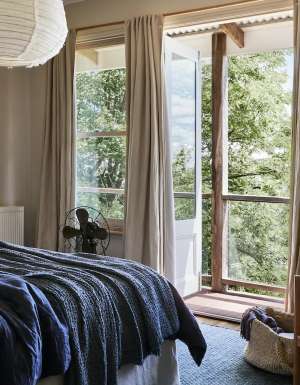
Dip into magic. Hepburn Bathhouse has reopened bigger and better – think private mineral baths, custom apothecary soaks and rooms that range from pink-tiled bliss to slate-minimal zen.
Custom ‘apothecary’ experience
Each guest who opts for a private ‘Alchemist Mineral Bath’ at Hepburn Bathhouse & Spa is invited to make their own custom concoction. As my bath is drawn, I laze in the adjacent sunken timber lounge, sipping on an organic, herbal house-made tea that features some of the very same botanicals as the essential oils on the table (calendula, licorice root and spearmint, to name a few). Snug in slippers and a white waffle robe, I unfurl one of the curled blankets across my lap as melodic spa music echoes, and succumb to the serenity that permeates the spa’s every corner.
Guests can now customise their own Apothecary concoction when booking a private bathing experience. (Image: Supplied)
The marble private bathing room is one of five new designs. (Image: Supplied)
The new Apothecary experience is for guests who opt for the private bathing rooms. (Image: Supplied)
Another version of the new private bathing rooms. (Image: Supplied)
Pink subway tiles create a soothing space to bathe. (Image: Supplied)
Private mineral baths updated
This hands-on ‘apothecary’ experience is one of the newest additions to Australia’s oldest spa (est. 1895), which reopened in August 2025 after a multimillion-dollar facelift. The entire space has undergone a refresh, from new tiling and lighting to refurbished changing rooms. But chief among the updates are the private mineral baths themselves, five of which were overhauled by contestants from the 21st season of The Block, each offering a wholly different vibe. One is vibrant and uplifting, plastered with pink subway tiles; another is awash with slate and captures a meditative minimalism; while a third is a riot of patterns, decked in veined marble, chevron-tiled floors, and an embossed copper-look ceiling.
A soothing soak in the mineral waters of Hepburn Bathhouse & Spa. (Image: Supplied)
The therapeutic powers of mineral bathing
A 45-minute soak in a private bath might feel like an eternity of solitude in an age defined by overscheduling, digital addiction, restlessness and hustle culture, yet the time slips by surprisingly quickly and proves unexpectedly restorative. There’s a sudden rosy glow on my long anaemic-looking cheeks, a softness to my skin, and, just maybe, a slower pace to my thoughts. The therapeutic powers of mineral bathing have, of course, been lauded for centuries: even the ancient Greeks and Egyptians extolled the virtues of mineral bathing for its relaxation properties and supposed ability to treat ailments. The warm, spring-fed waters here at Hepburn Bathhouse are rich in magnesium, calcium, silica and sulphur, helping to ease muscle tension and support skin health. But there’s a mindfulness element too.
The benefits of bathing have long been praised. (Image: Supplied)
In the main bathhouse, couples, friends, and mums and daughters all take to the waters, chatting, relaxing and generally enjoying each other’s company. Across history and cultures, bathhouses have acted as social hubs and anchors for local communities, and it feels profoundly refreshing to see people carve out time together, not a screen in sight; almost as if stepping into a time warp. Solo bathers find serenity here, too. Some resting their cheek on the pool’s edge and closing their eyes as their bodies float, others gazing straight out through the floor-to-ceiling windows to gorge on the abundant greenery beyond, and the occasional swamp wallaby.
From bathing to dining
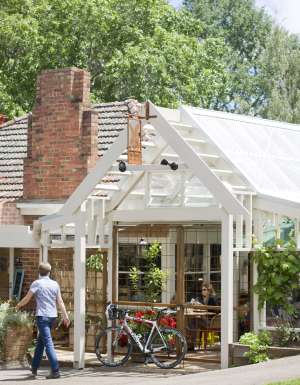
With only a small cafe onsite, those coming to (rightly) make a weekend of it must venture beyond the bathhouse for dinner. Lucky then that noteworthy cafes and restaurants are in strong supply in Australia’s Spa Capital, with Lake House Restaurant , Bar Merenda and The Surly Goat among the region’s frontrunners. Few local restaurants promise a dining experience as mindful and holistically considered as Kadota , however.
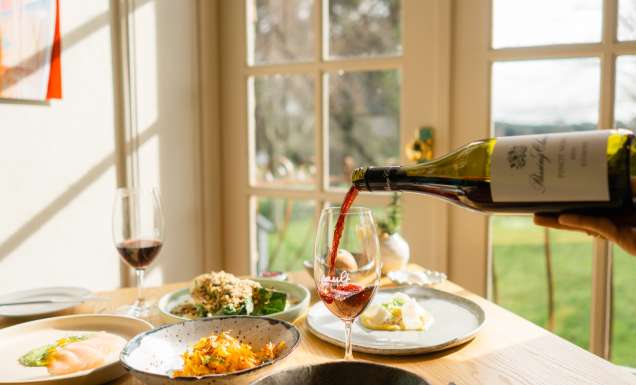
A kaiseki-style restaurant, Kadota invites diners to slow down and savour each elaborately plated morsel by honouring seasonality and exalting the provenance of every ingredient, all with typical Japanese modesty. Come winter, that might mean a pair of small, sweet mousse-like ‘pies’ made of slippery jack mushrooms, white chocolate and pine nuts, and moulded to resemble pumpkins that sit atop a dried oak leaf. Or a fermented kohlrabi and chive sauce that’s poured by teapot, tableside, onto local brassicas — the dish brightened by a cluster of cured salmon roe pearls and butterflies fashioned from daikon. Equal thought and care has been showered upon the dining room, which is a talking point in itself: light shades crafted by a local artist to mimic a lotus root; a feature wall of Daylesford pinewood, blackened using the traditional Japanese wood preservation method of yaki-matsu; hand-scribed scrolls made by co-owner Risa Kadota’s grandfather; and lemon balm stalks strung up along the wall to air-dry for tea.
Like Hepburn Bathhouse, Kadota possesses a special kind of alchemy that’s greater than the sum of its parts, affording guests a deeper connection with the present. Somehow, even the drive from Melbourne to Hepburn feels like part of the experience, as if the spa’s founders dreamed it up that way. The city’s grit, grey and congestion gradually recedes in the rearview mirror, giving way to bucolic scenes and quiet roads: woolly sheep grazing on golden fields, gently rolling hills, winding roads flanked by forest, horses in paddocks, and family-run farmgate stalls. The drive itself becomes part of the ritual, nudging visitors into a more mindful state before they’ve even dipped their toes in the town’s magical waters.
Weekly travel news, experiences insider tips, offers, and more.
Chloe Cann is an award-winning freelance travel and food writer, born in England, based in Melbourne and Roman by adoption. Since honing her skills at City St George's, University of London with a master's degree in journalism, she's been writing almost exclusively about travel for more than a decade, and has worked in-house at newspapers and travel magazines in London, Phnom Penh, Sydney and Melbourne. Through a mixture of work and pleasure, she's been fortunate enough to visit 80 countries to date, though there are many more that she is itching to reach. While the strength of a region's food scene tends to dictate the location of her next trip, she can be equally swayed by the promise of interesting landscapes and offbeat experiences. And with a small person now in tow, travel looks a little different these days, but it remains at the front of her mind.
Slow down and find your rhythm on a Murray River journey through time and place.
Trust is a funny thing. It seems not that long ago that my mother was insisting on pouring the milk into my cereal bowl, because she didn’t trust me not to slosh it over the table, and yet here I am on the Murray River at Mildura in far north-west Victoria, being handed the keys to a very new and very expensive luxury houseboat.
After a crash course in how not to crash, I’m at the wheel of the good ship Elevate – pride of the All Seasons fleet – guiding her upstream past red-ochre cliffs as pelicans glide above the rippled river and kookaburras call from reedy banks. There’s a brief moment of breath-holding while I negotiate a hairpin turn around a jagged reef of skeletal, submerged gum trees, before a cheer rings out and calm descends as the timeless river unfurls in front of us.
The Murray River winding through Yarrawonga. (Image: Rob Blackburn)
Setting sail from Mildura
Home to a large number of bird species, including pelicans. (Image: The Precint Studios)
A journey along the Murray River is never less than magical, and launching from Mildura makes perfect sense. Up here the river is wide and largely empty, giving novice skippers like myself the confidence to nudge the 60-tonne houseboat up to the riverbank where we tie up for the night, without fear of shattering the glass elevator (the boat is fully wheelchair accessible) or spilling our Champagne.
My friends and I spend three days on the water, swimming and fishing, sitting around campfires onshore at night, and basking in air so warm you’d swear you were in the tropics. The simplicity of river life reveals an interesting dichotomy: we feel disconnected from the world but at the same time connected to Country, privileged to be part of something so ancient and special.
Stop one: Echuca
A historic 19th-century paddlesteamer cruises along the Murray River. (Image: Visit Victoria)
The six-hour drive from Melbourne to Mildura (or four hours and 20 minutes from Adelaide) is more than worth it, but you don’t have to travel that far to find fun on the river. Once Australia’s largest inland port, Echuca is the closest point on the Murray to Melbourne (two hours 45 minutes), and you’ll still find a plethora of paddlesteamers tethered to the historic timber wharf, a throwback to the thriving river trade days of the 19th century. The PS Adelaide, built in 1866 and the oldest wooden-hulled paddlesteamer operating in the world, departs daily for one-hour cruises, while a brand-new paddlesteamer, the PS Australian Star, is launching luxury seven-night voyages in December through APT Touring.
The town is also a hot food and wine destination. St Anne’s Winery at the historic Port of Echuca precinct has an incredibly photogenic cellar door, set inside an old carriage builders’ workshop on the wharf and filled with huge, 3000-litre port barrels. The Mill, meanwhile, is a cosy winter spot to sample regional produce as an open fire warms the red-brick walls of this former flour mill.
Stop two: Barmah National Park
Camping riverside in Barmah National Park, listed as a Ramsar site for its significant wetland values. (Image: Visit Victoria/Emily Godfrey)
Just half-an-hour upstream, Barmah National Park is flourishing, its river red gum landscape (the largest in the world) rebounding magnificently after the recent removal of more than 700 feral horses. The internationally significant Ramsar-listed wetland sits in the heart of Yorta Yorta Country, with Traditional Owners managing the environment in close partnership with Parks Victoria. Walkways weave through the forest, crossing creeks lined with rare or threatened plants, passing remnants of Yorta Yorta oven mounds and numerous scar trees, where the bark was removed to build canoes, containers or shields.
The Dharnya Centre (open weekdays until 3pm) is the cultural hub for the Yorta Yorta. Visitors can learn about the ecological significance of the Barmah Lakes on a 90-minute river cruise, led by a First Nations guide, or take a one-hour, guided cultural walking tour along the Yamyabuc Trail.
Stop three: Cobram
Yarrawonga Mulwala Golf Club Resort. (Image: Visit Victoria)
Continue east to Cobram to find the southern hemisphere’s largest inland beach. Swarming with sun-seekers in summer, the white sand of Thompson’s Beach is shaded by majestic river red gums and dotted with hundreds of beach umbrellas, as beachgoers launch all manner of water craft and set up stumps for beach cricket. But the beach is at its most captivating at sunset, when the crowds thin out, the glassy river mirrors the purple sky, and the canopies of the gum trees glow fiery orange.
The region is also home to some fine resorts and indulgent retreats. Yarrawonga Mulwala Golf Club Resort has two riverside championship golf courses, luxury apartments and self-contained villas. While not strictly on the Murray, the historic wine town of Rutherglen is rife with boutique (and unique) accommodation, including an exquisitely renovated red-brick tower in a French provincial-style castle at Mount Ophir Estate. Fans of fortified wines can unravel the mystery of Rutherglen’s ‘Muscat Mile’, meeting the vignerons and master-blenders whose artistry has put the town on the global map for this rich and complex wine style.
Stop four: Albury-Wodonga
First Nations Yindyamarra Sculpture Walk is part of the Wagirra Trail. (Image: Carmen Zammit)
Follow the river far enough upstream and you’ll arrive at the twin border cities of Albury-Wodonga. The Hume Highway thunders through, but serenity can be found along the five-kilometre Yindyamarra Sculpture Walk – part of the Wagirra Trail that meanders through river wetlands just west of Albury in Wiradjuri country. Fifteen sculptures by local First Nations artists line the trail, conveying stories of reconciliation, enduring connection to culture, local Milawa lore and traditional practices. It feels a long way from Mildura, and it is, but the pelicans and kookaburras remind us that it’s the same river, the great conduit that connects our country.
A traveller’s checklist
Staying there
New Mildura motel Kar-rama. (Image: Iain Bond Photo)
Kar-Rama is a brand-new boutique, retro-styled motel in Mildura, with a butterfly-shaped pool and a tropical, Palm Springs vibe. Echuca Holiday Homes has a range of high-end accommodation options, both on the riverfront and in town.
Playing there
Bruce Munro’s Trail of Lights in Mildura. (Image: Imogen Eveson)
Artist Bruce Munro’s Trail of Lights installation, comprising more than 12,000 illuminated ‘fireflies’, is currently lighting up Mildura’s Lock Island in the middle of the Murray. Murray Art Museum Albury (MAMA) is a hub for contemporary art, with a rotating roster of exhibitions, and is a major outlet for young and First Nations artists.
Eating there
Mildura’s diverse demographic means it’s a fantastic place to eat. Andy’s Kitchen is a local favourite, serving up delicious pan-Asian dishes and creative cocktails in a Balinese-style garden setting. Call in to Spoons Riverside in Swan Hill to enjoy locally sourced, seasonal produce in a tranquil setting overlooking the river.