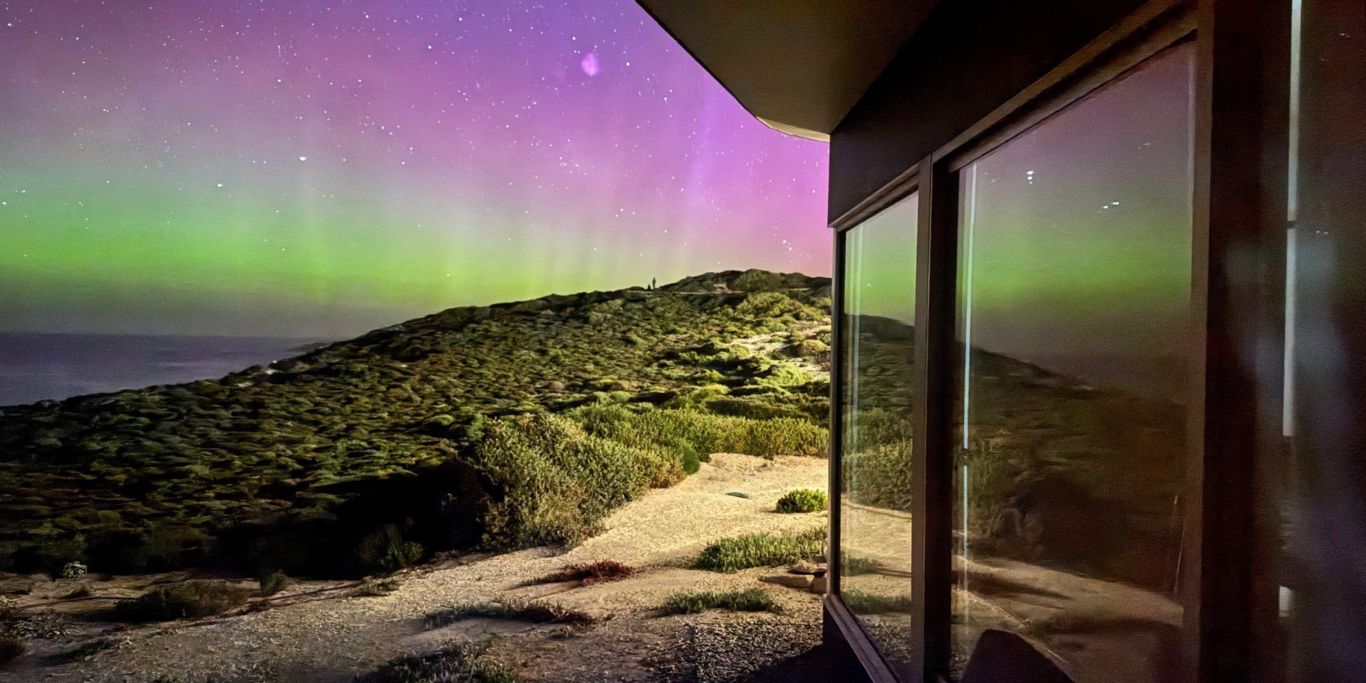

The hottest new accommodation amenity is 400 light-years away – and it might be the most compelling reason yet to book a holiday this season.
There’s a moment, standing on the limestone cliffs of Kangaroo Island’s southern coast, when the absence of something becomes the whole point. No city glow on the horizon. No ambient hum. Just the Southern Ocean stretching toward Antarctica, and above it, a sky so dark it feels almost confrontational.
Southern Ocean Lodge has always traded on its setting – the dramatic clifftop perch, the uninterrupted ocean views, the sense of being genuinely at the edge of something. But this winter, the lodge is inviting guests to turn their gaze away from the horizon and point it somewhere altogether more ambitious: straight up.
The aurora australis (southern lights) is not a guaranteed show. That’s part of the appeal. Unlike a spa treatment or a fine dining menu, it can’t be booked, timed or curated. It shows up on its own terms: shifting bands of green and pink that appear when charged particles from the sun collide with gases in the Earth’s atmosphere, releasing energy as colour across the night sky. The Bureau of Meteorology’s Australian Space Weather Forecasting Centre has identified three windows of heightened aurora activity this year: 12–16 July (peak 14 July), 10–14 August (peak 12 August) and 8–12 September (peak 10 September).
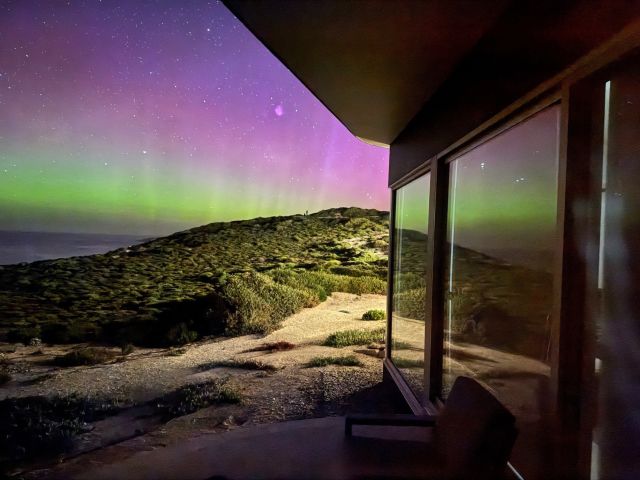
“On a clear winter night, standing on these cliffs with guests and watching the southern horizon is a truly special experience. When the aurora appears, it creates a remarkable spectacle, casting its glow across the ocean, the sky and the limestone coastline," Southern Ocean Lodge general manager Robyn Bautovich said.
You don’t need specialist gear. Modern smartphones in night mode, propped on a steady surface, can capture what your eyes might struggle to see. Though for those who prefer a long exposure and a wide aperture, the clifftop foreground of sculpted limestone and open sea offers a frame that most landscape photographers would plan a trip around.
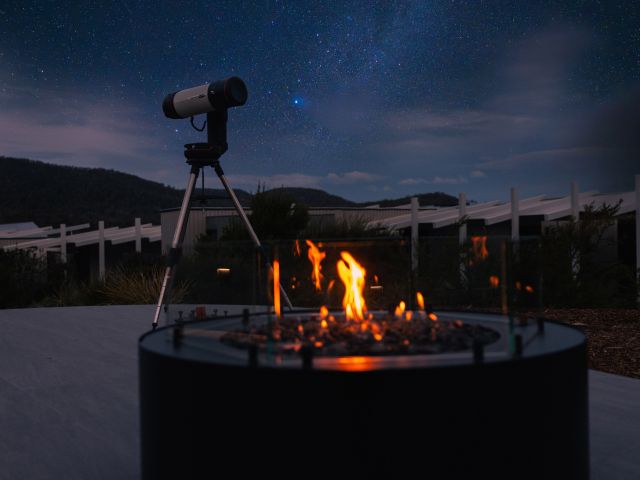
Over on Tasmania’s east coast, Saffire Freycinet has taken a more structured approach with Saffire After Dark, which launched in May this year. It’s the lodge’s answer to a question its guests have apparently always been asking: what happens out there after dinner? The answer, it turns out, involves a softly lit pathway, a sunken amphitheatre, high-powered Celestron telescopes, a Pegasus Smart Eye device, and a qualified astronomer who will walk you through the life cycle of a star.
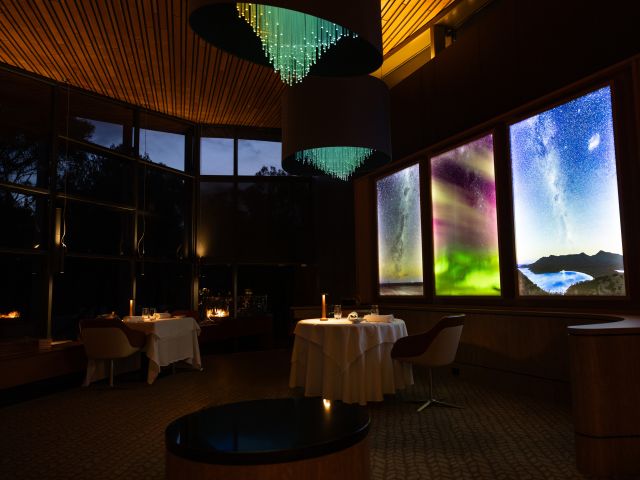
Tasmania already has a strong claim to some of the clearest night skies in the world. The east coast – remote, coastal, and blessedly free of the light pollution that ruins the sky for most of mainland Australia – offers peak Milky Way visibility in winter, along with the same aurora potential that’s drawing travellers to Kangaroo Island. Saffire, which recently picked up two MICHELIN Keys, has now formalised what was always an informal drawcard into a genuine signature experience, available to all guests at no additional cost.
The experience runs for an hour. Guests are guided through constellation identification and southern sky orientation before peering through telescopes at nebulae, star clusters, globular clusters and galaxies. It ends with the chance to handle actual meteorites. Among them: an 8.4-kilogram Boxhole meteorite found near Alice Springs in 1973 and a fragment of the Tissint Mars meteorite, which fell to Earth in Morocco in 2011.
“Winter, in particular, presents a rare opportunity to truly embrace the darkness. Saffire After Dark allows our guests to connect with that natural wonder in a way that feels thoughtful and deeply personal. It’s about creating a moment of awe that stays with you long after the evening ends," Saffire Freycinet general manager Dylan Counsel said.
Guests take home a curated digital collection of telescopic imagery from the night, a bespoke Saffire celestial chart, and a six-month stargazing guide – which, for anyone who finds themselves hooked, is something of a gateway drug.
Need tips, more detail or itinerary ideas tailored to you? Ask AT.
AI Prompt
Australia’s dark sky renaissance in luxury travel
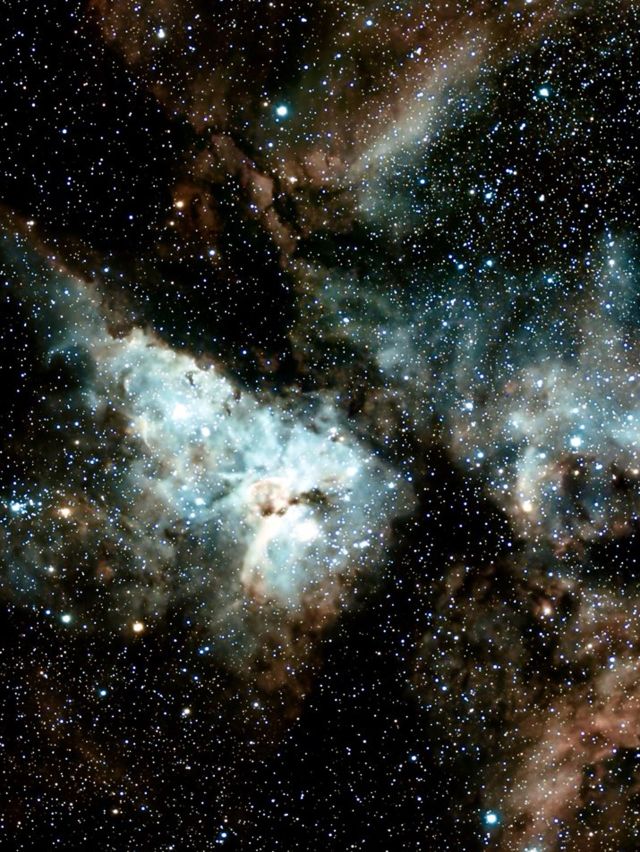
Both lodges have identified a shift in what luxury travellers are actually seeking. The infinity pool and the paddock-to-plate menu remain non-negotiable. But increasingly, the guests arriving at Australia’s most remote and considered properties are looking for something harder to manufacture: genuine awe. The kind that doesn’t come from a wine list or a thread count, but from standing in real darkness and remembering how small you are.
The night sky – ancient, indifferent and spectacularly unimpressed by five-star ratings – turns out to be the ultimate luxury amenity. You just have to be somewhere dark enough to see it.
Want to see more stories from Australian Traveller in your Google search results?
- Click here to set Australian Traveller as a preferred source.
- Tick the box next to "Australian Traveller". That's it.