Dream road tripsPerth to the Pilbara (return)

hero media
An eight-day, 3600-kilometre drive combining the best of outback WA with its glorious west coast (By Daniel Scott).

On the first morning of this trip, having driven our campervan out of Perth for five hours into the inky night the previous day, we awake in a layby in the middle of the desert. As the sun rises over the surrounding plains, a drowsy check of the map confirms that we are 70 kilometres from the nearest settlement, Paynes Find – home to 75 people and exactly one roadhouse.

We have an 800-kilometre drive ahead of us to reach Newman, in the southern Pilbara region. But the moment we rejoin the Great Northern Highway, which threads inland to the deep north-west, I am gripped by excitement.

On this road in remote Western Australia, I can feel freedom and relaxation washing over me. The emptiness of the terrain, the absence of traffic – we don’t see another moving vehicle for the first hour – and the distance from big cities is already releasing weeks of stress.
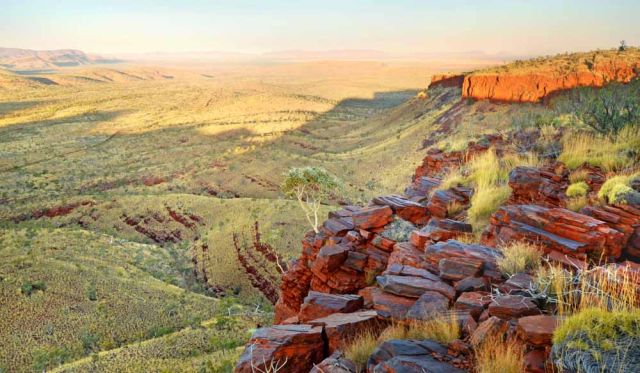
hiking rocks national park
Red rocks in Karajini National Park, Western Australia are some of the oldest exposed rocks in the world.

Passing through Mount Magnet and stopping for lunch at Meekatharra, a dusty rural town steeped in mining and pastoral history, we begin adjusting to a slower pace of life and enjoying the laconic characters it attracts.

Back on the highway, there is something hypnotic about the landscape: a Roman-straight road cutting through flat redness disappearing into a distant haze, and, above it, a penetratingly-blue outback sky scattered with wandering white clouds.

After 10 hours on the road, we spot the iron-ore-rich hills around Newman, crossing the Tropic of Capricorn for the first time during the trip, 15 kilometres south of town. After resting and stocking up on supplies we leave ‘civilisation’ behind and head for Karijini, a 627,000-hectare national park that sits among the Hamersley Range in the heart of the Pilbara.

Karijini is among the oldest landscapes on Earth; some of the rock formations are well over half the age of our 4.5-billion-year-old planet, a sedimentary remnant of when the ocean covered this whole region. Hardened, pushed up and subsequently scored and sliced by rampant waterways as ocean levels dropped, the Karijini landmass eventually became a warren of chasms and high-sided ravines. The chance to see this primordial labyrinth and get close to some of that unfathomably old rock is the main inspiration for our long drive from Perth.
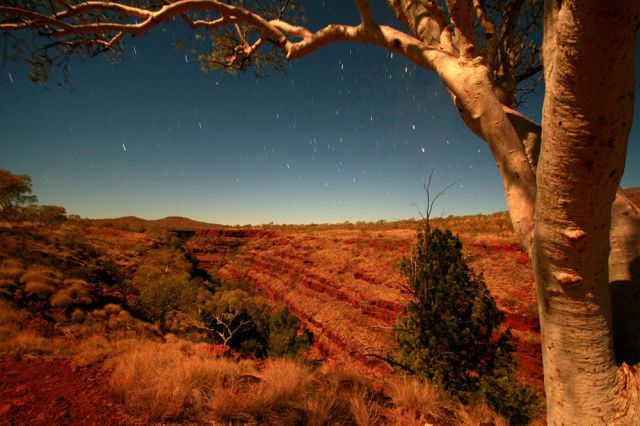
Nighttime at Karajini National Park in the Pilbara region in WA, by AT Reader Carl Drechsler.

Over the next few days, using a campsite at the Aboriginal-owned Karijini Eco Retreat as our base, we explore a succession of ancient canyons cleaved out of the folded Pilbara hills.

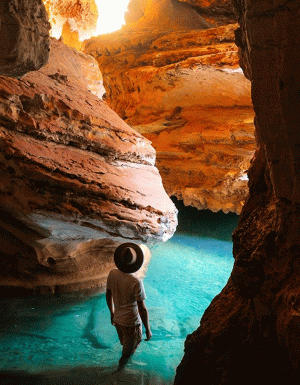
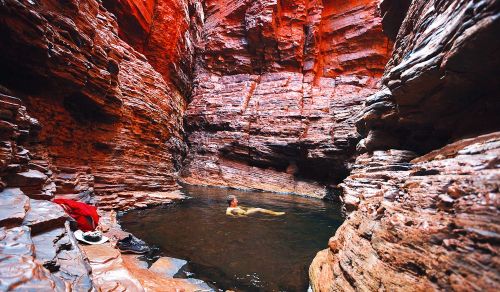
We journey to the centre of the Earth in Hancock Gorge, clambering down ladders fastened into its rock cliffs, then trekking, canyoning and swimming between its increasingly narrow 100-metre-high walls. When we emerge at Kermit’s Pool, an echoing water-filled chamber, we are surrounded by rock that is 2.7 billion years old.

We trek the four-kilometre return trip of Dales Gorge, the most Grand Canyon-esque of Karijini’s gorges, beginning at one sublime swimming hole, the emerald-coloured Fern Pool, and ending at Circular Pool, enclosed by a high rim of dark rock. In between, the creek bed is full of sunken gardens, shallow waterfalls and stacks of striped rock. In places the gorge walls rise up sheer, in others they are worn into chunky steps, climbing to the canyon rim.

Each night we return to our campsite overlooking the savannah, toasting the sunsets and watching the moon emerge as we eat dinner outside the van. Each morning the rising sun illuminates the red earth and brings glowing blue skies.

On our sixth morning we leave Karijini bound for the coast, a drive of over 700 kilometres. We stop only twice, at roadhouses, cross the Tropic of Capricorn again as we turn south and end our day at Bush Bay, near Carnarvon.
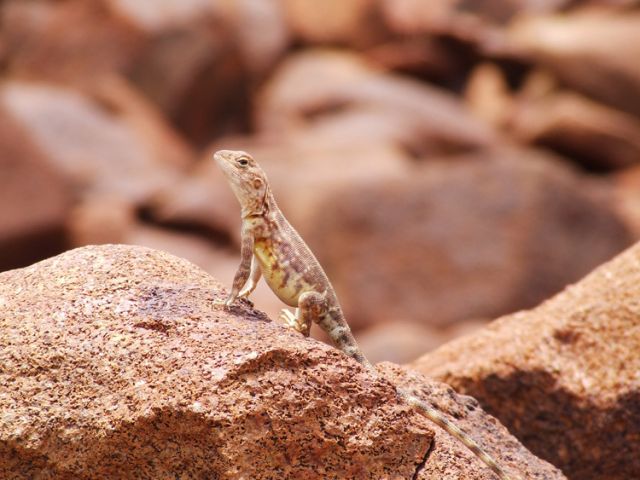
Pilbara Lizard
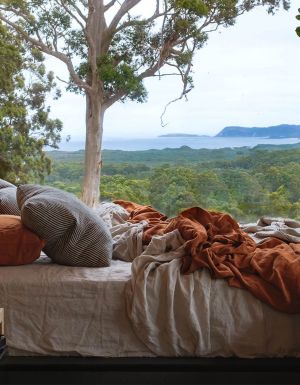
Sun Lounger – The Pilbara, WA

At the northern edge of Shark Bay, one of the few places on Earth to meet all four natural criteria for World Heritage listing, Bush Bay sits at the edge of a gently-rippling turquoise ocean. As we arrive, the west coast sunset begins turning the bubbling clouds out to sea purple and pink; the colours in the sky intensifying into a symphonic crescendo of crimson, red, gold and silver.

The next morning we visit Hamelin Pool, in Shark Bay’s south-eastern corner. Here a collection of mushroom-like stromatolites, closely resembling the micro-organic origins of life on Earth, poke from the shallows.

There are more natural wonders further south at Kalbarri National Park, where the Murchison River has carved loops and Z-bends in the sandstone hills as it heads for the sea. We stretch our legs on an eight-kilometre walk around the rim of Murchison Gorge, pausing at Nature’s Window, a hollowed rock that frames the winding river below.

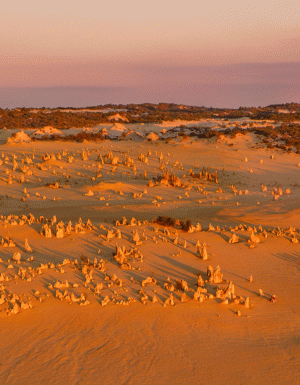
On our final day we take in Kalbarri’s coastal section where the ocean has smashed away at rocky shores creating points, islets and natural bridges. Then, after driving south for much of the day, we time our arrival at the Pinnacles Desert in the Nambung National Park, near Cervantes, to perfection. Thousands of strangely shaped limestone pillars and stacks rise from the coastal dunes, throwing jagged shadows across the desert at sunset.

Aborigines thought they were dead warriors turned to stone and 17th-century Dutch sailors, who were the first Europeans to visit this coast, assumed they were the ruins of a lost city.

We still have a three-hour drive to return to Perth but we dwell among these eerie sculptures until the dusk light drains away.

The Details


Equipment required:
4WD campervan for Karijini NP

Approximate Costs:

• $1360 for Britz campervan rental for two people – from $70 per day
• $900 for fuel
• $150 in campervan at a desert lay-by near Meekatharra for one night, a mining camp in Newman for one night, Bush Bay for one night, and Karijini Eco Retreat for three
• $278 for one night at Kalbarri Edge Resort
• $750 for food and drink, which was mainly self-catered
Total = $3438

The route:
Perth > Meekatharra > Newman > Karijini NP > Bush Bay (near Carnarvon) > Kalbarri NP >The Pinnacles > Perth

Highlights:
The gorges of Karijini National Park, stromatolites in Shark Bay, Kalbarri National Park’s twisting river canyons, Pinnacles rock formations

Best time to go:

April to October

hero media

7 Kimberley experiences that need to be on your bucket list

From thundering waterfalls to ancient Indigenous art, Kimberley’s raw beauty will take your breath away.

Wild, pristine, and shaped by nature, the Kimberley Coast is one of Australia’s most spectacular landscapes. A remote and rugged frontier that remains a bucket list destination for many travellers. Its most breathtaking attractions – including Montgomery Reef, King George Falls and Horizontal Falls – are accessible only by sea or air, making a guided expedition cruise aboard Silversea’s luxury expedition ship, Silver Cloud, the ideal way to explore it.

From its intricate intertidal zones to ancient rock art, extreme tides and rare wildlife found nowhere else in Australia – or the world – this journey offers an unparalleled exploration of one of Earth’s last true wildernesses.

Why Silversea?

Silversea offers a 10-day expedition departing Broome, or an extended 16-day expedition voyage from Indonesia, including landings on the hidden gems of Palopo Sulawesi and Komodo. Accompanied by expert guides and specialists in marine biology, history and geology, guests gain a deeper understanding of the Kimberley’s dramatic landscapes, rich cultural heritage and extraordinary biodiversity.

Silversea offers one of the experiential travel industry’s leading crew-to-guest ratios. Along with all-suite accommodation (80 per cent with private verandah), 24-hour butler service, a swimming pool and four dining options. Silver Cloud also has an experienced crew of multilingual expedition guides and specialists in marine biology, history and geology to enhance your Kimberley Experience.

silversea cruise ship pool deck
Take a dip in the pool deck.

1. Koolama Bay

​​Before visitors see King George Falls, they hear them – a growing rumble in the distance, steady and foreboding as the Zodiac glides through the gorge, the sound echoing off sheer rock formations. At 80 meters tall, the twin cascades carve through the red cliffs, churning the waters below in a spectacular finale – but Koolama Bay holds secrets beyond its striking scenery.

Named after a ship that beached here following an aerial attack by Japanese bombers in World War II, the bay may seem desolate, yet it teems with life. With Silversea’s expert guides on their 10-day Kimberley itinerary, guests gain a sharper eye for its hidden wonders – rock wallabies darting across the cliffs, crocodiles lurking among dense green mangroves, and high above, the silhouette of a bird of prey circling the sky.

King George Falls at koolama bay excursion on Silversea Kimberley Cruise
Take a shore excursion to see King George Falls.

2. Freshwater Cove / Wijingarra Butt Butt

Connect with Country on a wet landing at Freshwater Cove, also known as Wijingarra Butt Butt. Considered one of the most special experiences on both the 16-day and 10-day Kimberley cruises, Silversea guests are welcomed by the traditional Indigenous custodians of the land, painted with traditional ochre, and invited to take part in a smoking ceremony.

Located on the mainland near Montgomery Reef, Wijingarra Butt Butt holds deep cultural significance to the local Indigenous community. Here, rock formations along the shore represent spiritual ancestors, and guests are guided to a nearby rock overhang filled with ancient art, where traditional owners share the stories and meaning behind these sacred paintings.

welcome to country on freshwater cove during silversea kimberley cruise
Take part in a smoking ceremony. (Image: Tim Faircloth)

3. Vansittart Bay (Jar Island)

Modern history, ancient culture and mystery converge in Vansittart Bay, which is also known as Jar Island. Here, the first thing to catch the eye is the dented, silver fuselage of a World War II-era C-53 plane – a striking relic of the past. Yet, the true cultural treasures lie just a short hike away where two distinct styles of Indigenous rock art – Gwion Gwion and Wandjina – can be found.

The Wandjina figures, deeply connected to Indigenous traditions, stand in stark contrast to the enigmatic Gwion Gwion (Bradshaw) paintings, which date back more than 12,000 years. Significantly different in form and style, the two different styles create a striking juxtaposition, offering a rare glimpse into the region’s rich and complex past.

aerial view of Vansittart Bay, See it in you Silversea Kimberley Cruise.
Explore ancient Gwion Gwion rock art at Vansittart Bay. (Image: Janelle Lugge)

4. Horizontal Falls

Part illusion, part natural phenomenon, the Kimberley’s much-lauded Horizontal Falls aren’t a waterfall, but a tidal and geographic spectacle that visitors have to see to comprehend. Known as Garaanngaddim, the phenomenon occurs when seawater rushes through two narrow gaps- one just twenty metres wide, and the other seven metres in width, between the escarpments of Talbot Bay.

With each tidal shift,  the force of the water creates whirlpools, furious currents and the illusion of a horizontal cascade as thousands of gallons of water are pushed and pulled in through the gap every six hours with relentless movement, making this one of the Kimberley ’s most mesmerising natural wonders.

Horizontal Falls are described as "One of the greatest wonders of the natural world". They are formed from a break in-between the McLarty Ranges reaching up to 25m in width. The natural phenomenon is created as seawater builds up faster on one side of the gaps than the other, creating a waterfall up to 5m high on a King tide.
Watch whirlpools and furious currents collide. (Image: Janelle Lugge)

5. Montgomery Reef

As the tide turns in Montgomery Reef, magic happens. With the Kimberley’s legendary tides varying up to ten metres, at low tide the submerged reef almost appears to rise from the depths: exposing up to four metres of the sandstone reef.

The impact is otherworldly: as the water drains, waterfalls cascade on either side of the channel,  turtles left exposed scramble and dive, and fish leap in search of sanctuary in shallow pools. Meanwhile, the dinner bell rings for the migratory seabirds dugongs, reef sharks and dolphins that scavenge and feast in the area.

Using zodiacs, guests cruise through one of the world’s most significant inshore reef systems navigated by experienced guides, exploring the most intricate and fascinating parts of a 300-square-kilometre-wide biodiversity hotspot.

aerial view of boat going along Montgomery Reef
Witness seabirds, dolphins and reef sharks on the hunt.

6. Mitchell Falls by Helicopter

Experiencing the Kimberley by sea allows you to feel the power of the tides, but travelling by helicopter reveals the sandstone tapestry of the Kimberley, a landscape geologists believe is over 1.8 billion years old.

One of Silversea’s most popular optional excursions , guests who opt to fly into the interior from the onboard helipad soar up above the rust-coloured landscape of the Mitchell plateau, taking in one of Australia’s most scenic waterfalls: Mitchell Falls, a series of four emerald-coloured pools gently cascades into each other, before plunging down to the river below.

Seeing the landscape from above reveals a landscape weaved and shaped by the power of the freshwater wet season, juxtaposed to the constant lapping of the relentless and powerful tide on the coast.

aerial view of mitchell falls on silversea helicopter excursion
See emerald pools cascade into the river below. (Image: Tim Faircloth)

7. Indigenous Art Caves, Wandjina Art

The Kimberley Region of Western Australia is home to some of the most striking and significant

Indigenous rock art in Australia. Dotted throughout the landscape are caves, cliffs and rock overhangs depicting the striking, ethereal image of Wandjina, the rainmaker spirit and creation being central to many of the Dreamtime stories in this region.

Some of the paintings are regularly repainted by traditional custodians, while others are believed to be over 4,000 years old. Each artwork serves as both a cultural record and a living connection to the past, offering a rare opportunity to engage with the enduring traditions of the Kimberley’s Indigenous communities.

Freshwater Cover Rock Art the kimberleys
Walk among cultural records preserved in stone. (Image: Tim Faircloth)

See the best of this incredible part of the world on a Silversea Kimberley cruise. Book your 10- or extended 16-day expedition voyage at silversea.com