The zoo stay with all the creature comforts

hero media
A unique hotel in Canberra, Jamala Wildlife Lodge, lets you stay alongside some of the rarest animals on the planet (By: Leigh Ann Pow)

One of the many reasons that people check in to hotels is a little solitude from the Sturm und Drang of everyday life. But lying in my luxuriously appointed hotel room in the dead of night.


I am almost willing the silence to be broken.


And then I hear it, an almighty commotion from the room next door. It’s hard to tell if it’s an argument and at any other hotel I’d be demanding that the disturbance be dealt with, but instead I just lie there in awe.


You see, the occupants of Bungalow 1 next door are not quarrelling newlyweds, they are a pride of lions. It’s the kind of experience that safari camps in Africa pride themselves on delivering.


But I’m not in Africa. My 11-year-old and I are at Jamala Wildlife Lodge, a 10-minute drive from the centre of Canberra.


Part of the privately owned National Zoo and Aquarium, Jamala Wildlife Lodge is the passion project of Richard and Maureen Tindale, who, in 1998, bought an aquarium and small native wildlife park after it went into receivership.


Almost immediately they set about expanding the property, with a mission of housing animals in as comfortable surroundings as possible, aiming for best practice when it came to animal welfare.


Many of the animals they initially brought into the zoo had spent their lives in circuses and were in desperate need of love. In the 17 years since, the zoo has continued to take in animals in dire straits, growing in size and contributing to international breeding programs, while educating visitors on the importance of wildlife conservation.


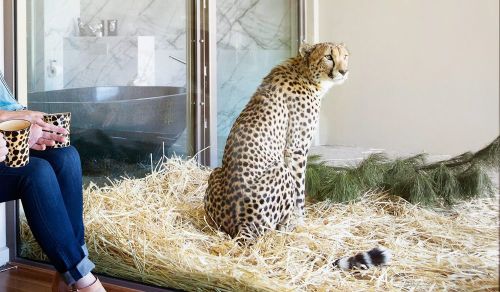
The lodge offers guests the chance to spend time with some of the most endangered animals in the world, from the comfort of five-star facilities. All of the rooms scattered around the zoo are directly adjacent to an animal enclosure, with just floor-to-ceiling walls of glass separating man from beast.


The rooms in the central uShaka Lodge overlook the likes of lemur, hyena, shark, and cheetah; six Giraffe Treehouses allow guests to feed the resident giraffe, Hummer, from their balconies; and the Jungle Bungalows look out over lions, cheetah, tiger and brown bear (conversely the animals can look in at the humans, including in the bath).


Our room, Bungalow 2, is directly adjacent to the Malayan Sun Bear enclosure, and when we enter (walking past a cute as a button red panda munching on bamboo) we find Arataki, the man of the house, sprawled outside the window determinedly working his way into a coconut with his enormous claws.


His partner Otay was rescued from Cambodia where she was being held in a cage until she was old enough to be sold to a restaurant – their paws are made into soup. It is impossible not to be totally transfixed, given that a Malayan sun bear is mere centimetres away.


Later at dinner, which is taken as a group safari-style back at uShaka Lodge, the zoo’s keepers coax a pair of white lions up into an enclosure on the verandah where pre-dinner drinks are taken.


The majestic beasts are close enough to reach out and touch (not advisable). While this kind of encounter may seem contrived and the opposite to being ‘in the wild’, many of these animals have never actually been in the wild.


It is a fact that hits home the next morning when we set out on a behind-the-scenes tour of the zoo. We stop at the Sumatran tiger enclosure and hear about their plight: deforestation in pursuit of money from palm oil harvesting is wiping out the big cat’s habitat at a sickening rate. In a mere 20 years, the only place you will be able to see these tigers is in zoos; they will be totally extinct in the wild.


And that’s where the gimmick of sleeping next to lions and tigers and bears becomes a serious attempt to stem the tragic flow of animals that are endangered. The funds raised from the room rates at Jamala go straight back into the zoo, allowing it to continue to strengthen its breeding program.


As we wrench ourselves away from Arataki and Otay to check out of our room in the late morning we glimpse the young couple who spent the previous night beside the raucous lion family. Like most of the other guests they look happy, if not just a little tired.


More information:


See JamalaWildlife Lodge


Finding the cool in Canberra


Need tips, more detail or itinerary ideas tailored to you? Ask AT.

AI Prompt

hero media

The Macedon Ranges is Victoria’s best-kept food and wine secret

    Emily McAuliffe Emily McAuliffe
    Located just an hour north-west of Melbourne, the largely undiscovered Macedon Ranges quietly pours some of Australia’s finest cool-climate wines and serves up some of Victoria’s best food.

    Mention the Macedon Ranges and most people will think of day spas and mineral springs around Daylesford, cosy weekends away in the countryside or the famous Hanging Rock (of enigmatic picnic fame). Or they won’t have heard of the Macedon Ranges at all.

    But this cool-climate destination has been inconspicuously building a profile as a high-quality food and wine region and is beginning to draw serious attention from oenophiles and epicureans alike.

    The rise of Macedon Ranges wine

    liquid gold barrels at Kyneton Ridge Estate Winery
    Barrels of liquid gold at Kyneton Ridge Estate Winery. (Image: Chloe Smith Photography)

    With elevations ranging from 300 to 800 metres, Macedon Ranges vineyards are among the highest in the country. This altitude, combined with significant day/night temperature swings, makes for a slow ripening season, in turn nurturing wines that embody elegance and structure. Think crisp chardonnays, subtle yet complex pinot noirs and delicate sparkling wines, along with niche varietals, such as gamay and nebbiolo.

    Despite the region’s natural advantages – which vary from estate to estate, as each site embodies unique terroir depending on its position in relation to the Great Dividing Range, soil make-up and altitude – the Macedon Ranges has remained something of an insider’s secret. Unlike Victoria’s Yarra Valley or Mornington Peninsula, you won’t find large tour buses here and there’s no mass marketing drawing crowds.

    Many of the 40-odd wineries are family-run operations with modest yields, meaning the wineries maintain a personal touch (if you visit a cellar door, you’ll likely chat to the owner or winemaker themselves) and a tight sales circle that often doesn’t go far beyond said cellar door. And that’s part of the charm.

    Though wines from the Macedon Ranges are just starting to gain more widespread recognition in Australia, the first vines were planted in the 1860s, with a handful of operators then setting up business in the 1970s and ’80s. The industry surged again in the 1990s and early 2000s with the entry of wineries, such as Mount Towrong, which has an Italian slant in both its wine and food offering, and Curly Flat, now one of the largest estates.

    Meet the new generation of local winemakers

    the Clydesdale barn at Paramoor.
    The Clydesdale barn at Paramoor. (Image: Chloe Smith Photography)

    Then, within the last 15 years, a new crop of vignerons like Andrew Wood at Kyneton Ridge Estate, whose vineyard in 2024 was the first in the Macedon Ranges to be certified by Sustainable Winegrowing Australia; Geoff Plahn and Samantha Reid at Paramoor, who have an impressive cellar door with a roaring fire and studded leather couches in an old Clydesdale barn; and Ollie Rapson and Renata Morello at Lyons Will, who rapidly expanded a small vineyard to focus on top-shelf riesling, gamay, pinot noir and chardonnay, have taken ownership of local estates.

    Going back to the early days, Llew Knight’s family was one of the pioneers of the 1970s, replacing sheep with vines at Granite Hills when the wool industry dwindled. Knight is proud of the fact that all their wines are made with grapes from their estate, including a light, peppery shiraz (some Macedon wineries purchase fruit from nearby warmer areas, such as Heathcote, particularly to make shiraz) and a European-style grüner veltliner. And, as many other wineries in the region do, he relies on natural acid for balance, rather than an additive, which is often required in warmer regions. “It’s all about understanding and respecting your climate to get the best out of your wines,” he says.

    farm animals atKyneton Ridge Estate
    Curious residents at Kyneton Ridge Estate. (Image: Chloe Smith Photography)

    Throughout the Macedon Ranges, there’s a growing focus on sustainability and natural and low-intervention wines, with producers, such as Brian Martin at Hunter Gatherer making waves in regenerative viticulture. Martin previously worked in senior roles at Australia’s largest sparkling winemaking facility, and now applies that expertise and his own nous to natural, hands‑off, wild-fermented wines, including pét‑nat, riesling and pinot noir. “Wild fermentation brings more complexity,” he says. “Instead of introducing one species of yeast, you can have thousands and they add different characteristics to the wine.”

    the vineyard at Kyneton Ridge Estate Winery
    The estate’s vineyard, where cool-climate grapes are grown. (Image: Chloe Smith Photography)

    Most producers also focus on nurturing their grapes in-field and prune and pick by hand, thus avoiding the introduction of impurities and the need to meddle too much in the winery. “The better the quality of the fruit, the less you have to interfere with the natural winemaking process,” says Wood.

    Given the small yields, there’s also little room for error, meaning producers place immense focus on quality. “You’re never going to compete in the middle [in a small region] – you’ve got to aim for the top,” says Curly Flat owner Jeni Kolkka. “Big wineries try to do things as fast as possible, but we’re in no rush,” adds Troy Walsh, owner and winemaker at Attwoods. “We don’t use commercial yeasts; everything is hand-harvested and everything is bottled here, so we bottle only when we’re ready, not when a big truck arrives.” That’s why, when you do see a Macedon Ranges product on a restaurant wine list, it’s usually towards the pointy end.

    Come for the wine, stay for the food

    pouring sauce onto a dish at Lake HouseDaylesford
    Dining at Lake House Daylesford is a treat. (Image: Chloe Smith Photography)

    If wine is the quiet achiever of the Macedon Ranges, then food is its not-so-secret weapon. In fact, the area has more hatted restaurants than any other region in Victoria. A pioneer of the area’s gourmet food movement is region cheerleader Alla Wolf-Tasker, culinary icon and founder of Daylesford’s Lake House.

    For more than three decades, Wolf-Tasker has championed local producers and helped define what regional fine dining can look like in Australia. Her influence is palpable, not just in the two-hatted Lake House kitchen, but in the broader ethos of the region’s dining scene, as a wave of high-quality restaurants have followed her lead to become true destination diners.

    the Midnight Starling restaurant in Kyneton Ridge Estate Winery
    The hatted Midnight Starling restaurant is located in Kyneton. (Image: Chloe Smith Photography)

    It’s easy to eat well, whether at other hatted restaurants, such as Midnight Starling in the quaint town of Kyneton, or at the wineries themselves, like Le Bouchon at Attwoods, where Walsh is inspired by his time working in France in both his food offering and winemaking.

    The beauty of dining and wine touring in the Macedon Ranges is that it feels intimate and unhurried. You’re likely to meet the winemaker, hear about the trials of the latest vintage firsthand, and taste wines that never make it to city shelves. And that’s worth getting out of the city for – even if it is just an hour down the road.

    dishes on the menu at Midnight Starling
    Delicate dishes on the menu at Midnight Starling. (Image: Chloe Smith Photography)

    A traveller’s checklist

    Staying there

    the accommodation at Cleveland Estate, Macedon Ranges
    Stay at the Cleveland Estate. (Image: Chloe Smith Photography)

    Soak up vineyard views from Cleveland Estate near Lancefield, embrace retro charm at Kyneton Springs Motel or indulge in lakeside luxury at the Lake House.

    Eating there

    Enjoy a four-course menu at the one-hatted Surly Goat in Hepburn Springs, Japanese-inspired fare at Kuzu in Woodend or unpretentious fine dining at Mount Monument, which also has a sculpture park.

    Drinking there

    wine tasting at PassingClouds Winery, Macedon Ranges
    A tasting at Passing Clouds Winery. (Image: Chloe Smith Photography)

    Settle in for a tasting at Boomtown in Castlemaine, sample local drops at the cosy Woodend Cellar & Bar or wine-hop around the many cellar doors, such as Passing Clouds.

    the Boomtown Winery and Cellar Bar signage
    Boomtown Winery and Cellar Bar. (Image: Chloe Smith Photography)

    Playing there

    a scenic river in Castlemaine
    Idyllic scenes at Castlemaine. (Image: Chloe Smith Photography)

    Wander through the seasonal splendour of Forest Glade Gardens, hike to the summit of Hanging Rock, or stroll around the tranquil Sanatorium Lake.

    purple flowers hanging from a tree
    Purple flowers hanging from a tree. (Image: Chloe Smith Photography)