Etiquette 101: How to be a better diner

hero media
Because there’s no customer equivalent of TripAdvisor, Leanne Clancey turns the tables to let hospitality pros dish the dirt on bad diners, and they have three things to say: communicate; be kind; and for crying out loud, put your phone away.

Since the media (and ergo, the world) became obsessed with food, it seems like every second grandma and school kid is laminating chocolate and sous vide-ing their venison. But while our levels of gastronomic sophistication might be at an all-time high, elsewhere our food experience is lagging. When it comes to being a good diner, it seems we’ve forgotten our manners.


Thanks to review sites like TripAdvisor, if you’ve got a gripe about your tripe, it’s game on. Restaurant bashing has become a very public sport, but you’ll seldom hear the other side of the story – that is the tales of inconsiderate, rude and downright reprehensible behaviour that diners routinely dole out to restaurant staff.


Melbourne-based food critic and former waitress, Larissa Dubecki chronicled the horrors of poor customer behaviour in her 2015 memoir, Prick with a Fork. In it she says: “There seems to be this psychological thing that once you are at a restaurant for a few hours, you have the right to this slave for the night and that slave doesn’t deserve basic human civility." It’s a shameful reality that most hospo pros will back up.


To get a sense of what things are like, I recently quizzed some industry friends about their pet peeves. I heard sordid stories of lies, sexism, stolen tips, pinched bums, and patrons sneaking off to get ‘intimate’ in the washroom between courses, but the core theme that united all of the feedback was a simple wish to be treated with respect. My restaurateur friend, Bernard Glaude from Daylesford’s Belvedere Social agrees, “Customers sometimes forget that their server is also a human being. Being rude, disrespectful or otherwise degrading just isn’t acceptable behaviour in the 21st century."


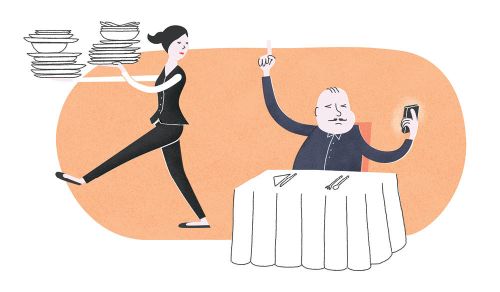
Other biggies? Stacking plates or handing plates to servers while they are clearing the table (waiters have a system for this, please let them do their job). Paper napkins stuffed in glassware (just gross). Fussy eaters and allergy fakers. Customers who voice complaints online when the issue could have been easily resolved with staff in the restaurant.


I also heard a lot of complaints about something that wasn’t an issue back in the ’90s: smartphones. Today’s wait staff have to deal with loud talkers, loud ring tones and loud videos, the latter of which – according to Glaude – is the biggest vibe killer. “Playing videos in a dining room is just not acceptable," he says. “If you do it here, you will be told to turn it off like a naughty school child."


There’s also a loss of presence that comes with being a phone-addict: Instagrammers, Tinder swipers, alpha males doing deals, silent couples scrolling their way through multi-course degustations.


Then there’s the straight-up abuse that restaurant staff endure on the job. Rudeness, arrogance, aggression, racism and sexism are all part of the territory, and yet a waiter’s role is to grin, bear it and always, always apologise.


For anyone working in a service-led workplace the old “the customer is always right" mantra is drilled in from the get-go – no matter how bad, wrong or indefensibly ill-mannered said customer might be, but if there’s one industry in which the adage really stretches the friendship, it’s hospitality.


Trust me, there’s a reason your waiter wants your tips – after cleaning up the messes of feral kids, being hit on by lecherous drunks, and obeying the endless dietary whims of weight-conscious, joyless gluten frauds all week, there’s a very good chance they’ve earnt them.


One of the industry’s other big gripes is the rising trend of the no-show: people who book a table and don’t turn up, without bothering to let the venue know. As a diner, it may not feel like a big deal to change your mind and blow off a restaurant booking at the last minute without calling, but according to restaurant booking site Dimmi, it’s an epidemic that is said to be costing the industry an estimated $75 million per year.


To help combat the issue, last year Dimmi decided to take a firm stand by allowing restaurants to blacklist Dimmi users who fail to honour their reservation. In the last 12 months, Dimmi partner restaurants have blacklisted more than 38,000 diners, up from around 3000 the previous year. The company’s founder and CEO, Stevan Premutico, says the average diner doesn’t realise the consequences. “The majority of people don’t understand the impact that no-shows have on the restaurant industry. They think somebody else is going to make up that booking, but that’s typically not the case," he explains.


For small businesses already working on tiny margins, keeping tables full is crucial. The combination of low profit margins, high wage costs and high staff turnover make running a restaurant a precarious balancing act. That 30-second phone call can be the difference between a business wasting a table, losing revenue and sending staff home early or, alternatively, them re-booking it and staying afloat financially.


Sydney restaurateur, Erez Gordon says that another factor that is especially galling during a busy service is when a party shows up with fewer numbers than originally booked, without letting the restaurant know in advance. “If we know, we can sell the other two seats and rearrange the table plan to maximise our earning potential for that service," he explains. “It has a big impact." But like any well-trained hospo pro, Gordon has to grin and bear it. “In a saturated and highly competitive market, we simply smile and accept poor behaviour [otherwise] we risk disenfranchising potential future customers."


But despite all this, most hospitality professionals are in the industry because they get a kick out of showing diners a good time. “These stories of bad customer behaviour might sound really terrible, but thankfully they are rare," explains veteran Melbourne restaurateur and industry advocate, Matteo Pignatelli. “I truly love 98 per cent of my customers, and I’m extremely grateful because these people come to us rather than the thousands of other restaurants around town.


“The best customers understand how hard we work to make sure they’re happy and they let us do that for them. At the end of the day, what we want more than anything is to make customers happy and see them come back. It’s our job – it’s what we do."

hero media

The perfect mid-week reset an hour from Melbourne

    Kellie FloydBy Kellie Floyd
    Winding down in the Yarra Valley, where ‘work from home’ becomes ‘work from wine country’.

    Steam from my morning coffee curls gently into the cool valley air, mist-veiled vineyards stretch out in neat rows below me. Magpies warble from trees, and the morning’s quiet carries the soft bleating of lambs from a nearby paddock. Midweek in the Yarra Valley has its own rhythm. It’s slower, quieter, with more empty tables at cafes and cellar doors, and walking trails I can claim all to myself. It’s as if the entire region takes a deep breath once the weekend crowd leaves.

    walking trails in the Yarra Valley
    You’ll find walking trails are less crowded during the week. (Image: Visit Victoria)

    I haven’t come here for a holiday, but to do a little work somewhere other than my home office, where I spend too much time hunched over my desk. Deadlines still loom, meetings still happen, but with flexible work evolving from ‘work from home’ to ‘work from anywhere’, I’m swapping the view of my front yard to the vineyards.

    A quiet afternoon at Yarra Valley Dairy

    holding a glass of wine at Yarra Valley Dairy
    Wine time at Yarra Valley Dairy, where you can enjoy a toastie or bagel in the cafe. (Image: Visit Victoria)

    With the Yarra Valley just over an hour from the CBD, many Melburnians could drive here in their lunch break. I arrive late in the afternoon and am delighted to discover the Yarra Valley Dairy still open. On weekends, I’ve seen queues spilling out the door, but today there’s only one other couple inside. There’s no need to rush to secure a table; instead I browse the little store, shelves stacked with chutneys, spices, artisan biscuits and gorgeous crockery that would look right at home in my kitchen. It’s hard not to buy the lot.

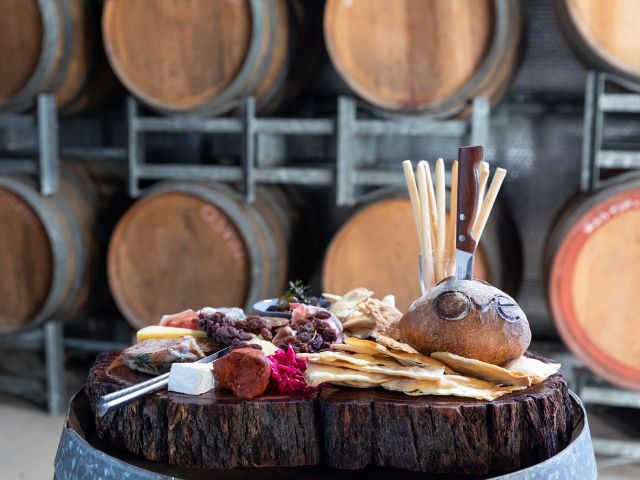
    a cheese tasting plate atYarra Valley Dairy
    A cheese tasting plate at Yarra Valley Dairy.

    I order a coffee and a small cheese platter, though the dairy has a full menu, and choose a wooden table with bentwood chairs by a wide window. The space feels part farm shed, part cosy café: corrugated iron ceiling, walls painted in muted tones and rustic furniture.

    Outside, cows meander toward milking sheds. If pressed for time, there’s the option of quick cheese tastings – four samples for five dollars in five minutes – but today, I’m in no rush. I sip slowly, watching a grey sky settle over the paddock. Less than an hour ago I was hunched over my home-office desk, and now my racing mind has slowed to match the valley’s pace.

    Checking in for vineyard views at Balgownie Estate

    Restaurant 1309 at Balgownie Estate
    Restaurant 1309 at Balgownie Estate has views across the vines.

    As my car rolls to a stop at Balgownie Estate , I’m quietly excited, and curious to see if my plan to work and play comes off. I’ve chosen a suite with a spacious living area and a separate bedroom so I can keep work away from a good night’s sleep. I could have booked a cosy cottage, complete with open fireplace, a comfy couch and a kettle for endless cups of tea, but as I am still here to get some work done, I opt for a place that takes care of everything. Dinner is served in Restaurant 1309, as is breakfast.

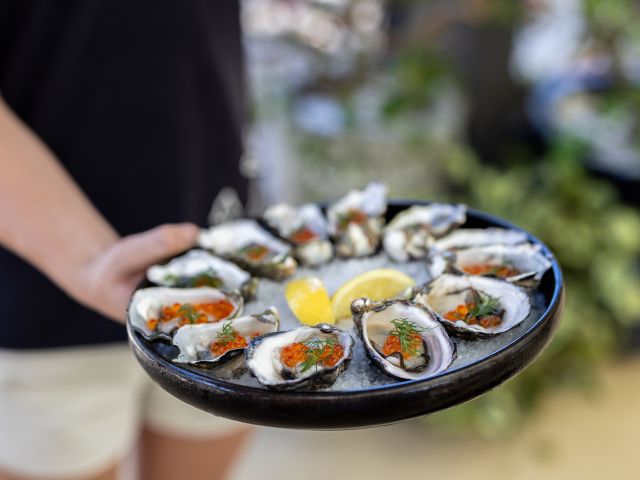
    oysters at Restaurant 1309, Balgownie Estate
    Oysters pair perfectly with a crisp white at Restaurant 1309.

    On my first evening, instead of the usual walk about my neighbourhood, I stroll through the estate at an unhurried pace. There’s no need to rush – someone else is preparing my dinner after all. The walking trails offer beautiful sunsets, and it seems mobs of kangaroos enjoy the view, too. Many appear, grazing lazily on the hillside.

    I wake to the call of birds and, after breakfast, with the mist still lingering over the vineyards, I watch two hot-air balloons silently drift above clouds. Perched on a hill, Balgownie Estate sits above the mist, leaving the valley below veiled white.

    kangaroos in Yarra Valley
    Spotting the locals on an evening walk. (Image: Visit Victoria)

    Exploring the Yarra Valley on two wheels

    the Yarra Valley vineyards
    Swap your home office for a view of the vineyards. (Image: Visit Victoria/Cormac Hanrahan)

    Perhaps because the Yarra Valley is relatively close to where I live, I’ve never considered exploring the area any way other than by car or on foot. And with a fear of heights, a hot-air balloon is firmly off the table. But when I discover I can hop on two wheels from the estate and cycle into Yarra Glen, I quickly realise it’s the perfect way to step away from my laptop and experience a different side of the region.

    COG Bike offers pedal-assist e-bikes, and while the bike trail and paths into town aren’t particularly hilly, having an extra bit of ‘oomph’ means I can soak up the surroundings. Those lambs I heard calling early in the morning? I now find them at the paddock fence, sniffing my hands, perhaps hoping for food. Cows idle nearby, and at a fork in the bike path I turn left toward town.

    It’s still morning, and the perfect time for a coffee break at The Vallie Store. If it were the afternoon, I’d likely turn right, in the direction of four wineries with cellar doors. The ride is about 15 kilometres return, but don’t let that put you off. Staying off the highway, the route takes you along quiet backroads where you catch glimpses of local life – farmers on tractors, weathered sheds, rows of vines and the kind of peaceful countryside you don’t see from the main road.

    A detour to the Dandenong Ranges

    legs hanging over the sides of the train, Puffing Billy Railway
    The iconic Puffing Billy runs every day except Christmas Day.

    The beauty of basing myself in the Yarra Valley is how close everything feels. In barely half an hour I’m in the Dandenong Ranges, swapping vineyards for towering mountain ash and fern-filled gullies. The small villages of Olinda and Sassafras burst with cosy teahouses, antique stores and boutiques selling clothing and handmade body care items.

    I’m drawn to RJ Hamer Arboretum – Latin for ‘a place for trees’. Having grown up among tall trees, I’ve always taken comfort in their presence, so this visit feels like a return of sorts. A stroll along the trails offers a choice: wide open views across patchwork paddocks below, or shaded paths that lead you deeper into the quiet hush of the peaceful forest.

    The following day, I settle into a quiet corner on the balcony of Paradise Valley Hotel in Clematis and soon hear Puffing Billy’s whistle and steady chuff as the steam train climbs towards town. Puffing Billy is one of Australia’s most beloved steam trains, running through the Dandenong Ranges on a narrow-gauge track. It’s famous for its open carriages where passengers can sit with their legs hanging over the sides as the train chugs through the forest. This is the perfect spot to wave to those on the train.

    After my midweek break, I find my inbox still full and my to-do list not in the least shrunken, just shifted from one task to another. But I return to my home office feeling lighter, clearer and with a smug satisfaction I’d stolen back a little time for myself. A midweek wind-down made all the difference.

    A traveller’s checklist

    Staying there

    Balgownie Estate offers everything from cellar door tastings to spa treatments and fine dining – all without leaving the property.

    Playing there

    the TarraWarra Museum of Art, Yarra Valley
    Visit the TarraWarra Museum of Art. (Image: Visit Victoria)

    Wander through Alowyn Gardens, including a stunning wisteria tunnel, then explore the collection of contemporary artworks at TarraWarra Museum of Art . Cycle the Yarra Valley with COG Bike to visit local wineries and cellar doors.

    Eating and drinking there

    Olinda Tea House offers an Asian-inspired high tea. Paradise Valley Hotel, Clematis has classic pub fare, while the iconic Yering Station offers wine tastings and a restaurant with seasonal dishes.

    seasonal dishes at the restaurant inside Yering Station
    The restaurant at Yering Station showcases the best produce of the Yarra Valley. (Image: Visit Victoria)