A close encounter with Ningaloo‘s whale sharks

hero media
If swimming with whale sharks isn’t on your outback bucket list, well then you’re missing out, says Daniel Scott.

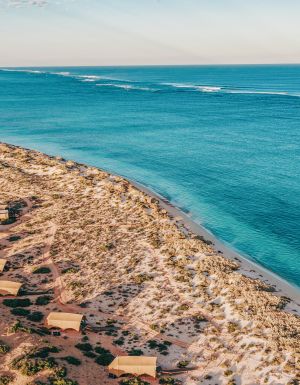
Just being here on this sparkling winter morning would be enough, cruising from Tandabiddy boat ramp through a break in one of the largest fringing reefs in the world. And Ningaloo Reef is right here in Australia, running for 300 kilometres along the continent’s north-western tip and enshrined on the World Heritage List since 2011 for its outstanding natural beauty and biological diversity.


After diving and snorkelling on its coral forests for the past three – unforgettable – days with Sail Ningaloo, I cannot imagine there being a healthier reef system anywhere on our planet. Nor one that draws such abundant and varied marine life. It’s impossible to count the number of tropical fish I’ve seen while snorkelling, decorated in luminous, electric colours that would outshine any neon-lit Tokyo street. While diving, I’ve loped along with a 90-year old loggerhead turtle, tried to keep up with cruising reef sharks and made awkward attempts to fly in formation alongside manta rays with five-metre wingspans.


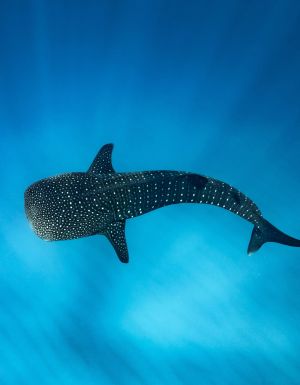
But today, along with about 20 other passengers, I am about to realise a long-held dream: to swim with the biggest fish in the sea. Whale sharks: animals that can grow to 12 metres in length and weigh 21 tonnes and are yet among the most difficult of creatures to find on the planet. It’s another of Ningaloo Reef’s miracles that whale sharks are drawn, in significant numbers, to its plankton-enriched waters, between April and July every year.


Yesterday, on a scenic flight, I saw four of these behemoths in the deeper, darker Indian Ocean outside the reef, their spotted patterns clearly visible from 300 metres above. Now, my pilot Tiffany is up in the sky again, acting as a spotter for our boat, Kings Ningaloo Reef Tour’s The Magellan.


As we are briefed by our young whale shark guides, the sense of anticipation builds.


“Once we’ve located a whale shark," my guide Nadine tells our group of eight snorkellers, “the skipper will get the boat ahead of it. Then I will jump in, find it underwater and hold my arm up to indicate which way it is travelling. Then…"


“Whale shark!"


Before she has time to finish, the cry has gone up and The Magellan is powering toward a nearby sighting.


“Get in one by one," says Nadine shuffling to the back of the boat in her fins, “and fan out on either side in two groups of four. And please remember to stay three metres away from the…"


Nadine is in and swimming like an Olympian in the open ocean. I’ve got the sinking feeling and thumping pulse I always get when my sense of adventure is about to propel me into a situation my comfort-loving self would never consider.


Nadine has stopped and pumped her arm above the swell.


“Go, go, go!"


I take a deep half-breath, step onto the tailboard and stride off the boat. There’s bubbles and white water everywhere.


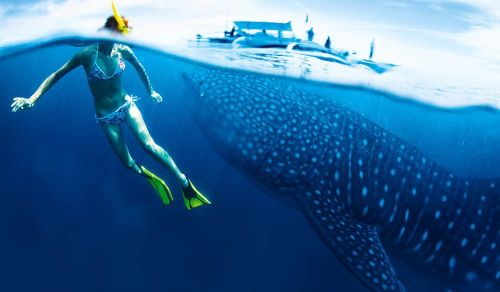
Strewth, I think, when the commotion clears, this water must be 80 metres deep. Before I can dwell on that, I catch a flash of Nadine’s yellow fins and push off towards her. Then I see it, an immense grey blur off to Nadine’s right. A second later it is a huge flat head proceeded by an outsized mouth, with natural lips that would put collagen out of business, heading straight toward me.


Getting run-down by a sub-aquatic double-decker bus wasn’t in my script. I gulp a snorkel full of ocean and fin backwards, sideways, anyways I can to get out of its road. It’s still coming toward me, the feeding whale shark’s mouth formed into an ‘O’, like one of those cool kids at school that blew perfect smoke rings.

Finally, I’m clear. I breathe easier and take in those markings that I’d seen from the air. Hundreds of off-white dots adorn its head and run in symmetrical patterns down its body. As it flashes past, I see the well-defined ridges of its back leading down to its vertical tail fin.


It takes 15 seconds for my first whale shark, an adolescent male that’s a mere four-and-a-half metres long and has the speed and grace of a marine cheetah, to be gone. As I flounder after it, it pulls away with a dismissive flap of its tail, leaving eight snorkellers gurgling like excited babies into their snorkels.


With careful manoeuvring, The Magellan drops us twice more into the path of this speedy shark. Later, we make the more relaxing acquaintance of a bigger, slower-moving female. But it is those first moments, described by shark expert Valerie Taylor as being like watching “a tanker emerging from the fog" that will remain etched in my brain as the greatest wildlife encounter of my life.

Need tips, more detail or itinerary ideas tailored to you? Ask AT.

AI Prompt

The details

Getting there


• Fly from Perth to Exmouth (Learmonth Airport) and head north to Exmouth (20 minutes) or south to Coral Bay (30 minutes). Both Coral Bay and Exmouth offer whale shark tours. You are more likely to swim with whale sharks at Exmouth (but only just – sightings at Coral Bay still happen at least 80 per cent of the time). Coral Bay is better known for its manta ray swims.

Staying there


• If you’re a luxury lodge fiend, glamping property Sal Salis in the Cape Range National Park is the only place to stay. Often there is a three-night package including a whale shark experience, for around $2660 per person, twin share.


• We stayed onboard Sail Ningaloo; they operate three, five and nine-day Ningaloo Reef Tours between March and December. Prices begin from $1700 for a three-night tour in a deluxe cabin including all meals and non-alcoholic drinks, transfers from Coral Bay and equipment. However, you won’t see whale sharks with Sail Ningaloo – that’s a day experience offered through other operators (see ‘Playing There’).

Weekly travel news, experiences
insider tips, offers, and more.

Playing there


• We swam with Kings Ningaloo Reef Tours, but there are several operators to choose from: seven at Exmouth and one at Coral Bay. Prices range from $385–$400 per person. Most offer a return ticket for the next day if the whale sharks don’t show up.


MORE: Swim with a real shark – ‘The Great White Truth About Cage Diving With Sharks

hero media

Exploring an icon: inside the massive upgrade to Broome’s famous Cable Beach

(Credit: Tourism WA)

    Lucy Cousins Lucy Cousins
    With unhurried mornings, long, sun-filled afternoons, evenings shaped around sunset, this iconic beach offers an all-day experience (and it’s about to get even better).

    As the sun slowly rises over the languid waves and fine sand of Broome’s Cable Beach, the morning colours shift from rich apricot to pale gold and frosty pearl. Remnants of life reveal themselves in the subtle shadows – crab claw marks, towel impressions, footprints. Life here is unhurried, but don’t be fooled. This town is continually shifting like the desert dunes that surround it.

    And with a $75 million upgrade – offering easier and more inclusive access for people of all abilities – it’s getting even better.

    Cable Beach upgrade foreshore redevelopment stage 1
    Discover the Cable Beach redevelopment.

    The addition of comfortable and welcoming spaces has begun (and will continue). This means visitors will be able to spend longer enjoying this beautiful environment, while knowing that the upgrade will create a more environmentally protected setting that preserves the natural character visitors come for. Come sunset, soak it in all the better thanks to the already improved foreshore areas, made for lingering while the light changes. And for the kids, a new splash park and accessible dry playground will make it easy to while away the hours.

    Think you know what a day at this beach is like? Think again.

    Morning colours

    car on cable beach at sunrise
    Cable Beach comes alive after sunrise. (Credit: Tourism WA)

    As the sun colours the sky, Cable Beach shows signs of life (and not just the aquatic kind). Locals and visitors alike float in the cool water as it laps the shore, landlubbers explore the coast on foot, runners pace and beachside yoga classes bring quiet movement to the day.

    When the sky is blue and the sun is firmly in position, head down to the well-known Cable Beach House for a long, slow breakfast overlooking the ocean. Think fresh tropical fruit, eggs cooked your way and strong coffee in the warm morning breeze.

    Afternoon adventures

    camel train on cable beach in broome at sunset
    Join a camel train at sunset. (Credit: C J Maddock)

    When you’re ready to explore, carve a path along the Minyirr Park Trail – a gentle 1.5-2km track through coastal bushland with spectacular views of the dunes. Refuel at the nearby Spinifex Brewery for lunch with its low-key, outdoor beer garden. There’s even an outdoor playground if you’re travelling with young humans.

    Walk off your lazy lunch by watching (or joining) one of the beach soccer or volleyball games, or even try Silent Beats Broome – a silent walking disco through the dunes. Or book a spot on the famous camel trains, watching the sun drop below the horizon along the way. They’re a constant reminder of the fascinating history, landscape and cultural mix in this part of the country.

    Evening degustation

    server at Cable Beach Club
    Stop into the Cable Beach Club. (Credit: Tourism WA)

    As the day closes, watch the world-famous Cable Beach sunset from the appropriately named Sunset Grill at Cable Beach Club. This open-air terraced dining spot overlooking the beach is the kind of place where the view takes centre stage.

    While you sip on a lychee, lime & lemonade mocktail or a local beer, enjoy the bustle of life and nature outside as the day comes to an end.

    For dinner, nab a table at the Bali Hai Cafe, where they offer pan-fried crispy barramundi, Abrolhos Island scallops and deep-sea snow crab. When you’re ready for bed, check in to Pinctada Hotel Broome – a lush, tropical resort with palm-dotted gardens and a large, lagoon-style pool to cool off in.

    Beyond the beach

    Beyond the wide, open beach and never-ending sky of Cable Beach, there are many more reasons to visit North West Australia. These are just a few.

    Unmatched experiences

    Shinju Matsuri Festival's popular Long Table Dinner on cable beach
    Join Shinju Matsuri Festival’s popular Long Table Dinner. (Credit: Tourism WA)

    Engage with the history of the land and its people on an Indigenous cultural tour exploring everything from the local wildlife to the tastes of bush tucker. To understand the importance of pearling to this town, take a tour of Chinatown, or head outside of town to the live pearl harvests at Willie Creek or Cygnet Bay Pearl Farm, one of Australia’s oldest pearl farms.

    Learn why Japanese pearlers were central to Broome’s pearling success and visit the largest Japanese cemetery in Australia, where 900 Japanese pearlers were buried – a testament to the risks and rewards of this dangerous profession.

    And book ahead every spring for when communal tables, freshly cooked local fare and festoon lighting fill the beach for the extremely popular Long Table Dinner on Cable Beach. It’s a highlight of the Shinju Matsuri Festival, along with the Floating Lanterns Matsuri, where you can personalise a lantern and gently release it into the sea to honour those you love.

    Dining discoveries

    Matso’s Broome Brewery
    Settle in for Matso’s famous ginger or mango beer. (Credit: Tourism WA)

    Further your culinary adventure at the laid-back Sunday Sesh at Matso’s Broome Brewery. Chow down on smoked crocodile or Aussie barramundi while kicking back to a local DJ as the heat of the day fades.

    For more tunes, the beautiful outdoor Bay Club at the Mangrove Hotel is a great choice for dinner with live music, DJs or an event that stretches on into the early hours. Still hungry? Pop by Johnny Sausage for Italian-influenced meals paired with impeccable wines.

    Natural beauties

    Gantheaume Point cabnle beach broome
    Experience the striking colours of Gantheaume Point. (Credit: Tourism WA)

    Avoid the crowds and head to Town Beach for a quieter vantage point to see the phenomenal Staircase to the Moon – a natural illusion where the rising full moon is reflected on the tidal flats, creating a shimmering ‘staircase’ stretching up to the sky.

    Just south of Cable Beach are the deep red cliffs and dramatic ocean views of Gantheaume Point, where 130-million-year-old dinosaur footprints can be seen, revealed at low tide. Or head to Roebuck Bay to visit the internationally significant wetlands, where vast tidal flats are home to shorebirds and coastal fauna.

    Between October and March, watch turtles nesting and hatchlings emerge from the sand. You’ll be holding your breath as they make their way down to the shoreline, ready to start their life in one of Australia’s most beautiful landscapes.

    For more on Cable Beach and Australia’s North West, visit australiasnorthwest.com.